The Calling of Saint Matthew

by Caravaggio

Caravaggio’s The Calling of Saint Matthew stages the instant when divine grace pierces ordinary life. A diagonal beam of light and Christ’s Sistine‑echoing hand single out Matthew at a money table, suspending time between hesitation and assent [2][3]. The painting fuses Baroque tenebrism with contemporary dress to dramatize conversion as a public, present-tense event [1][2].

Fast Facts

Year
1599–1600
Medium
Oil on canvas
Dimensions
322 × 340 cm
Location
Contarelli Chapel, San Luigi dei Francesi, Rome
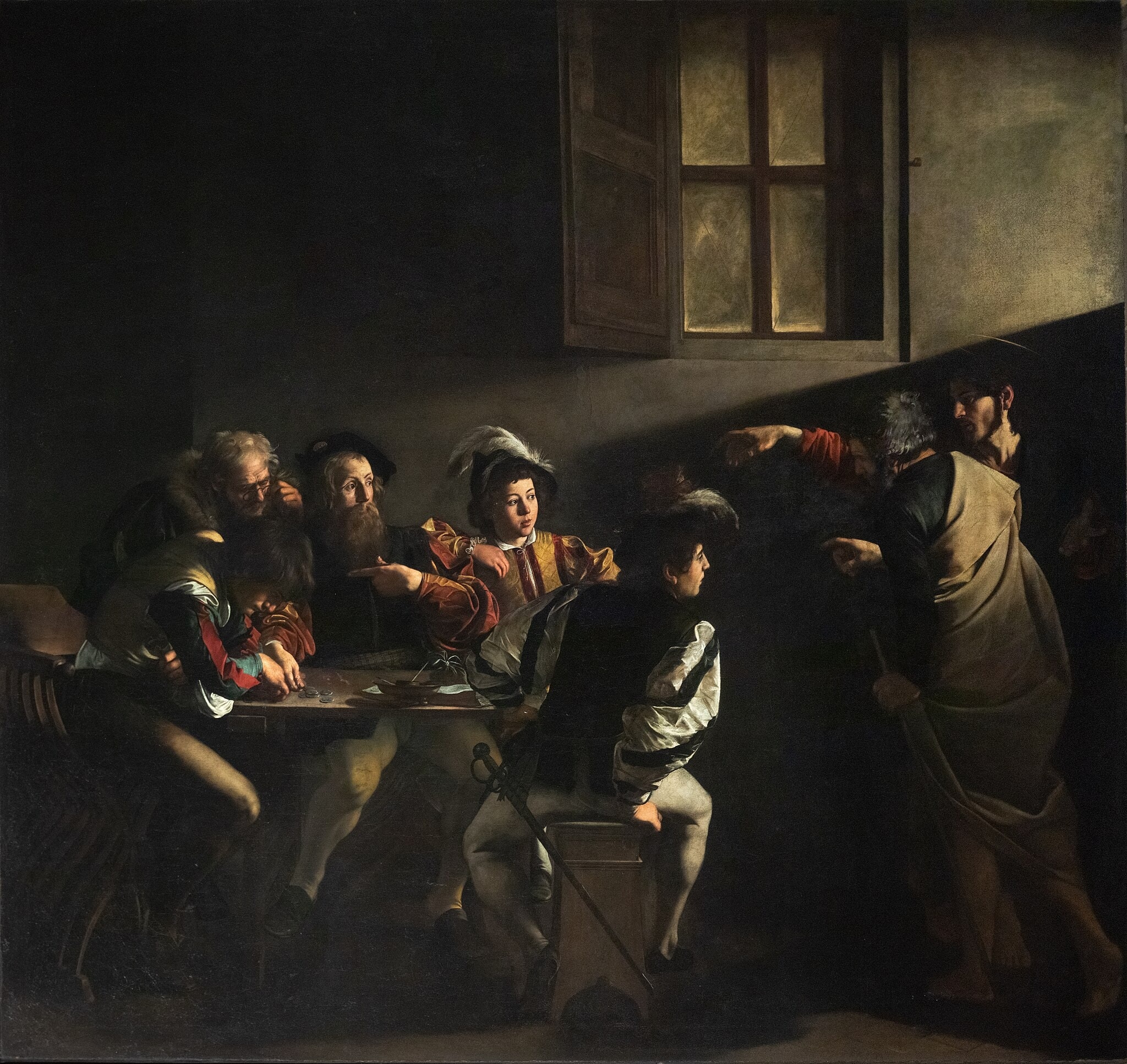
The Calling of Saint Matthew by Caravaggio (1599–1600) featuring Diagonal beam of light, Christ’s extended hand (Creation echo), Closed window with cross muntins, Coins and ledger on the table

Click on any numbered symbol to learn more about its meaning

Meaning & Symbolism

Caravaggio constructs the drama as a judgment of light. From the right, Christ raises a hand whose extended fingers quote Michelangelo’s Adam, but now the gesture creates rather than receives life—Christ as the Second Adam calling Matthew into a new humanity 2. The luminous wedge that slants across the rear wall is keyed to the chapel’s actual light and functions as grace made visible; it bypasses the shuttered window above, whose muntins form a quiet cross, underscoring that true illumination arrives with Christ rather than from nature alone 237. At the table, silk sleeves, plumed hats, and scattered coins render the world of profit tactile; yet the light ignores the money to strike faces and hands, the sites of recognition and consent. One bearded man at center jerks back and touches his chest—“Me?”—while others point or stare, their fingers multiplying Christ’s summons into a volley of self-interrogations. This suspended beat between hearing and rising is the painting’s theological core: vocation happens in the instant before movement, when will and grace meet. The presence of Peter—barefoot, massive, and shadowed—clarifies how the call is mediated through the Church in a Counter‑Reformation key 5. His body partially occludes the light like a living threshold: to approach Christ is to pass through the apostolic witness. Around the table Caravaggio arrays responses to grace as a moral spectrum. The youth at left keeps his head bent over coins; the bespectacled clerk peers at a ledger, a witty emblem of shortsightedness so absorbed in near values that he misses the light at his elbow 6. Another youth swivels on a stool, half-rising, caught between curiosity and attachment. Even costume preaches: Christ and Peter wear timeless robes and show bare feet, signs of poverty and pilgrimage, opposed to the sumptuous hose and velvet of the tax men—their identities stitched to fabric and silver 28. Caravaggio’s tenebrism is not decorative; it is moral architecture. Darkness thickens where attention is locked on money; light ignites where the self awakens to a summons. The closed window, the hard edge of the beam, the stark wall, and the proximity of our viewpoint conspire to place the event here and now, not in a distant biblical past. A live scholarly question intensifies the drama: who is Matthew? The majority view identifies him as the bearded man pointing to himself; others argue Matthew is the younger clerk at the table’s end, while the bearded figure points across, asking, “Him?” 4. Caravaggio cultivates this ambiguity to force viewers into the decision-field: if even identification is contested, the call might land on any of us. Programmatically, the canvas pairs with the Martyrdom of Saint Matthew across the chapel, turning conversion into an arc from calling to witness unto death—an index of the painting’s stakes for the Contarelli commission and for Baroque sacred art 2. This is why The Calling of Saint Matthew is important: it inaugurates a public style of salvation-history in which painted light acts, gestures legislate theology, and the viewer stands within range of a life-changing command.

Explore Deeper with AI

Ask questions about The Calling of Saint Matthew

Popular questions:

Powered by AI • Get instant insights about this artwork

💬 Ask questions about this artwork!

Interpretations

Site-Specificity & Phenomenology

Caravaggio keys the painting’s diagonal beam to the chapel’s real light high at right, turning San Luigi dei Francesi into a theological light machine. In situ, the viewer enters the same raking illumination that touches Matthew, collapsing pictorial and architectural space into a single conversion environment. The beam does not behave as naturalism alone; it is a choreographic device that directs the body—yours—toward the picture’s threshold where Peter stands. The result is phenomenological address: the call is not only represented but staged to be felt in one’s own peripheral vision. This calibrated darkness/brightness ratio—tenebrism scaled to a dim chapel—illustrates Baroque affective engineering, where optics are harnessed to devotion 134.

Source: Smarthistory; Contarelli Chapel overview; Britannica

Socioeconomic Lens & Northern Genre Echoes

The money table—counting, coin-glint, ledger—draws on Northern moneylender imagery while converting genre into salvation drama. Caravaggio borrows the tight huddle, props, and tactile surfaces known from Netherlandish scenes, but inverts their moral by introducing a beam that refuses to valorize coin. This is an economy of attention: fabrics and silver receive paint’s descriptive riches, yet light withholds honor from them, privileging recognition (faces) and assent (hands). The result is a critique of value: reckoning is displaced from the ledger to conscience. Matthew’s profession—taxation within Rome’s extractive system—grounds the scene in classed labor while exposing its limits when confronted by a rival calculus of grace 21.

Source: Web Gallery of Art (genre precedents); Britannica

Counter‑Reformation Mediation & Authority

By inserting Peter—absent from Matthew 9:9—Caravaggio visualizes ecclesial mediation: grace arrives with Christ yet passes through apostolic witness. Peter’s mass and occluding silhouette form a living threshold, a pictorial theology of the Church as conduit. In the Contarelli program, this aligns with Tridentine emphasis on sacrament and authority, countering Protestant suspicion of intermediation. The rhetorical staging is precise: Christ’s creating hand, Peter’s transmitting body, Matthew’s awakening consent. The sequence reads like a catechetical diagram rendered as drama, exemplifying how Baroque art fuses doctrine and affect to persuade in public space 15.

Source: Britannica; RAI Scuola

Ambiguity as Devotional Technology

Who is Matthew? Caravaggio’s deliberate ambiguity—bearded elder pointing “me?” or younger clerk at the table’s end—functions as participatory ethics. The viewer is compelled to decide, and in deciding, to measure oneself against the beam: am I already responding or not yet looking up? The ongoing scholarly debate, still active in current research, is not a failure of clarity but a devotional engine that universalizes vocation. Identification becomes a mirror; the painting’s strongest address is second-person: “You.” Such productive indeterminacy typifies Baroque strategies that bind spectatorship to spiritual self-scrutiny 67.

Source: Wikipedia (summary of debate, Varriano note); Kunsthistorisches Institut in Florenz (2025 lecture notice)

Intertextuality & the Politics of Quotation

Christ’s hand quotes Michelangelo’s Adam, but the vector reverses: Adam once received life; here Christ gives it. This is not mere homage; it is doctrinal appropriation—Sistine humanism recoded under Counter‑Reformation soteriology. Caravaggio claims the apex of High Renaissance authority to argue that true creation in the present occurs through calling. The gesture’s legal clarity—index and middle fingers extended—acts like a visual performative, a speech-act in paint. By installing this Michelangelesque sign in a dark tavern, Caravaggio asserts that grace’s epic now unfolds among the urban poor, not on vaults of princes and popes 1.

Source: Britannica

Optics, Vision, and Moral Myopia

Caravaggio literalizes spiritual failure as a problem of vision. The bespectacled clerk—anachronistic eyewear at a sacred moment—embodies near-sighted absorption in accounts, missing the blaze at his elbow. Nearby, the window’s muntins sketch a faint cross, a cool geometry of “available” light that the drama effectively overrides, implying that true seeing requires more than optics. The painting thus contrasts natural sight, corrective devices, and illuminated recognition, mapping a hierarchy from data-entry to discipleship. It is an epistemology in chiaroscuro: what counts cannot be counted; what saves is seen when the soul turns toward the caller 89.

Source: Archdiocese of San Francisco; Art in Context

Related Themes

About Caravaggio

Caravaggio (1571–1610) revolutionized Italian Baroque painting with radical naturalism, live models, and extreme chiaroscuro, rejecting Mannerist idealization. The Contarelli Chapel cycle was his first major public commission and made him the most influential painter in Rome; his impact shaped artists from Rembrandt to Velázquez [8]. His turbulent career and early death only sharpened the legend of a painter who turned light into drama and doctrine.
View all works by Caravaggio

More by Caravaggio