The Church at Moret

by Alfred Sisley

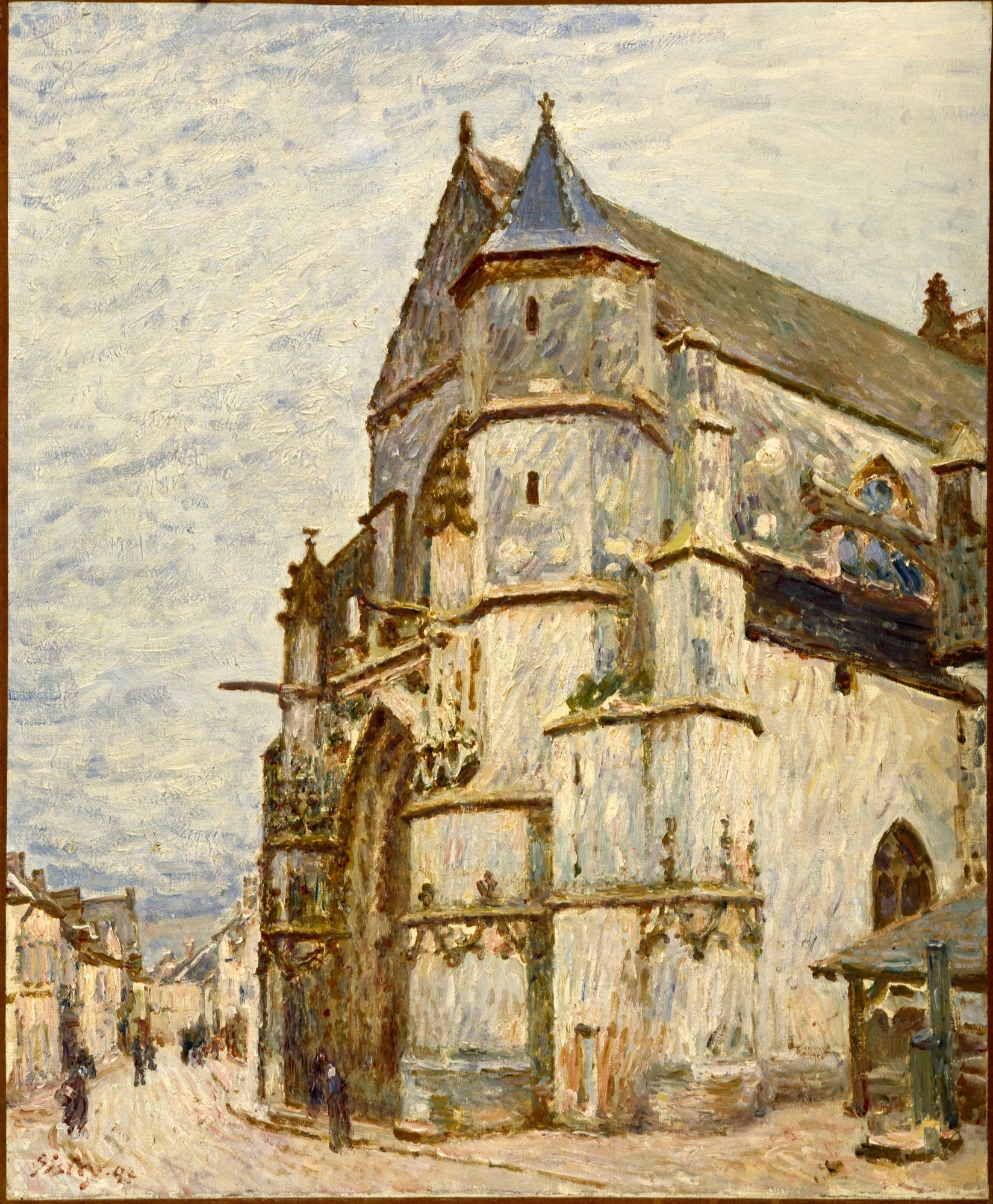
Alfred Sisley’s The Church at Moret turns a Flamboyant Gothic façade into a living barometer of light, weather, and time. With cool blues, lilacs, and warm ochres laid in broken strokes, the stone seems to breathe as tiny townspeople drift along the street. The work asserts permanence meeting transience: a communal monument held steady while the day’s atmosphere endlessly remakes it [1][2][3].

Fast Facts

Year
1894
Medium
Oil on canvas
Dimensions
73 x 60.3 cm
Location
Detroit Institute of Arts, Detroit
The Church at Moret by Alfred Sisley (1894) featuring Gothic West Portal (shadowed arch), Cylindrical Buttresses and Corner Turrets, Cross Finials, Market Shelter (wooden lean‑to)

Click on any numbered symbol to learn more about its meaning

Meaning & Symbolism

From an oblique, slightly elevated viewpoint, Sisley compresses the church’s west front into a vertical mass: stacked cylindrical buttresses, corner turrets, and a shadowed portal surge upward while the street glides away at left. That diagonally receding lane, dotted with two or three small figures, is not anecdote but argument—scale and social life measure the building’s authority. Across the sky, a woven field of cool gray‑blue strokes rhymes with the façade’s chilled whites and lilacs; the weather and the stone share a palette, binding monument and atmosphere into one event. Near the lower right, the simple market shelter tucks against the wall, a humble counter‑form that clarifies the church’s role as civic anchor: worship and commerce, ritual and routine, coexist in a single square 4. Sisley’s paint handling—short, creamy touches that toggle between blue‑cool shadow and warm ochre light—lets the limestone read as porous, not plated. Shadow is not an outline but a cloud passing. The portal darkens like a breath drawn in; the turrets flash then dim; moisture on the street turns the ground into a pale reflector. In the Detroit variant, signed “Sisley 94,” the after‑rain air softens contrast and nudges colors toward a wet luminosity, proving how weather calibrates the façade’s tonality without erasing its structure 2. This union of solidity and flux defines Sisley’s ethics of looking. Working from a fixed window opposite the square, he repainted the motif across a dozen‑plus canvases, tracking “evening,” “morning sun,” and “after the rain” effects like a disciplined experiment 13. Unlike Monet’s near‑mystic dematerialization of Rouen Cathedral, Sisley maintains architectural legibility: profiles stack, joints hold, and the viewer can count cornices and read the plan, even as light transfigures the stone 3. The effect is not anti‑poetic; it is poetry redistributed—from symbolism in the motif to revelation in the encounter. Permanence is not a refusal of change but the capacity to accept it. The church stands for continuity and communal memory, yet its appearance remains contingent, revised by season and hour. In this balance, Sisley redefines sacredness as a property of perception: the holy is not only in the edifice but in the moment that reveals it. That conviction explains the series’ insistence on a constant vantage: by removing compositional novelty, Sisley makes variation itself the subject—weather as author, time as collaborator 123. Thus the painting’s narrative is civic rather than devotional. People pass, a cart trail fades, the market roof waits for business; the church does not tower to dominate but to endure. Brushwork aligns with this stance: the strokes are measured and persistent, not flamboyant; color is descriptive before it is decorative; sensation is calibrated rather than ecstatic. The result is a public image of faith and place, grounded in observation. That is why The Church at Moret endures: it shows, with persuasive calm, how a modern painter can be faithful to facts and still find the world transfigured by light 123.

Explore Deeper with AI

Ask questions about The Church at Moret

Popular questions:

Powered by AI • Get instant insights about this artwork

💬 Ask questions about this artwork!

Interpretations

After Rain: Material Optics and Stone

In the Detroit variant, damp air lowers contrast and turns stone into a light-absorbing, light-shedding surface; moisture on the street acts as a pale reflector, rebounding cool wavelengths into shadows 2. Sisley’s short, creamy touches flick between lilac-gray shade and warm ochre light, giving limestone a porous rather than plated read. This is observational optics: edges soften as humidity scatters light; pigments sit as granular equivalents of aerosolized atmosphere. The result is not decorative chroma but calibrated tonal weathering, demonstrating how meteorology rewrites matter without erasing form 12.

Source: Detroit Institute of Arts; Petit Palais

Phenomenological Sacredness (Religious Studies Lens)

Sisley reframes the sacred as an event of perception, not an iconographic program. The façade is the same, but its meaning arrives in the encounter—morning, evening, after rain—each a different revelatory instant 3. This shifts piety from symbol to sensation, where the holy is apprehended in light’s transient address to stone. Architectural clarity matters here: because joints and buttresses remain readable, what changes is not belief but the mode of appearing. The work becomes a modest phenomenology of devotion: to look carefully, repetitively, and truthfully is itself a devotional act.

Source: Réunion des Musées Métropolitains Rouen Normandie

Civic Space and the Sacred Ordinary (Social Art History)

The tucked market shelter and tiny figures articulate the square as a civic organism where sacred and secular use interpenetrate. Rather than staging ecclesiastical dominance, Sisley shows a church that anchors circulation—trade, errands, passing conversation—thereby dignifying labor and routine as coequal with ritual 34. The façade becomes a backdrop for livelihood, and after-rain reflective pavements fold townspeople and monument into one field of light. This social choreography aligns with Impressionism’s attentiveness to everyday modernity, but here tempered by architectural endurance: the church endures not by commanding the scene, but by holding space for it.

Source: Réunion des Musées Métropolitains Rouen Normandie; Musée Calvet (Avignon)

Serial Method as Ethics (Comparative Formalism)

Sisley’s choice to paint the façade from a fixed second‑floor window functions as a methodological ethic as much as a compositional device. By constraining vantage, he treats weather as the true variable—an experimental control that lets light, humidity, and hour recalibrate the same mass. This differs from Monet’s cathedral, where color veils verge on abstraction; Sisley maintains legibility while modulating tonality, insisting on truth-to-appearance rather than optical rapture 136. The result is not anti-poetic but a redistribution of poetry into phenomenal change: small strokes track dampness, refraction, and atmospheric scatter, letting structure survive within flux. Seriality becomes content, a disciplined wager that the world’s variability suffices for invention.

Source: Petit Palais; Réunion des Musées Métropolitains Rouen Normandie; Web Gallery of Art

Reception and Legacy (Cultural History)

Contemporaries and later writers singled out the Moret series—Proust reportedly praised the subject as among Sisley’s most beautiful achievements 4. Institutional histories show early validation: the evening canvas entered Paris’s civic collection from the 1896 Salon, marking public endorsement before broad market recognition 1. Posthumously, museums parsed the sequence as a late apex of Impressionist seriality rooted in truthful observation rather than bravura 5. This reception arc matters: it situates Sisley as the movement’s most consistent naturalist, whose rigor made serial perception a civic image as much as an aesthetic one.

Source: Musée Calvet (Avignon); Petit Palais; National Gallery (London)

Related Themes

About Alfred Sisley

Alfred Sisley (1839–1899) was a Franco-British Impressionist devoted to painting landscape en plein air, especially along the Seine. Close to Monet and Pissarro, he pursued a lucid, atmospheric idiom that balanced careful structure with transient light. His years around Marly-le-Roi and Port-Marly produced key series where reflections, weather, and urban-river interfaces define his mature style [2][5].
View all works by Alfred Sisley

More by Alfred Sisley