Flood at Port-Marly

by Alfred Sisley

In Flood at Port-Marly, Alfred Sisley turns a flooded street into a reflective stage where human order and natural flux converge. The aligned, leafless trees function like measuring rods against the water, while flat-bottomed boats replace carriages at the curb. With cool, silvery strokes and a cloud-laden sky, Sisley asserts that the scene’s true drama is atmosphere and adaptation, not catastrophe [1][2][4].

Fast Facts

Year
1876
Medium
Oil on canvas
Dimensions
50 × 61.7 cm
Location
Carmen Thyssen-Bornemisza Collection (on display at Museo Nacional Thyssen-Bornemisza), Madrid
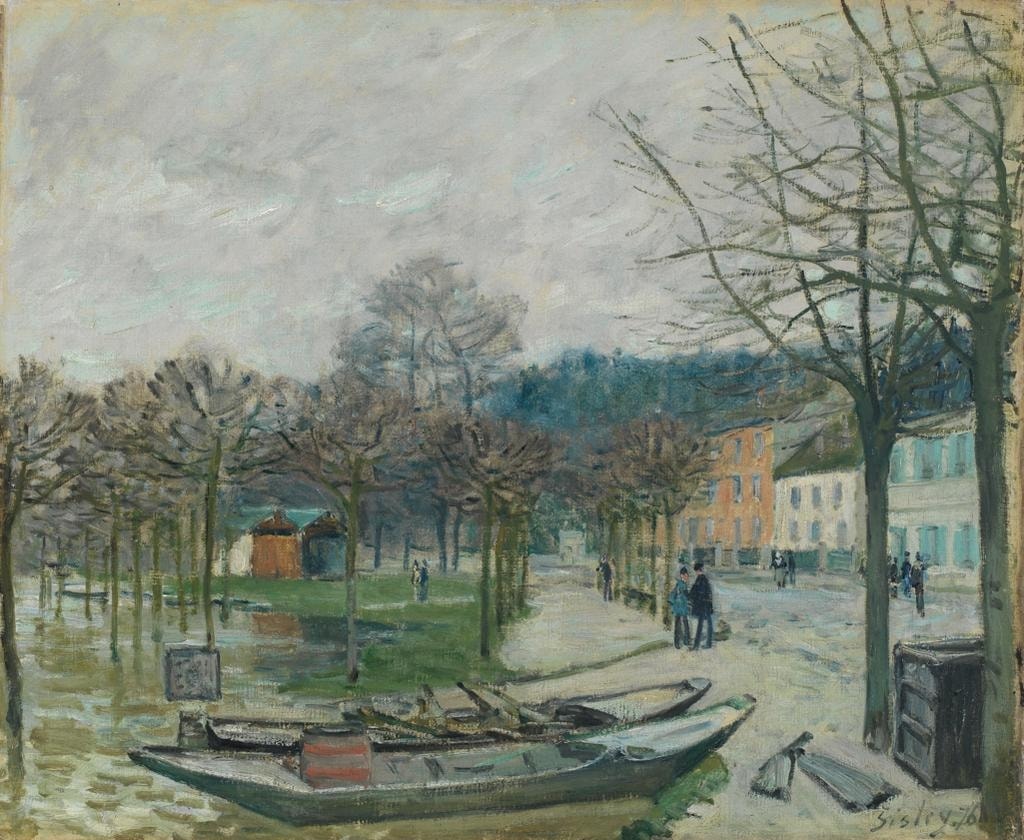
Flood at Port-Marly by Alfred Sisley (1876) featuring Regimented leafless trees, Flat-bottomed boats, Reflections on floodwater, Overcast, cloud-laden sky

Click on any numbered symbol to learn more about its meaning

Meaning & Symbolism

Sisley constructs meaning through the decisive juxtaposition of built order and hydraulic drift. The double row of pruned plane trees, regimented like a civic diagram, recedes in clean perspective, while the Seine’s overflow turns their bases into markers of depth and time; water climbs the trunks, then releases them back to air, a cycle the picture quietly encodes. Boats moored at the curb—workaday, flat-bottomed, painted in dull greens and reds—declare that mobility has been rewired; the street has become a canal. Small figures congregate on the damp promenade rather than fleeing it, their dark silhouettes lending scale and broadcasting composure. The low, cloud-thick sky reduces contrast and broadens the tonal register into greys, greens, and silvers, which Sisley orchestrates as a single atmospheric system. This is an argument, not a mood: the world we build rests within larger, cyclical forces, and the painter’s task is to witness their terms with accuracy and restraint 124. The picture’s reflective skin is not decoration; it is the engine of its thought. Reflections double the trees and façades, briefly making the town a mirror of itself, a literal re-inscription of urban space by nature. That doubling functions as a philosophical device: the familiar appears anew—Paul Jamot’s “unexpected, enigmatic” everyday—so that attention sharpens and contingency becomes legible 23. Sisley’s brushwork enforces this: architecture receives steadier contours while water and sky are laid down in adjacent, horizontal strokes that flicker and dissolve, a formal opposition that encodes permanence versus transience without rhetoric. The townspeople’s ordinariness—chatting, crossing, pausing—confirms the National Gallery of Art’s point that the scene renders a “mundane” climate event; the absence of melodrama is itself the claim 4. Finally, because this canvas belongs to a cluster of 1876 flood views made from neighboring vantage points, it participates in Impressionism’s emergent series logic: the subject is not a single event but the measurable passage of time across site, water level, and light. Seen against the 1872 and 1876 groups, this version advances a modern ethic of looking—systematic, local, and attuned to shifts—explaining why Flood at Port-Marly has become a touchstone for reading Sisley’s quiet radicalism and, today, for reassessing how art registers environmental change without sacrificing calm to spectacle 135.

Explore Deeper with AI

Ask questions about Flood at Port-Marly

Popular questions:

Powered by AI • Get instant insights about this artwork

💬 Ask questions about this artwork!

Interpretations

Formal Analysis: Structure vs. Flux

Sisley orchestrates a dialectic between architectural fixity and hydraulic indeterminacy. The façades, tree allée, and curb read as a classical armature, while water and sky are laid in adjacent, horizontal strokes that vibrate and dissolve—painterly choices that differentiate the stable from the fugitive. This opposition is not rhetorical but material, embedded in the facture that renders buildings with steadier edges and the river with broken, scintillating touches. The effect is to make the flood both a motif and a method, turning reflection, refraction, and lowered contrast into active compositional devices. In several versions, the inn and gangways act as rectilinear “keels” against which the opalescent water plays, clarifying how perception organizes contingency in real time 128.

Source: Musée d’Orsay; Musée des Beaux‑Arts de Rouen

Historical-Topographic Reading: Port-Marly as Measure

Port‑Marly’s rue de Paris, with its double rows of pruned trees and proximity to the Seine, becomes a topographic instrument for registering flood stage. Identifiable landmarks—the wine‑merchant’s “À St‑Nicolas” (patron of sailors), improvised gangways, flat‑bottomed boats—anchor the eye and index adaptation when the street becomes a canal. Rather than anecdote, these specifics mark a civic landscape designed for traffic and shade now recalibrated for passage by water. The repeated choice of motifs engineered for reflection (façades, trunks, quay) reveals Sisley’s on‑the‑spot method and his insistence that modern urban edges are permeable membranes where river and town interpenetrate 234.

Source: Musée des Beaux‑Arts de Rouen; National Gallery of Art; Carmen Thyssen‑Bornemisza Collection

Seriality & Time: An Impressionist Protocol

The Port‑Marly floods catalyze Sisley’s serial phenomenology: multiple canvases across 1872 and 1876 map shifting vantage points (including the Fitzwilliam’s rare upstream view), water levels, and atmospheric states. This is not merely repetition but an analytic program—a way to visualize time as measurable difference across the same coordinates. Curators link these sets to Impressionism’s broader embrace of series as a modern epistemology, replacing narrative climax with calibrated observation. In Sisley’s case, the flood is a laboratory where duration, not drama, is the subject; the works together perform an ethics of local, systematic looking that anticipates later modernist engagements with motif and iteration 57.

Source: Fitzwilliam Museum; Rouen Museum Consortium (Sisley and the Seine)

Environmental Humanities: Calm as Climate Discourse

NGA’s description of a “mundane portrayal of a climate disaster” reframes the paintings as early documents of environmental disruption seen without spectacle. Sisley’s restraint—small figures, leveled tonalities, reflective surfaces—builds a grammar for everyday adaptation: boats moored at curbs, gangways bridging thresholds, promenaders lingering. Recent framing at the Orsay within climate‑focused displays underscores how the pictures model a way of seeing environmental change that privileges accuracy over alarm, making space for slow violence, seasonal cycles, and civic resilience to register visually without sensationalism 136.

Source: National Gallery of Art; Musée d’Orsay

Material History & Conservation: Surface as Argument

The Orsay canvas’s complex conservation—mid‑century transposition of the paint layer and 2024–25 removal of yellowed varnish and overpaint—reveals how material history can veil or restore the work’s reflective logic. As discolored layers were cleared, the calibrated silver‑greens and greys re‑emerged, reinstating the painting’s core premise: reflections as engines of thought. The episode highlights how the artwork’s meaning depends on the legibility of its skin—the minute contrasts that distinguish stable architecture from flickering water. Conservation thus becomes hermeneutic, recovering the painting’s capacity to measure atmosphere and flux as Sisley intended 61.

Source: Musée d’Orsay (restoration report)

Phenomenology of the Everyday: The Enigmatic Ordinary

Paul Jamot’s remark that floods render the everyday “unexpected, enigmatic” clarifies Sisley’s strategy: make perception newly alert by letting nature re‑inscribe urban order through reflective doubling. The mirrored town is not romantic fantasy but a brief ontological shift in which things appear as their own other, sharpening attention to contingency. Rouen’s emphasis on the inn as landing stage and the sheeted reflections confirms that the motif was engineered to sustain this optical and philosophical play. The paintings’ affect—composure tinged with strangeness—emerges from that calibrated defamiliarization 28.

Source: Musée d’Orsay (Jamot citation); Musée des Beaux‑Arts de Rouen

Related Themes

About Alfred Sisley

Alfred Sisley (1839–1899) was a Franco-British Impressionist devoted to painting landscape en plein air, especially along the Seine. Close to Monet and Pissarro, he pursued a lucid, atmospheric idiom that balanced careful structure with transient light. His years around Marly-le-Roi and Port-Marly produced key series where reflections, weather, and urban-river interfaces define his mature style [2][5].
View all works by Alfred Sisley

More by Alfred Sisley