Still Life with Flowers

by Pierre-Auguste Renoir

Pierre-Auguste Renoir’s Still Life with Flowers (1885) sets a jubilant bouquet in a pale, crackled vase against softly dissolving wallpaper and a wicker screen. With quick, clear strokes and a centered, oval mass, the painting unites Impressionist color with a classical, post-Italy structure [1][2][4]. The slight droop of blossoms turns the domestic scene into a gentle vanitas—a savoring of beauty before it fades [5].

Fast Facts

Year
1885
Medium
Oil on canvas
Dimensions
81.9 × 65.8 cm (32.2 × 25.9 in.)
Location
Solomon R. Guggenheim Museum, New York (Thannhauser Collection)
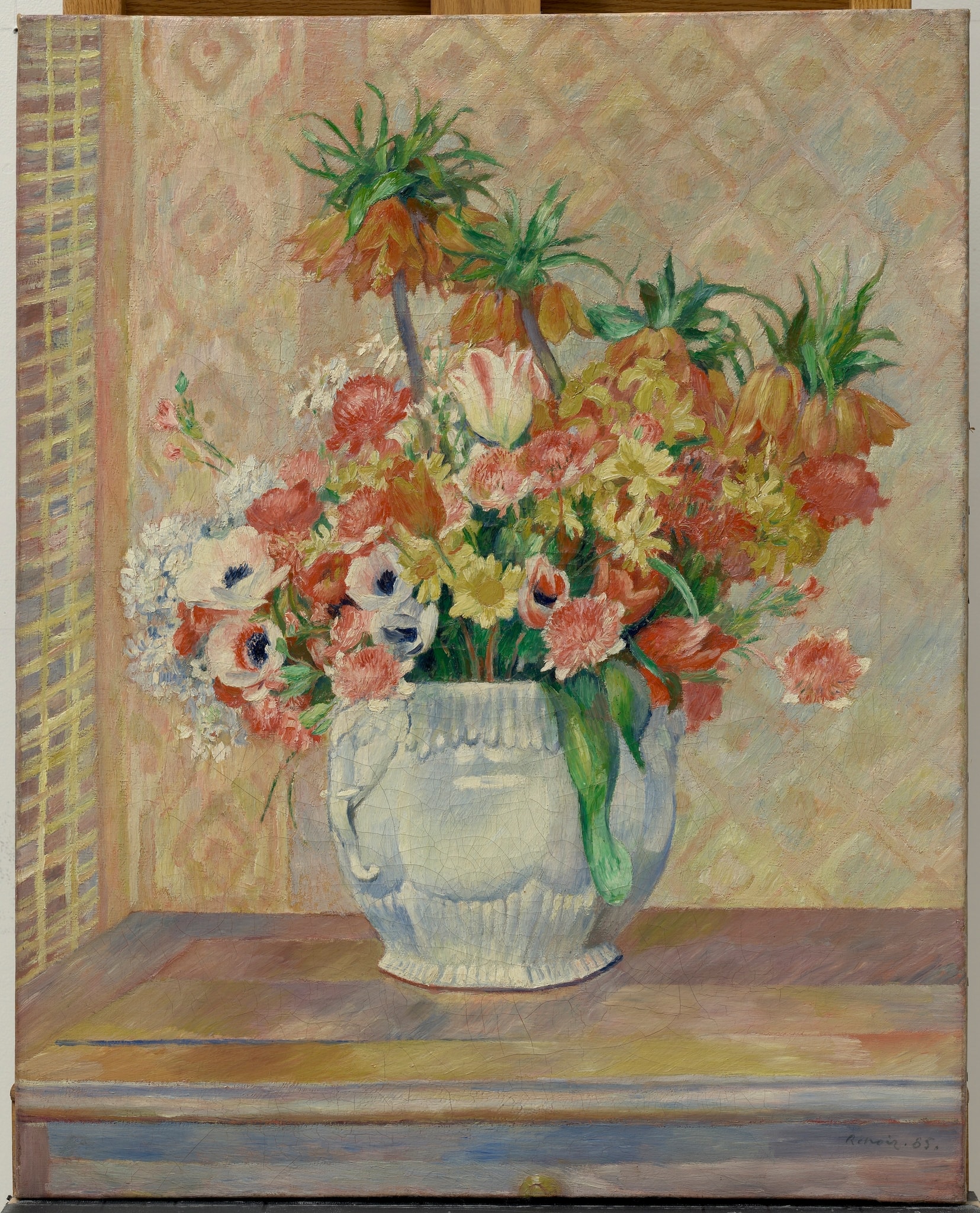
Still Life with Flowers by Pierre-Auguste Renoir (1885) featuring Crown imperials (Fritillaria), Tulips, Anemones, Crackled porcelain vase

Click on any numbered symbol to learn more about its meaning

Meaning & Symbolism

Still Life with Flowers declares order without stiffness. The bouquet forms a deliberate oval, centered over the vase and steadied by the tabletop’s planar bands; this classical geometry reflects Renoir’s post‑Italy turn toward firmer drawing and clearer structure, a shift museums describe across his early‑to‑mid‑1880s work 4. Yet the structure never dampens chromatic life. Warm oranges and pinks—especially the coppery crown imperials cresting the bouquet—play against cool greens and creamy whites, while the patterned wallpaper and woven screen dissolve into pastel diamonds and lattices. Renoir keeps edges alive: petals quiver, leaves splay, and even the table’s brushed planks carry small temperature shifts. The crackled porcelain, with its reflected highlights and weighty handles, acts as a counterweight to the bouquet’s fugitive bloom, giving the scene a poised equilibrium between permanence and flux 12. Renoir intensifies meaning by transforming genre conventions rather than citing them. European flower pieces long signaled mortality and the vanity of worldly show; here, the vanitas message arrives not via skulls or hourglasses but through drooping stems and the artist’s flicker of touch—a modernized memento mori grounded in perception 5. The specific flowers enrich this register without locking into a program: crown imperials carry a faint aura of courtly grandeur, tulips whisper of cultivated taste and luxury from their long European history, and anemones brush against classical associations of love and loss. Renoir treats these as associative color-notes, not rigid codes, making the bouquet a field where culture, season, and sensation intermingle 16. The paint itself does some of the symbolic lifting. Critics have called his floral canvases “fictions of color” with “immaterial completeness,” signaling that meaning emerges from chromatic harmony and tactile facture rather than narrative plotting 3. This canvas also registers a technical and intellectual dialogue in 1885. In the wake of Italy and in proximity to Cézanne, Renoir sought greater durability—what the Met identifies as experiments in “dry” light tones akin to fresco, visible here in the matte, articulate passages of the background and tabletop 2. The bouquet’s centered mass and the vase’s firm silhouette court stability, while the brushwork remains mobile and breathing. Such duality—classical order fused with Impressionist immediacy—clarifies why Still Life with Flowers is important: it condenses Renoir’s transitional ambitions into a single domestic drama where color performs on a humble stage. The homey tabletop becomes a proscenium for optical music, and the wallpaper’s receding diamonds act like a soft grid, catching and releasing light. As Georges Rivière noted, flower painting gave Renoir “mental relaxation” and freedom to “experiment boldly with tones and values”—liberties he leverages here to reconcile sensation with structure 3. The result is a quietly radical proposition: permanence achieved through the very strokes that confess impermanence. The vase endures, the petals fall, and painting—poised between them—turns passing light into lasting form.

Explore Deeper with AI

Ask questions about Still Life with Flowers

Popular questions:

Powered by AI • Get instant insights about this artwork

💬 Ask questions about this artwork!

Interpretations

Historical Context

Painted in 1885, the work sits at the hinge of Renoir’s post‑Italy classicism and his Impressionist touch. After his 1881–82 Italian sojourn, he sought firmer drawing and a more linear, classical order, tendencies evident in the bouquet’s centered oval and the vase’s decisive silhouette 4. In dialogue with Cézanne that same year, Renoir also explored “dry,” fresco‑like light tones, visible in the matte passages of the background and tabletop 2. This hybrid—classical geometry plus breathing brushwork—marks the still life as a laboratory where durability and immediacy were tested together. Read against 1885 debates about structure vs. sensation, the canvas functions as a compact case study in how an Impressionist could claim permanence without petrifying his surfaces.

Source: The Metropolitan Museum of Art; National Gallery, London

Symbolic Reading (Modern Vanitas)

Renoir modernizes vanitas by letting perishability be carried by touch and time, not props. Instead of skulls or extinguished candles, he gives us drooping stems, tender frays at petal edges, and strokes that seem to fade as they state—an optic memento mori 5. In this register, meaning is atmospheric: the bouquet’s vitality is inseparable from its evanescence, and the viewer’s pleasure in chroma is knowingly time‑bound. Renoir’s contemporaries noted that his floral paintings pursue “immaterial completeness,” signaling that symbolic gravitas emerges through color harmonies and facture rather than fixed emblems 3. The result is a gentle ethics of looking: relish the bloom while acknowledging the clock embedded in its paint.

Source: National Gallery, London (Glossary: Still life/vanitas); Art Institute of Chicago

Formal Analysis (Structure as Experiment)

The bouquet’s deliberate oval mass and the calibrated horizontals of the table set a classical armature that contains, yet never stifles, chromatic play. This is not mere decoration: the clear geometry is part of Renoir’s 1880s project to secure lasting form while keeping surface alive 4. The “dry,” fresco‑evoking palette he tested around 1885 lends the background a matte, breathable plane, against which saturated blossoms flicker in controlled contrast 2. Edges quiver without dissolving; the vase’s weighty handles counter the bouquet’s airy spread. Such articulate balancing—stability versus flux—turns the still life into a studio of method, where compositional discipline becomes the very condition for painterly freedom.

Source: National Gallery, London; The Metropolitan Museum of Art

Medium Reflexivity (Color as Content)

Critics described Renoir’s florals as “fictions of color” with an “immaterial completeness,” a claim that reframes the subject: the painting is about what color and touch can do as much as what flowers are 3. Here, chromatic intervals—warm oranges and pinks against cool greens and creamy whites—generate a self‑sufficient order that rivals the bouquet’s natural arrangement. The paint’s handling carries the work’s symbolic lift; facture becomes iconography. This is medium reflexivity in a gentle key: the surface confesses its artifice while delivering sensation so convincing it feels true. Renoir’s still life thus argues that modern meaning can arise from pictorial harmony itself, not from narrative or emblem.

Source: Art Institute of Chicago (Rivière; Meier‑Graefe)

Social Optics (Taste, Status, and the Domestic)

The ensemble reads as a portrait of cultivated taste. Tulips—long associated with luxury and elite collecting in Europe—quietly inflect the bouquet with status connotations, even as Renoir resists rigid symbolism 6. The likely crown imperials, historically cultivated in courtly gardens, add a faint echo of hierarchy rising above more familiar blossoms 1. Yet the staging is emphatically domestic: a homey tabletop and patterned wall turn refinement into lived decor, not pomp. This tension—courtly whispers in an everyday room—tracks modern bourgeois culture, where aesthetic aspiration enters the home through flowers, fabrics, and light. Renoir’s still life shows how social meaning can be felt through objects without becoming didactic.

Source: Norton Simon Museum; Solomon R. Guggenheim Museum

Related Themes

About Pierre-Auguste Renoir

Pierre-Auguste Renoir (1841–1919) emerged from craft training into the avant-garde circle around Monet, Sisley, and Bazille, helping to found Impressionism. In the mid‑1870s he focused on outdoor scenes of modern leisure in and around Montmartre, using dappled light and high-chroma color to capture transient sensations [1][2][5].
View all works by Pierre-Auguste Renoir

More by Pierre-Auguste Renoir
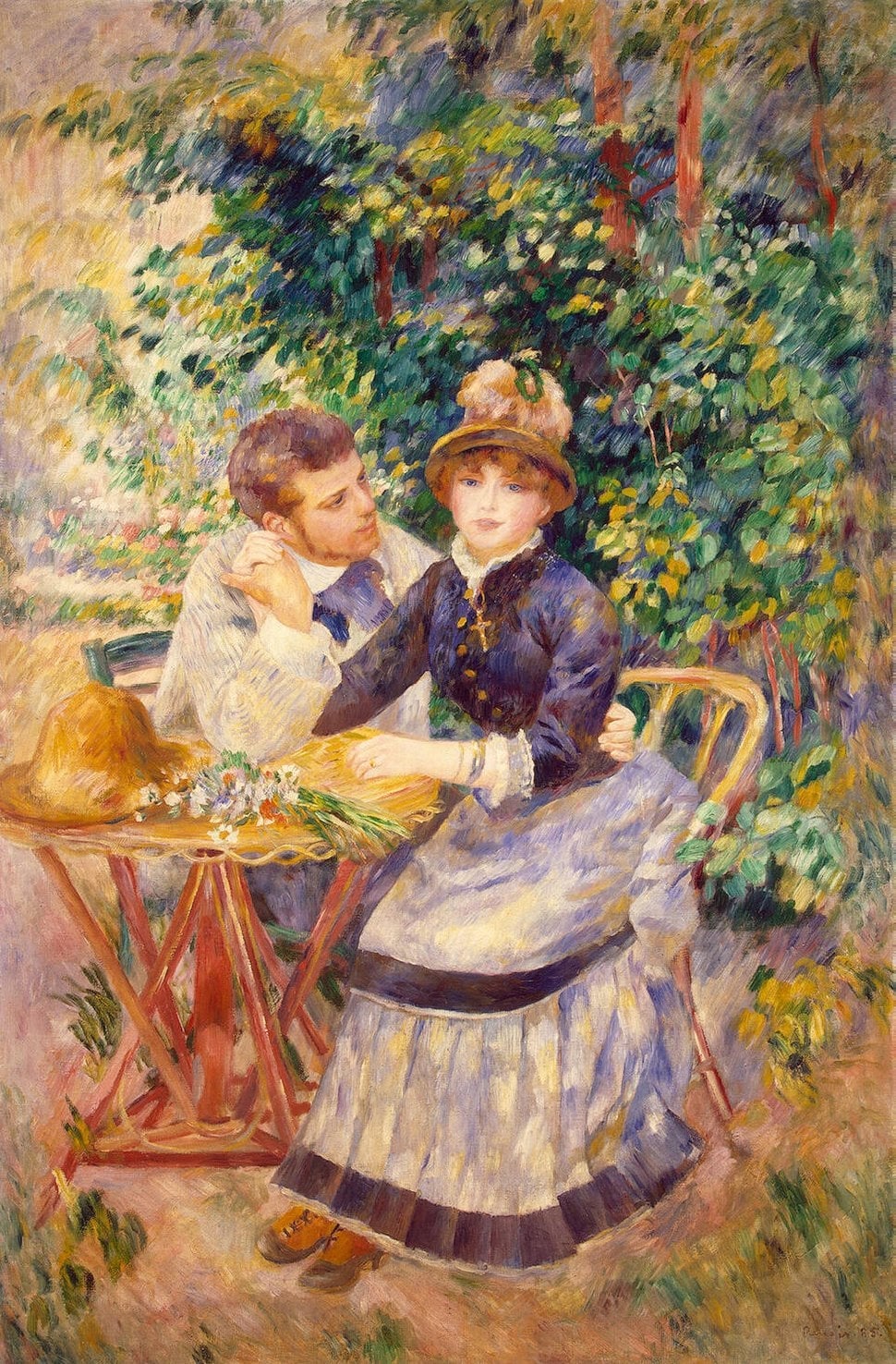
In the Garden by Pierre-Auguste Renoir

In the Garden

Pierre-Auguste Renoir (1885)

In the Garden presents a charged pause in modern leisure: a young couple at a café table under a living arbor of leaves. Their lightly clasped hands and the bouquet on the tabletop signal courtship, while her calm, front-facing gaze checks his lean. Renoir’s flickering brushwork fuses figures and foliage, rendering love as a <strong>transitory, luminous sensation</strong> <sup>[1]</sup><sup>[3]</sup>.
Young Girls at the Piano by Pierre-Auguste Renoir

Young Girls at the Piano

Pierre-Auguste Renoir (1892)

Renoir’s Young Girls at the Piano turns a quiet lesson into a scene of <strong>attunement</strong> and <strong>bourgeois grace</strong>. Two adolescents—one seated at the keys, the other leaning to guide the score—embody harmony between discipline and delight, rendered in Renoir’s late, <strong>luminous</strong> touch <sup>[1]</sup><sup>[2]</sup>.

Pont Neuf Paris by Pierre-Auguste Renoir

Pont Neuf Paris

Pierre-Auguste Renoir (1872)

In Pont Neuf Paris, Pierre-Auguste Renoir turns the oldest bridge in Paris into a stage where <strong>light</strong> and <strong>movement</strong> bind a city back together. From a high perch, he orchestrates crowds, carriages, gas lamps, the rippling Seine, and a fluttering <strong>tricolor</strong> so that everyday bustle reads as civic grace <sup>[1]</sup>.

The Large Bathers by Pierre-Auguste Renoir

The Large Bathers

Pierre-Auguste Renoir (1884–1887)

Pierre-Auguste Renoir’s The Large Bathers unites modern bodies with a pastoral grove to stage an <strong>Arcadian ideal</strong>. Three monumental nudes form interlocking curves and triangles while two background figures splash and groom, fusing <strong>sensual warmth</strong> with <strong>classical order</strong> <sup>[1]</sup><sup>[2]</sup>.

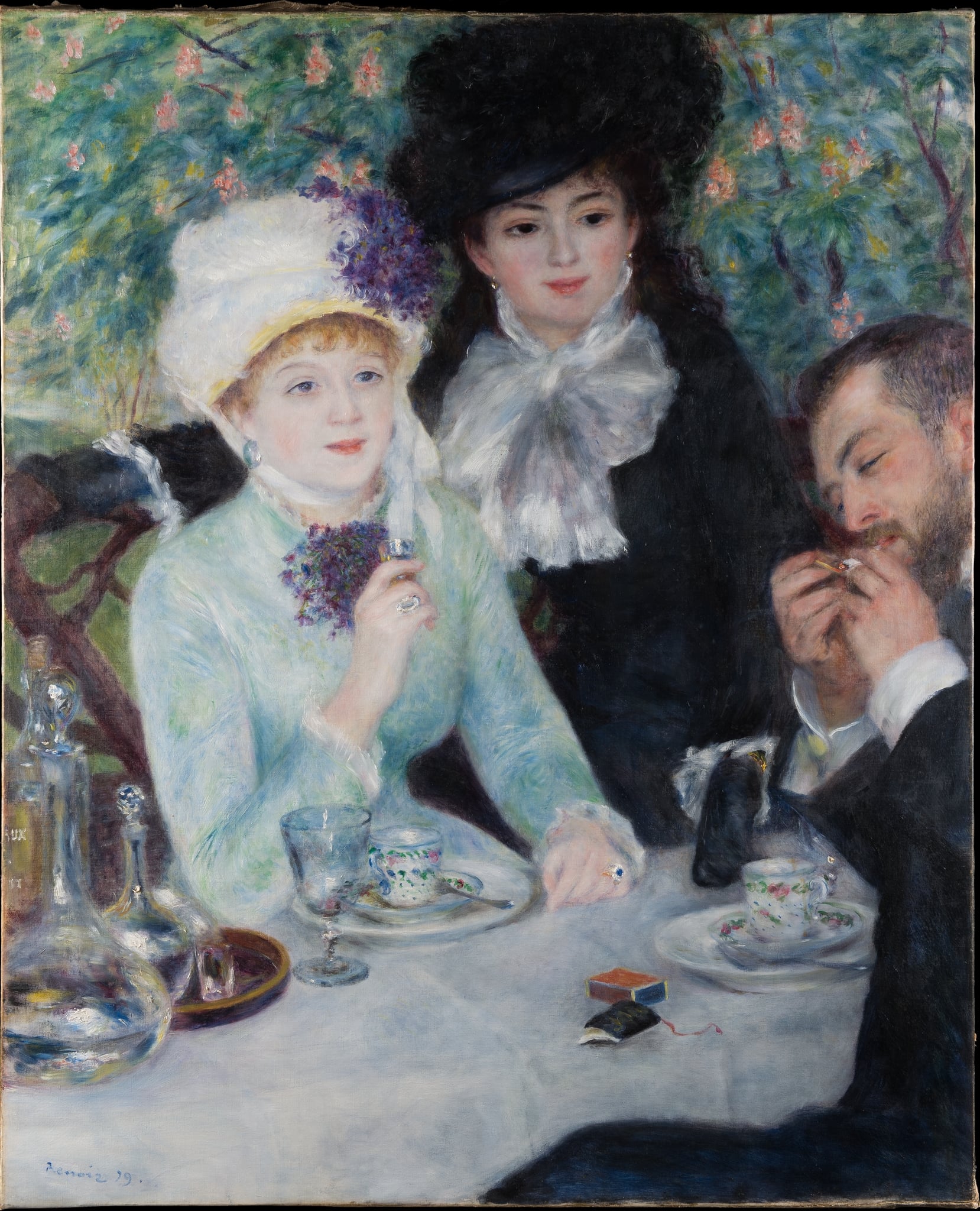
After the Luncheon by Pierre-Auguste Renoir

After the Luncheon

Pierre-Auguste Renoir (1879)

After the Luncheon crystallizes a <strong>suspended instant</strong> of Parisian leisure: coffee finished, glasses dappled with light, and a cigarette just being lit. Renoir’s <strong>shimmering brushwork</strong> and the trellised spring foliage turn the scene into a tapestry of conviviality where time briefly pauses.
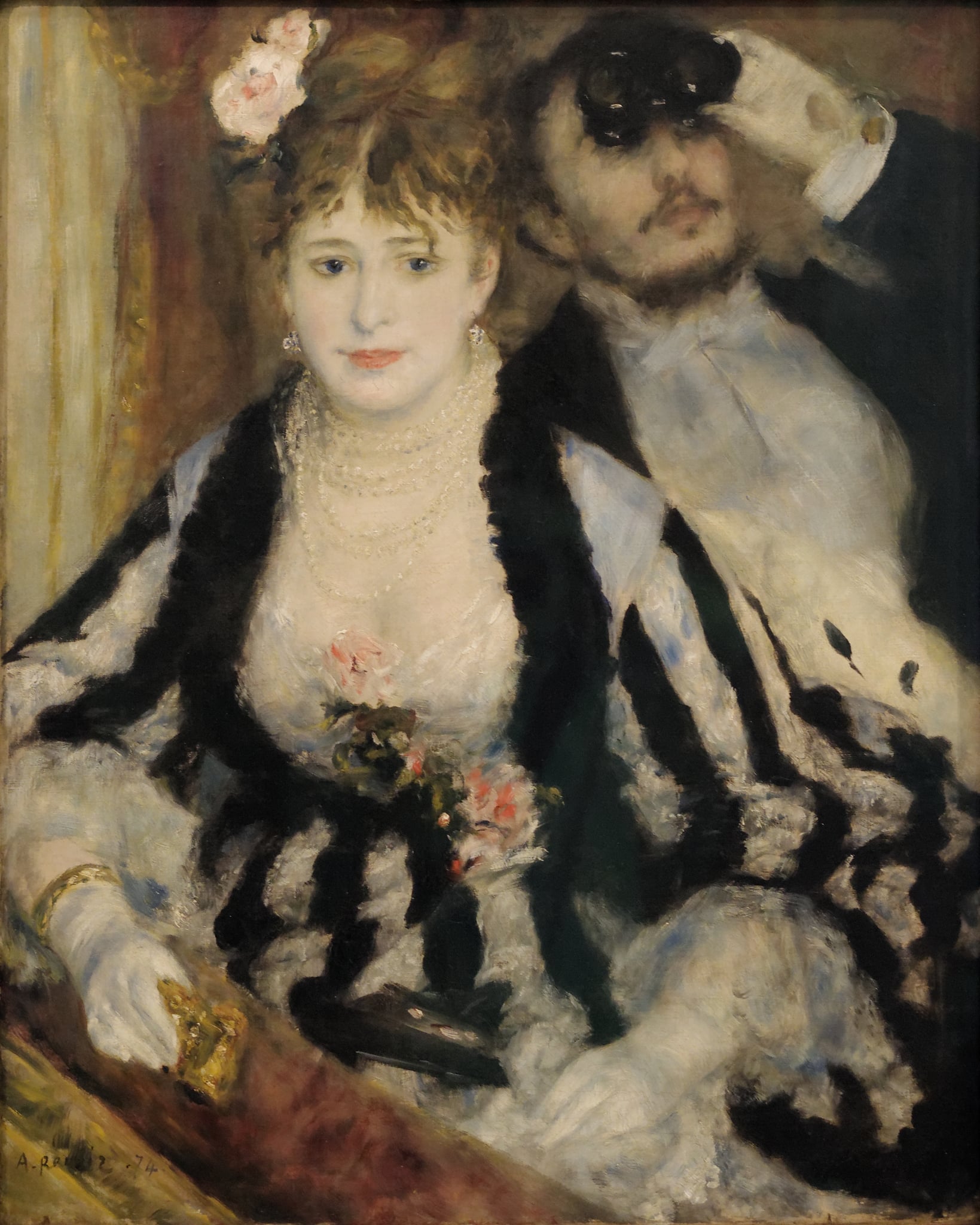
The Loge by Pierre-Auguste Renoir

The Loge

Pierre-Auguste Renoir (1874)

Renoir’s The Loge (1874) turns an opera box into a <strong>stage of looking</strong>, where a woman meets our gaze while her companion scans the crowd through binoculars. The painting’s <strong>frame-within-a-frame</strong> and glittering fashion make modern Parisian leisure both alluring and self-conscious, turning spectators into spectacles <sup>[1]</sup><sup>[2]</sup>.