Camille Monet on a Garden Bench

by Claude Monet

Claude Monet’s Camille Monet on a Garden Bench (1873) stages an intimate pause where light, grief, and modern leisure intersect. Camille, shaded and withdrawn, holds a letter while a top‑hatted neighbor hovers; a bright bank of red geraniums and a strolling woman with a parasol ignite the distance [1]. Monet converts a domestic garden into a scene about psychological distance amid fleeting sunlight.

Fast Facts

Year
1873
Medium
Oil on canvas
Dimensions
60.6 × 80.3 cm
Location
The Metropolitan Museum of Art, New York
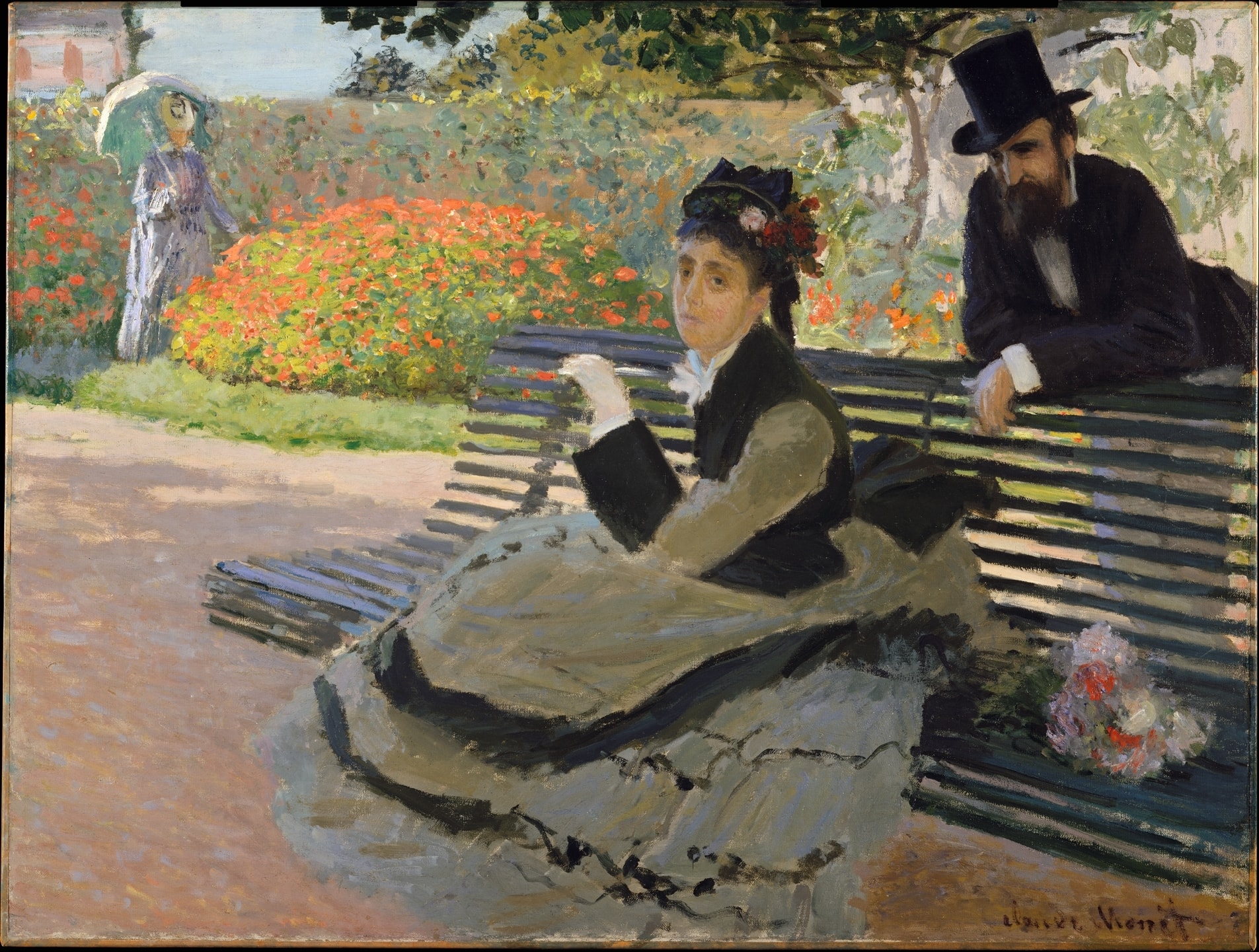
Camille Monet on a Garden Bench by Claude Monet (1873)

Click on any numbered symbol to learn more about its meaning

Meaning & Symbolism

Monet anchors the drama at the bench’s steep diagonals, where Camille turns toward us, face shaded, a letter pinched in her left glove. At the bench’s edge, a bouquet lies unused, its pinks and whites echoing the geranium blaze beyond; the man in the top hat leans in from the right, his posture echoing the bench’s slats yet failing to bridge the gap to Camille. Their gazes do not meet. This triangulation—letter, bouquet, and leaning figure—codifies a scene of condolence interrupted, a reading grounded by 1873’s family bereavement and the Met’s observation that the gentleman is best understood as a “neighbor” rather than a familiar intimate 13. The woman with a parasol, set near the geranium bank, passes like weather—another moving element in a composition about things that shift while feelings resist being soothed. Monet’s color structure turns emotion into optics. The foreground figures sit in cool shadow—black waistcoat, gray‑green skirt, sable hat—while the background detonates into complementary red and green geraniums under noon light. That chromatic opposition is not decorative; it sharpens a conceptual split between the garden’s vitality and the figures’ suspended mood 1. Brushwork is brisk but targeted: soft scumbles map the shaded path; flicks of cadmium red pulse in the geraniums; the neighbor’s jacket is a slab of near‑matte black, a social presence rendered as a block of tone. Even the bench’s slats function narratively. Their recession draws the eye into space, but their raking angle also corrals the figures into a shallow, pressurized corner, explaining why Camille’s body turns out toward us—her only route of exit is visual. At Argenteuil Monet was testing how modern life—domestic gardens, urban fashion, neighbors—could bear the weight of serious narrative without recourse to anecdote or illustration 24. Fashion details derived from contemporary magazines mark Camille as decidedly of her moment, yet Monet declines to fix a story; instead he lets time do the telling, through dappled leaves that slide across the bench and a path scraped with transient light 1. The neighbor’s hat brim casts a wedge of shade over his brow, hiding intention; the bouquet’s placement—neither offered nor accepted—keeps social ritual unresolved. Such deliberate ambiguities explain why curators call this one of Monet’s most enigmatic genre scenes 1. They also signal a pivot: where earlier painters built narratives from gesture and symbol, Monet builds his from perception itself. The letter is legible as form, not text; the condolence is inferred by placement and light. In that sense, the painting demonstrates why Camille Monet on a Garden Bench is important: it proves that Impressionism could deliver modern psychology through sensation, binding private grief to passing sunshine, and making the Argenteuil garden a laboratory for both optical truth and emotional truth 24.

Explore Deeper with AI

Ask questions about Camille Monet on a Garden Bench

Popular questions:

Powered by AI • Get instant insights about this artwork

💬 Ask questions about this artwork!

Interpretations

Technical Optics as Emotion

Monet recasts feeling as value orchestration. The foreground is held in a cool, compressed register—sable hat, gray‑green skirt, near‑matte black jacket—while the background detonates into complementary red/green geraniums under hard noon light. That chromatic counterpoint is not decorative; it produces a legible split between public brightness and private suspension. Note the handling: dry scumbles on the path, high‑chroma flicks in the flowers, and the neighbor’s jacket rendered as a single tonal slab, a social presence conceived as a block of darkness. Edge control is crucial: the bench’s slats sharpen toward the right, corralling bodies into a shallow wedge and building affective pressure that syntax alone would not convey 1.

Source: The Metropolitan Museum of Art

Fashion Mediation and Modern Identity

Camille’s velvet-and-damask ensemble, traceable to La Mode Illustrée (March 1873), turns the sitter into an index of consumer modernity. Fashion here is not mere decor; it timestamps the scene and mediates grief through the protocols of urban appearance. In Argenteuil—rail‑linked to Paris—couture enters the domestic garden, making private sorrow legible in public styles. Monet leverages this duality: the outfit’s dark lusters absorb light in the shade, while the geranium bank flares as a boutique of color behind her. The painting thus stages a collision between ephemeral trends and durable affect, aligning Impressionism’s interest in the “modern” with the social codes that dictate how one dresses to receive condolences 12.

Source: The Metropolitan Museum of Art; National Gallery of Art (Paul Hayes Tucker)

Narrative Indeterminacy and Genre Experiment

The work occupies a charged space between plein‑air study and genre tableau. The Met calls it among Monet’s most “enigmatic” scenes, and the indeterminacy is strategic: the letter is legible as form, not text; the bouquet is placed, not offered; the neighbor’s hat brim masks intention. Early speculation cast the man as Eugène Manet, but Monet’s 1921 letter corrects him to a “neighbor,” draining biographical romance and underscoring everyday social protocol instead 13. By refusing anecdotal closure, Monet tests whether modern optics can shoulder serious narrative—a claim central to the Argenteuil enterprise on the eve of the 1874 Impressionist exhibition 2.

Source: The Metropolitan Museum of Art; Colin B. Bailey (Annenberg Collection); National Gallery of Art (Paul Hayes Tucker)

Time-as-Subject: Weather, Passing, Delay

Impressionism’s famous present tense becomes dramaturgy. The woman with a parasol moves “like weather” near the geranium bank, while leaf‑shadows slide across the bench—temporal marks that outpace human consolation. Monet composes delay: the bouquet lies unused; the neighbor leans but does not bridge the gap; Camille turns outward, her only “exit” the viewer’s gaze. These micro‑temporal cues align with Argenteuil experiments in capturing transience—fugitive light, quickening color, and urban leisure measured in moments, not stories. The result models how time, rather than gesture, narrates: grief here is less an event than a duration, stretched across sun and shadow 12.

Source: The Metropolitan Museum of Art; National Gallery of Art (Paul Hayes Tucker)

Social Distance Engineered by Space

Monet converts furniture into social architecture. The bench’s steep diagonals function as both perspectival device and etiquette barrier, channeling bodies into a compressed corner while preventing the neighbor’s lean from becoming intrusion. The bouquet’s placement at the bench’s edge keeps consolation procedural—present but unconsummated—consistent with condolence etiquette that defers intimacy. The hat brim’s wedge of shade anonymizes the caller, aligning with Monet’s later clarification that he is simply “a neighbor,” not a familiar intimate, which recalibrates the scene from romance to protocol 13. Spatial grammar—angles, occlusions, value blocks—does the tactful work of saying what the figures cannot.

Source: The Metropolitan Museum of Art; Colin B. Bailey (Annenberg Collection)

Related Themes

About Claude Monet

Claude Monet (1840–1926) led Impressionism’s pursuit of open-air painting and optical immediacy, especially during his Argenteuil years focused on modern leisure and light. He later developed serial studies of changing conditions, culminating in the Water Lilies cycle [2].
View all works by Claude Monet

More by Claude Monet

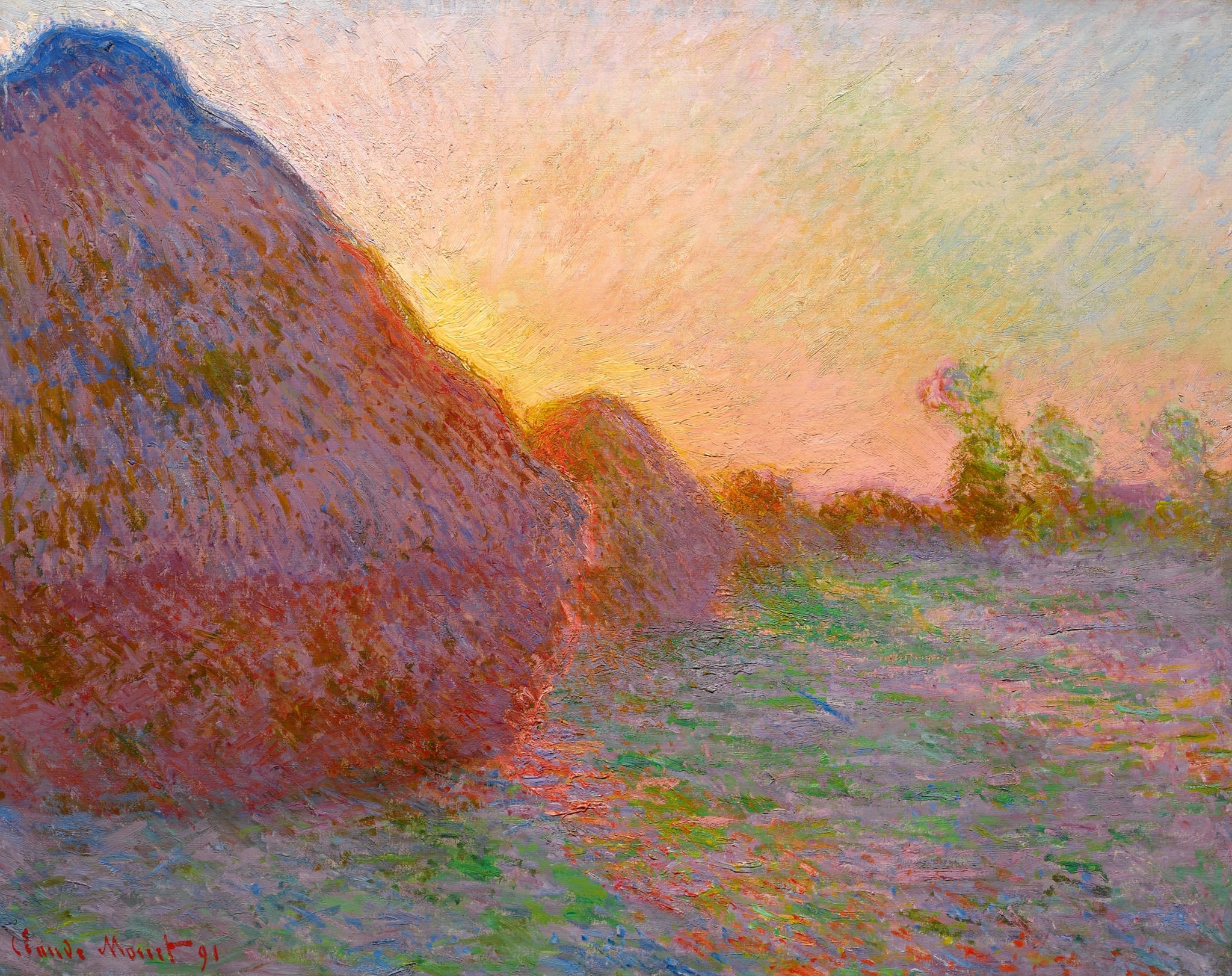
Haystacks Series by Claude Monet | Light, Time & Atmosphere by Claude Monet

Haystacks Series by Claude Monet | Light, Time & Atmosphere

Claude Monet

Claude Monet’s <strong>Haystacks Series</strong> transforms a routine rural subject into an inquiry into <strong>light, time, and perception</strong>. In this sunset view, the stacks swell at the left while the sun burns through the gap, making the field shimmer with <strong>apricot, lilac, and blue</strong> vibrations.
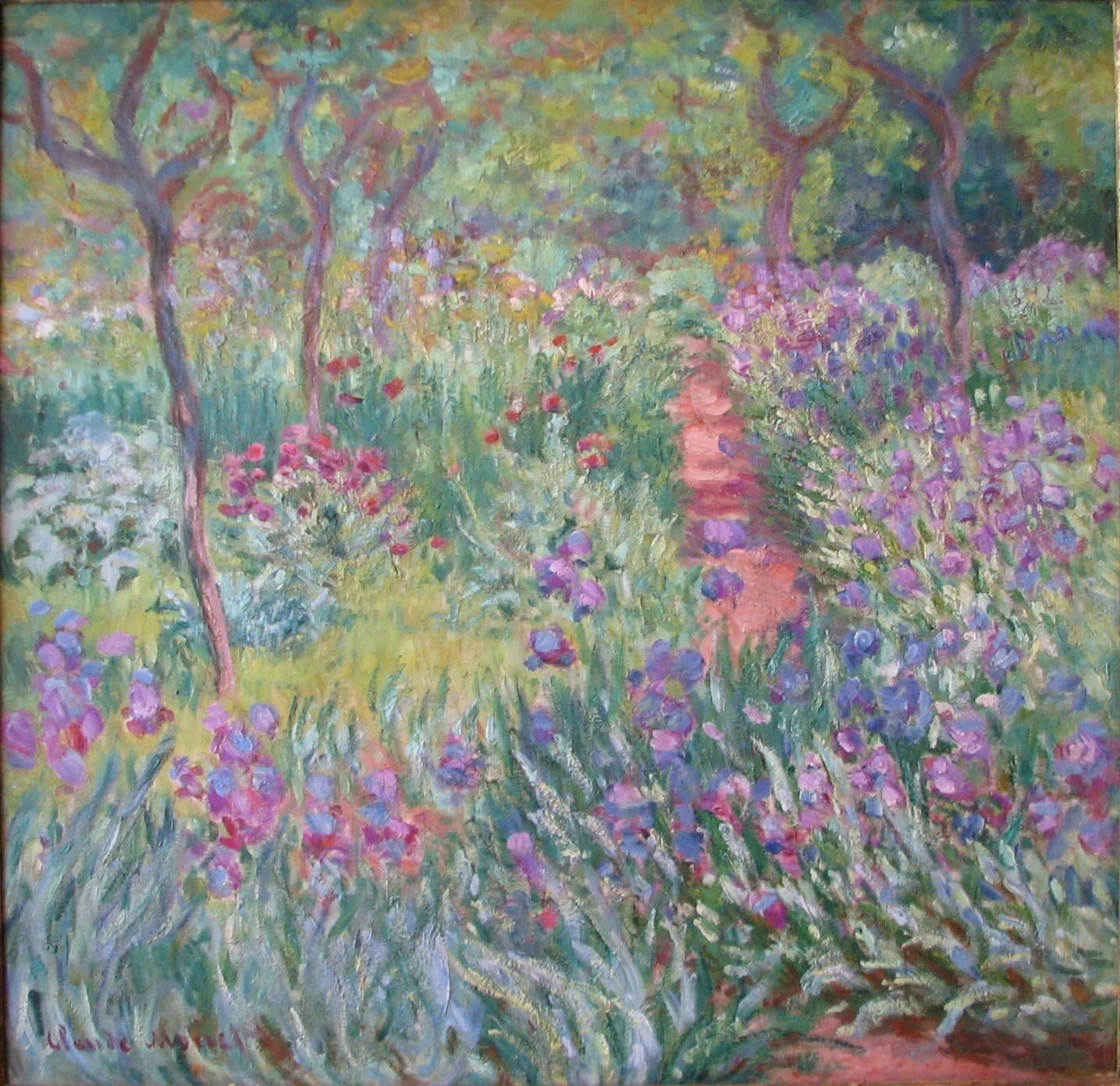
The Artist's Garden at Giverny by Claude Monet

The Artist's Garden at Giverny

Claude Monet (1900)

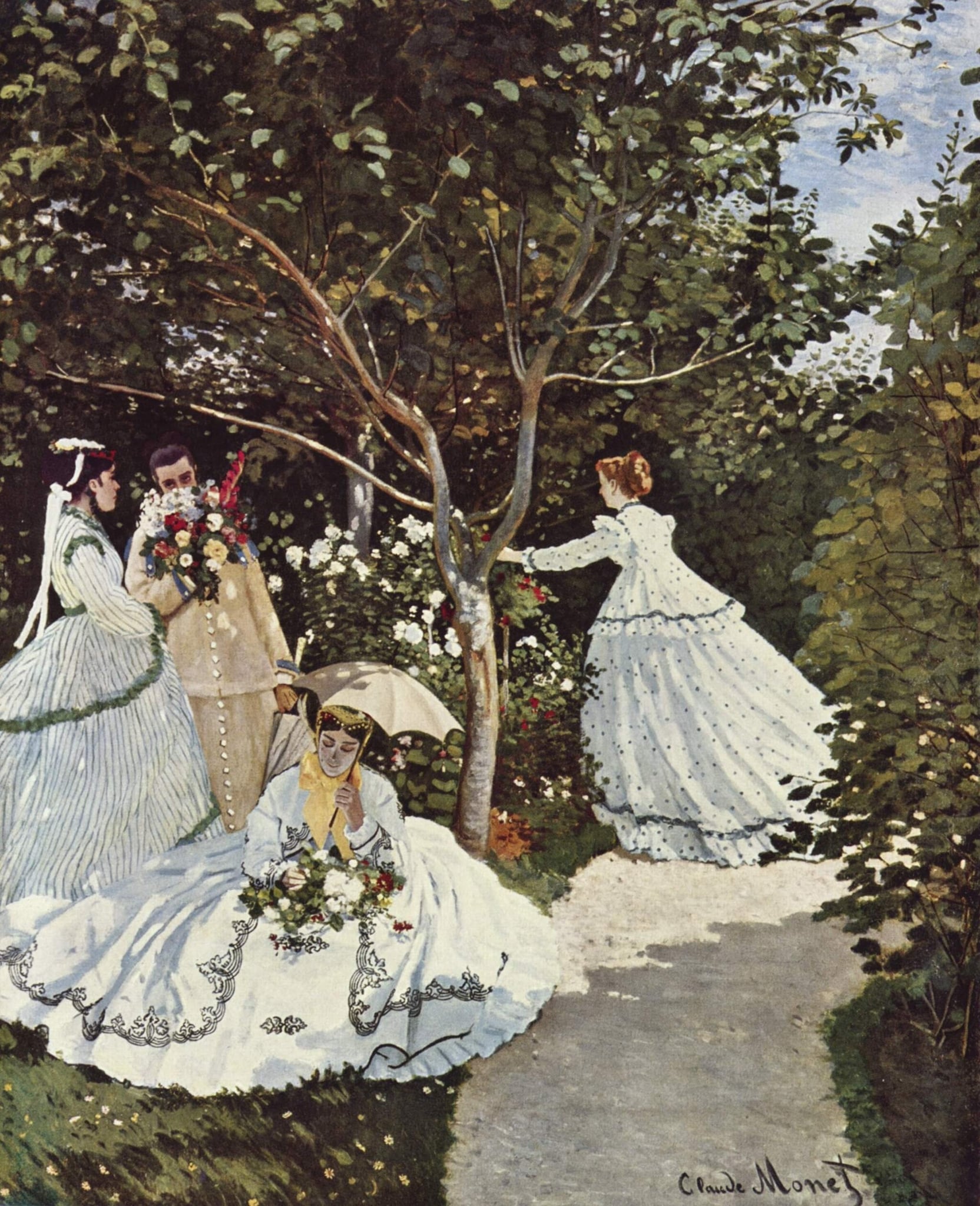
In The Artist's Garden at Giverny, Claude Monet turns his cultivated Clos Normand into a field of living color, where bands of violet <strong>irises</strong> surge toward a narrow, rose‑colored path. Broken, flickering strokes let greens, purples, and pinks mix optically so that light seems to tremble across the scene, while lilac‑toned tree trunks rhythmically guide the gaze inward <sup>[1]</sup><sup>[3]</sup>.
The Water Lily Pond by Claude Monet

The Water Lily Pond

Claude Monet (1899)

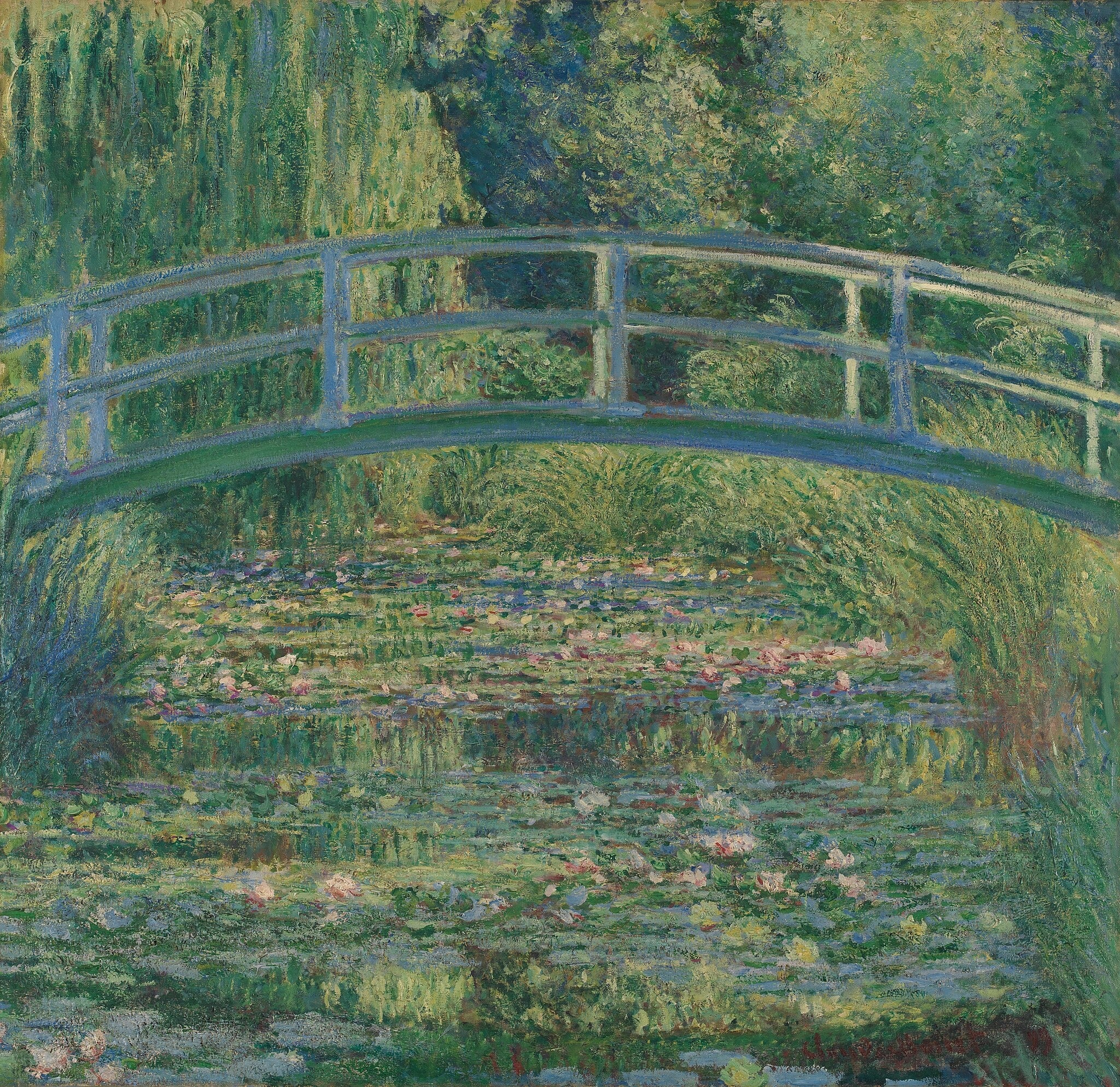
Claude Monet’s The Water Lily Pond transforms a designed garden into a theater of <strong>perception and reflection</strong>. The pale, arched <strong>Japanese bridge</strong> hovers over a surface where lilies, reeds, and mirrored willow fronds dissolve boundaries between water and sky, proposing <strong>seeing itself</strong> as the subject <sup>[1]</sup><sup>[3]</sup>.

Waterloo Bridge, Sunlight Effect by Claude Monet

Waterloo Bridge, Sunlight Effect

Claude Monet (1903 (begun 1900))

Claude Monet’s Waterloo Bridge, Sunlight Effect renders London as a <strong>lilac-blue atmosphere</strong> where form yields to light. The bridge’s stone arches persist as anchors, yet the span dissolves into mist while <strong>flecks of lemon and ember</strong> signal modern traffic crossing a city made weightless <sup>[1]</sup><sup>[2]</sup>. Vertical hints of chimneys haunt the distance, binding industry to beauty as the Thames shimmers with the same notes as the sky <sup>[1]</sup><sup>[3]</sup>.

Morning on the Seine (series) by Claude Monet

Morning on the Seine (series)

Claude Monet (1897)

Claude Monet’s Morning on the Seine (series) turns dawn into an inquiry about <strong>perception</strong> and <strong>time</strong>. In this canvas, the left bank’s shadowed foliage dissolves into lavender mist while a pale radiance opens at right, fusing sky and water into a single, reflective field <sup>[1]</sup><sup>[2]</sup>.

Woman with a Parasol by Claude Monet

Woman with a Parasol

Claude Monet (1875)

Claude Monet’s Woman with a Parasol fixes a breezy hillside instant in high, shifting light, setting a figure beneath a <strong>green parasol</strong> against a vast, vibrating sky. The low vantage and <strong>broken brushwork</strong> merge dress, clouds, and grasses into one atmosphere, while a child at the rise anchors depth and intimacy <sup>[1]</sup>. It is a manifesto of <strong>plein-air</strong> perception—painting the sensation of air in motion rather than the contours of things <sup>[2]</sup>.