The Red Boats, Argenteuil

by Claude Monet

Claude Monet’s The Red Boats, Argenteuil crystallizes a luminous afternoon on the Seine, where two vermilion hulls anchor a scene of leisure and light. The tremoring reflections and vertical masts/poplars weave nature and modern recreation into a single atmospheric field [1].

Fast Facts

Year
1875
Medium
Oil on canvas
Dimensions
61.8 × 82.5 cm
Location
Harvard Art Museums/Fogg Museum, Cambridge, MA
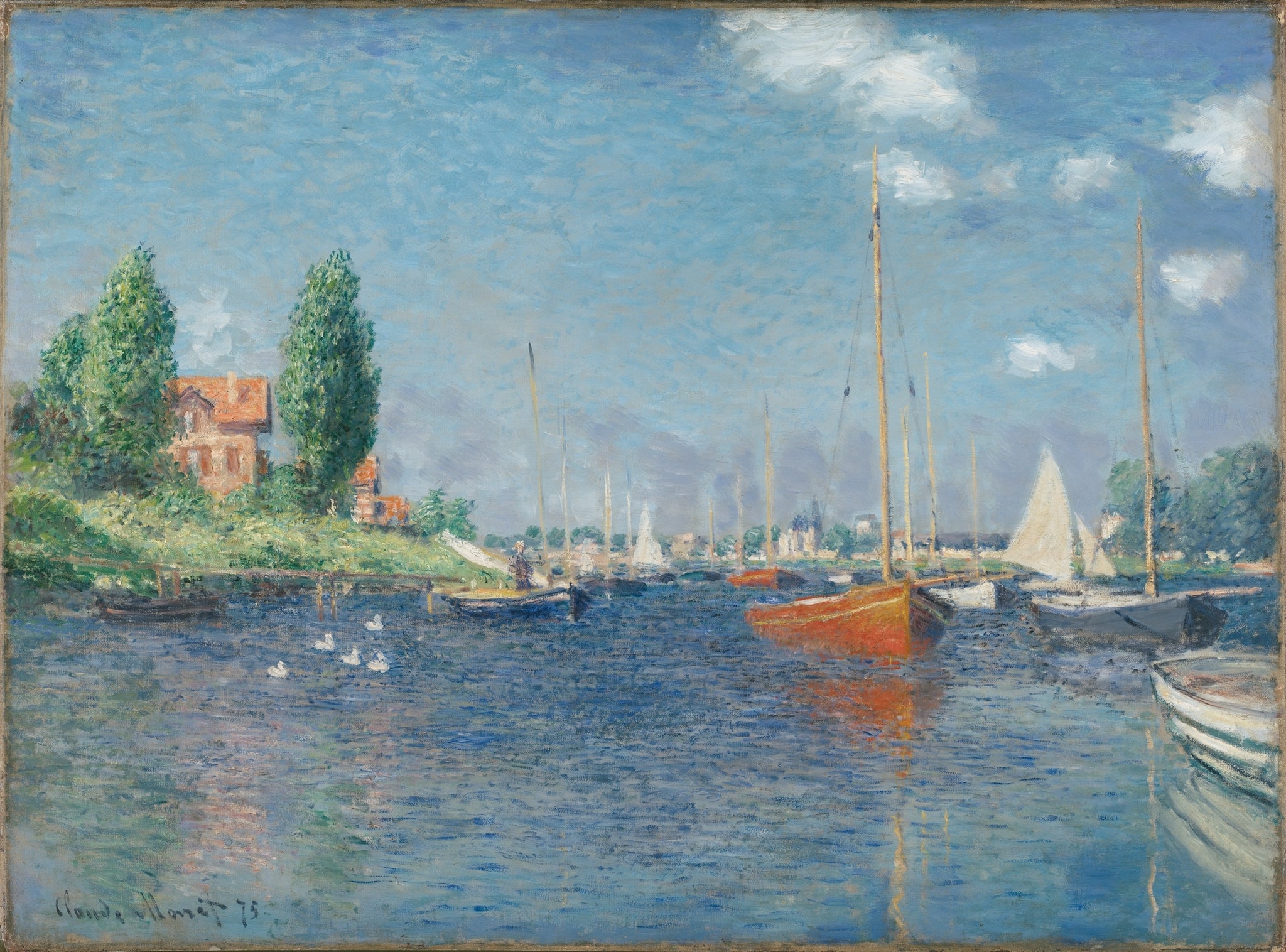
The Red Boats, Argenteuil by Claude Monet (1875) featuring Red boats (vermilion hulls), Water reflections, Masts and poplars (verticals), White sail

Click on any numbered symbol to learn more about its meaning

Meaning & Symbolism

At the picture’s center-right, the two red boats act as chromatic anchors whose warm hue is doubled in the water, stabilizing a composition otherwise alive with broken, scintillating strokes. Their slender masts rhyme with the poplars on the left bank and the pale spars across the harbor, binding discrete things—boats, trees, clouds—into a single field of sensation. The orange roof on the left echoes the hulls’ warmth, while the small white ducks punctuate the foreground, confirming a near-shore vantage and animating the surface with gentle motion. Monet’s orchestration of these repetitions and complements is not merely decorative; it asserts a social idea. In Argenteuil, a railroad suburb known for regattas as much as industry, such motifs signal regulated, respectable recreation; the boat-rental area on the left, the flash of a white sail to the right, and the calm spacing of craft all read as signs of a controlled, bourgeois Eden 132. That ideological harmony is actively made. Harvard’s technical notes record that Monet repainted passages and even removed a sixth duck, and, more crucially, that he omitted factory smokestacks visible at the site 1. T. J. Clark has argued that Monet’s Argenteuil images often absorb or minimize industrial signs so they hardly register as different from nature; here, the strategy is sharper: exclusion preserves the pictorial and social coherence of leisure 4. The consequence is a panorama where the verticals of masts and poplars become the only “chimneys,” and where smoke gives way to vaporous cloudlets, all translated into the same airy touch. Such selection clarifies the painting’s politics of vision: modernity is welcome insofar as it appears as pleasure, cleanliness, and light. Robert Herbert’s account of Impressionism’s suburban imagery fits precisely—Monet offers Argenteuil as a well-ordered suburb where nature and modern pastime meet without friction 3. Yet the image also insists on a different kind of truth: the truth of instantaneity. The river does not mirror; it flickers. The reflections of the red hulls are broken by choppy, short strokes of blue and green; the sail at right is a bright triangle that catches light for a moment and will pass; the ducks advance in a loose diagonal that remakes the surface as they glide. Such facture states Monet’s central conviction that reality happens as changing effects of light, grasped in a vivid now 1. The lavender band along the horizon, a reworked passage identified by x‑rays, underscores the paradox—“instant” sensation achieved through revision 1. That paradox is integral to the meaning of The Red Boats, Argenteuil: spontaneity is crafted, and harmony is chosen. Situated within Monet’s years living and working on the Seine—sometimes from his studio boat—the painting aligns looking with boating itself: a modern pastime of drifting, scanning, and catching reflections before they dissolve 62. Displayed at the Second Impressionist Exhibition in 1876, the canvas helped define the movement’s wager that modern life could be seen, and felt, as a sequence of luminous accords. Its significance endures because it shows how pictorial selection and optical immediacy collaborate to make modernity appear natural, pleasurable, and whole 143.

Explore Deeper with AI

Ask questions about The Red Boats, Argenteuil

Popular questions:

Powered by AI • Get instant insights about this artwork

💬 Ask questions about this artwork!

Interpretations

Ideological Editing of the Suburb

Monet’s Argenteuil is not simply seen; it is curated. The documented choice to remove nearby smokestacks refashions a mixed industrial suburb into a seamless leisure panorama, where masts, poplars, and cloudlets rhyme as benign verticals. This is ideological landscaping—an aesthetic filtering that domesticates modernity into light, clarity, and decorum. T. J. Clark argues that Argenteuil images absorb or erase industrial signs so they barely differ from nature; here the tactic is stronger: exclusion itself becomes the guarantor of harmony. The result is a visual polity in which modern pleasure appears innocent and total, a suburb of agreeable effects rather than conflicting interests—an art of consensus by omission 14.

Source: T. J. Clark

Leisure Infrastructure and Class Coding

Reading with social history, the picture encodes a petite-bourgeois Eden: rental boats, disciplined spacing, and villas proclaim a world of regulated, respectable recreation. As Robert L. Herbert shows, Impressionist suburbs materialize new freedoms enabled by rail—day trips, regattas—while polishing them into civic virtue. In Monet’s scene, chromatic echoes (red hulls/orange roof) and parallel verticals (masts/poplars) naturalize this order, making classed amenities appear as landscape. Argenteuil’s dual identity—pleasure hub and growing industry—gets resolved into a decorous leisure infrastructure, a civic branding that turns pastime into social ethics and makes modernity legible as comfort, cleanliness, and light 32.

Source: Robert L. Herbert

Crafted Spontaneity: Technique as Argument

Harvard’s technical dossier records reworked passages, a painted‑out sixth duck, and a lavender horizon revised in layers—evidence that Monet’s vaunted instantaneity is a constructed effect. The broken touches that make the water flicker are not reportage but a calibrated facture that argues for optical truth while relying on revision. Such material choices stage a paradox: an image that feels like first sight yet is built through after-the-fact corrections. The carding of brushstrokes across reflections, the tuned warm–cool complements, and the suppressed motifs all reveal a painter making a case: the most faithful account of the moment may require deliberate retouching of reality and paint alike 1.

Source: Harvard Art Museums

River Mobility and the Tempo of Modern Life

Monet’s Seine functions as a sensorium of speed: sails flick by, reflections shear, and the viewer’s implied position hovers near water level—akin to sighting from his studio boat, which enabled him to track drifting effects. Paul Hayes Tucker links Argenteuil to rail-enabled suburban modernity; the picture absorbs this mobility into optic form—short strokes, bright planar sails, a scanning gaze. National Gallery context on Argenteuil’s commuter leisure complements this: a suburb synchronized to Paris yet staged as ease. The painting translates circulation—train, boat, eye—into visual tempo, arguing that modern life can be felt as a sequence of luminous, graspable nows 572.

Source: Paul Hayes Tucker; National Gallery of Art (Washington); National Gallery, London

Environmental Optics or Environmental Screen?

The canvas offers a pristine riparian surface by strategically screening industrial presence. Are we seeing ecological harmony—or a painterly mitigation strategy that replaces smoke with cloud and chimney with mast? Clark’s thesis (harmonization of signs) and Harvard’s note on omitted smokestacks suggest the latter: Argenteuil’s pollution risk is converted into atmosphere, its factories into absent presences. Curatorial accounts of the site’s mixed identity reinforce this tension. Monet’s optics are exquisitely truthful to light, yet environmentally selective—an early instance of how images can make modern nature appear whole by translating industry into weather 412.

Source: T. J. Clark; Harvard Art Museums; National Gallery, London

Time’s Surface: Flicker as Memento of the Instant

The water’s flicker does more than describe reflection; it enacts time. The red hulls double and shatter, the sail flashes, the ducks traverse—each a small vanishing. Read as a subtle memento mori, the scene’s pleasures hinge on the perishability that makes them vivid. Monet’s career-long pursuit of changing effects (from Argenteuil to Giverny) frames this as a philosophy: to paint is to register passing light before it dies on the surface. The Harvard revisions make that mortality formal—sensation arrives only through erasure and redoing. The instant is beautiful because it is terminal, and the picture holds that terminal beauty in suspension 16.

Source: The Met Heilbrunn Timeline of Art History; Harvard Art Museums

Related Themes

About Claude Monet

Claude Monet (1840–1926) led Impressionism’s pursuit of open-air painting and optical immediacy, especially during his Argenteuil years focused on modern leisure and light. He later developed serial studies of changing conditions, culminating in the Water Lilies cycle [2].
View all works by Claude Monet

More by Claude Monet

Haystacks Series by Claude Monet | Light, Time & Atmosphere by Claude Monet

Haystacks Series by Claude Monet | Light, Time & Atmosphere

Claude Monet

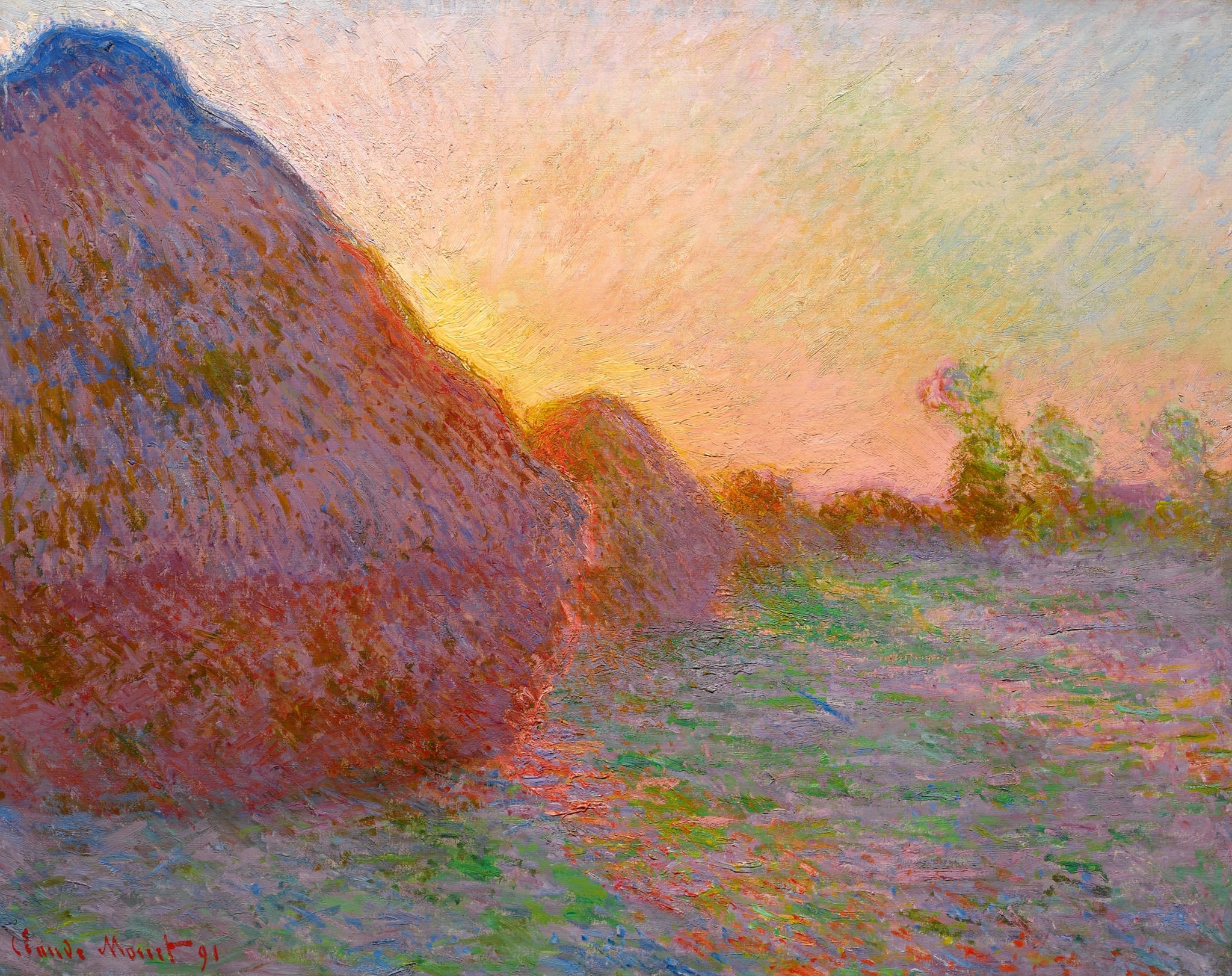
Claude Monet’s <strong>Haystacks Series</strong> transforms a routine rural subject into an inquiry into <strong>light, time, and perception</strong>. In this sunset view, the stacks swell at the left while the sun burns through the gap, making the field shimmer with <strong>apricot, lilac, and blue</strong> vibrations.
The Artist's Garden at Giverny by Claude Monet

The Artist's Garden at Giverny

Claude Monet (1900)

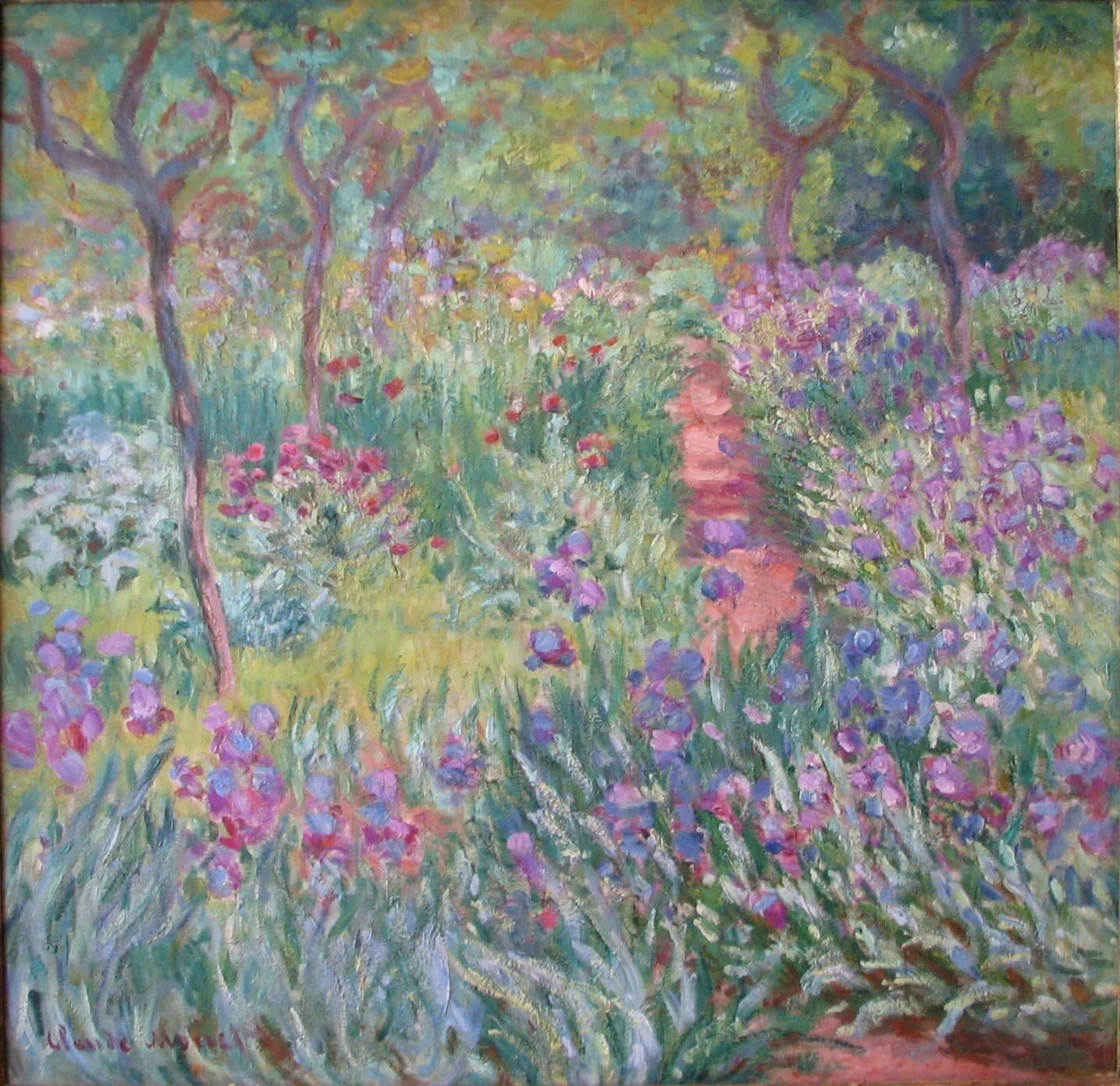
In The Artist's Garden at Giverny, Claude Monet turns his cultivated Clos Normand into a field of living color, where bands of violet <strong>irises</strong> surge toward a narrow, rose‑colored path. Broken, flickering strokes let greens, purples, and pinks mix optically so that light seems to tremble across the scene, while lilac‑toned tree trunks rhythmically guide the gaze inward <sup>[1]</sup><sup>[3]</sup>.
The Water Lily Pond by Claude Monet

The Water Lily Pond

Claude Monet (1899)

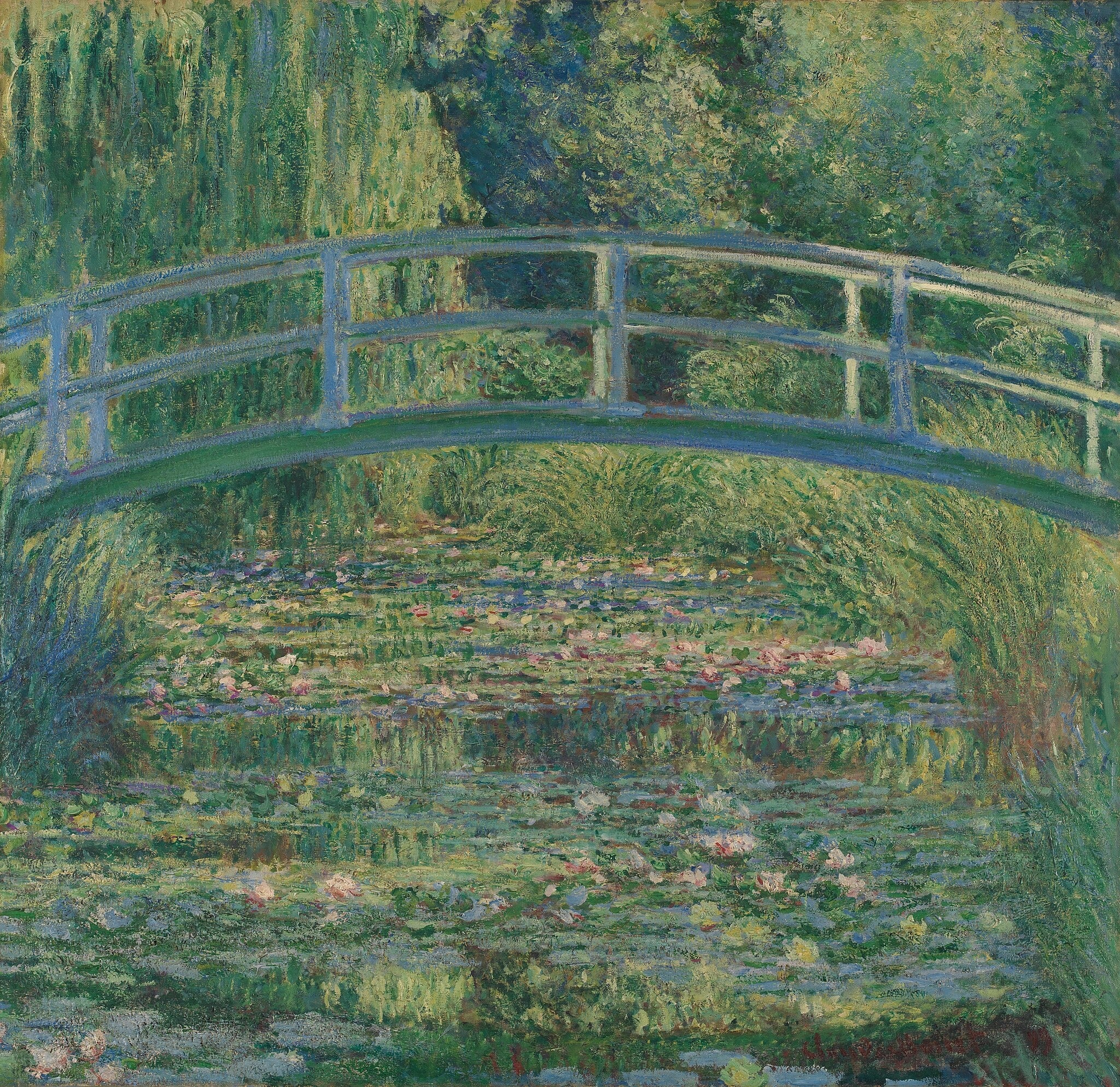
Claude Monet’s The Water Lily Pond transforms a designed garden into a theater of <strong>perception and reflection</strong>. The pale, arched <strong>Japanese bridge</strong> hovers over a surface where lilies, reeds, and mirrored willow fronds dissolve boundaries between water and sky, proposing <strong>seeing itself</strong> as the subject <sup>[1]</sup><sup>[3]</sup>.

Waterloo Bridge, Sunlight Effect by Claude Monet

Waterloo Bridge, Sunlight Effect

Claude Monet (1903 (begun 1900))

Claude Monet’s Waterloo Bridge, Sunlight Effect renders London as a <strong>lilac-blue atmosphere</strong> where form yields to light. The bridge’s stone arches persist as anchors, yet the span dissolves into mist while <strong>flecks of lemon and ember</strong> signal modern traffic crossing a city made weightless <sup>[1]</sup><sup>[2]</sup>. Vertical hints of chimneys haunt the distance, binding industry to beauty as the Thames shimmers with the same notes as the sky <sup>[1]</sup><sup>[3]</sup>.

Morning on the Seine (series) by Claude Monet

Morning on the Seine (series)

Claude Monet (1897)

Claude Monet’s Morning on the Seine (series) turns dawn into an inquiry about <strong>perception</strong> and <strong>time</strong>. In this canvas, the left bank’s shadowed foliage dissolves into lavender mist while a pale radiance opens at right, fusing sky and water into a single, reflective field <sup>[1]</sup><sup>[2]</sup>.

Woman with a Parasol by Claude Monet

Woman with a Parasol

Claude Monet (1875)

Claude Monet’s Woman with a Parasol fixes a breezy hillside instant in high, shifting light, setting a figure beneath a <strong>green parasol</strong> against a vast, vibrating sky. The low vantage and <strong>broken brushwork</strong> merge dress, clouds, and grasses into one atmosphere, while a child at the rise anchors depth and intimacy <sup>[1]</sup>. It is a manifesto of <strong>plein-air</strong> perception—painting the sensation of air in motion rather than the contours of things <sup>[2]</sup>.