Beach at Trouville

by Claude Monet

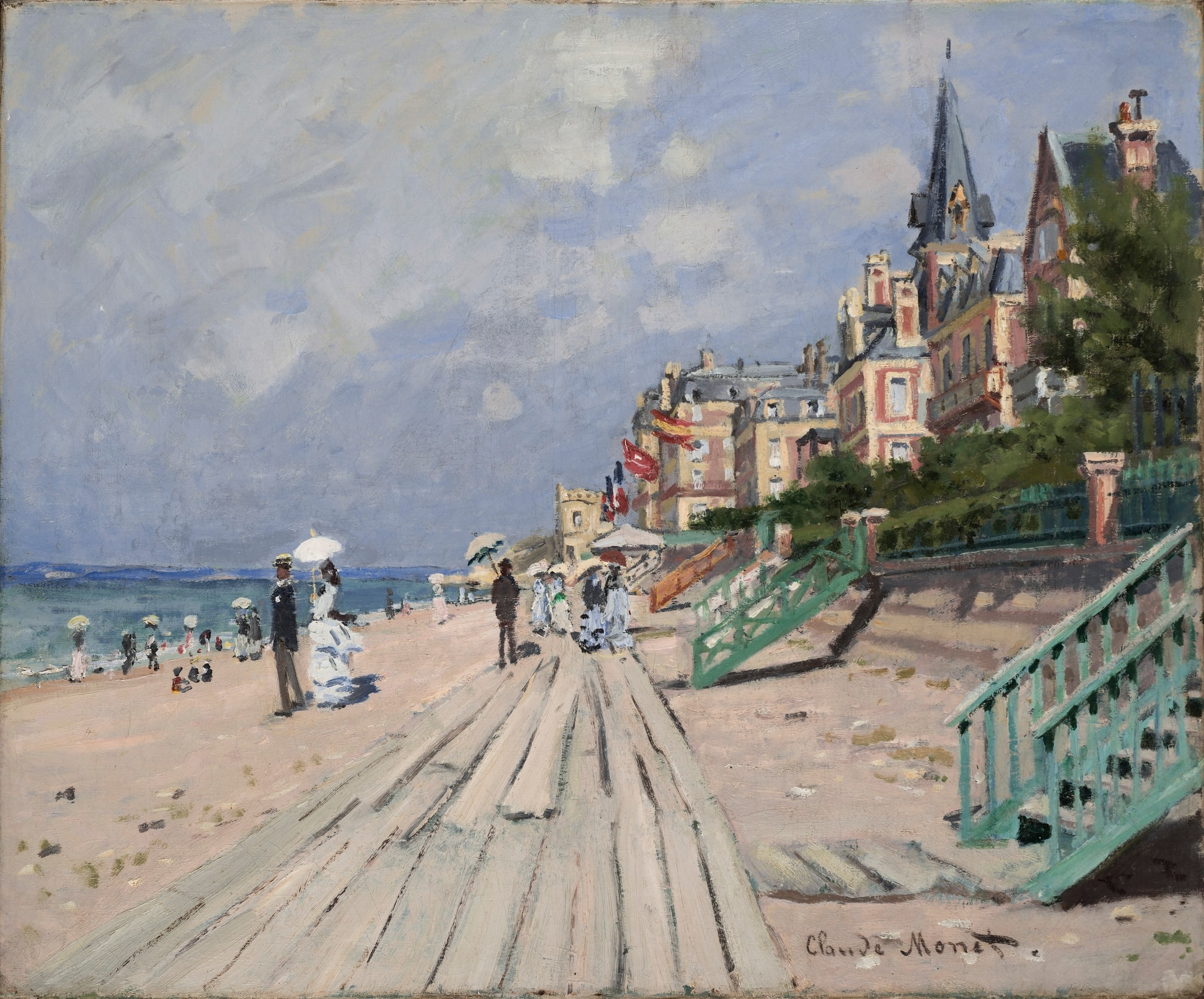
Beach at Trouville turns the Normandy resort into a stage where modern leisure meets restless weather. Monet’s diagonal boardwalk, wind-whipped red flags, and white parasols marshal the eye through a day animated by light and air rather than by individual stories [1][2]. The work asserts Impressionism’s claim to immediacy—there is even sand embedded in the paint from working on site [1].
💰

Market Value

$30-55 million

How much is Beach at Trouville worth?

Fast Facts

Year
1870
Medium
Oil on canvas
Dimensions
38 x 46.5 cm
Location
National Gallery, London
Beach at Trouville by Claude Monet (1870) featuring Diagonal boardwalk, Red flags in the wind, White parasols, Mint‑green railings and steps

Click on any numbered symbol to learn more about its meaning

Meaning & Symbolism

Monet structures the scene with a decisive diagonal—a pale boardwalk that slices from the lower left into depth—so the viewer walks visually into the picture alongside the promenaders. On the right, mint-green railings and steep steps cadence the climb toward the bluff, where tall villas and a needle-like spire catch light in pinks and ochres. At mid-distance, a row of red flags snaps hard to the left, echoed by clouds sheared across a silver-blue sky; that repeated directional cue makes wind the organizing force of the day 12. Figures in dark coats and pale dresses stand and drift like buoyant notes; the women’s parasols bloom white against the sea, while faces remain summary, confirming that social type and movement—not portrait likeness—are the point 1. Color zones—cool sea-blues, sandy pinks, brick reds, and the mint of resort carpentry—interlock in broad, broken strokes, knitting architecture, shore, and air into a single weather system. The handling is not cosmetic description; it is evidence. The National Gallery notes grains of wind-blown sand embedded in the paint, an index of plein-air execution that binds surface to site and turns the canvas into a fragment of Trouville itself 1. That formal program carries a social thesis. Beach at Trouville shows a coast re-scripted for bourgeois tourism: boardwalk engineering, hotel façades, fashionable dress, and a choreography of seeing and being seen 3. Where earlier Normandy views often centered laboring boats, Monet makes infrastructure and spectatorship the subject; the villas climb the bluff like a new citadel of leisure while the ocean’s horizontal band asserts nature’s enduring baseline. The cropping brings us unusually close for a seascape—figures are clipped at the edges, as if caught by a candid glance—signaling a modern, photographic way of looking that contemporaries associated with urban and resort experience 13. The weather motifs connect style to story: flags and scudding cloudlets render transience, a spectacle of passing effects that mirrors the fleeting pleasures of holiday time. These decisions crystallize a pivotal moment in 1870, when Monet, newly married and painting on the coast, moved decisively from picturesque seascape toward images of contemporary life, a shift reinforced by his work alongside Eugène Boudin that summer and by the late‑season upheavals of the Franco‑Prussian War 123. Critically, the painting’s importance is not just that it looks modern; it argues that modernity is experienced as atmosphere—gusts, glare, and glimmer—apprehended in real time. By making the wind legible in every flag and hem, by letting parasols flare like brief lanterns of light, and by stitching site and paint together with literal sand, Monet turns observation into event. Beach at Trouville thus stands as an early, confident demonstration of Impressionism’s core wager: that the truth of the present is best told through momentary sensation, where subject (the resort) and method (fleeting facture) reinforce one another 134.

Explore Deeper with AI

Ask questions about Beach at Trouville

Popular questions:

Powered by AI • Get instant insights about this artwork

💬 Ask questions about this artwork!

Interpretations

Symbolic Reading

Those wind-torqued flags do more than register weather: they brand the resort with national color and convert meteorology into patriotic spectacle. In Second Empire/early Third Republic beach culture, bunting and masts were part of the visual merchandising of leisure—signs that a place was curated, safe, and modern. Here, the flags’ emphatic leftward snap and the clouds’ parallel shear bind nation and atmosphere in a single vector of sensation. Read retrospectively, on the cusp of the Franco‑Prussian War, their insistence courts unease: a carefree sky stitched with state emblems just before rupture. Monet doesn’t sermonize; he lets weather carry the charge, making ideology ride the wind like everything else 123.

Source: Musée d’Orsay; Robert L. Herbert

Historical Context

This canvas is a honeymoon document—Monet was newly married, painting at Trouville with Camille and their son. The National Gallery notes a child’s shoe hanging from a chair in related views from the same stay, a domestic token that domestically inflects a public stage. That small sign reframes the beach: not just a display of class leisure, but a moment of family life inserted into the promenade’s choreography. The proximity and candid cropping read like snapshot keepsakes as much as showpieces. The irony is biographical: behind the holiday veneer lay precarious finances and, by summer’s end, flight to London to escape war. Domesticity becomes a fragile anchor amid a world organized by gusts—of wind, of fashion, of history 1.

Source: National Gallery, London

Formal/Technical Analysis

The work literalizes its claim to immediacy: grains of wind‑blown sand embedded in the paint turn the surface into an index of the site. This is medium reflexivity—the painting shows, materially, how it was made and where. Such indexicality complicates the old binary of mimesis vs. abstraction: Monet’s strokes are schematized, yet the deposit of place itself guarantees contact with the real. The plein‑air procedure becomes legible as data—gusts recorded in flags and hems, grit lodged in pigment—so that looking is also reading evidence. The beach is not simply depicted; it is partially present, anchoring fleeting optical shorthand to the body of the day 1.

Source: National Gallery, London

The Modern Lens

Figures cut by the frame and a near-view angle produce a modern, photographic way of looking—a candid glance that Monet’s contemporaries associated with urban speed and resort spectatorship. The National Gallery underscores how this differs from Boudin’s more distant, frieze-like beach panoramas; Monet chooses proximity and interruption, effects akin to the camera’s accidental crop. This optics aligns with the painting’s thesis: modernity is apprehended as instantaneous effect. The promenade becomes a moving field of partial views, where identity yields to type and gesture, and where the viewer’s path maps onto the diagonal boardwalk that slices the scene into action 15.

Source: National Gallery, London; Art Institute of Chicago (Online Scholarly Catalogues)

Sociology of Space

Trouville appears as a purpose-built machine for tourism: the boardwalk, railings, hotel façades, and steps orchestrate circulation, vantage, and display. Robert L. Herbert argues that Monet’s Normandy works register how resorts re-script shoreline as a commodity, replacing laboring boats with promenaders and façades as the main actors. In this painting the infrastructure isn’t background—it is the subject’s armature, a visible technology of classed leisure. The ocean remains a cool horizontal—nature’s baseline—but the new citadel is the bluff of villas. Monet’s facture—broad, broken strokes—mirrors this churn of looking, a visual economy where effects, not essences, are traded in real time 134.

Source: Robert L. Herbert; Cleveland Museum of Art (Monet in Normandy)

Related Themes

About Claude Monet

Claude Monet (1840–1926) led Impressionism’s pursuit of open-air painting and optical immediacy, especially during his Argenteuil years focused on modern leisure and light. He later developed serial studies of changing conditions, culminating in the Water Lilies cycle [2].
View all works by Claude Monet

More by Claude Monet

La Japonaise (Camille Monet in Japanese Costume) by Claude Monet

La Japonaise (Camille Monet in Japanese Costume)

Claude Monet (1876)

Claude Monet’s La Japonaise (Camille Monet in Japanese Costume) (1876) stages a witty confrontation between <strong>Parisian modernity</strong> and the fashion for <strong>Japonisme</strong>. A fair-skinned model in a blazing red uchikake preens before a wall tiled with uchiwa fans, lifting a <strong>tricolor</strong> hand fan that asserts Frenchness amid the imported decor. The painting turns costume, props, and gaze into a performance about <strong>desire, display, and identity</strong> <sup>[1]</sup><sup>[2]</sup>.

Boating by Claude Monet

Boating

Claude Monet (1887)

Monet’s Boating crystallizes modern leisure as a drama of perception, setting a slim skiff and two pale dresses against a field of dark, mobile water. Bold cropping, a thrusting oar, and the complementary flash of hull and foliage convert a quiet outing into an experiment in <strong>modern vision</strong> and the <strong>materiality of water</strong> <sup>[1]</sup><sup>[2]</sup>.

The Thames below Westminster by Claude Monet

The Thames below Westminster

Claude Monet (about 1871)

Claude Monet’s The Thames below Westminster turns London into <strong>light-made architecture</strong>, where Parliament’s mass dissolves into mist and the river shivers with <strong>industrial motion</strong>. Tugboats, a timber jetty with workers, and the rebuilt Westminster Bridge assert a modern city whose power is felt through atmosphere more than outline <sup>[1]</sup>.

Haystacks Series by Claude Monet | Light, Time & Atmosphere by Claude Monet

Haystacks Series by Claude Monet | Light, Time & Atmosphere

Claude Monet

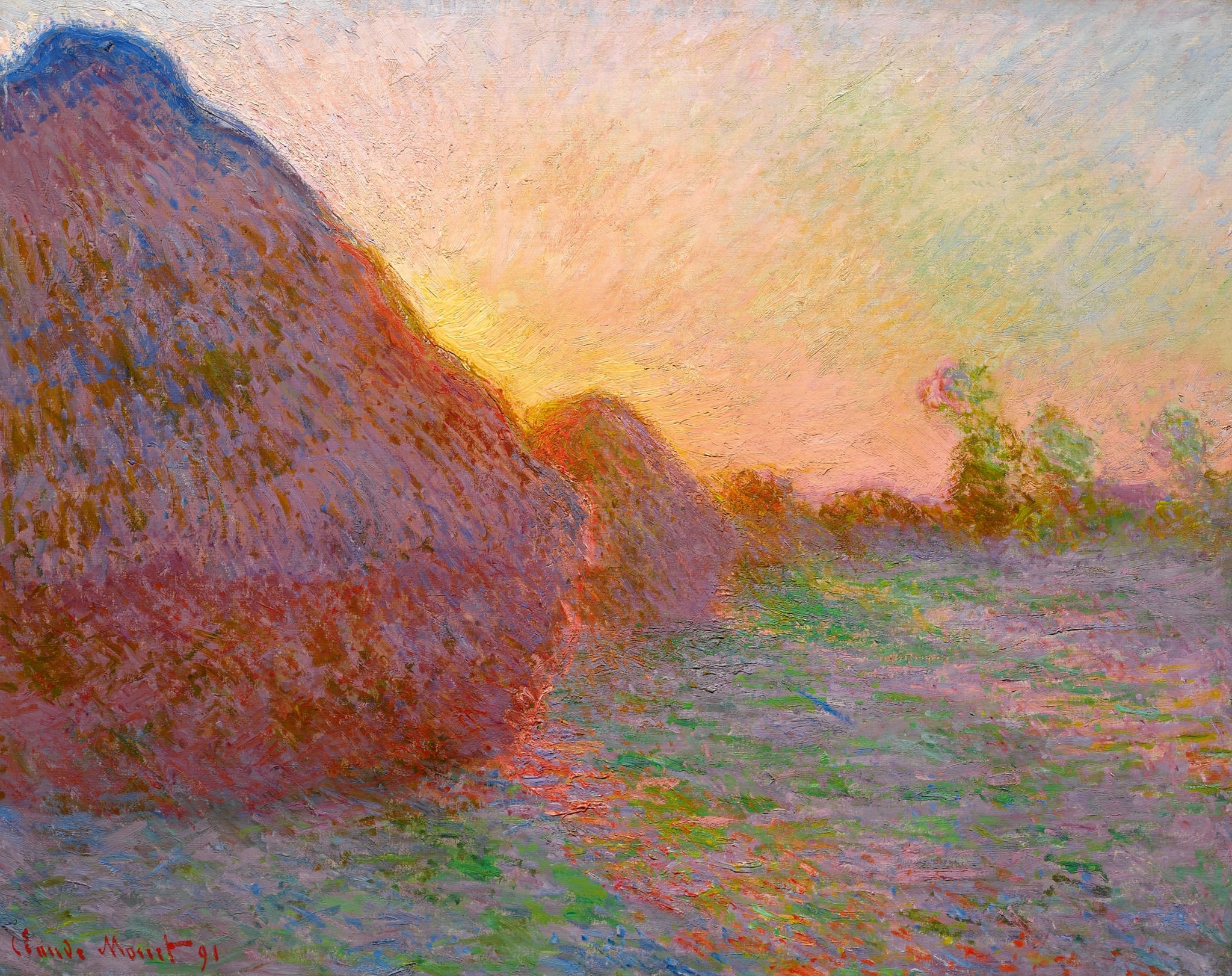
Claude Monet’s <strong>Haystacks Series</strong> transforms a routine rural subject into an inquiry into <strong>light, time, and perception</strong>. In this sunset view, the stacks swell at the left while the sun burns through the gap, making the field shimmer with <strong>apricot, lilac, and blue</strong> vibrations.
Women in the Garden by Claude Monet

Women in the Garden

Claude Monet (1866–1867)

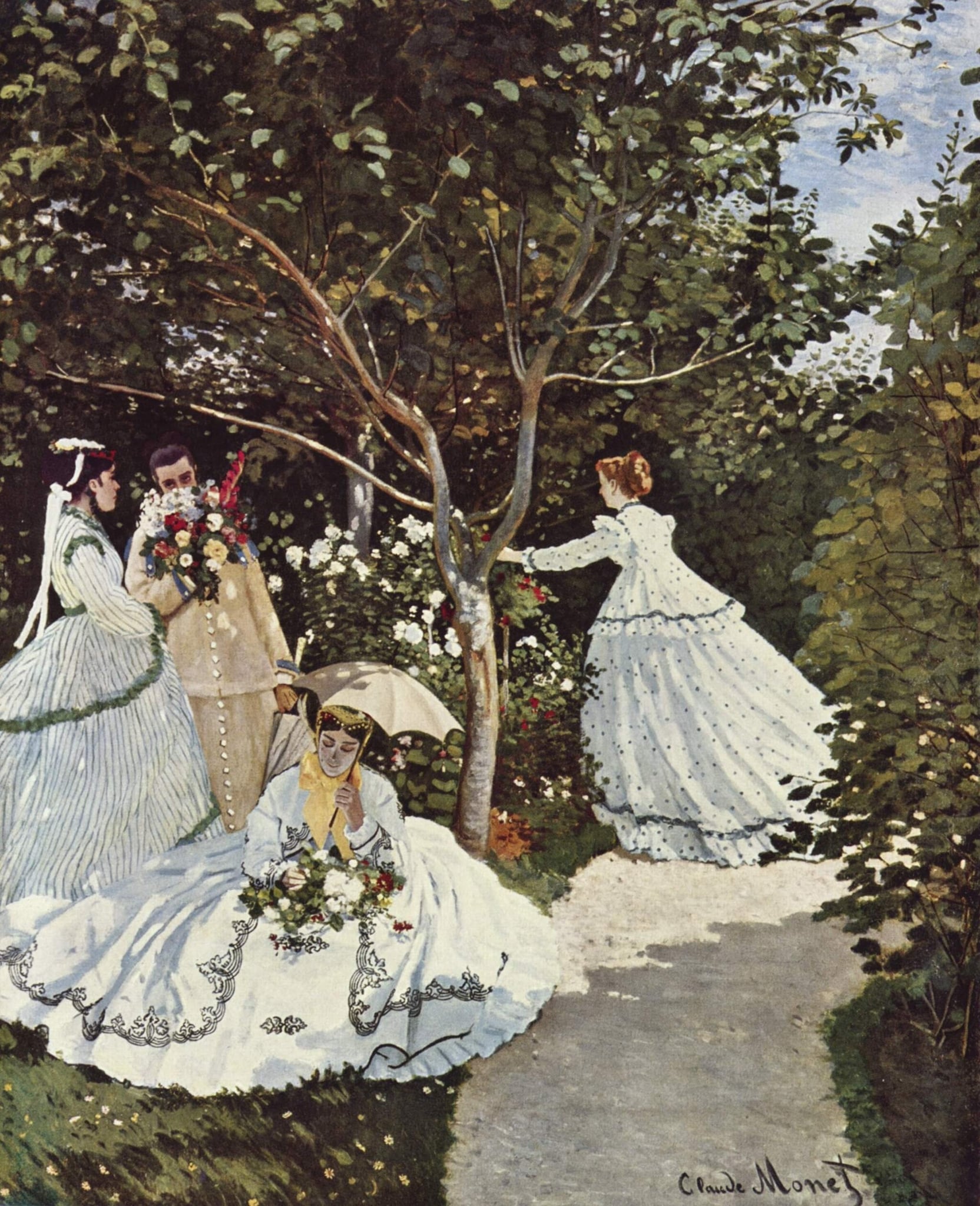
Claude Monet’s Women in the Garden choreographs four figures in a sunlit bower to test how <strong>white dresses</strong> register <strong>dappled light</strong> and shadow. The path, parasol, and clipped flowers frame a modern ritual of leisure while turning fashion into an instrument of <strong>perception</strong>. The scene reads less as portraiture than as a manifesto for painting the <strong>momentary</strong> outdoors <sup>[1]</sup><sup>[3]</sup>.
Impression, Sunrise by Claude Monet

Impression, Sunrise

Claude Monet (1872)

In Impression, Sunrise, Claude Monet turns Le Havre’s fog-bound harbor into an experiment in <strong>immediacy</strong> and <strong>modernity</strong>. Cool blue-greens dissolve cranes, masts, and smoke, while a small skiff cuts the water beneath a blazing, <strong>equiluminant</strong> orange sun whose vertical reflection stitches the scene together <sup>[1]</sup><sup>[3]</sup>. The effect is a poised dawn where industry meets nature, a quiet <strong>awakening</strong> rendered through light rather than line.