Seated Bather

by Pierre-Auguste Renoir

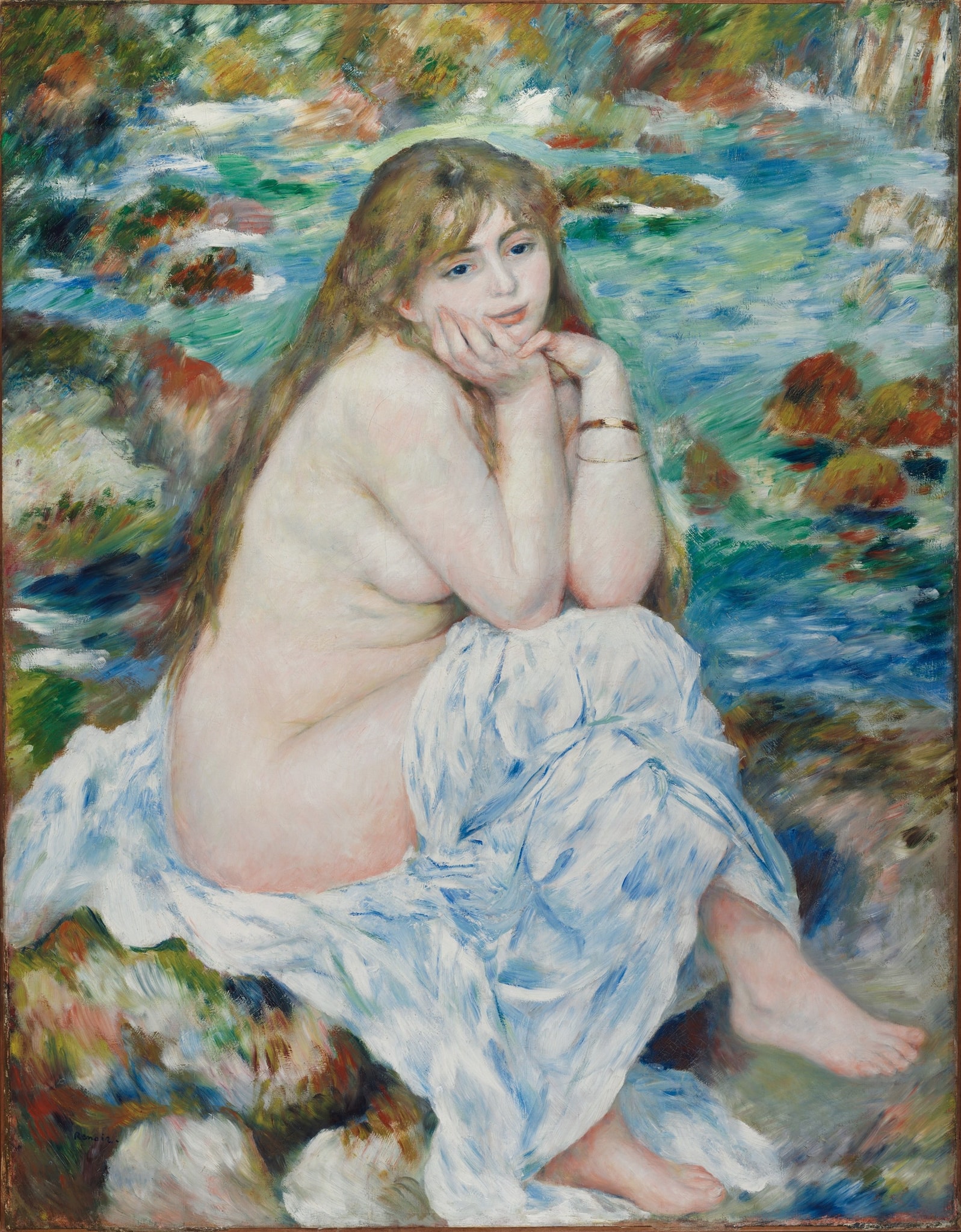
Renoir’s Seated Bather stages a quiet pause between bathing and reverie, fusing the model’s pearly flesh with the flicker of stream and stone. The white drapery pooled around her hips and the soft, frontal gaze convert a simple toilette into a modern Arcadia where body and landscape dissolve into light. In this late-Impressionist idiom, Renoir refines the nude as a timeless ideal felt through color and touch [1][2].

Fast Facts

Medium
Oil on canvas
Seated Bather by Pierre-Auguste Renoir (unknown year) featuring Flowing water/stream, White drapery (towel/veil), Rocks/stone perch, Gold bracelet

Click on any numbered symbol to learn more about its meaning

Meaning & Symbolism

Renoir stages the figure at the lip of a rushing stream, her elbows nestled on her knees, chin resting on laced fingers, and a narrow gold bracelet catching the light on her wrist. These specifics anchor the scene in the everyday language of the toilette even as the artist lifts it toward an antique register. The white drapery gathered around her thighs reads as both towel and classical veil; the rocks beneath her echo the traditional bather’s perch; and the cool, flickering eddies behind her supply the symbolic charge of water—renewal, sensuality, passage between states 3. Across the surface, short, loaded strokes thread blues and greens through water and stone, while warm, rosy tones breathe through the model’s shoulders, cheek, and knees. This interweaving makes contour a permeable frontier: the body seems to take on the atmosphere of the stream, and the stream in turn appears to pulse with bodily warmth. Renoir thus asserts that beauty is not a static outline but a sensation in flux, apprehended through touch-like color and light. That sensory thesis underwrites his broader classicizing ambition. Since the 1880s, Renoir had sought a new, modern classicism—figures with the weight and unity of ancient sculpture yet animated by Impressionist color 1. In Seated Bather, the rounded torso and heavy thigh are deliberately “sculptural,” but their authority comes from how the paint handles them: pearly half-tones knit the volumes; feathered transitions blur the hard edge where flesh meets river; and the white drapery, riffled with blue inflections, binds body to environment. The effect is to relocate the ideal from myth to nature. Instead of Venus unveiled by attendants, we encounter a woman who, after immersion, pauses to meet our gaze. The pose—chin on hands, elbows forward—suggests thought rather than display; the bracelet and loose hair keep her in the present tense. Renoir’s theme of the bather becomes a secular rite of renewal and pleasure without strain, a vision of harmony where the self is briefly continuous with the world 23. Why Seated Bather is important is that it condenses Renoir’s late project into a single, legible image: a reconciliation of opposites—mass and shimmer, permanence and fluidity, the classical and the everyday. The stream’s broken color asserts Impressionism’s authority as a language of perception, while the figure’s fullness asserts a countervailing pull toward permanence; together, they model a path that later moderns mined for their own neoclassical turns 14. At the same time, the painting preserves the controversies that shadowed Renoir’s nudes: to some, the swollen forms challenged contemporary ideals; to others, they proposed a humane, sensuous measure of beauty anchored in light and touch 1. Seen up close, the painting resolves that debate in practice: the body is not perfected by line but by the living weave of color, where drapery, skin, and water meet. In this crossing of elements, Renoir gives the nude back its world—and lets the world glow with the body’s warmth.

Explore Deeper with AI

Ask questions about Seated Bather

Popular questions:

Powered by AI • Get instant insights about this artwork

💬 Ask questions about this artwork!

Interpretations

Historical Context

Painted in 1914 at Les Collettes and deposited with Durand‑Ruel just as World War I began, Seated Bather belongs to Renoir’s late Cagnes period, when he pursued a consciously modern classicism under physical constraint from rheumatoid arthritis. The Art Institute’s catalogue identifies the model as probably Madeleine Bruno, who joined the household after Gabrielle Renard’s departure, marking a transition in Renoir’s studio circle and domestic rhythms. Dealers like Durand‑Ruel and admirers such as Matisse and Picasso were attentive to these late nudes, which Renoir conceived as timeless counterweights to a destabilized modern world. The picture’s everyday toilette cues, classical echoes, and sun‑struck setting compress biography, market networks, and ideology into a single, poised image of renewal 15.

Source: Art Institute of Chicago

Formal Analysis

Renoir fuses sculptural mass with an Impressionist surface: pearly half‑tones knit the torso, while short, loaded strokes thread blues and greens through water and stone, making contour a permeable frontier. This oscillation between volume and shimmer refuses the academic hard edge (Ingres) without relinquishing weight, producing a palpable, touch‑forward illusionism. The white drapery, riffled with cool inflections, acts as a chromatic hinge—cooling the warmth of flesh and binding it to the site’s aqueous light. The result is a pictorial economy in which body and environment co‑generate form; “truth” resides not in outline but in the optical‑tactile weave of color, a late Renoir hallmark that critics alternately praised as sensuous vitality and disparaged as softness 12.

Source: Art Institute of Chicago; Detroit Institute of Arts

Symbolic Reading

The bather at the rock by a stream is a self‑conscious classical sign: water carries the allegorical freight of purification, sensual renewal, and liminality. Renoir doubles this with the toilette—hair, drapery, and bracelet—translating Venus’s attendants into modern habits of grooming. In late work, the Provençal landscape functions as Arcadia, a timeless locus where figure and ground interpenetrate. Here, cool eddies and white cloth stage a threshold between states—wet/dry, nude/veiled, ideal/real. Such devices recall the academic “Venus at her bath” while redirecting myth toward lived sensation; the ideal is relocated from Olympus to a local stream, where light and touch make the classical newly contemporary 123.

Source: National Gallery (London); Art Institute of Chicago; Detroit Institute of Arts

Reception, Gender, and the Gaze

Contemporary responses exposed fault lines around the female nude: Apollinaire celebrated Renoir’s “fabulous, voluptuous nudes,” while Mary Cassatt condemned the “enormously fat red women with very small heads.” Such polemics hinged on gendered expectations of proportion, finish, and decorum. Renoir’s seated figure “pauses to meet our gaze,” yet the introspective pose—chin on hands, elbows forward—mitigates display, reframing eroticism as absorbed reverie. Recent scholarship reads these late bathers as sites where ideal beauty, desire, and domestic modernity collide: a male‑authored classicism that both perpetuates and complicates the gaze, proposing pleasure “without strain” while insisting on the body’s lived, tactile presence in nature 14.

Source: Art Institute of Chicago; Clark Art Institute

Influence and Modern Classicism

Renoir’s reconciliation of mass and shimmer—classical gravitas animated by Impressionist color—offered a template for post‑WWI modern classicism. Picasso’s neoclassical bathers, among others, mine this solution: weighty anatomies softened by atmospheric handling. By relocating the ideal from myth to nature, Renoir made classicism a matter of painting’s sensuous means rather than iconography—contour softened, volume breathed by half‑tones, figure fused to landscape. This procedural classicism proved durable, enabling later artists to toggle between permanence and flux without abandoning modern perception. Seated Bather succinctly stages that method: a legible, monumental nude whose authority issues from the method of painting itself, not from narrative or academic citation 14.

Source: Art Institute of Chicago; Clark Art Institute

Related Themes

About Pierre-Auguste Renoir

Pierre-Auguste Renoir (1841–1919) emerged from craft training into the avant-garde circle around Monet, Sisley, and Bazille, helping to found Impressionism. In the mid‑1870s he focused on outdoor scenes of modern leisure in and around Montmartre, using dappled light and high-chroma color to capture transient sensations [1][2][5].
View all works by Pierre-Auguste Renoir

More by Pierre-Auguste Renoir
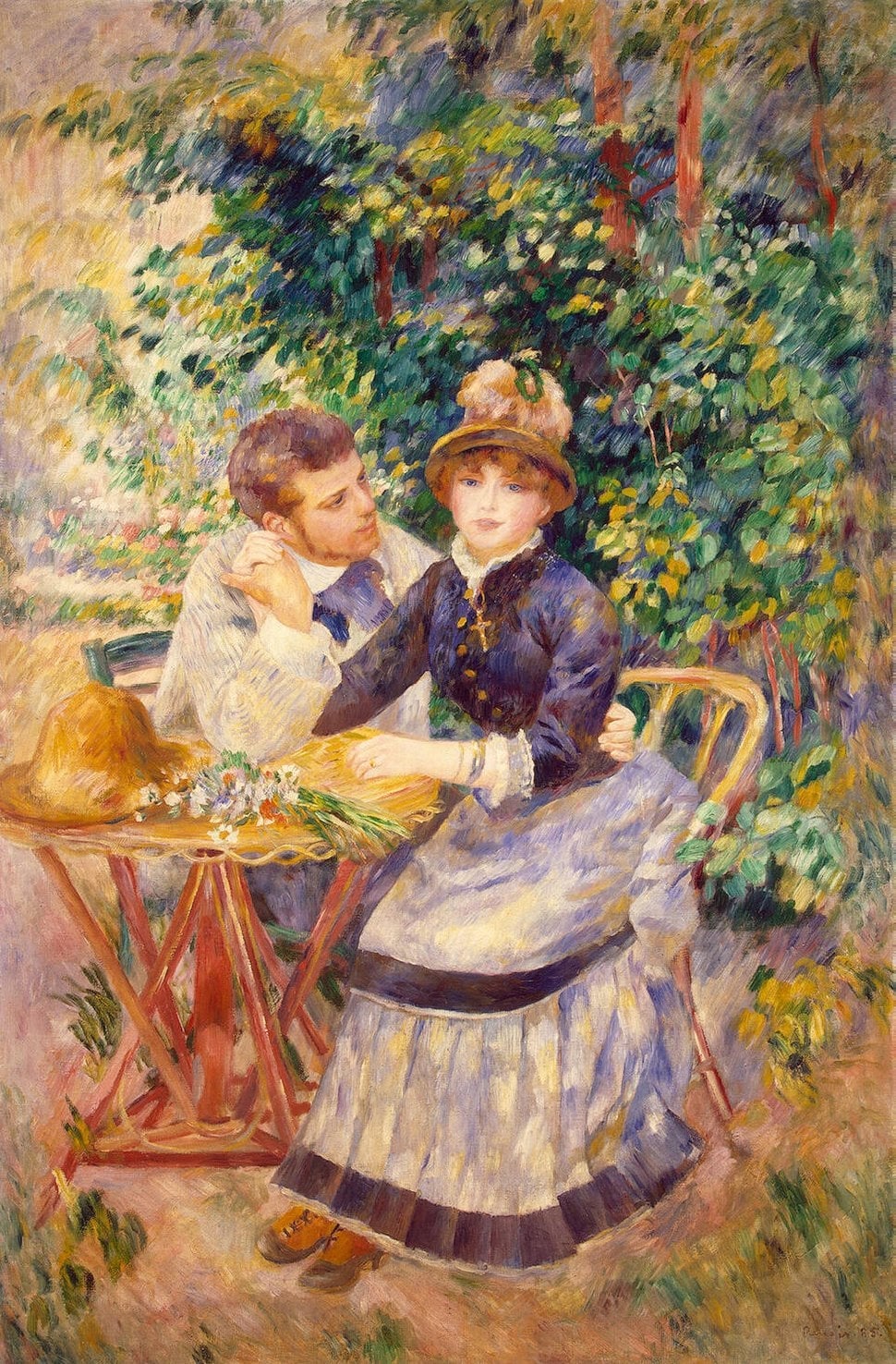
In the Garden by Pierre-Auguste Renoir

In the Garden

Pierre-Auguste Renoir (1885)

In the Garden presents a charged pause in modern leisure: a young couple at a café table under a living arbor of leaves. Their lightly clasped hands and the bouquet on the tabletop signal courtship, while her calm, front-facing gaze checks his lean. Renoir’s flickering brushwork fuses figures and foliage, rendering love as a <strong>transitory, luminous sensation</strong> <sup>[1]</sup><sup>[3]</sup>.
Young Girls at the Piano by Pierre-Auguste Renoir

Young Girls at the Piano

Pierre-Auguste Renoir (1892)

Renoir’s Young Girls at the Piano turns a quiet lesson into a scene of <strong>attunement</strong> and <strong>bourgeois grace</strong>. Two adolescents—one seated at the keys, the other leaning to guide the score—embody harmony between discipline and delight, rendered in Renoir’s late, <strong>luminous</strong> touch <sup>[1]</sup><sup>[2]</sup>.

Pont Neuf Paris by Pierre-Auguste Renoir

Pont Neuf Paris

Pierre-Auguste Renoir (1872)

In Pont Neuf Paris, Pierre-Auguste Renoir turns the oldest bridge in Paris into a stage where <strong>light</strong> and <strong>movement</strong> bind a city back together. From a high perch, he orchestrates crowds, carriages, gas lamps, the rippling Seine, and a fluttering <strong>tricolor</strong> so that everyday bustle reads as civic grace <sup>[1]</sup>.

The Large Bathers by Pierre-Auguste Renoir

The Large Bathers

Pierre-Auguste Renoir (1884–1887)

Pierre-Auguste Renoir’s The Large Bathers unites modern bodies with a pastoral grove to stage an <strong>Arcadian ideal</strong>. Three monumental nudes form interlocking curves and triangles while two background figures splash and groom, fusing <strong>sensual warmth</strong> with <strong>classical order</strong> <sup>[1]</sup><sup>[2]</sup>.

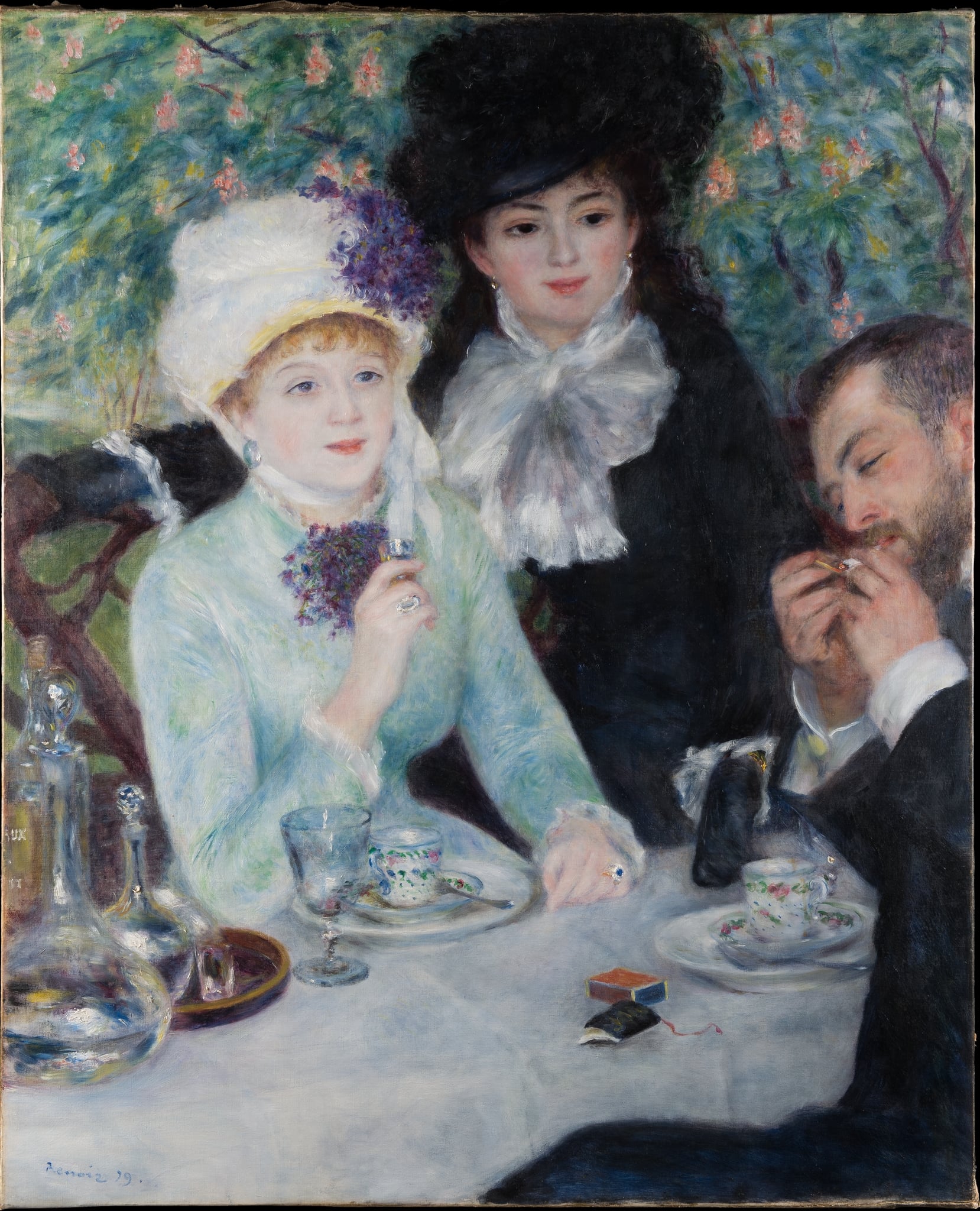
After the Luncheon by Pierre-Auguste Renoir

After the Luncheon

Pierre-Auguste Renoir (1879)

After the Luncheon crystallizes a <strong>suspended instant</strong> of Parisian leisure: coffee finished, glasses dappled with light, and a cigarette just being lit. Renoir’s <strong>shimmering brushwork</strong> and the trellised spring foliage turn the scene into a tapestry of conviviality where time briefly pauses.
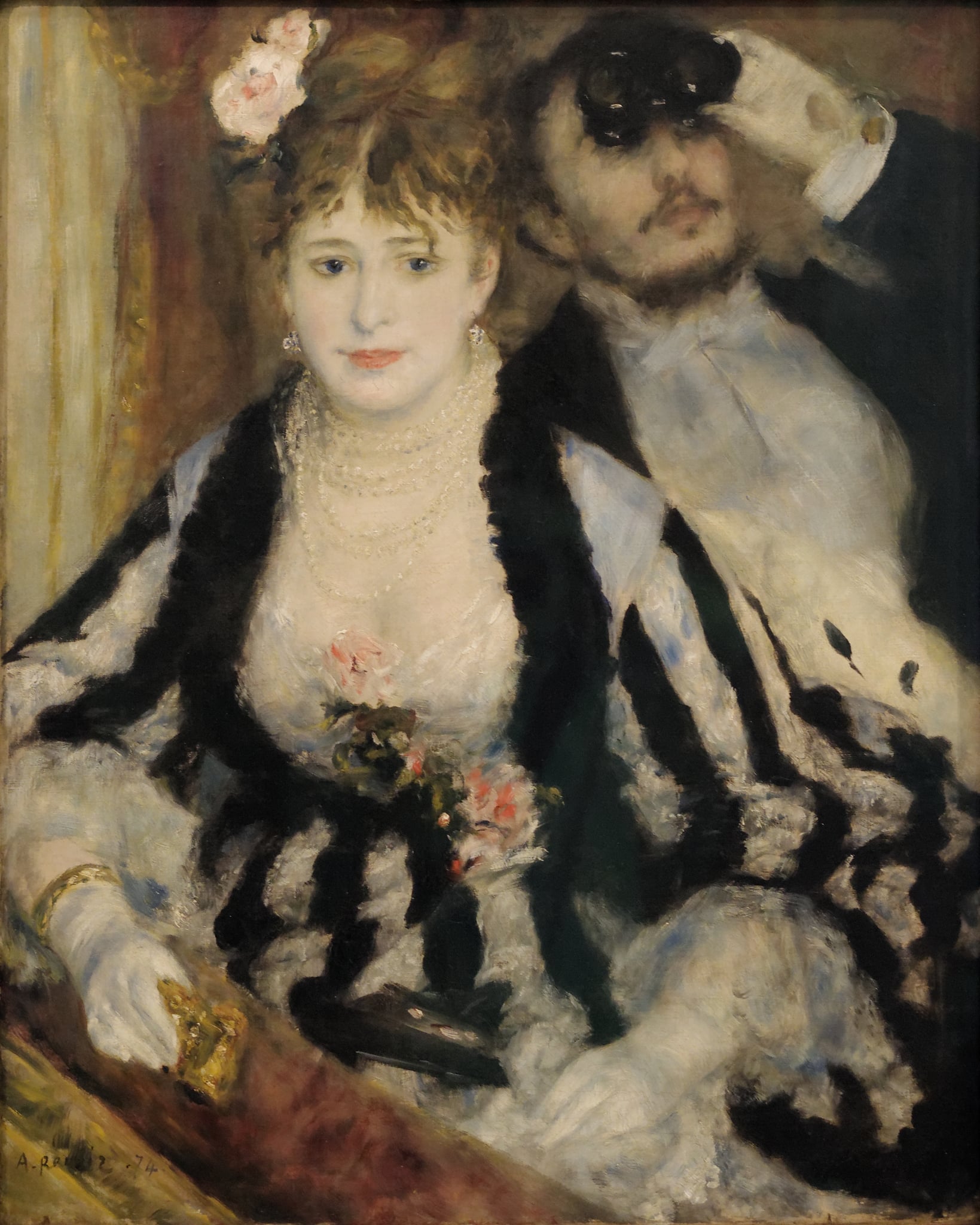
The Loge by Pierre-Auguste Renoir

The Loge

Pierre-Auguste Renoir (1874)

Renoir’s The Loge (1874) turns an opera box into a <strong>stage of looking</strong>, where a woman meets our gaze while her companion scans the crowd through binoculars. The painting’s <strong>frame-within-a-frame</strong> and glittering fashion make modern Parisian leisure both alluring and self-conscious, turning spectators into spectacles <sup>[1]</sup><sup>[2]</sup>.