The Cliff, Etretat

by Claude Monet

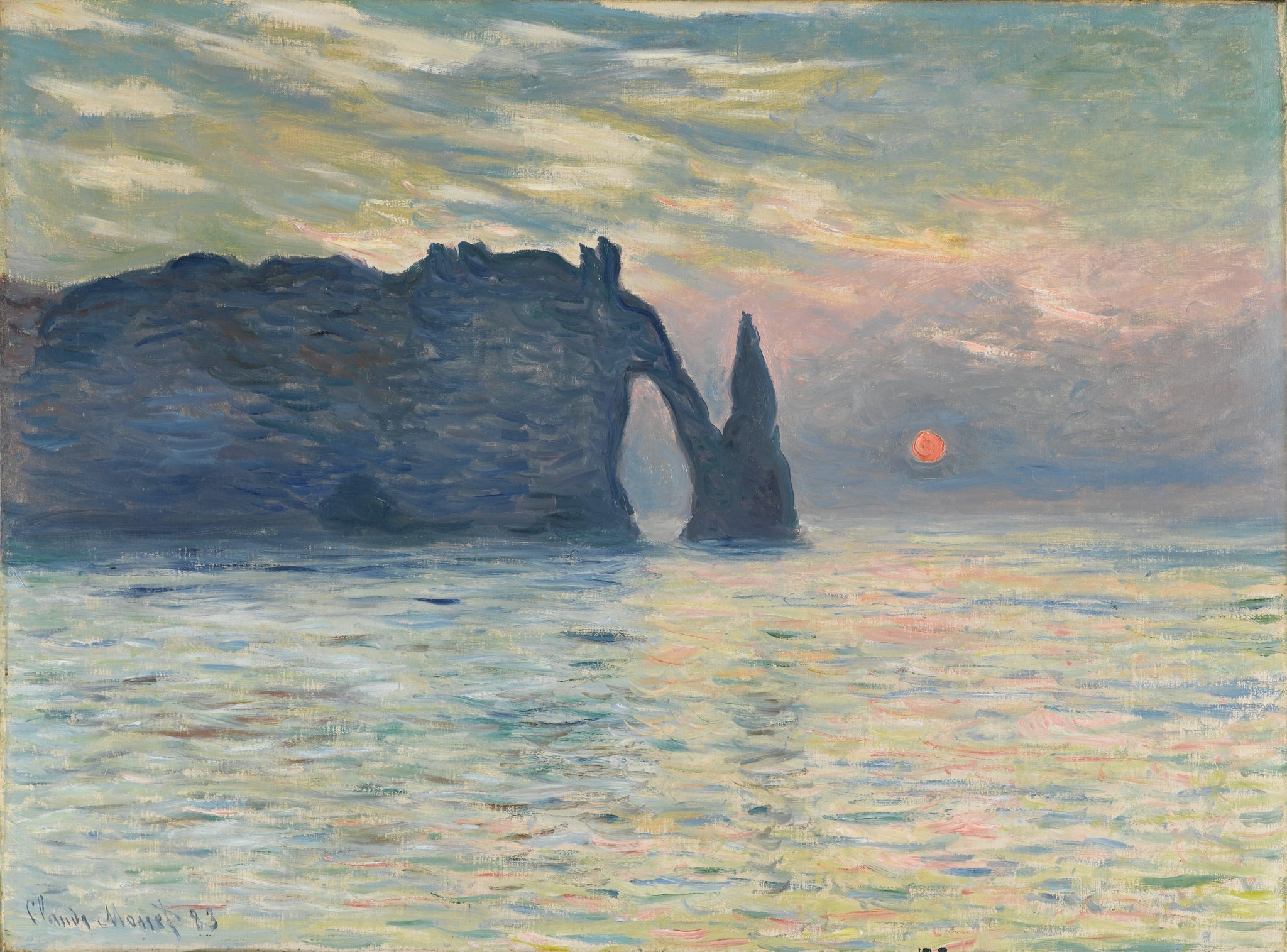
The Cliff, Etretat stages a confrontation between permanence and flux: the dark mass of the arch and needle holds like a monument while ripples of coral, green, and blue light skate across the water. The low solar disk fixes the instant, and Monet’s fractured strokes make the sea and sky feel like time itself turning toward dusk. The arch reads as a threshold—an opening to the unknown that organizes vision and meaning [1][2].

Fast Facts

Year
1882–1883
Medium
Oil on canvas
Dimensions
60.5 × 81.8 cm
Location
North Carolina Museum of Art, Raleigh
The Cliff, Etretat by Claude Monet (1882–1883) featuring Cliff Mass (Silhouette), Sea Arch (Portal), Needle Stack (Sentinel), Solar Disk

Click on any numbered symbol to learn more about its meaning

Meaning & Symbolism

Read from left to right, the composition sets a heavy, blue-black cliff against a waterplane woven from small, separate touches—lemon, mint, lavender, and coral broken into quivering stripes. The arch’s opening is the only clear passage through the mass; next to it, the freestanding needle rises like a sentinel. At the horizon, a tight ember-red sun burns in a mauve haze, and its color shards scatter across the sea in quick lateral strokes. These choices are declarative, not descriptive: Monet asserts that the enduring forms of geology are graspable only through their encounter with fugitive light. The cliff is purposefully simplified into a single, weighty silhouette, while the water is multiplied into countless touches; together they articulate permanence versus flux as the painting’s central proposition 24. The arch functions as a portal—a literal gap but also a conceptual hinge where rock yields to atmosphere. Viewers’ sightlines are pulled through that aperture toward the orange disk and the beyond, converting a famous coastal “Gate” (celebrated in 19th‑century accounts) into a modern emblem of liminality: we witness not scenery but passage—of day into night, of solid into shimmer, of motif into moment 5. Technique is meaning here. Monet’s wet-over-wet mixtures around the sun blur violet and rose, letting the air seem to cool as it nears the horizon, while the water’s brisk, parallel strokes register tiny discontinuities—ripples as units of time. This is the serial Monet in embryo: the same motif pursued across shifting effects, with multiple canvases rotated as conditions changed, a practice well attested in his Étretat campaigns 2. In this canvas, that method becomes visible as sensation: the sea does not reflect one color but many micro-moments. The unusually explicit solar disk made the scene forensically dateable to late afternoon on February 5, 1883, anchoring the lyricism in measurable astronomy and tide—evidence that Monet’s ephemerality is rigorously observed, not invented 31. The work also speaks to modern spectatorship. Étretat’s arches and paths were already a curated spectacle of nature within a culture of tourism; Monet accepts the iconic view, then destabilizes it by letting light unmoor the cliff’s substance. In doing so, he recasts a postcard vista as a study of vision’s limits: we cannot hold the moment, only register its transient radiance. That is why the painting feels “seen in a breath”—a paradox of planning and immediacy that defines Impressionism’s mature ambition 267. The meaning of The Cliff, Etretat thus lies in its refusal of emblematic heroism in favor of quiet, time-bound grandeur. The arch’s darkness is not menace but measure; it shows how much the world can change around a fixed form. And why The Cliff, Etretat is important is that it condenses Monet’s broader project—seriality, observational rigor, modernity’s staged views—into a single, lucid proposition: nature’s endurance is legible only through light’s ceaseless change 246.

Explore Deeper with AI

Ask questions about The Cliff, Etretat

Popular questions:

Powered by AI • Get instant insights about this artwork

💬 Ask questions about this artwork!

Interpretations

Social-Historical Context: Tourism, Spectacle, and the ‘Grand View’

Étretat’s arches were already a celebrated sightseeing circuit by the 1880s, codified by guidebooks and anecdotes, so Monet’s composition begins with a pre-framed view. Rather than reject this spectacle, he complicates it: the canonical “Gate” dissolves under unstable color, and a postcard vantage becomes an inquiry into how modern spectatorship mediates nature. Robert L. Herbert situates Monet’s Normandy in the rise of leisure travel and image-circulation, where certain vistas hardened into clichés; Monet answers by letting atmosphere erode the cliché in real time. In this sense, the painting stages a gentle resistance to commodified nature: the place remains iconic, but the experience is durational, contingent, and personal, not a fixed souvenir 61.

Source: Robert L. Herbert; North Carolina Museum of Art

Seriality as Meaning: Repetition, Control, and Loss

Across his Étretat campaigns Monet pursued the motif under shifting conditions, a practice Steven Z. Levine reads as modern seriality: repetition that both seeks mastery over the ungraspable and admits obsession’s ambivalence. The NCMA sunset compresses that logic into one canvas—its broken strokes index micro-changes, while the cliff’s silhouette asserts control. Yet the tiny sun and trembling sea hint that control is provisional, always slipping. The series method turns “subject” into a moving target, making meaning accrue across returns rather than within a single depiction. Here, viewers sense the tension between the painter’s will (the dark, declarative mass) and the world’s flux (scintillating water), a dialectic at the heart of Monet’s serial ambition 73.

Source: Steven Z. Levine; The Metropolitan Museum of Art

Optical Forensics: Dating a Sunset, Testing Impressionism

This canvas’s unusually explicit solar disk let researchers triangulate sunset angle, tides, and weather to pinpoint a likely moment—February 5, 1883, c. 4:53 p.m. local mean time. Such astronomical dating anchors Impressionism’s ephemerality in measurable phenomena, countering the myth that Monet simply invented effects. The finding aligns with his documented winter stay and letters noting tide and weather constraints. Technique and science meet: wet-over-wet violets and roses around the sun correspond to near-horizon scattering, while lateral water strokes track ripples as time-units. The result is not romantic license but rigorously observed optics, a painted experiment legible to both connoisseurship and empirical analysis 92.

Source: Sky & Telescope; North Carolina Museum of Art (Learn)

Formal Analysis: Silhouette, Facture, and Edge Hierarchies

Monet organizes vision via an emphatic silhouette (cliff/arch) against a field of particulate strokes (sea/sky). The hard contour acts like a compositional armature, while the water’s horizontal, unblended touches produce optical mixture and lateral shimmer. Edges are hierarchical: the cliff’s crispness binds the mass; the sun’s softened halo—wet-over-wet—lets air feel denser near the horizon. This oscillation between planar weight and broken facture converts geology into a perceptual event. The strategy pushes mimesis toward abstraction without abandoning reference: simplified masses read as “cliff,” yet their meaning lies in how paint behaves. Form and method fuse, turning facture into a grammar of time 23.

Source: NCMA (Learn); The Metropolitan Museum of Art

Labor and Risk: Working the Edge of Weather and Tide

Étretat in winter was a site of logistical difficulty—steep paths, slick chalk, unpredictable tides, and bitter wind. Monet’s letters and contemporaries describe his rotating multiple canvases as light shifted, a practice that required caching supplies and sprinting between vantage points. The NCMA painting’s exacting alignment of arch, needle, and sun implies a precise perch timed to a narrow tidal window. Such conditions make the painting a record of work as much as vision: endurance against cold, speed against dusk, and the bodily calibration of stance, easel, and brush to hold a horizon line in gusts. The image’s calm belies a strenuous choreography of making 24.

Source: NCMA (Learn); Clark Art Institute

Icon and Threshold: The ‘Gate’ Recast

Nineteenth-century writers, including Maupassant, called Étretat’s arches Gates, fixing them as icons of passage. Monet exploits that notoriety yet redefines the gate’s function: not a scenic emblem but a perceptual threshold. Sightlines thread through the aperture toward the sun, and the cliff’s dark mass becomes a measure of how air and water unmake solidity. Compared with other Étretat canvases (e.g., Manneporte views), this painting intensifies the threshold by miniaturizing the sun into a tight optical lure, making the gate a conduit between material and atmospheric registers. The familiar landmark thus shifts from topographic celebrity to a modern emblem of liminality—seeing as crossing 53.

Source: Musée d’Orsay; The Metropolitan Museum of Art

Related Themes

About Claude Monet

Claude Monet (1840–1926) led Impressionism’s pursuit of open-air painting and optical immediacy, especially during his Argenteuil years focused on modern leisure and light. He later developed serial studies of changing conditions, culminating in the Water Lilies cycle [2].
View all works by Claude Monet

More by Claude Monet

Haystacks Series by Claude Monet | Light, Time & Atmosphere by Claude Monet

Haystacks Series by Claude Monet | Light, Time & Atmosphere

Claude Monet

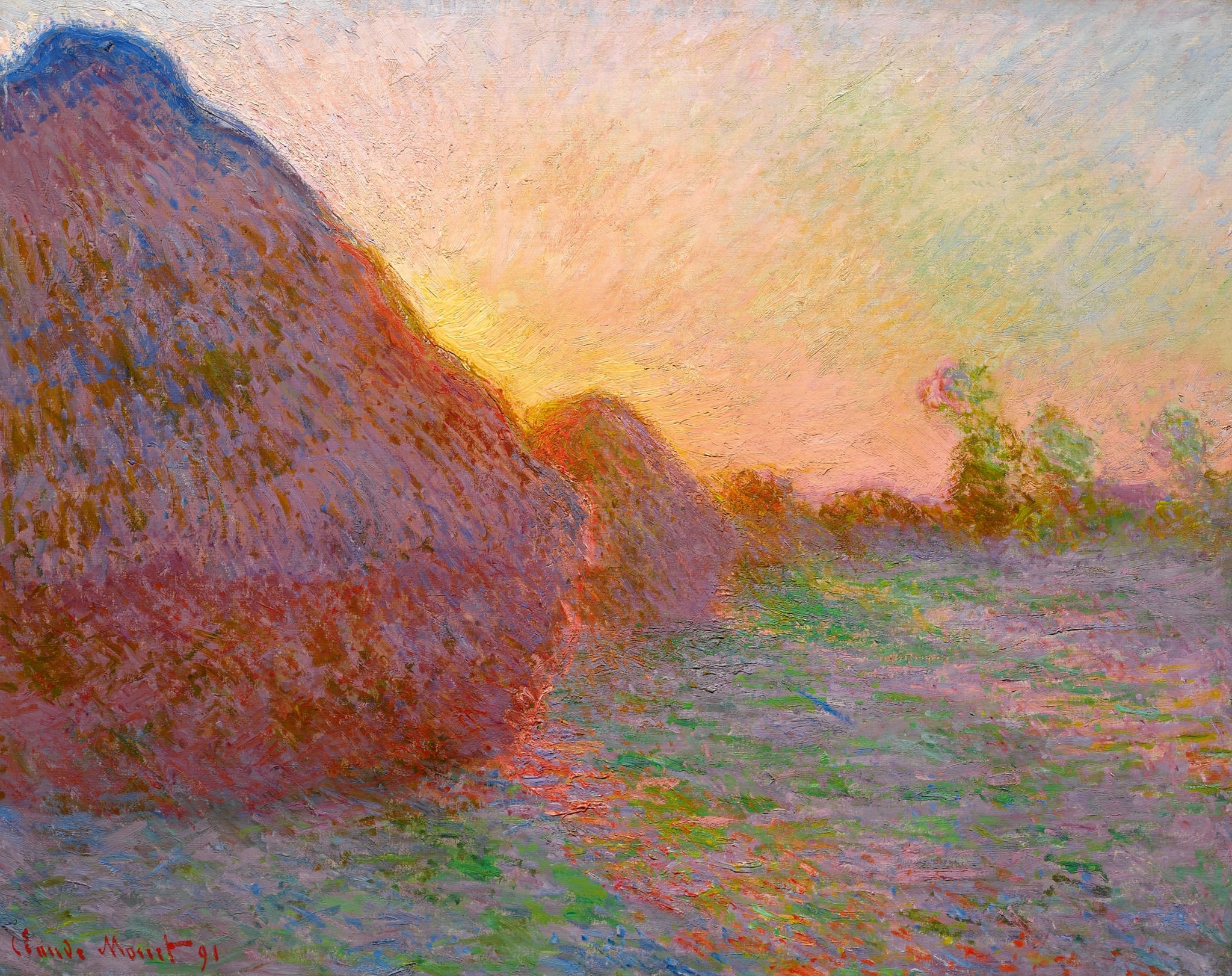
Claude Monet’s <strong>Haystacks Series</strong> transforms a routine rural subject into an inquiry into <strong>light, time, and perception</strong>. In this sunset view, the stacks swell at the left while the sun burns through the gap, making the field shimmer with <strong>apricot, lilac, and blue</strong> vibrations.
The Artist's Garden at Giverny by Claude Monet

The Artist's Garden at Giverny

Claude Monet (1900)

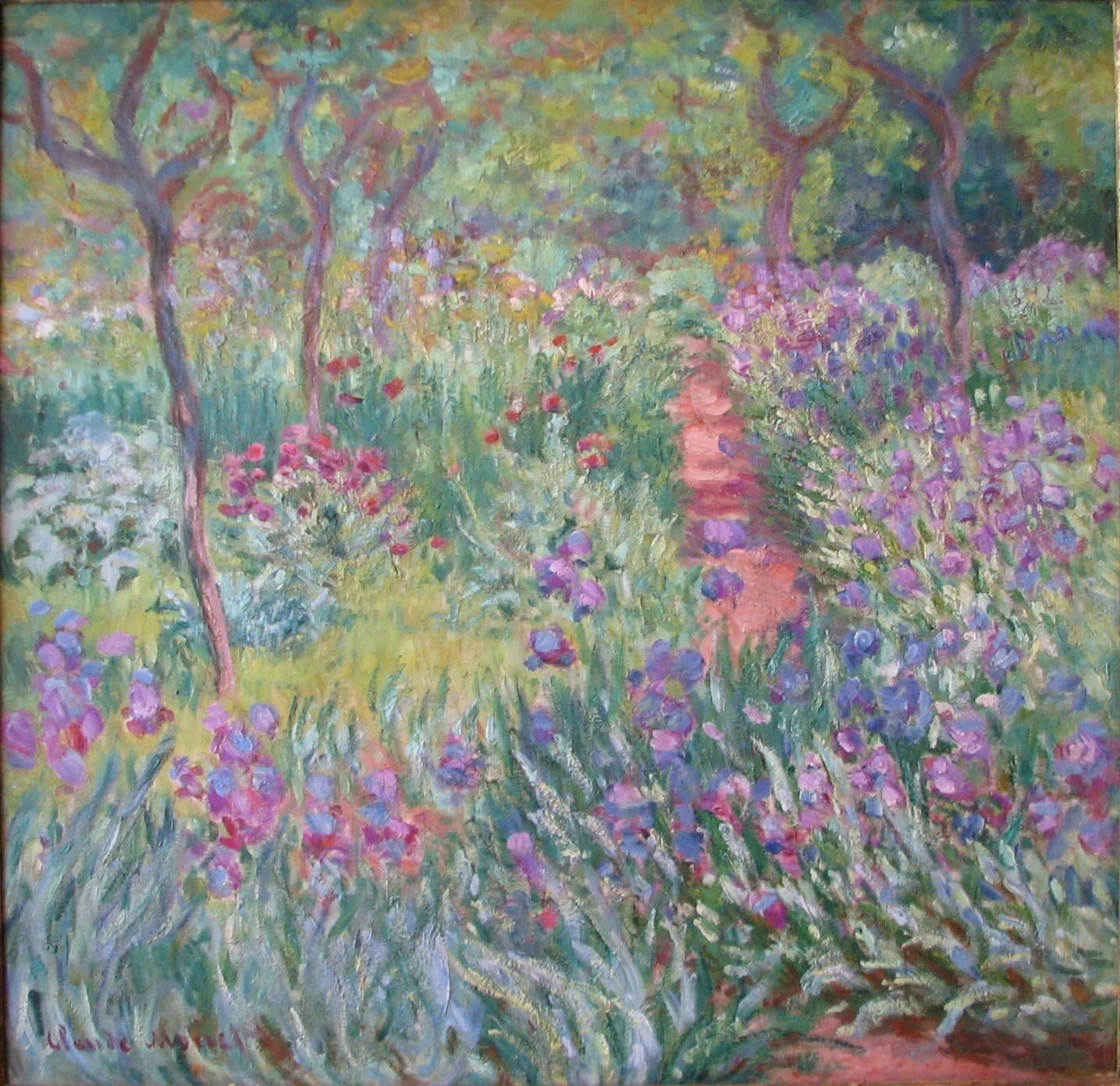
In The Artist's Garden at Giverny, Claude Monet turns his cultivated Clos Normand into a field of living color, where bands of violet <strong>irises</strong> surge toward a narrow, rose‑colored path. Broken, flickering strokes let greens, purples, and pinks mix optically so that light seems to tremble across the scene, while lilac‑toned tree trunks rhythmically guide the gaze inward <sup>[1]</sup><sup>[3]</sup>.
The Water Lily Pond by Claude Monet

The Water Lily Pond

Claude Monet (1899)

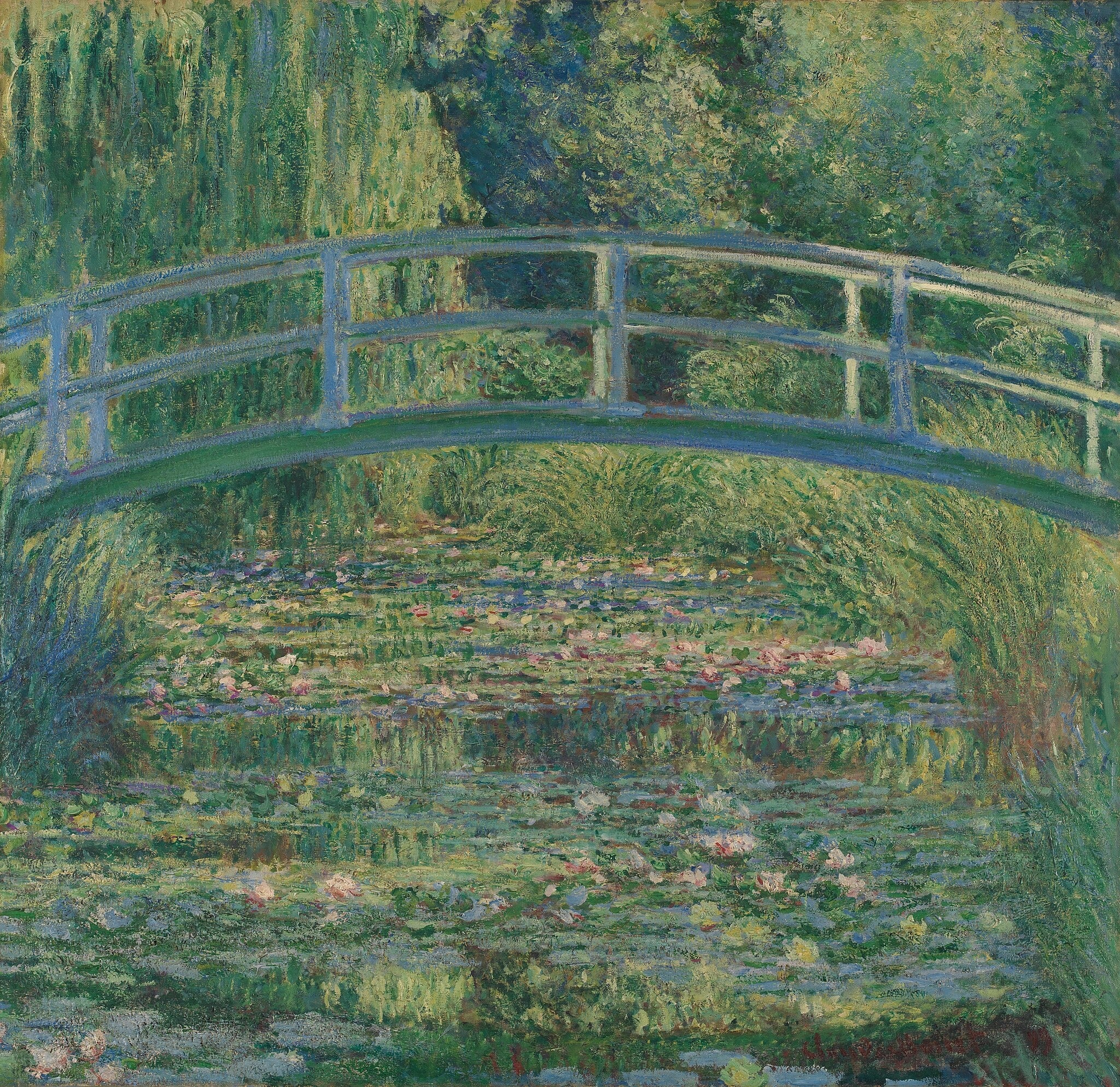
Claude Monet’s The Water Lily Pond transforms a designed garden into a theater of <strong>perception and reflection</strong>. The pale, arched <strong>Japanese bridge</strong> hovers over a surface where lilies, reeds, and mirrored willow fronds dissolve boundaries between water and sky, proposing <strong>seeing itself</strong> as the subject <sup>[1]</sup><sup>[3]</sup>.

Waterloo Bridge, Sunlight Effect by Claude Monet

Waterloo Bridge, Sunlight Effect

Claude Monet (1903 (begun 1900))

Claude Monet’s Waterloo Bridge, Sunlight Effect renders London as a <strong>lilac-blue atmosphere</strong> where form yields to light. The bridge’s stone arches persist as anchors, yet the span dissolves into mist while <strong>flecks of lemon and ember</strong> signal modern traffic crossing a city made weightless <sup>[1]</sup><sup>[2]</sup>. Vertical hints of chimneys haunt the distance, binding industry to beauty as the Thames shimmers with the same notes as the sky <sup>[1]</sup><sup>[3]</sup>.

Morning on the Seine (series) by Claude Monet

Morning on the Seine (series)

Claude Monet (1897)

Claude Monet’s Morning on the Seine (series) turns dawn into an inquiry about <strong>perception</strong> and <strong>time</strong>. In this canvas, the left bank’s shadowed foliage dissolves into lavender mist while a pale radiance opens at right, fusing sky and water into a single, reflective field <sup>[1]</sup><sup>[2]</sup>.

Woman with a Parasol by Claude Monet

Woman with a Parasol

Claude Monet (1875)

Claude Monet’s Woman with a Parasol fixes a breezy hillside instant in high, shifting light, setting a figure beneath a <strong>green parasol</strong> against a vast, vibrating sky. The low vantage and <strong>broken brushwork</strong> merge dress, clouds, and grasses into one atmosphere, while a child at the rise anchors depth and intimacy <sup>[1]</sup>. It is a manifesto of <strong>plein-air</strong> perception—painting the sensation of air in motion rather than the contours of things <sup>[2]</sup>.