San Giorgio Maggiore by Twilight

by Claude Monet

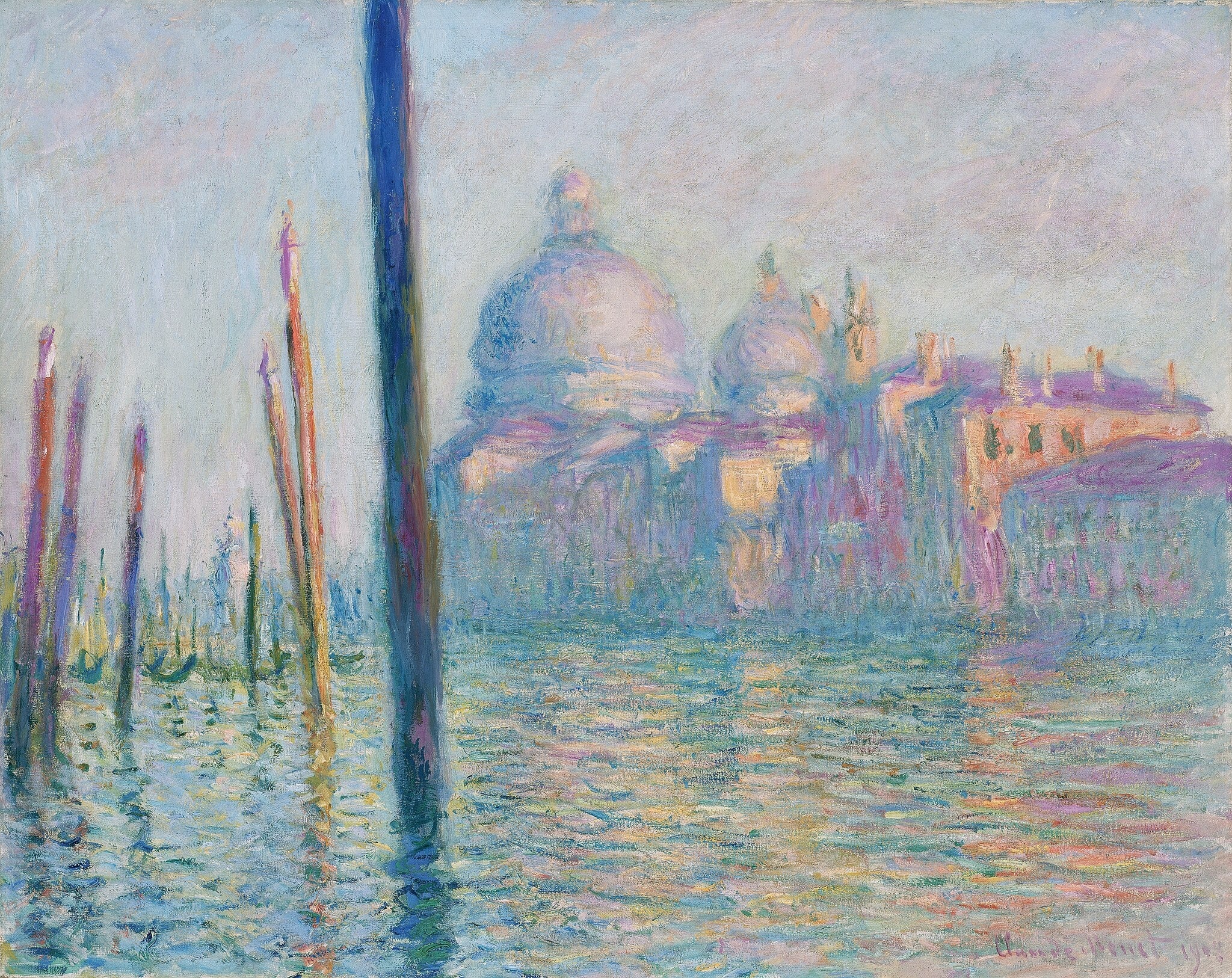
Claude Monet’s San Giorgio Maggiore by Twilight turns Venice into a luminous threshold where stone, air, and water merge. The dark, melting silhouette of the church and its vertical reflection anchor a field of apricot–rose–violet light that drifts into cool turquoise, making permanence feel provisional [1]. Monet’s subject is not the monument, but the enveloppe of atmosphere that momentarily creates it [4].

Fast Facts

Year
1908
Medium
Oil on canvas
Dimensions
65.2 × 92.4 cm
Location
Amgueddfa Cymru – National Museum Wales (National Museum Cardiff), Gallery 16
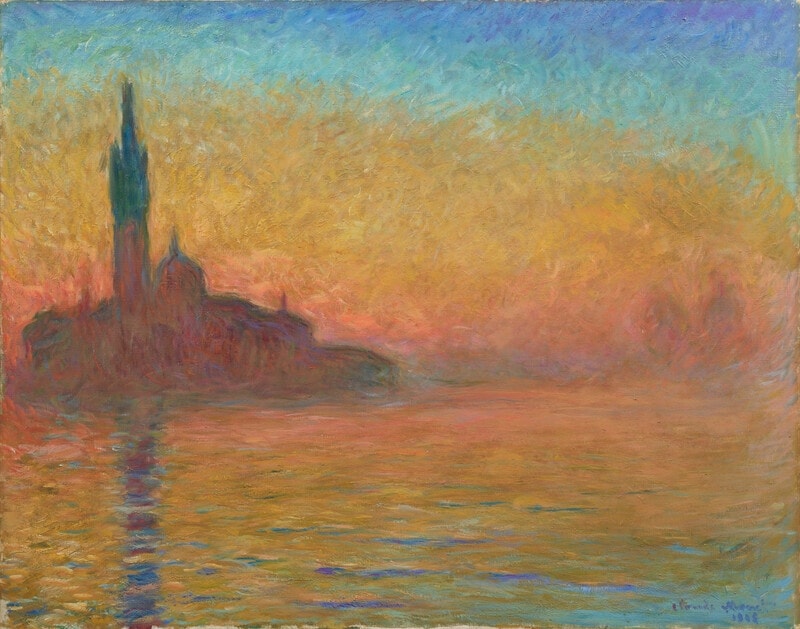
San Giorgio Maggiore by Twilight by Claude Monet (1908) featuring Silhouette of San Giorgio Maggiore, Campanile’s vertical reflection, Twilight color gradient, Rippled horizontal bands in the lagoon

Click on any numbered symbol to learn more about its meaning

Meaning & Symbolism

Monet composes the canvas around two counterforces: the near‑black mass of San Giorgio Maggiore at left and the saturated, horizontally banded lagoon that absorbs and re‑emits the sky. The campanile’s reflection—a wavering, vertical wick—threads downward through ripples that smear violet into orange, asserting that even the most emphatic vertical can only survive here by entering water’s grammar of movement. The church is legible only as a silhouette; its Palladian detail is surrendered to a feathered skin of paint. This is deliberate. As Richard Thomson argues, Monet uses architecture as an armature for the real subject, which is the enveloppe of light and air; Venice lets him “do architecture without doing its features,” so endurance appears only within flux 4. In this picture, permanence is a negotiated fiction: the island seems to materialize from mist at dusk and could just as quickly recede. Color stages that argument. Monet lays a crepuscular arc—apricot and rose condensing into violet—beneath a top band of cooler turquoise, then lets the lagoon mirror it in rippled strata. The mirror is not a copy; it is a transformative medium that breaks the sky’s gradations into tactile strokes, turning sight into touch. The emptied right half allows faint cues—haze hints of Santa Maria della Salute and the Grand Canal—to surface and sink again, place information subordinated to atmosphere 1. The composition’s upper/lower polarity—dark architectural silhouette above a field of more autonomous, liquid brushwork—enacts a quiet modernism: representation on top, near‑abstraction below, a laboratory of surface that critics see as anticipating later pictorial autonomy 3. In short, the painting argues that vision is time‑bound and ecological: stone becomes climate; sacred mass becomes weather. Historical circumstance deepens the stakes. Monet, sixty‑eight, painted intensively in Venice from October to December 1908, later finishing canvases at Giverny for the 1912 Bernheim‑Jeune exhibition; he reputedly called the city “too beautiful to be painted,” a confession that frames the series as an encounter with excess, not simply spectacle 12. Curators now read the Venice works as meditations on interdependence—air, water, and architecture fusing into a single atmospheric system—rather than views of monuments 3. The crepuscular hour and depopulated quays inflect the image with late‑style melancholy, yet the tone is not elegy so much as liminality: day tips into night, stone into light, memory into present sensation. Within that threshold, San Giorgio Maggiore ceases to be the painting’s subject and becomes its instrument, a vessel through which perception composes the world. The result is an ethical claim about looking: truth resides less in the durability of things than in the honesty of how they appear, change, and vanish. That is why San Giorgio Maggiore by Twilight endures—because it shows Venice not as a city of stones but as a radiant event, continuously made by light, tide, and time 134.

Explore Deeper with AI

Ask questions about San Giorgio Maggiore by Twilight

Popular questions:

Powered by AI • Get instant insights about this artwork

💬 Ask questions about this artwork!

Interpretations

Ecocritical Reading: Venice as Atmospheric System

Rather than a city of stones, Venice becomes a climate-machine in Monet’s hands: a site where air, water, and architecture operate as a single, co‑dependent enveloppe. The lagoon doesn’t mirror so much as metabolize the sky, creating an image of feedback between built and natural forces. This ecocritical lens reframes the painting as a study of interdependence—tidal water softens stone; stone stabilizes the scene for perception; color circulates between media like energy in an ecosystem. The result is a model of place defined by process rather than objects, anticipating contemporary environmental aesthetics that treat cities as hybrid ecologies as much as cultural artifacts 123.

Source: Brooklyn Museum; Rizzoli Electa (Monet and Venice)

Medium Reflexivity: The Mirror That Paints

Monet turns reflection into a theory of painting. The lagoon’s “mirror” is explicitly “not a copy,” but a transformative medium: verticals fray into eddies; gradations fragment into strokes. In other words, water performs what the brush does—translate optical continuity into tactile facture. This is medium reflexivity: the picture shows how seeing becomes making, recoding vision as touch. By threading the campanile’s reflection like a wavering wick, Monet demonstrates that any rigid form must submit to the grammar of movement that both water and paint enforce. The viewer thus reads the surface as a workshop of perception, aligning with pedagogical accounts of Monet’s reflective method 16.

Source: National Gallery of Art (US) teacher resource; National Museum Wales

Architecture as Armature: Palladio Dissolved

Following Richard Thomson, the basilica functions as armature—a sign of human order that structures the picture—while its features are deliberately evacuated into atmosphere. Venice lets Monet “do architecture without doing its features,” a strategy that turns Palladian authority into a silhouette that sponsors chromatic experimentation. The serial San Giorgio variants make this clear: the building stays, the enveloppe changes, yielding a comparative matrix where endurance is staged against flux. This is an ethics of looking that privileges appearance over essence, the perceivable over the presumed permanent, and it links the Venice series to earlier cycles (Rouen, London) where architecture is both subject and foil 1348.

Source: Richard Thomson, Monet & Architecture; National Museum Wales; Christie’s series notes

Late Style and Affective Time

Monet at sixty‑eight worked up these canvases through 1912, in the shadow of personal loss; critics read the crepuscular settings and depopulated views as charged with melancholy and temporal drift. But the mood is less elegy than liminality: day crossing into night, memory into sensation. The staging of architectural solidity over liquid bands becomes a metaphor for aging vision—the need for anchors amid perceptual flux. This late‑style temporality is historical too: the 1912 exhibition gathered 29 works into a serial tempo, asking viewers to compare and re‑compare changing conditions, turning duration into form. The painting’s pathos thus lies in how it holds time, not merely in what it depicts 2510.

Source: Financial Times; Brooklyn Museum; Smithsonian Magazine

Toward Abstraction: The Water’s Autonomy

The canvas bifurcates: a legible silhouette above and an increasingly autonomous field below. Recent scholarship highlights how the water passages behave like self‑directed surfaces, not just reflections—anticipating modernist concerns with flatness and the canvas as an arena of marks. André Dombrowski’s analysis, echoed in new catalog essays, reads Venice as Monet’s laboratory for pictorial autonomy, where representation coexists with procedures edging toward abstraction. The lagoon’s stratified bands neither describe nor deny reality; they extract its rhythms into paint, making the lower half a proto‑abstract register within a recognizably figurative whole 3.

Source: Rizzoli Electa (Monet and Venice; essays by Dombrowski et al.)

Related Themes

About Claude Monet

Claude Monet (1840–1926) led Impressionism’s pursuit of open-air painting and optical immediacy, especially during his Argenteuil years focused on modern leisure and light. He later developed serial studies of changing conditions, culminating in the Water Lilies cycle [2].
View all works by Claude Monet

More by Claude Monet

Haystacks Series by Claude Monet | Light, Time & Atmosphere by Claude Monet

Haystacks Series by Claude Monet | Light, Time & Atmosphere

Claude Monet

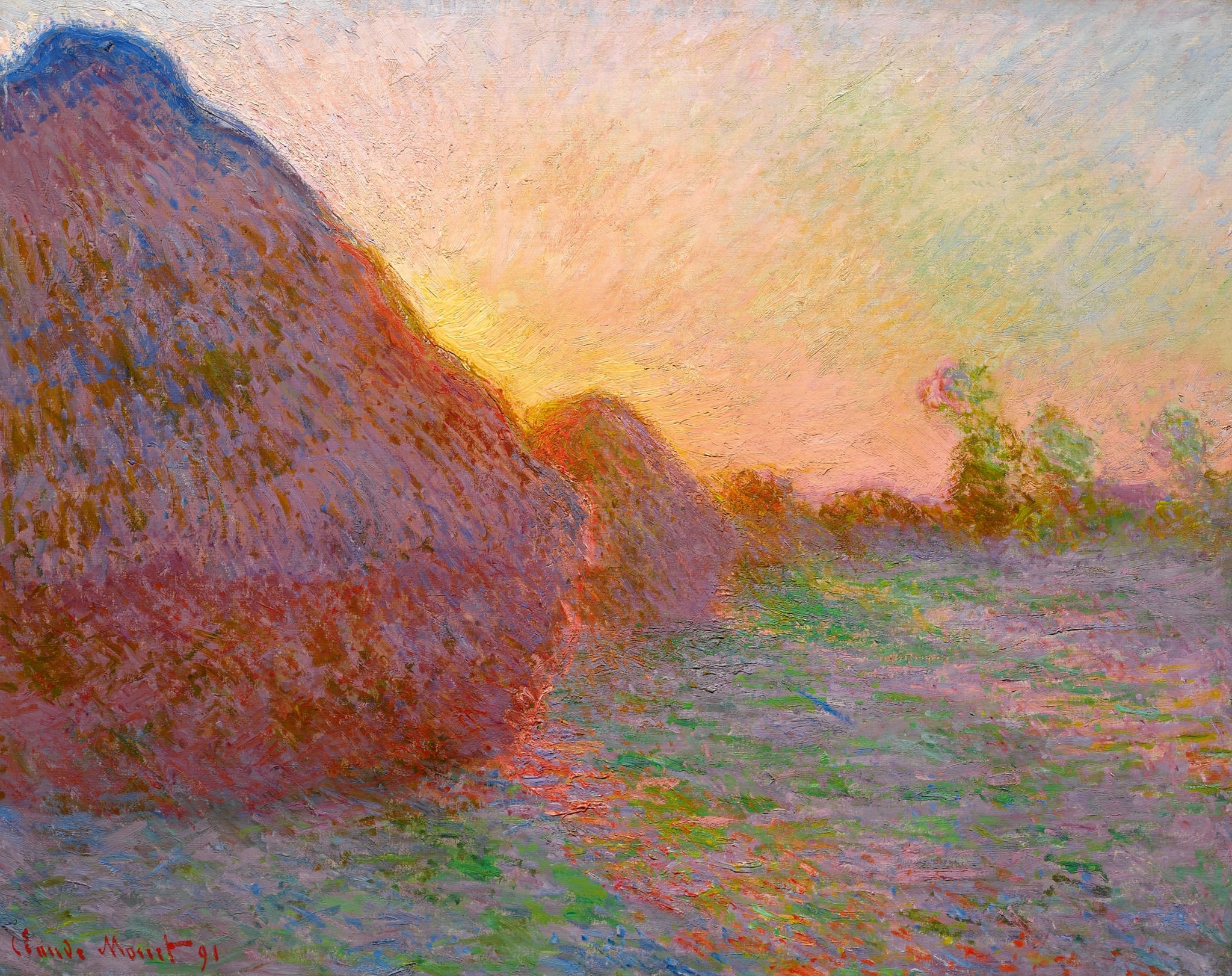
Claude Monet’s <strong>Haystacks Series</strong> transforms a routine rural subject into an inquiry into <strong>light, time, and perception</strong>. In this sunset view, the stacks swell at the left while the sun burns through the gap, making the field shimmer with <strong>apricot, lilac, and blue</strong> vibrations.
The Artist's Garden at Giverny by Claude Monet

The Artist's Garden at Giverny

Claude Monet (1900)

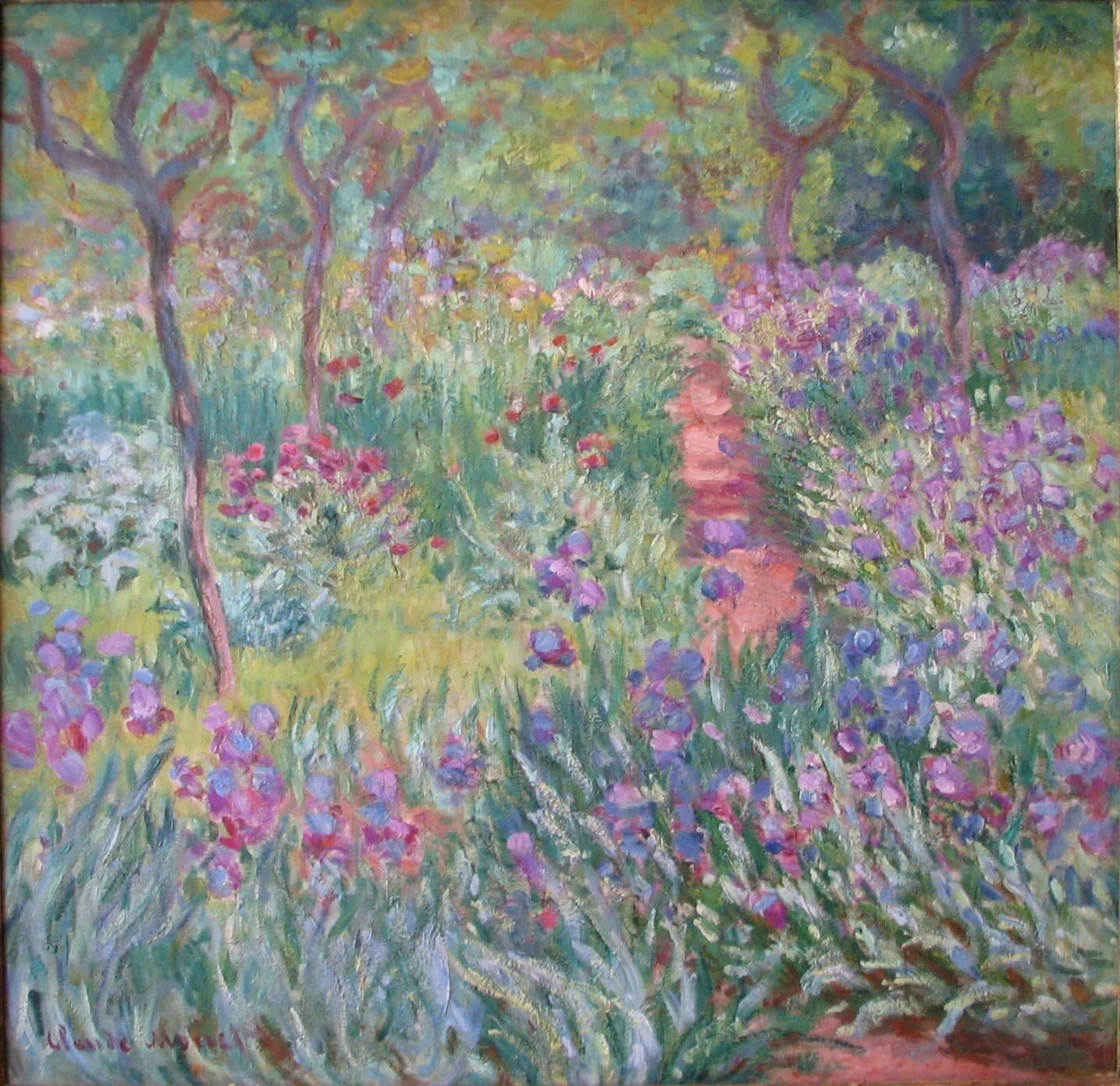
In The Artist's Garden at Giverny, Claude Monet turns his cultivated Clos Normand into a field of living color, where bands of violet <strong>irises</strong> surge toward a narrow, rose‑colored path. Broken, flickering strokes let greens, purples, and pinks mix optically so that light seems to tremble across the scene, while lilac‑toned tree trunks rhythmically guide the gaze inward <sup>[1]</sup><sup>[3]</sup>.
The Water Lily Pond by Claude Monet

The Water Lily Pond

Claude Monet (1899)

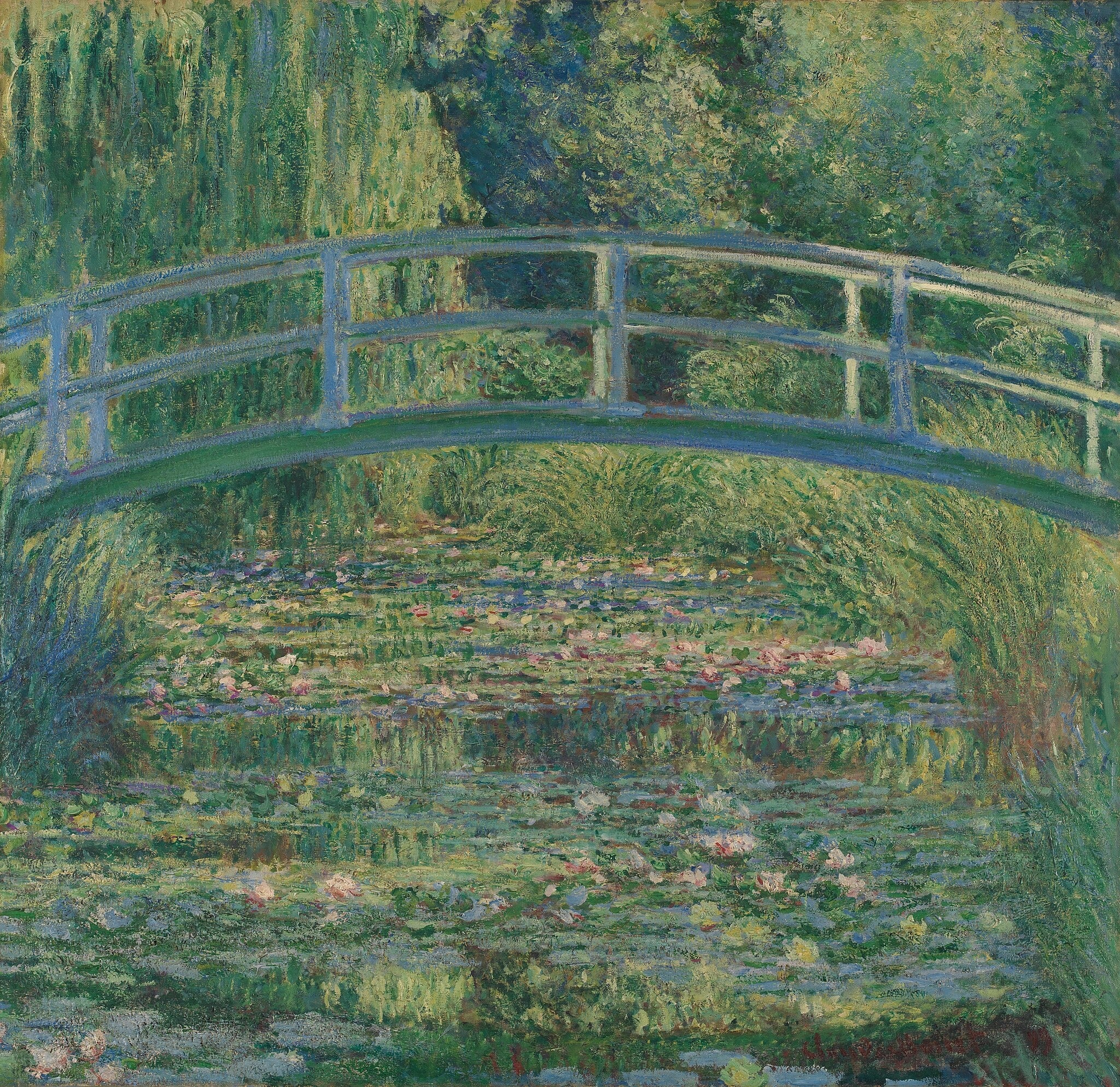
Claude Monet’s The Water Lily Pond transforms a designed garden into a theater of <strong>perception and reflection</strong>. The pale, arched <strong>Japanese bridge</strong> hovers over a surface where lilies, reeds, and mirrored willow fronds dissolve boundaries between water and sky, proposing <strong>seeing itself</strong> as the subject <sup>[1]</sup><sup>[3]</sup>.

Waterloo Bridge, Sunlight Effect by Claude Monet

Waterloo Bridge, Sunlight Effect

Claude Monet (1903 (begun 1900))

Claude Monet’s Waterloo Bridge, Sunlight Effect renders London as a <strong>lilac-blue atmosphere</strong> where form yields to light. The bridge’s stone arches persist as anchors, yet the span dissolves into mist while <strong>flecks of lemon and ember</strong> signal modern traffic crossing a city made weightless <sup>[1]</sup><sup>[2]</sup>. Vertical hints of chimneys haunt the distance, binding industry to beauty as the Thames shimmers with the same notes as the sky <sup>[1]</sup><sup>[3]</sup>.

Morning on the Seine (series) by Claude Monet

Morning on the Seine (series)

Claude Monet (1897)

Claude Monet’s Morning on the Seine (series) turns dawn into an inquiry about <strong>perception</strong> and <strong>time</strong>. In this canvas, the left bank’s shadowed foliage dissolves into lavender mist while a pale radiance opens at right, fusing sky and water into a single, reflective field <sup>[1]</sup><sup>[2]</sup>.

Woman with a Parasol by Claude Monet

Woman with a Parasol

Claude Monet (1875)

Claude Monet’s Woman with a Parasol fixes a breezy hillside instant in high, shifting light, setting a figure beneath a <strong>green parasol</strong> against a vast, vibrating sky. The low vantage and <strong>broken brushwork</strong> merge dress, clouds, and grasses into one atmosphere, while a child at the rise anchors depth and intimacy <sup>[1]</sup>. It is a manifesto of <strong>plein-air</strong> perception—painting the sensation of air in motion rather than the contours of things <sup>[2]</sup>.