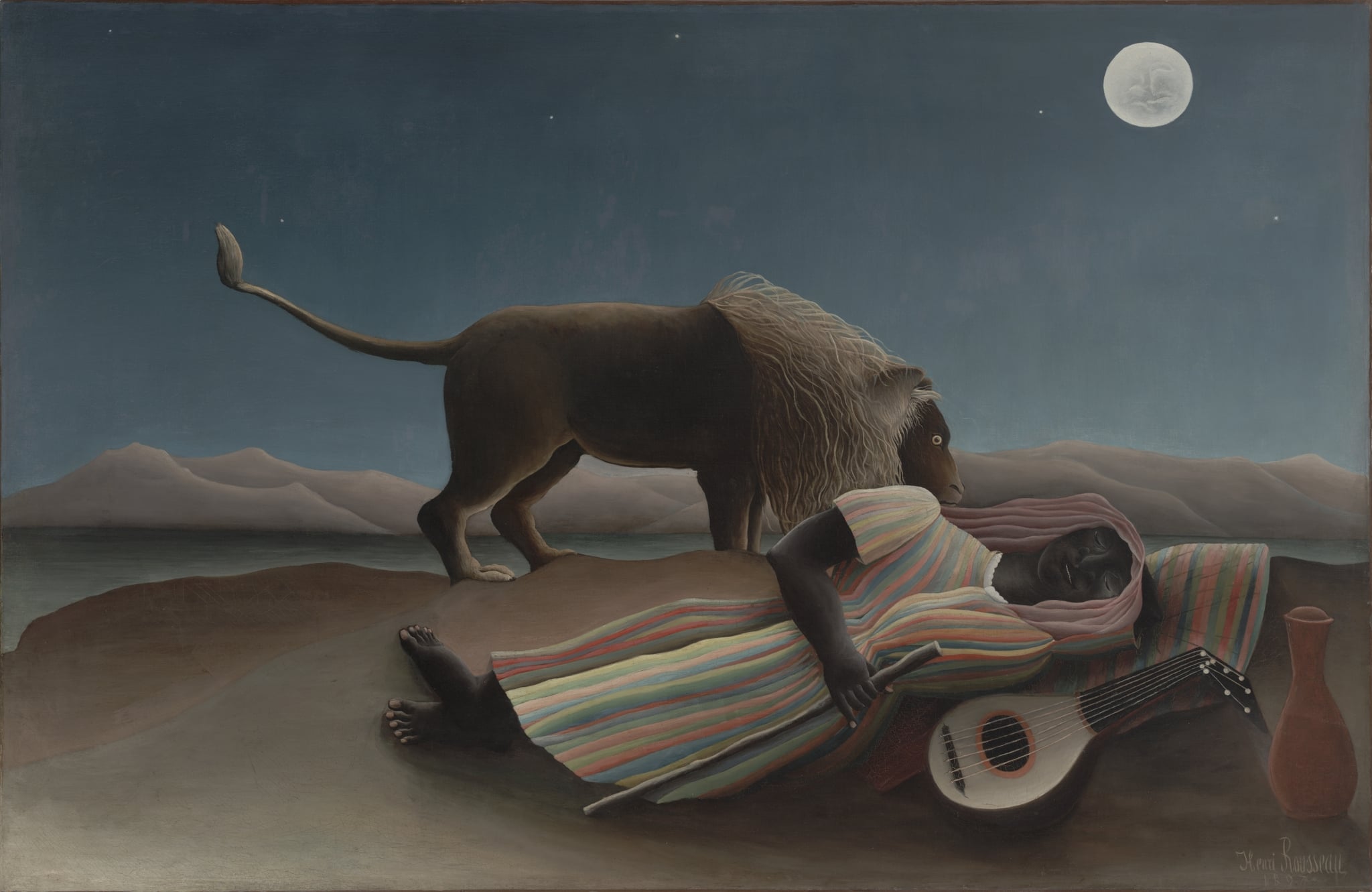
The Sleeping Gypsy

by Henri Rousseau

Under a cold moon, a traveler sleeps in a striped robe as a lion pauses to sniff, not strike—an image of danger held in suspension and imagination as protection. Rousseau’s polished surfaces, flattened distance, and toy-like clarity turn the desert into a dream stage where art (the mandolin) and life (the water jar) keep silent vigil [1][2].

Fast Facts

Year
1897
Medium
Oil on canvas
Dimensions
129.5 x 200.7 cm
Location
The Museum of Modern Art (MoMA), New York
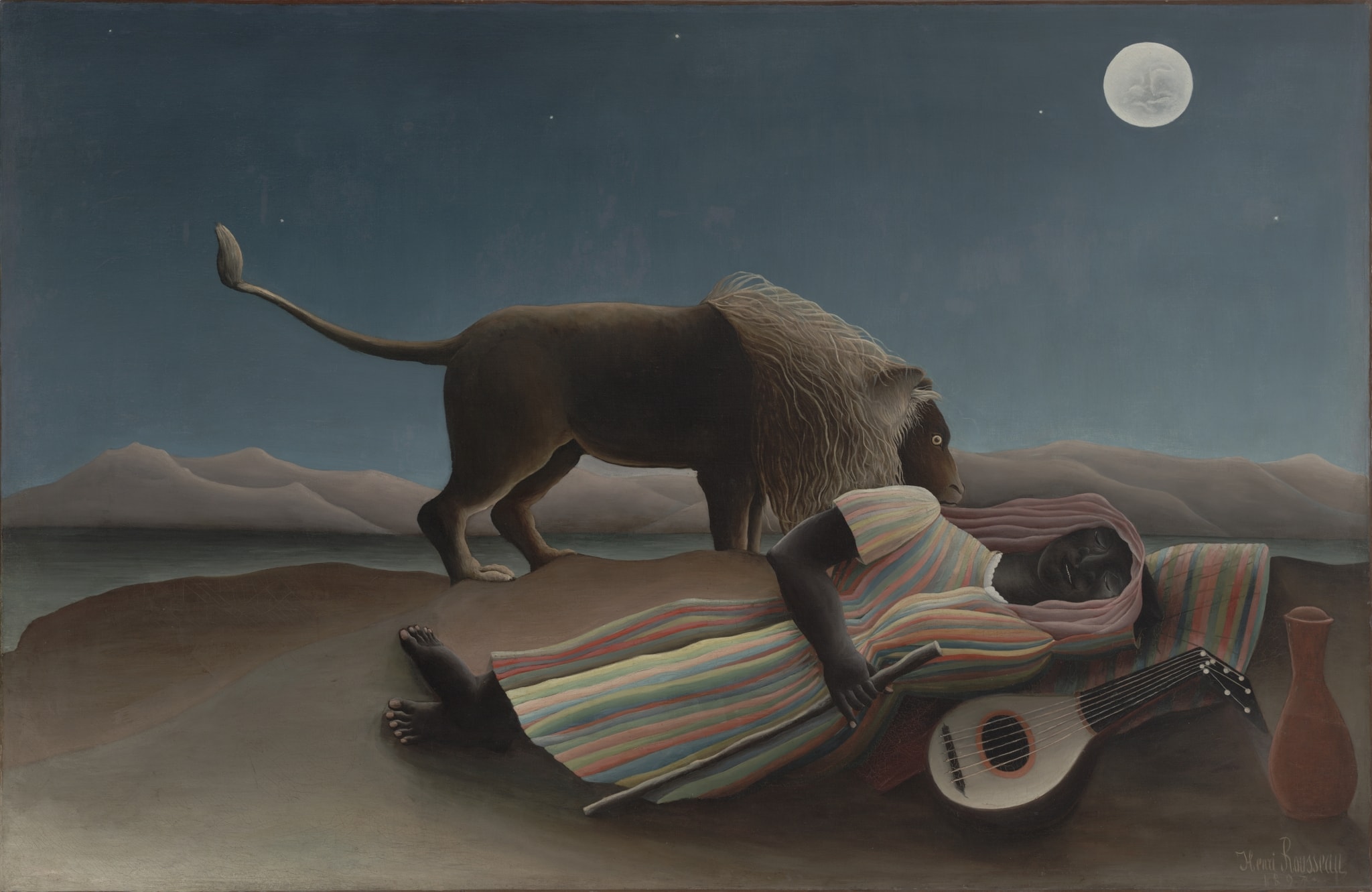
The Sleeping Gypsy by Henri Rousseau (1897) featuring Lion, Striped robe and pillow, Mandolin, Water jar

Click on any numbered symbol to learn more about its meaning

Meaning & Symbolism

Rousseau constructs a world where peril pauses. The lion’s round, unblinking eye hovers inches above the sleeper’s covered head, its paws planted and tail lifted, yet the animal does not pounce; instead, its snout merely tests the air. That hesitation is the painting’s thesis: a state of suspended threat in which the unconscious asserts dominion over the external world. The figure’s striped robe and matching pillow create a chromatic enclave—bands of warm coral, mint, and sand—set against the cool, nearly uniform blue of the sky. This enclave functions like a psychic boundary, reinforced by the sleeper’s staff diagonally braced across the torso and by the mandolin and earthen jar aligned at the threshold of the body. Rousseau himself described a “wandering … mandolin player” asleep as a lion “picks up her scent yet does not devour her,” under a moonlight “very poetic,” confirming the picture’s intentional poise between danger and safekeeping 16. The glassy river strip and paper‑cut mountains behind the lion flatten into simple silhouettes, eliminating depth cues and with them the ordinary logic of cause and effect; in this evacuated space, the moon’s white disc—almost a mask—becomes a witness to the truce, not a driver of nocturnal appetite 13. The painting translates this dream‑logic into form. Rousseau’s enamel‑smooth surfaces, simplified volumes, and outline‑driven modeling refuse academic naturalism, creating a visionary clarity that reads as symbolic rather than descriptive 23. The lion’s carefully combed mane and the instrument’s crisp strings receive the same meticulous attention, equating predator and art as parallel powers—one of nature, one of culture. Yet culture quietly steadies the scene: the mandolin lies intact, its soundboard turned to the viewer, while the jar remains upright and full; they silently assert continuity, sustenance, and memory. Jean Cocteau later suggested the lion and landscape might be the woman’s dream—an interpretation that aligns with the painting’s sealed stillness and with the way the desert functions as an “elsewhere,” a purified stage for emblematic encounter 43. Read this way, the lion becomes a guardian as much as a menace, an image of nature’s awe that the dream can host without catastrophe. Why The Sleeping Gypsy is important is that it compresses modernism’s wager: that radical simplification can carry metaphysical weight. Rousseau, self‑taught and long dismissed as a “primitive,” places a marginalized traveler at the center of a cosmic balance, using stylization to access inner truth rather than external reportage 2. The still water, the three pinprick stars, and the moon’s chalky face lock time; the world waits for the sleeper to wake, but the painting refuses narrative release. In that refusal it anticipates Surrealism’s suspended narratives and symbolic dreamscapes, while retaining the Symbolist desire for a picture to be an allegory of inward life 23. The result is not an anecdote of a near‑attack; it is an assertion that the imagination can broker peace—however provisional—between human fragility and the vast, indifferent night 14.

Explore Deeper with AI

Ask questions about The Sleeping Gypsy

Popular questions:

Powered by AI • Get instant insights about this artwork

💬 Ask questions about this artwork!

Interpretations

Colonial Imagination and the Racialized Sleeper (Symbolic Reading)

Rousseau’s own phrasing—“a wandering Negress, a mandolin player” asleep under “very poetic” moonlight—frames the figure through 19th‑century racialized and exoticizing optics, positioning her as a spectacle of otherness in a purified “elsewhere.” The desert and lion derive not from travel but from Parisian display cultures (zoos, botanical gardens, world’s‑fair imaginaries), a common pipeline by which European artists synthesized the “exotic” into dream tableaux 56. Read this way, the painting activates the pleasures and problems of colonial fantasy: the scene centers an itinerant, racialized subject yet sterilizes danger into emblem, allowing the European viewer to contemplate nature’s awe at safe remove. The work is thus a double allegory—of inward life and of the period’s apparatus for imagining cultural difference 256.

Source: MoMA (Rousseau letter; curatorial audio); Encyclopaedia Britannica

Flatness as Metaphysics (Formal Analysis)

The picture’s enamel-smooth surfaces, strict contours, and compressed planes reject academic perspectival space, pursuing what critics call a sign-system of forms. Depth cues dissolve into a banded ground and paper‑cut mountains; every element—the lion’s mane, taut mandolin strings, jar’s oval—is equally articulated, flattening hierarchy and redirecting attention to symbolic equivalences 13. This is not naïveté as deficiency but programmatic simplification: Rousseau’s “visionary clarity” recasts mimesis as emblem, allowing metaphysical content to ride on contour and chromatic enclosure rather than illusionistic space 123. In this register, stillness is a formal outcome (frontalized, planar structure) and a philosophical one (arrested time), aligning the work with Symbolist aims and anticipating Surrealism’s charged, suspended mise‑en‑scène 23.

Source: MoMA; Larousse; Encyclopaedia Britannica

Psycho-Dreaming and Guardianship (Psychological Interpretation)

Jean Cocteau’s early reading suggested that the lion and desert might be the sleeper’s dream, proposing guardianship rather than predation. The painting’s locked temporality—moon as mask, stars like pins, water still as glass—supports a oneiric suspension where instinct is present but domesticated by dream-law 4. Within this psychic economy, the lion doubles as the sleeper’s companion-image: an avatar of untamed potency the mind can host without catastrophe. Such logic reaches beyond anecdote toward a proto‑Surrealist state of latency, where narrative is withheld and desire/anxiety circulate as crisp forms. Rousseau’s own description of “very poetic” moonlight affirms that atmospheric poise is the subject, not a backdrop 46.

Source: Jean Cocteau (via TheArticle); Rousseau letter (MoMA Highlights)

Objects at the Threshold (Iconographic Analysis)

The mandolin and water jar function as guardian attributes. Placed at the body’s boundary, they articulate a liminal bar where culture (music, memory) and sustenance (water, survival) stabilize the scene. Rousseau’s letter identifies the instrument as a mandolin—correcting the frequent “lute” mislabel—and underscores the jar as drinking water, tying the objects to concrete needs within an emblematic field 16. Their intactness (stringed oval unbroken; jar upright and full) counters the lion’s potential violence with signs of continuity and replenishment. Formally, their ovals echo moon and muzzle, binding human craft to nature’s cycle; symbolically, they propose that art and care can hold the line against nocturnal threat, even if only for a suspended interval 16.

Source: MoMA (object record; Rousseau letter)

Outsider to Vanguard: Authorship and Authenticity (Historical Context)

Long mocked as a “primitive,” Rousseau was later championed by avant‑gardists (Picasso, Matisse, Delaunay), who prized his radical simplification and emblematic clarity 2. The Sleeping Gypsy’s reception includes a 1920s authenticity controversy, a symptom of how its unclassifiable style unsettled period norms; scholarship now firmly affirms Rousseau’s authorship 7. Its provenance—from early private custody to Kahnweiler and the Quinn collection, and ultimately MoMA—tracks the painting’s shift from curiosity to modernist touchstone 127. This trajectory recodes its meaning: what once read as naïve becomes programmatic modernism, a wager that distilled forms can bear metaphysical weight. Authorship here is not an index of academic training but of a new, vanguard license to invent 127.

Source: MoMA (provenance); TheArtStory; Encyclopaedia Britannica

Ecology of Truce: The Sublime Without Attack (Environmental Reading)

The desert’s aridity, river’s glass strip, and lunar glare compose a minimal ecology where energies are present but conserved. The lion’s scenting rather than striking marks a recalibration of predator–prey dynamics into emblematic coexistence, a sublime pitched not to terror but to poised awe 36. This atmosphere reframes “human vs. nature” as a temporary armistice, aligning with Symbolist serenity and projecting a proto‑Surrealist quietude that suspends appetite and time alike 23. The scene’s spareness—cool sky, schematic reliefs—renders environment as stage, yet the stage asserts agency: climate and terrain script behavior as much as psychology does. Rousseau’s “very poetic” moonlight is thus ecological as well as lyrical, governing the truce that holds the world in breath‑held balance 236.

Source: Larousse; Encyclopaedia Britannica; Rousseau letter (MoMA Highlights)

Related Themes

About Henri Rousseau

Henri Rousseau (1844–1910) was a self‑taught French painter and former customs clerk whose precise contours, polished surfaces, and imagined ‘exotic’ scenes drew on zoos, botanical gardens, and illustrated sources rather than travel. Mocked in his lifetime, he was later championed by the avant‑garde, and works like The Sleeping Gypsy became touchstones for modern art’s dream imagery [2][5].
View all works by Henri Rousseau