The Supper at Emmaus

by Caravaggio

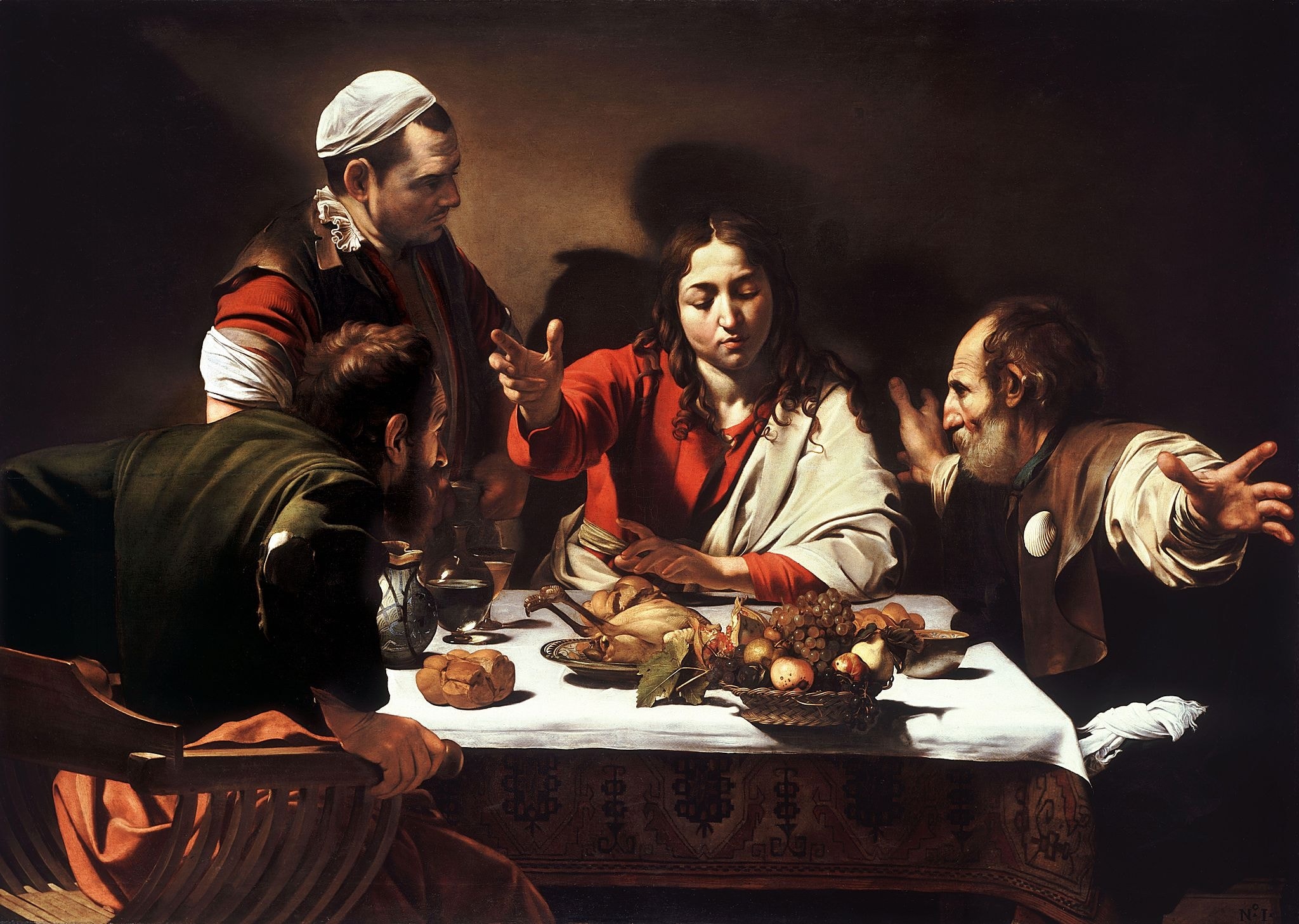
Caravaggio’s The Supper at Emmaus captures the split-second when two disciples recognize Christ in the breaking of bread. A raking light isolates Christ’s calm blessing while the disciples erupt—one surging forward with a torn sleeve, the other flinging his arms wide—so the shock of revelation reads as bodily fact. The teetering basket of fruit and Eucharistic table amplify themes of abundance and fragility [1][4].

Fast Facts

Year
1601
Medium
Oil on canvas
Dimensions
141 × 196.2 cm
Location
National Gallery, London
The Supper at Emmaus by Caravaggio (1601) featuring Bread (breaking of bread), Precarious basket of fruit, Pilgrim’s scallop shell

Click on any numbered symbol to learn more about its meaning

Meaning & Symbolism

Caravaggio fixes the instant named in Luke—“he was known to them in breaking of bread”—and turns it into a theory of vision. Christ, beardless and centrally lit, extends a measured hand of blessing while his companions erupt in asymmetrical astonishment: at left a disciple vaults forward so hard his chair skids, at right another throws his arms wide, sleeves bunched, a pilgrim’s scallop shell pinned to his chest. Their common, travel‑worn dress—one sleeve ripped open—grounds the miracle in the grit of daily life; the uncomprehending innkeeper, head cocked and cap askew, hasn’t yet seen what light means. Caravaggio’s raking illumination does more than model forms: it declares revelation. Look at the wall behind Christ—curators and scholars have long noted how cast shadows create a subtle “negative halo,” a visual paradox where sanctity appears not as a gold disk but as perceivable light, legible only to those with eyes to see 123. The table performs parallel work. Bread lies before Christ beside a glass of wine and a humble carafe; a roast fowl, grapes, and a brimming basket of fruit sit on a white cloth whose edge projects toward us. This still‑life is not ornament but argument: the Eucharistic pairing of bread and wine names presence, while the everyday fare marks the ordinary meal transfigured. Caravaggio makes that claim spatially, too. The basket is balanced on the brink, its leaves curling into our air; together with the disciples’ thrusting arms, it breaks the picture plane and drags the viewer into the scene as witness-participant 14. Subtle blemishes on the apples and the precarious perch suggest mortality and the instability of earthly goods; recognition, then, is felt as a conversion from perishability to promise. Scholars have further observed that the wicker strands and shadow under the basket sketch the contour of a fish—ichthys, an early Christ sign—braiding catechesis into optics; the same logic governs the “reverse” halo in shadow behind Christ 23. These are not hidden puzzles so much as a consistent strategy: to make symbols grow out of the physics of light and the facts of seeing. Formally, the painting articulates a Baroque ethics of attention. Life‑size figures, extreme foreshortening, and tenebrism compress sacred history into our space and time, insisting that revelation is not abstract but embodied and contemporary. The measured calm of Christ, draped in red and cream, opposes the disciples’ explosive diagonals, staging belief as movement from confusion to clarity. That movement is the painting’s drama—and its pedagogy. By refusing hieratic distance (no aureoles, no idealized types) and by flooding the table with legible detail—the torn sleeve, the slick glint on the wine glass, the nap of the still‑life—Caravaggio argues that grace enters the world we actually inhabit. The meaning of The Supper at Emmaus is therefore not a lesson appended to a scene but a scene that makes the lesson self‑evident: recognition happens when light touches bread and eyes, and when ordinary bodies pivot toward that light. This is why The Supper at Emmaus is important: it crystallizes a new, persuasive mode of religious image-making in which theology is enacted by gesture, light, and matter—the very terms of painting itself 14.

Explore Deeper with AI

Ask questions about The Supper at Emmaus

Popular questions:

Powered by AI • Get instant insights about this artwork

💬 Ask questions about this artwork!

Interpretations

Technical Study

Under the drama lies meticulous craft. The National Gallery’s technical research shows Caravaggio working over a warm, transparent ground with careful abbozzo and even incised guidelines; whites sometimes mix in egg tempera, and walnut oil contributes to the sustained sheen of the glass and flesh. This undercuts the myth of a purely improvisatory naturalism and helps explain the painting’s hyper-clarity: edges, specular highlights, and raking light read as if optically inevitable because they were engineered at the level of ground, medium, and layering. The tactile certainty of the bread, the slick carafe, and the tenebrist relief of arms thrust into space are therefore not happenstance but calibrated effects—material scaffolding for a theology of visibility that the scene performs 14.

Source: National Gallery, London (object entry; Technical Bulletin)

Comparative Late Style (London 1601 vs. Milan 1606)

Set against the 1601 London canvas, the Brera Emmaus (1606) replaces bravura still-life with austere essentials—bread, a jug, a bowl—and reins in gesture and color. A serving woman appears; Christ and disciples are quieter, the surface tonality more subdued. Painted while Caravaggio was a fugitive, this version’s restraint has often been read as a deepening of spiritual gravity: less spectacle, more presence. The shift suggests a move from demonstrative revelation to inward contemplation, where recognition is no longer proven by optical shock but registered in hushed indices—reduced props, darker palette, softened outlines. Technical imaging at Brera confirms the work’s autograph status and underdrawing, reinforcing that this austerity is a deliberate late-style recalibration of Emmaus’s meaning 56.

Source: Pinacoteca di Brera; Smarthistory

Emblematic Optics

Beyond Eucharistic bread and wine, scholars have noted emblem-like forms grown from light and shadow. The wall behind Christ yields a “negative halo”—sanctity as perceivable light rather than applied gold—and the basket’s strands with its shadow sketch the contour of a fish (ichthys), an early Christ sign. Crucially, these are not add-on puzzles but a program where symbols emerge from optics: revelation is what light makes legible, and catechesis is folded into perception itself. Such readings, grounded in early modern emblem culture, explain why Caravaggio’s realism can carry dense theology without allegorical labels: meaning arrives through cast shadow, reflection, and the viewer’s trained sight-line across the table’s brink 23.

Source: Charles Scribner III, The Art Bulletin; National Gallery (audio transcript)

Counter‑Reformation Rhetoric and the Viewer

Emmaus exemplifies the Counter‑Reformation call for clarity and affect. Life‑size proximity, extreme foreshortening, and tenebrist spotlighting collapse sacred time into the present, recruiting the viewer as witness-participant when the basket and arms project into our space. This is persuasion by immediacy: doctrinal truths (Real Presence; recognition) are not abstracted but enacted in ordinary bodies and tableware. As Smarthistory notes, the divine enters the everyday, fulfilling post‑Tridentine ideals of vivid, teachable images that stir devotion without obscurity. The uncomprehending innkeeper functions rhetorically as the yet‑to‑be‑converted onlooker—a proxy whom the painting aims to transform, just as the disciples pivot from confusion to sight 167.

Source: National Gallery, London; Smarthistory; Britannica (Counter‑Reformation context)

Reception and Social Naturalism

Seventeenth‑century theorist Gian Pietro Bellori faulted Caravaggio’s Emmaus for “low and vulgar forms,” citing the beardless Christ and rustic apostles. That complaint pinpoints the painting’s wager: sanctity articulated through class-marked realism—ripped sleeve, travel‑worn dress, tavern light—rather than idealized types. What Bellori condemned as vulgarity becomes the work’s ethical and devotional claim: grace addresses the ordinary. Caravaggio’s refusal of hieratic distance, already noted by the National Gallery’s curators, is not mere provocation but a theological stance about how truth appears—locally, materially, and to common sight. The controversy thus maps an early fault line between academic decorum and a radical naturalism that would reshape Baroque piety and pictorial rhetoric 13.

Source: Gian Pietro Bellori (via Charles Scribner III, The Art Bulletin); National Gallery, London

Related Themes

About Caravaggio

Caravaggio (1571–1610) revolutionized Italian Baroque painting with radical naturalism, live models, and extreme chiaroscuro, rejecting Mannerist idealization. The Contarelli Chapel cycle was his first major public commission and made him the most influential painter in Rome; his impact shaped artists from Rembrandt to Velázquez [8]. His turbulent career and early death only sharpened the legend of a painter who turned light into drama and doctrine.
View all works by Caravaggio

More by Caravaggio