Waterloo Bridge, Sunlight Effect

by Claude Monet

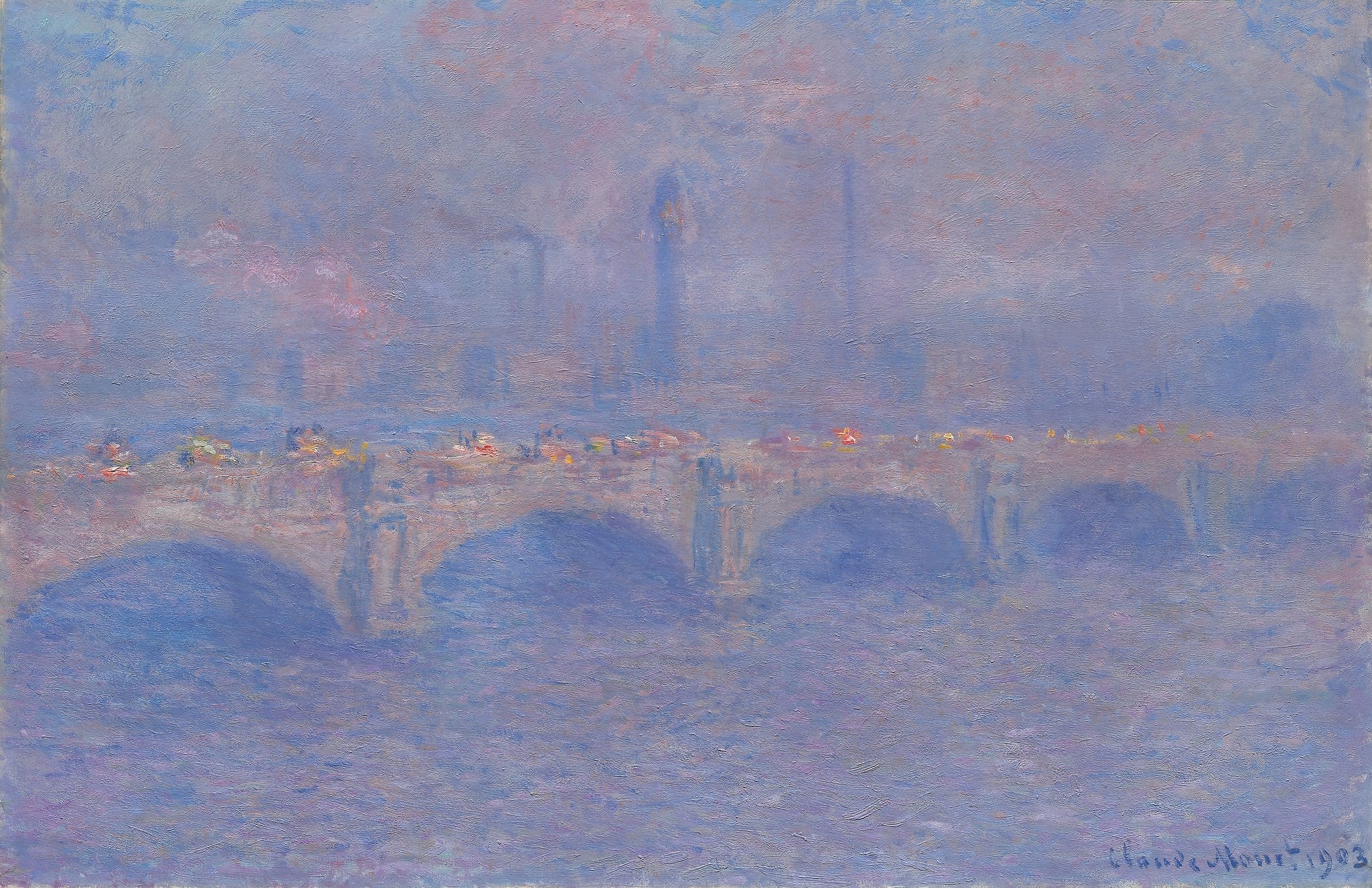
Claude Monet’s Waterloo Bridge, Sunlight Effect renders London as a lilac-blue atmosphere where form yields to light. The bridge’s stone arches persist as anchors, yet the span dissolves into mist while flecks of lemon and ember signal modern traffic crossing a city made weightless [1][2]. Vertical hints of chimneys haunt the distance, binding industry to beauty as the Thames shimmers with the same notes as the sky [1][3].

Fast Facts

Year
1903 (begun 1900)
Medium
Oil on canvas
Dimensions
65.7 × 101 cm
Location
Art Institute of Chicago, Chicago
Waterloo Bridge, Sunlight Effect by Claude Monet (1903 (begun 1900)) featuring Waterloo Bridge arches, Warm traffic/lamp flashes, Industrial chimneys and towers, Thames water

Click on any numbered symbol to learn more about its meaning

Meaning & Symbolism

Monet structures the canvas around the rhythm of Waterloo Bridge’s arches, but he lets light, not line, do the defining. The arches are legible as cool, violet ellipses, yet their edges are softened to the point of breath—each span more a temperature than a contour. Across the roadway, tiny raised dabs of cadmium-orange, red, and white flicker as omnibuses or lamps, a shorthand for modern traffic. Those sparks punctuate a broad field of lilac and cobalt, so the bridge reads as a temporal event—a pulse of moving light—rather than a fixed object 12. In the distance, faint verticals—chimneys and towers—rise and fade inside the violet haze, their silhouettes present but porous. The river below mirrors the sky’s chords; thickened touches where warm rose intermingles with ultramarine register sunlight striking polluted moisture, a material sign that the city’s atmosphere is literally made of paint and particulate 23. That facture—broken, feathery, breathing—enacts the argument. Monet’s strokes do not describe masonry; they calibrate intervals of color that cohere only at the scale of perception. The bridge thus becomes a proposition: permanence is an effect produced by countless, shifting sensations. This choice refutes the nineteenth‑century city’s rhetoric of monumentality; the most engineered structure in view is rendered vulnerable to fog and time. Yet the painting does not moralize; it mediates. By letting lemon and ember flares of traffic sparkle amid cool violets, Monet reconciles modernity and nature, implying that the very pollutants of an industrializing London generate new optical splendors. Contemporary accounts and recent scholarship underscore that the ‘fog’ is inseparable from smoke; Monet sought weekdays when factories operated, and even embedded smokestacks as spectral accents in the background 234. Composed from a high vantage in the Savoy and resolved later in Giverny, the canvas participates in a serial orchestration: dozens of Waterloo Bridges tuned to different hours, weathers, and chromatic keys, then exhibited together in 1904 as a symphonic whole 25. Within that sequence, this Sunlight Effect strikes a cool‑warm equilibrium—dominant cobalt‑violet modulated by brief, high‑chroma notes—arguing that meaning resides not in iconography but in relationships of hue and value over time. The painting therefore marks a pivot toward modernism: an engineered city seen as fields of sensation; a representational subject dissolved into near‑abstraction without forfeiting recognition. In short, the meaning of Waterloo Bridge, Sunlight Effect is that perception is historical and atmospheric—shaped by industry, weather, and time—and why Waterloo Bridge, Sunlight Effect is important is that it turns those conditions into a new visual ethics, where even smog becomes a vehicle for seeing anew 245.

Explore Deeper with AI

Ask questions about Waterloo Bridge, Sunlight Effect

Popular questions:

Powered by AI • Get instant insights about this artwork

💬 Ask questions about this artwork!

Interpretations

Technical/Material Analysis

Monet’s “Sunlight Effect” is built from a London‑supplied, marine‑size linen support and a palette of cobalt blue and violet, ultramarine, viridian, lead white, cadmium yellow, vermilion, and red lake—pigments chosen to stage micro‑contrasts that fuse at viewing distance 2. The bridge’s traffic is rendered as impasto dabs of cadmium orange, red, and white, a shorthand that asserts paint’s material presence even as it signifies modern motion 2. Conservation research on related versions shows Monet’s preference for an unvarnished surface—preserving a matte scintillation that keeps the enveloppe breathable and prevents tonal amalgamation that varnish would impose 6. There is no drawing underlayer; instead, successive sessions “calibrate” chromatic intervals, so facture becomes both method and meaning: stone is constructed by color, not contour 2.

Source: Art Institute of Chicago (Scholarly Catalogue); Denver Art Museum conservation reporting

Environmental History / Eco‑criticism

The picture’s radiance is inseparable from industrial smog. Monet sought weekday conditions when factories operated; chimneys rise as “spectral accents,” and sunlight striking polluted moisture becomes the chromatic event itself 13. Critics note how the paintings both aestheticize and expose London’s wealth‑producing pollution, transforming toxicity into optical splendor while keeping its sources legible in the haze 4. Far from pastoral nostalgia, this is an urban ecology: particulate matter thickens the air into a visual medium, enabling the lilac‑cobalt chord that unifies sky, bridge, and river 5. Eco‑critically, the work neither condemns nor celebrates; it renders a feedback loop where industry fabricates new forms of beauty, and beauty returns our attention to industry’s atmospheric cost 345.

Source: National Gallery of Canada; The Guardian; Financial Times

Urban Modernity & Speed

Tiny, high‑chroma flecks across the roadway act as temporal punctuation, reading as omnibuses or lamps that beat time across a dissolving span 2. The bridge is less infrastructure than rhythm; London appears as a city legible in pulses—fog banks, traffic flashes, river shimmers—rather than as fixed mass 12. Seen within the broader Thames campaign, each canvas isolates a micro‑tempo of the day; together they construct an urban chronometry, an index of speed and stoppage 7. Monet’s technique thus aligns with modernity’s proprioception: quick, discontinuous, serial. Spectators complete forms in real time as the eye integrates scattered chroma, mirroring the city’s own coordination of flows—vehicles, steam, sun—into a momentary coherence 27.

Source: Art Institute of Chicago (Scholarly Catalogue); Worcester Art Museum exhibition

Seriality as Form

Monet orchestrated the Waterloo Bridges as a single ensemble, reworking canvases in Giverny and exhibiting them as Vues de la Tamise in 1904 at Durand‑Ruel—a curatorial gambit that makes comparison the work’s true medium 15. Any one “Sunlight Effect” is a movement in a symphony whose structure resides in difference: hour to hour chromatic keys, weather envelopes, and the variable visibility of industrial forms 15. The delayed dating (often 1903) reflects a studio logic of inter‑canvas tuning, not mere completion 1. Seriality here is not repetition but argument: meaning accrues across adjacencies, where a cobalt‑violet field modulated by ember accents debates a neighbor’s rose‑gold haze, making temporality itself the subject 15.

Source: Art Institute of Chicago (Object Record); Financial Times

Phenomenology of Perception

Monet converts the bridge into a proposition about seeing: forms cohere only at the scale of perception, where the eye averages discrete chromatic events into legible structure 12. The canvas privileges “relationships of hue and value over time,” aligning vision with duration; the world is known not by outline but by lived intervals of light 12. Such near‑abstraction does not forfeit recognition; rather, it reallocates truth to sensation—anticipating modernist claims that perception is historically and materially conditioned (fog, smoke, hour) 23. The spectator’s role is constitutive: moving closer or farther shifts the bridge from pigment to place, making viewing itself the engine that reconciles modernity’s hardness with nature’s flux 23.

Source: Art Institute of Chicago (Scholarly Catalogue); National Gallery of Canada

Related Themes

About Claude Monet

Claude Monet (1840–1926) led Impressionism’s pursuit of open-air painting and optical immediacy, especially during his Argenteuil years focused on modern leisure and light. He later developed serial studies of changing conditions, culminating in the Water Lilies cycle [2].
View all works by Claude Monet

More by Claude Monet

Haystacks Series by Claude Monet | Light, Time & Atmosphere by Claude Monet

Haystacks Series by Claude Monet | Light, Time & Atmosphere

Claude Monet

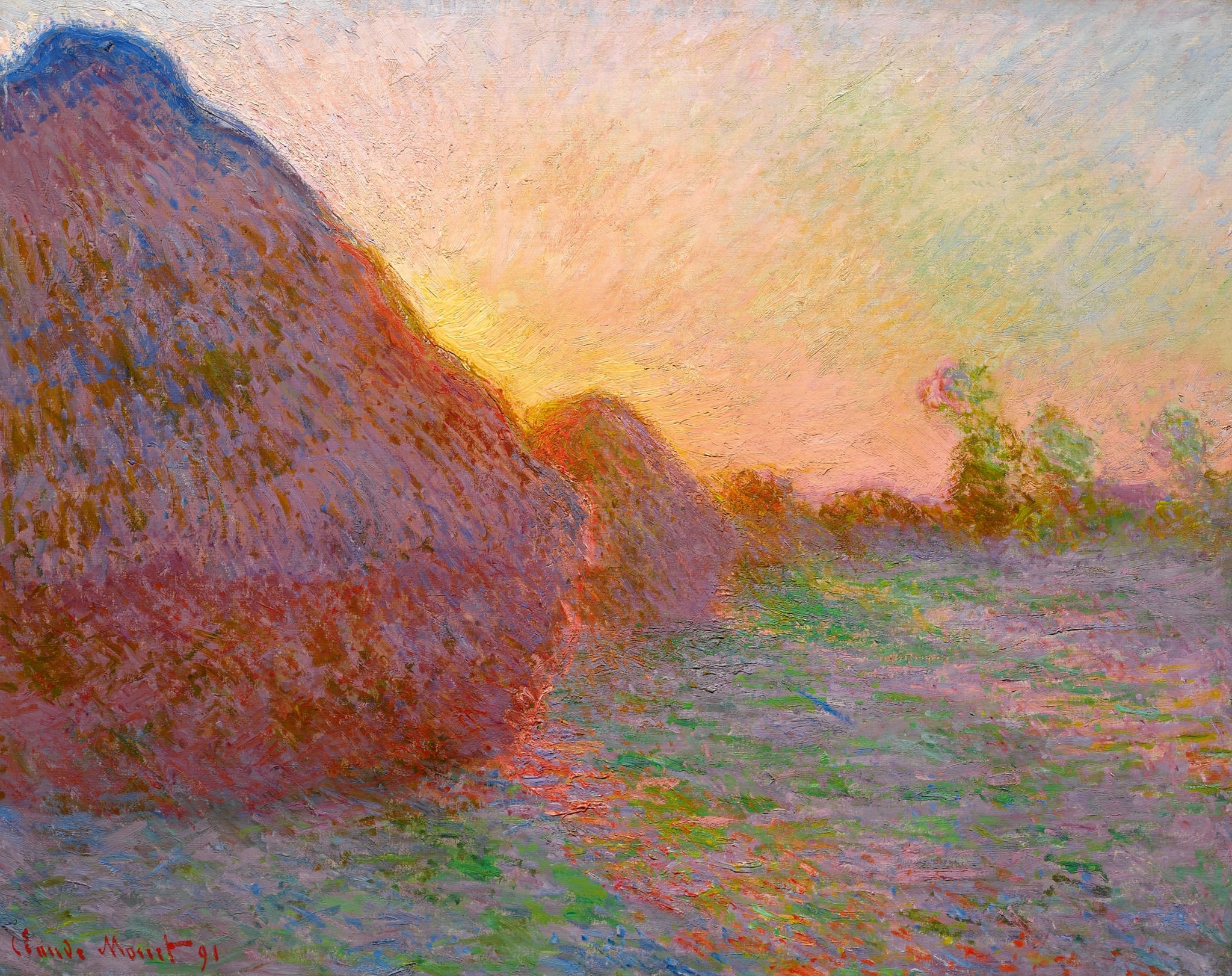
Claude Monet’s <strong>Haystacks Series</strong> transforms a routine rural subject into an inquiry into <strong>light, time, and perception</strong>. In this sunset view, the stacks swell at the left while the sun burns through the gap, making the field shimmer with <strong>apricot, lilac, and blue</strong> vibrations.
The Artist's Garden at Giverny by Claude Monet

The Artist's Garden at Giverny

Claude Monet (1900)

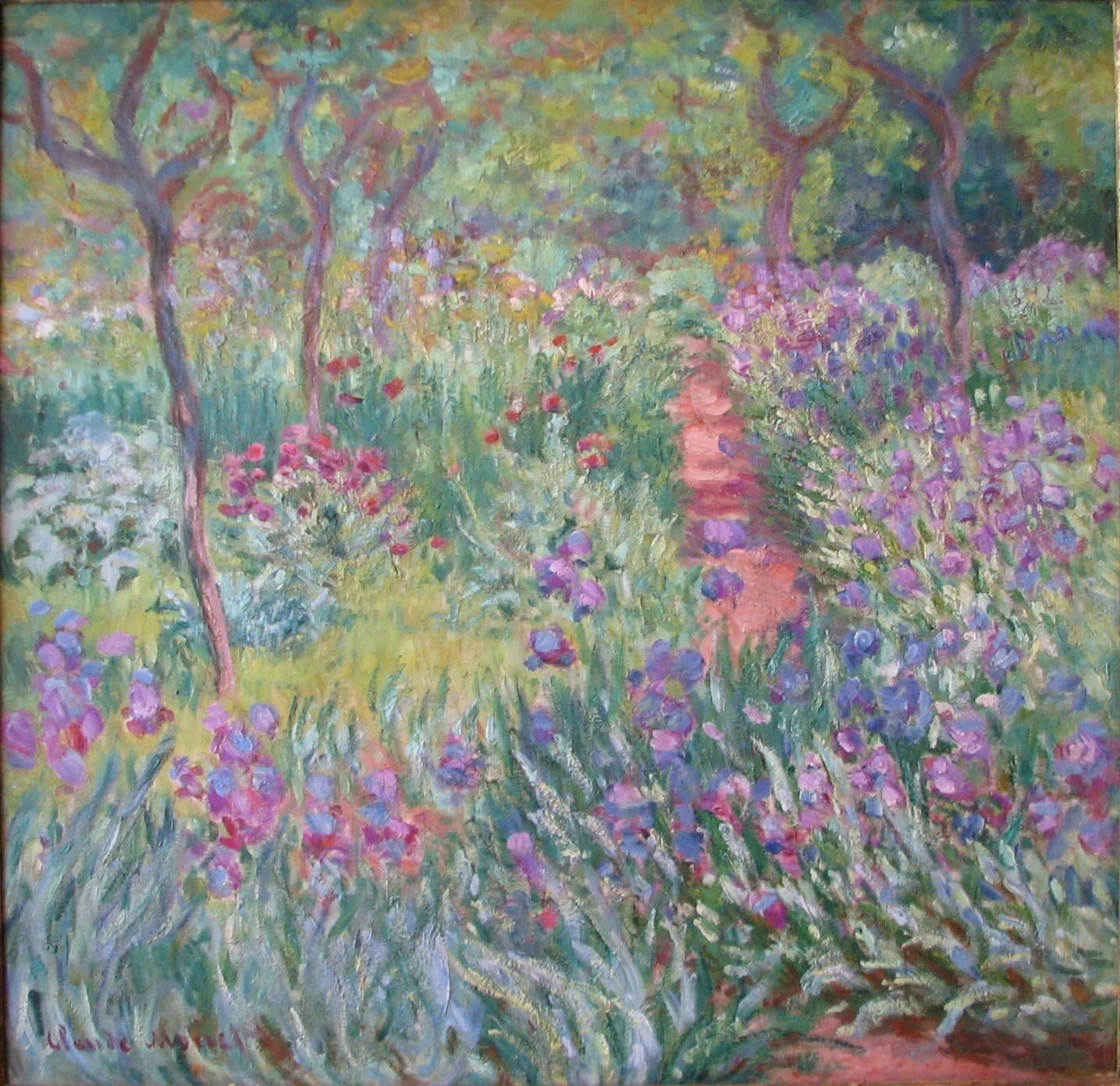
In The Artist's Garden at Giverny, Claude Monet turns his cultivated Clos Normand into a field of living color, where bands of violet <strong>irises</strong> surge toward a narrow, rose‑colored path. Broken, flickering strokes let greens, purples, and pinks mix optically so that light seems to tremble across the scene, while lilac‑toned tree trunks rhythmically guide the gaze inward <sup>[1]</sup><sup>[3]</sup>.
The Water Lily Pond by Claude Monet

The Water Lily Pond

Claude Monet (1899)

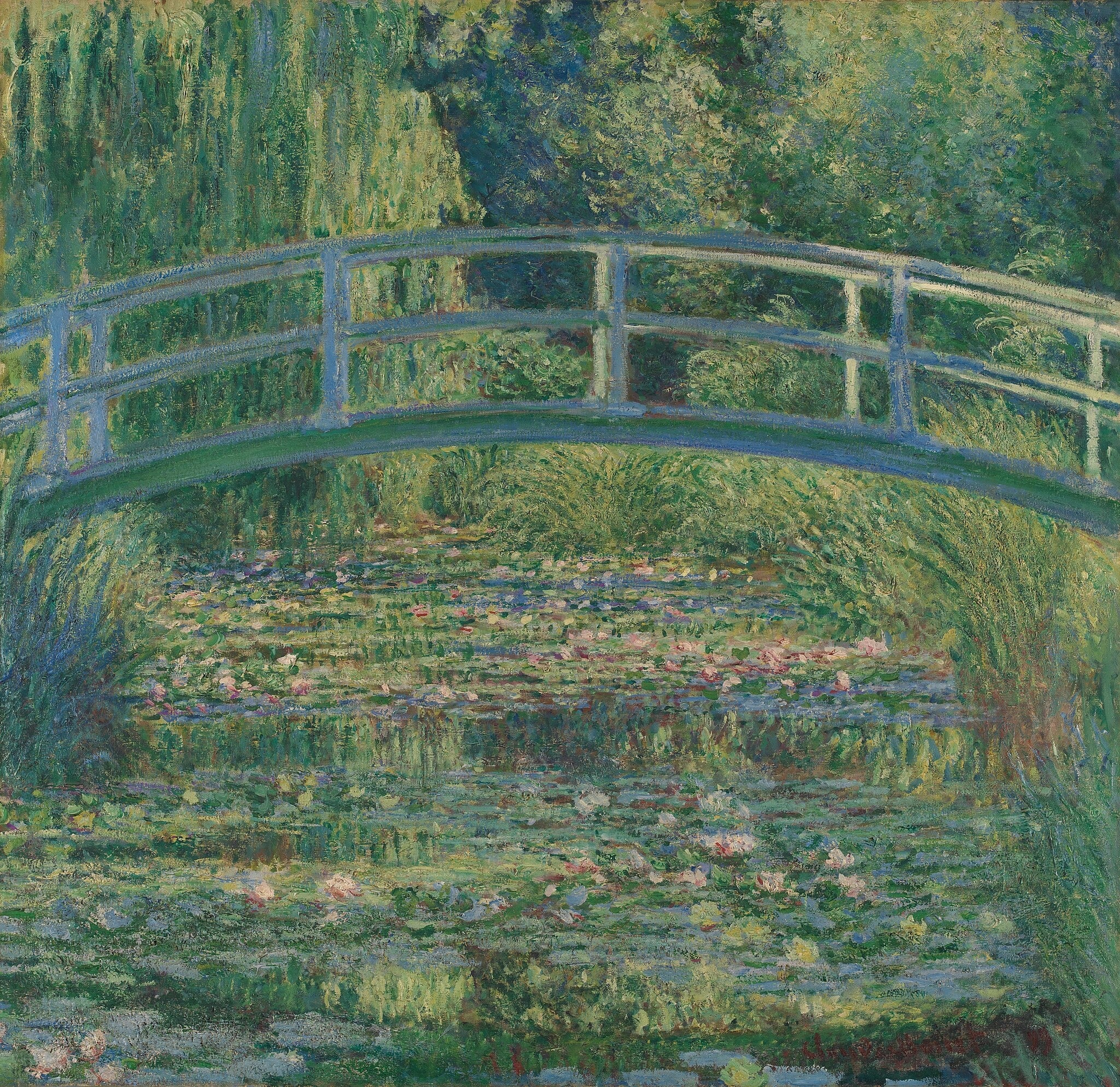
Claude Monet’s The Water Lily Pond transforms a designed garden into a theater of <strong>perception and reflection</strong>. The pale, arched <strong>Japanese bridge</strong> hovers over a surface where lilies, reeds, and mirrored willow fronds dissolve boundaries between water and sky, proposing <strong>seeing itself</strong> as the subject <sup>[1]</sup><sup>[3]</sup>.

Morning on the Seine (series) by Claude Monet

Morning on the Seine (series)

Claude Monet (1897)

Claude Monet’s Morning on the Seine (series) turns dawn into an inquiry about <strong>perception</strong> and <strong>time</strong>. In this canvas, the left bank’s shadowed foliage dissolves into lavender mist while a pale radiance opens at right, fusing sky and water into a single, reflective field <sup>[1]</sup><sup>[2]</sup>.

Woman with a Parasol by Claude Monet

Woman with a Parasol

Claude Monet (1875)

Claude Monet’s Woman with a Parasol fixes a breezy hillside instant in high, shifting light, setting a figure beneath a <strong>green parasol</strong> against a vast, vibrating sky. The low vantage and <strong>broken brushwork</strong> merge dress, clouds, and grasses into one atmosphere, while a child at the rise anchors depth and intimacy <sup>[1]</sup>. It is a manifesto of <strong>plein-air</strong> perception—painting the sensation of air in motion rather than the contours of things <sup>[2]</sup>.

The Japanese Footbridge by Claude Monet

The Japanese Footbridge

Claude Monet (1899)

Claude Monet’s The Japanese Footbridge turns his Giverny garden into an <strong>immersive field of perception</strong>: a pale blue-green arc spans water crowded with lilies, while grasses and willows dissolve into vibrating greens. By eliminating the sky and anchoring the scene with the bridge, Monet makes <strong>reflection, passage, and time</strong> the picture’s true subjects <sup>[1]</sup><sup>[2]</sup>.