The Arnolfini Portrait
by Jan van Eyck
Study print
Prefer the curated version?
View the study print we made for this artwork, pairing the full painting with a close reading of one meaningful detail.

Study Print Studio
Create a personal study print
Build a companion study sheet around the part of this painting that speaks to you most. Choose a detail, shape an interpretation, and walk away with something personal and display-worthy.
Fast Facts
- Year
- 1434
- Medium
- Oil on oak panel
- Dimensions
- 82.2 × 60 cm
- Location
- The National Gallery, London
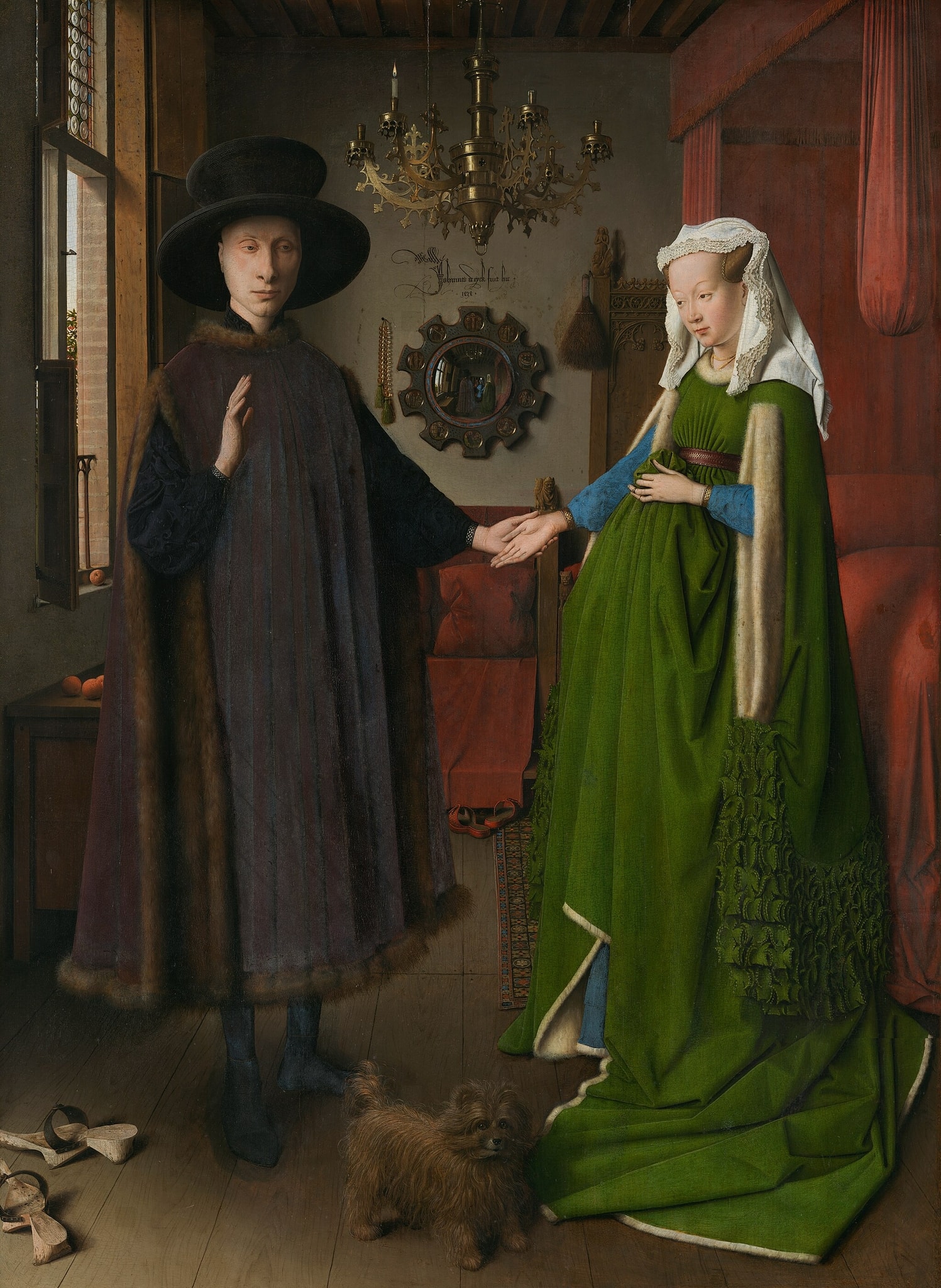
Click on any numbered symbol to learn more about its meaning
Meaning & Symbolism
Explore Deeper with AI
Ask questions about The Arnolfini Portrait
Popular questions:
Powered by AI • Get instant insights about this artwork
Interpretations
Formal Analysis
Source: National Gallery; Lorne Campbell (NG Catalogue); The Met Heilbrunn Timeline
Social-Economic Context
Source: National Gallery; Lorne Campbell (NG Catalogue); Craig Harbison, Renaissance Quarterly
Devotional-Domestic Theology
Source: National Gallery; Lorne Campbell (NG Catalogue)
Ritual & Legal Culture (Comparative Reading)
Source: Lorne Campbell (NG Catalogue); Erwin Panofsky; Edwin Hall
Memorial Hypothesis (Debated)
Source: Margaret L. Koster; Lorne Campbell (NG Catalogue)
Explore Specific Elements
Dive deeper into individual scenes and details within The Arnolfini Portrait.
The Convex Mirror
At the heart of Jan van Eyck’s Arnolfini Portrait gleams a convex mirror that turns a private room into a stage shared with the viewer. Its reflection folds artist, visitors, and beholder into the scene, while the frame’s tiny Passion scenes tether worldly luxury to devotional time.
The Single Candle
A single flame glows from the lavish brass chandelier, improbably lit in daylight. Van Eyck turns this tiny light into a fulcrum of status, ritual, and vision—hovering above the mirror and signature where presence and witnessing are staged.
The Discarded Shoes
Two pairs of discarded pattens — the man’s pale wooden overshoes at lower left and the woman’s red leather‑covered pair beside the bed — quietly stage a passage from street to chamber in Jan van Eyck’s Arnolfini Portrait. Rendered with forensic clarity, they fuse everyday practice with meanings that scholars have debated for nearly a century.
The Little Dog
Van Eyck’s little lapdog stands between the couple like a living seal of their bond—rendered hair by hair, yet charged with meaning. Its direct gaze and privileged placement turn a household pet into a compact emblem of fidelity and elite domestic life.
Van Eyck's Signature
At the center of The Arnolfini Portrait, Jan van Eyck signs the painted wall itself: “Johannes de eyck fuit hic .1434” — “Jan van Eyck was here. 1434.” This audacious, room‑embedded signature collapses the distance between artist, image, and viewer, proclaiming the painter’s physical presence while showcasing his mastery of illusion [1][2].