Van Eyck's Signature in The Arnolfini Portrait
A closer look at this element in Jan van Eyck's 1434 masterpiece
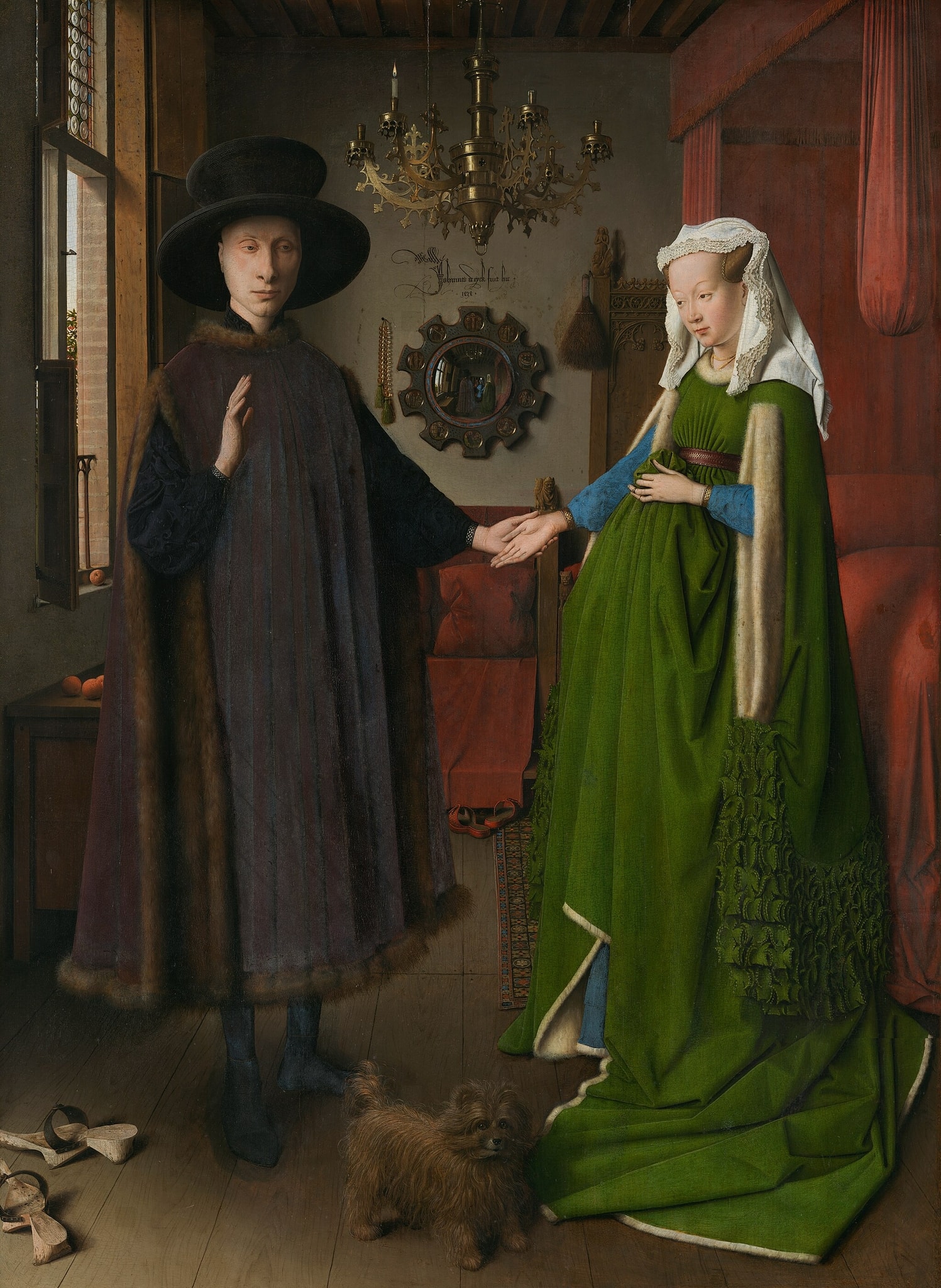
At the center of The Arnolfini Portrait, Jan van Eyck signs the painted wall itself: “Johannes de eyck fuit hic .1434” — “Jan van Eyck was here. 1434.” This audacious, room‑embedded signature collapses the distance between artist, image, and viewer, proclaiming the painter’s physical presence while showcasing his mastery of illusion [1][2].
Historical Context
In 1434, Jan van Eyck inscribed the rear wall of The Arnolfini Portrait with the line “Johannes de eyck fuit hic .1434,” positioning it directly above the convex mirror at the composition’s center. The wording departs from common medieval and early Renaissance formulas such as “me fecit” or “pinxit,” which declare authorship; instead, the phrase “fuit hic” — “was here” — asserts bodily presence within the pictured space 12.
Museum scholarship emphasizes that such phrasing belongs to the realm of informal graffiti rather than to legal witnessing formulas, which used different expressions and fuller documentary dating 12. Van Eyck, who elsewhere cultivated a conspicuous authorial identity (including the motto ALS ICH CAN), here integrates his name into the depicted plaster, not onto a separate frame. The result is a signature that participates in the fiction of the room, amplifying the panel’s naturalism and its play with seeing and being seen. By dating the line 1434, van Eyck anchors the image to a specific year while simultaneously claiming to have “entered” the scene, a bravura move that aligns with his broader practice of self-conscious inscription and sophisticated illusionism 12.
Symbolic Meaning
Van Eyck’s wall-written autograph functions as a compact statement about presence, authorship, and truth-claim. Erwin Panofsky’s influential thesis read the inscription together with the two tiny figures reflected in the mirror: the painter (and a companion) appear as witnesses to a marriage, making the painting a visual record with the signature as attestation 35. This “marriage certificate” interpretation shaped much twentieth‑century reception.
Later scholarship rejects the legal reading on philological and documentary grounds: “fuit hic” is not a notarial formula, and the inscription lacks the exact wording typical of legal records 1. Instead, the line announces that the painter stood in — and constructed — this room, collapsing the boundary between reality and image. Its graffiti-like tone underscores a self-aware boast of presence: a 15th‑century “I was here” that turns the wall into a stage for authorship 2.
Read this way, the signature becomes meta‑pictorial. It names the maker within the illusion he perfected, dovetailing with the mirror’s doubled space to engage the viewer as a participant in looking and verifying. Whether one favors a domestic, ceremonial, or even memorial interpretation of the scene, the signature insists that belief in the image depends on the artist’s asserted presence — the guarantor of the painting’s striking claim to reality 15.
Artistic Technique
The inscription is executed in a highly flourished calligraphic hand with cadels, painted freehand so that the line rises slightly from left to right. Technical study shows van Eyck used a long, narrow brush, building the larger flourishes from multiple strokes; evidence suggests the signature was added late, after adjustments to the chandelier and the mirror’s scale 1.
Visually, the letters read as inked onto plaster, not as gold or carved relief, enhancing the work’s trompe‑l’œil effect and aligning it with contemporary wall texts or graffiti 46. Its placement — centered above the convex mirror — ties the calligraphy to the optical device below, creating a precise hinge between writing, reflection, and space. The sober, dark brown tonality and crisp edges of the script sit naturally within the wall’s texture, making the “real” and the represented indistinguishable at a glance 16.
Connection to the Whole
Positioned directly over the convex mirror, the signature anchors the painting’s network of looking, witnessing, and presence. The mirror expands the room and admits two additional figures at the doorway; the line “fuit hic” names the one who stands there — the painter — and binds that vantage to ours 15.
Compositional axes converge on this nexus: the couple’s joined hands, the chandelier’s stem, and the bed’s canopy guide the eye toward the mirror and the autograph. As a result, authorship becomes a structural element of the scene, not an afterthought. The inscription dates the encounter to 1434 and, more crucially, guarantees the picture’s persuasive fiction: the artist “was here,” therefore what you see claims the status of observed truth — a rhetorical seal that deepens the portrait’s enduring power 15.
Explore More from This Painting
This detail is one part of The Arnolfini Portrait. Use the links below to return to the full interpretation, browse the full set of details, or view the painting's valuation if available.
Sources
- National Gallery, London — Lorne Campbell, Catalogue entry “The Arnolfini Portrait” (updated 2021)
- National Gallery, London — Fruits of the Spirit: Generosity (on “fuit hic” vs. “me fecit” and graffiti-like presence)
- Erwin Panofsky, “Jan van Eyck’s Arnolfini Portrait,” The Burlington Magazine (1934)
- National Gallery, London — Audio description of The Arnolfini Portrait
- Smarthistory — Jan van Eyck, The Arnolfini Portrait (debate overview)
- Wikipedia — Arnolfini Portrait (basic description; cross-checked against NG)