The Single Candle in The Arnolfini Portrait
A closer look at this element in Jan van Eyck's 1434 masterpiece
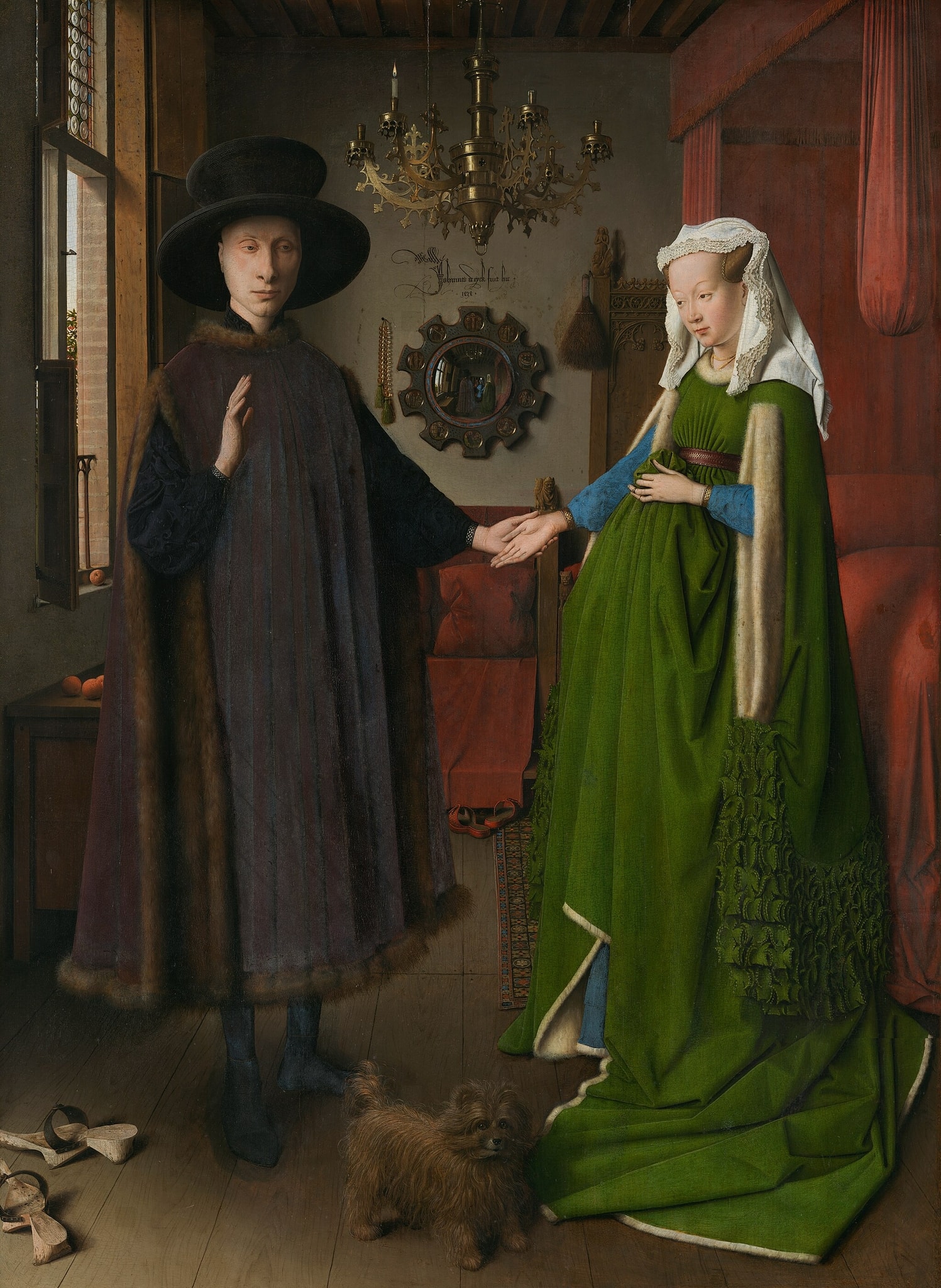
A single flame glows from the lavish brass chandelier, improbably lit in daylight. Van Eyck turns this tiny light into a fulcrum of status, ritual, and vision—hovering above the mirror and signature where presence and witnessing are staged.
Historical Context
Painted in Bruges in 1434, The Arnolfini Portrait depicts a prosperous household closely tied to Burgundian culture. The ornate brass chandelier and wax candles were luxury goods, and their inclusion signals wealth appropriate to elite urban circles. Van Eyck seizes on this costly object to showcase material splendor within a meticulously appointed interior 2.
Etiquette manuals from the Burgundian milieu describe lighting wax candles when visitors entered a chamber; the single candle in the chandelier likely marks the reception of guests—the two figures glimpsed in the convex mirror—despite ample daylight from the window. At the same time, the device lets Van Eyck stage a controlled experiment in contrasting natural and artificial illumination, a preoccupation throughout his practice. Both the social custom and the painter’s optical ambition anchor the candle historically and visually within the world the National Gallery reconstructs for this painting 12.
Symbolic Meaning
Erwin Panofsky’s landmark essay cast the burning candle as a sacral sign: a marriage light, or the all-seeing presence of God witnessing a solemn vow. In this reading, the lone flame functions as a theological eye that sanctions the scene and aligns domestic space with liturgical symbolism 3. Public-facing art-history syntheses have long repeated this interpretation, reinforcing the idea of divine presence emanating from a single, perfect flame 5.
Later scholarship has recalibrated the claim. The National Gallery’s catalogue finds no documentary basis for a specific “marriage candle” in the rites of the period and instead proposes a courtesy light for visitors and a painterly exploration of mixed lighting—daylight and candlelight together—within a status portrait 2.
A different, memorial reading argues that the lit candle above the man, paired with an extinguished or nearly spent counterpart over the woman’s side, encodes a life-versus-death contrast, signaling a husband portrayed from life and a deceased wife commemorated in effigy. This interpretation links the candle to broader motifs of remembrance woven through the panel 46. Across these views, the candle consistently operates as a sign of presence—divine, social, or memorial—concentrating meaning in a pinpoint of light.
Artistic Technique
Van Eyck renders brass, flame, and wax with microscopic precision: crisp sconce outlines, pinpoint highlights that articulate the chandelier’s lobed arms, and wax dribbles that catch the light. The tiny flame is a dart of warm yellow-white set against cooler daylight, allowing a calibrated contrast of light sources. The chandelier reappears in the convex mirror, a tour de force of reflection and spatial coherence that ties object, light, and viewpoint together 12. Technical study notes minimal underdrawing for such details—suggesting late-stage, deliberately placed touches rather than a rigid symbolic program from the outset. The audio guide confirms the play between the single burning taper and a snuffed counterpart, details that Van Eyck paints with economical yet exact strokes 26.
Connection to the Whole
Suspended above the mirror and the boldly written signature, the candle anchors a vertical axis of seeing and witnessing. Its glow crowns the zone where two visitors appear in reflection and where the painter proclaims his presence, fusing social testimony with optical revelation 12. The light also converses with the Passion roundels surrounding the mirror and, in the memorial hypothesis, with cues of mortality, bringing Christian meditation into a domestic setting 4. Even without adopting a single symbolic key, the candle intensifies the portrait’s dual aims: to display worldly status through costly objects and to demonstrate painterly virtuosity in rendering light, surface, and reflection 12.
Explore More from This Painting
This detail is one part of The Arnolfini Portrait. Use the links below to return to the full interpretation, browse the full set of details, or view the painting's valuation if available.
Sources
- National Gallery, London — Work overview (context, mirror and signature)
- National Gallery, London — Lorne Campbell, Catalogue entry (chandelier/candle details; etiquette; technique; critique of marriage-candle idea)
- Erwin Panofsky, 'Jan van Eyck’s Arnolfini Portrait,' The Burlington Magazine (1934)
- Margaret L. Koster, 'The Arnolfini Double Portrait: A Simple Solution,' Apollo (2003)
- Smarthistory — Jan van Eyck, The Arnolfini Portrait (overview of competing interpretations)
- National Gallery, London — Audio description (one lit candle; one snuffed)