The Convex Mirror in The Arnolfini Portrait
A closer look at this element in Jan van Eyck's 1434 masterpiece
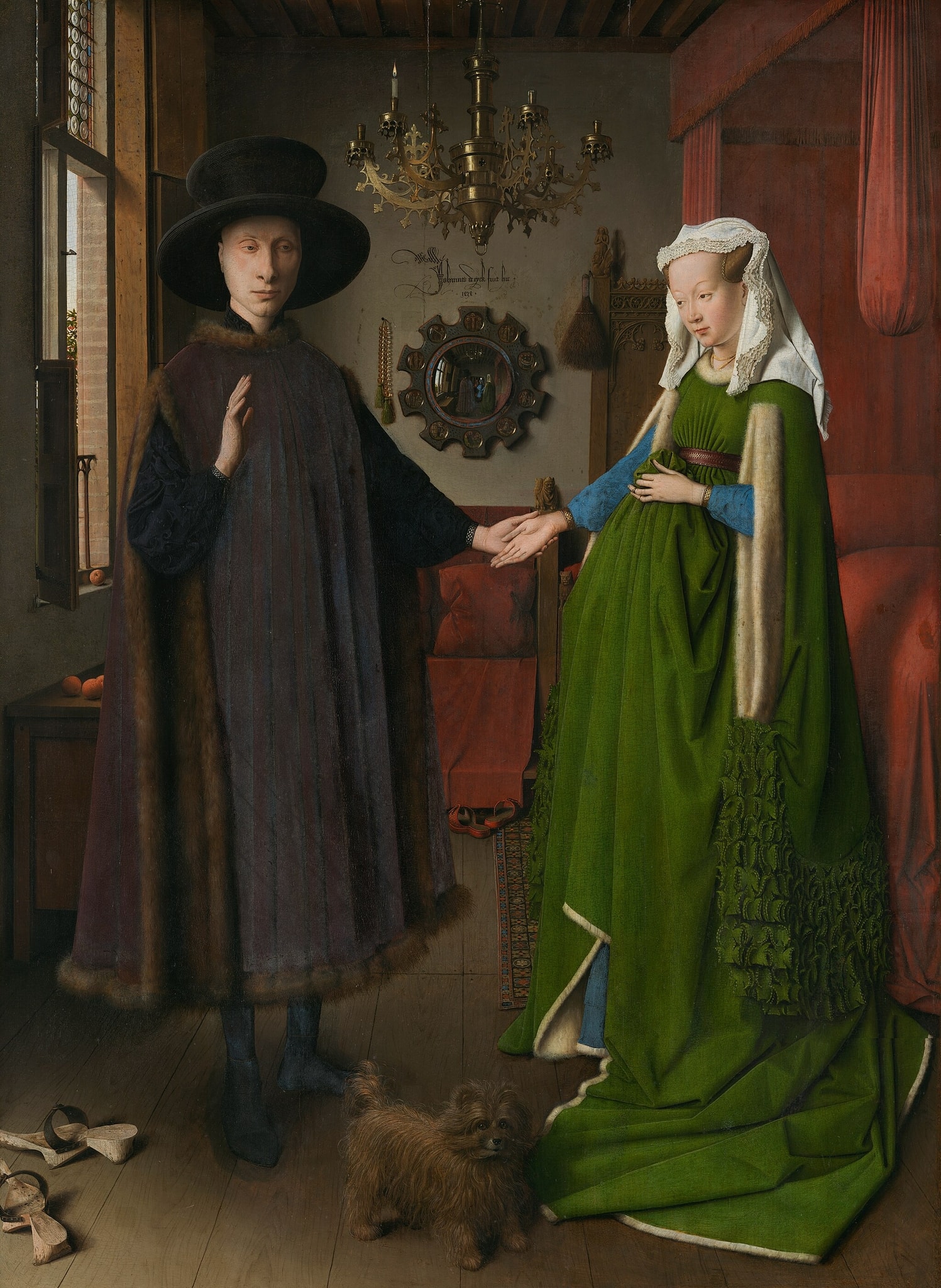
At the heart of Jan van Eyck’s Arnolfini Portrait gleams a convex mirror that turns a private room into a stage shared with the viewer. Its reflection folds artist, visitors, and beholder into the scene, while the frame’s tiny Passion scenes tether worldly luxury to devotional time.
Historical Context
Painted in Bruges in 1434, the convex mirror reflects a culture newly captivated by optics and lifelike illusion. Northern painters pursued feats of seeing that collapsed the boundary between image and reality, and van Eyck made reflective surfaces his signature means of extending pictorial space. In the Arnolfini Portrait, the mirror shows the couple from behind, the open doorway, and two entrants in blue and red, while the large cursive inscription—“Johannes de eyck fuit hic 1434”—crowns the device like a proclamation of presence 1.
Convex mirrors themselves were luxury objects in Burgundian elite interiors. Van Eyck heightens that prestige and visibility by enlarging the glass and by encircling it with ten Passion roundels, a form of embedded household devotion well attested in contemporary furnishings. Technical study further suggests he first conceived an even bigger or differently shaped mirror before revising it, underscoring the object’s deliberate centrality in the final design 2.
Symbolic Meaning
The mirror’s most explicit program is devotional. Ten Passion roundels on the frame—beginning with the Agony in the Garden and proceeding to the Resurrection—surround the room’s everyday actions with the arc of salvation history, encouraging meditative looking “through” Christ’s suffering. Medieval writers such as Bernard of Clairvaux described Christ’s body as a “mirror for the soul,” making the Passion a pointed subject for a mirror’s frame 2.
Within Netherlandish art, convex mirrors also signify moral sight and truth-telling. In Petrus Christus’s Goldsmith in His Shop a comparable mirror juxtaposes virtuous conduct with street traffic, inviting ethical comparison; van Eyck’s device similarly measures behavior by what and how it reflects 5. Panofsky famously argued that the mirror served as an ‘eye-witness’ to a marriage, its two reflected figures acting as legal witnesses beneath a notarial-style inscription. Later scholarship has dismantled the legal claim—fuit hic is graffiti-like, not documentary—but preserves the themes of witnessing and presence the mirror dramatizes 621. Seen this way, the object fuses moral scrutiny, devotional framing, and the artist’s self-conscious role as guarantor of vision.
Artistic Technique
Van Eyck renders wide-angle, correct convex distortions with layered oil glazes and microscopic brushwork. Modern geometric analyses confirm that the reflection coheres with a spherical mirror’s optics, even as the glass’s overall scale is artistically amplified 4. The ten-sided frame is painted to a subtle gloss; each Passion scene sits on a red ground and is sealed by its own tiny convex cover, creating a scintillating ring of highlights that echoes the chandelier’s gleam 2. Strategically centered, the mirror aligns with the flowing rosary and the flamboyant inscription, so its dark circumference becomes a visual anchor that gathers sightlines and reflective sparks across the room 1.
Connection to the Whole
The mirror is the painting’s conceptual fulcrum. It binds the room’s geometry to the viewer’s space, stages an act of ‘witnessing,’ and quietly inserts the artist among the entrants it reflects. Paired with the autograph above, it turns looking into testimony: the scene is both seen and affirmed as present here 13.
At the same time, the Passion cycle tightens the bond between courtly display and lay devotion, situating luxury within a salvific frame. By enlarging the glass and adjusting architecture to its optics, van Eyck acknowledges artifice even as he promises truth—an elegant tension that animates the Arnolfini Portrait as a whole 23.
Explore More from This Painting
This detail is one part of The Arnolfini Portrait. Use the links below to return to the full interpretation, browse the full set of details, or view the painting's valuation if available.
Sources
- National Gallery, London – Object page (Overview/In-depth)
- National Gallery, London – Catalogue entry (Lorne Campbell, 1998; updated 2021)
- The Met – Heilbrunn Timeline, Jan van Eyck (mirror as spatial fiction)
- Microsoft Research – Criminisi, Kemp, Kang, “Reflections of Reality in Jan van Eyck and Robert Campin”
- The Met – Petrus Christus, A Goldsmith in His Shop (convex mirror, moral meaning)
- Erwin Panofsky, “Jan van Eyck’s Arnolfini Portrait,” The Burlington Magazine