The Little Dog in The Arnolfini Portrait
A closer look at this element in Jan van Eyck's 1434 masterpiece
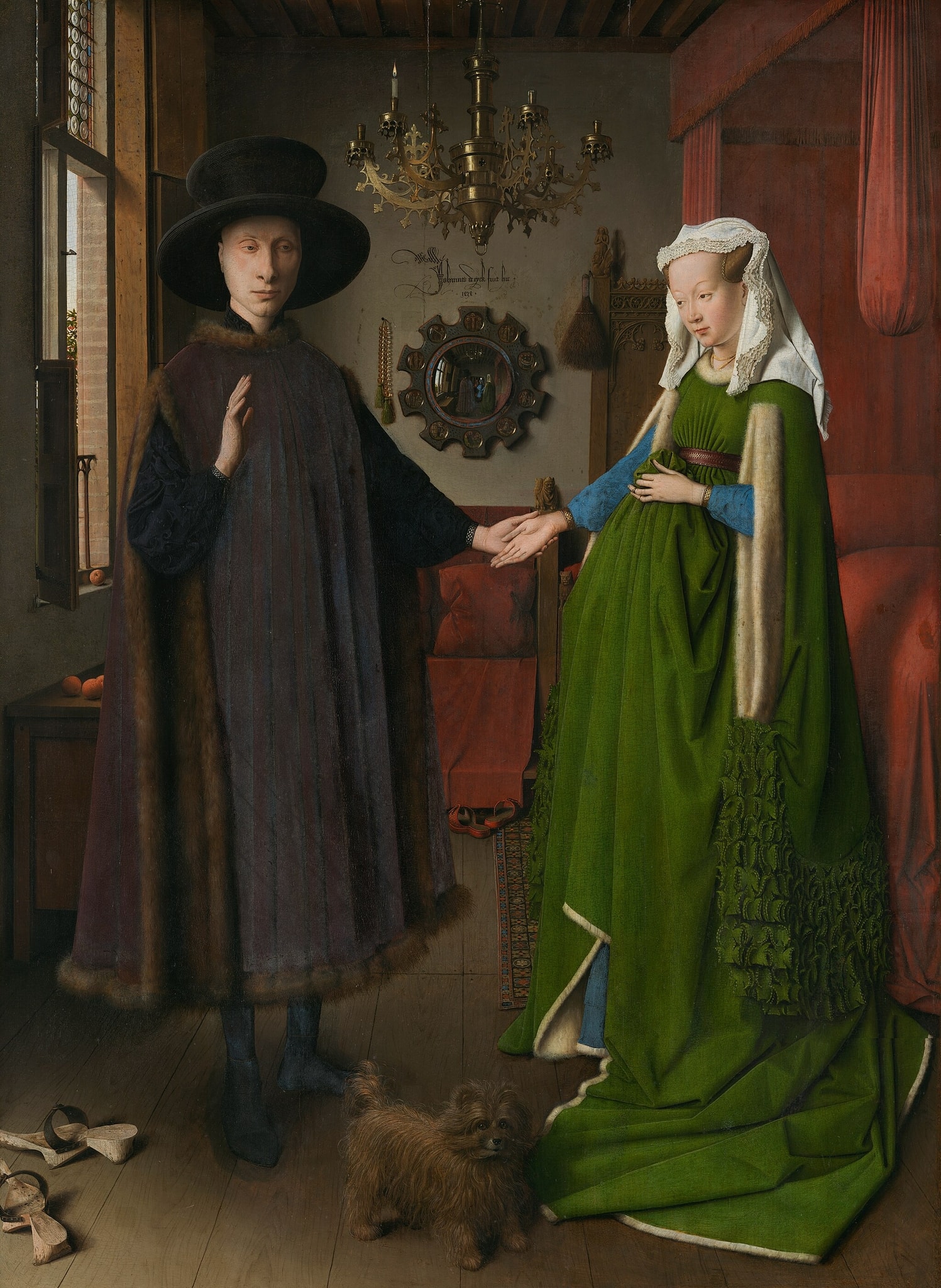
Van Eyck’s little lapdog stands between the couple like a living seal of their bond—rendered hair by hair, yet charged with meaning. Its direct gaze and privileged placement turn a household pet into a compact emblem of fidelity and elite domestic life.
Historical Context
Painted in Bruges in 1434, The Arnolfini Portrait arose within the opulent world of Burgundian commerce and courtly display. In this milieu, small lapdogs were fashionable companions that signaled refinement and household status. The National Gallery describes the terrier‑like dog at the picture’s center as exquisitely observed—“every hair” delicately rendered—and as a period sign of marital faithfulness, aligning the creature with the painting’s domestic and conjugal themes 2.
Technical study clarifies when and how van Eyck introduced this motif. Infrared examination finds no underdrawing for the dog; it was painted over the already laid‑in interior, and the shadow by its hind leg was softened with the artist’s fingertip—a rare, tangible trace of his working process 1. This late insertion allowed van Eyck to fine‑tune both composition and message: the animal sits front and center on the floorboards, complementing the display of luxury textiles, chandelier, bed hangings, and fruit while underwriting the couple’s professed fidelity 12.
Symbolic Meaning
Across late‑medieval and early Renaissance portraiture, dogs commonly signify loyalty—especially conjugal fidelity. The National Gallery’s iconographic glossary cites the Arnolfini dog as a textbook instance: a domestic pet positioned at the sitters’ feet to index the steadfastness expected in marriage 3. Within this framework, the animal’s central station becomes a visual pledge, binding the couple’s clasped hands to a broader ethic of household virtue.
Scholars have layered additional meanings onto this core. Erwin Panofsky embedded the dog in his influential account of the painting as a scene freighted with “disguised symbolism,” in which each domestic object carries moral weight; for him, the dog consolidates the contract of faith between spouses 6. Craig Harbison, by contrast, argues for multivalence: in Burgundian culture, such motifs could resonate both piously and erotically, so the pet might nod toward sexuality and hoped‑for fertility even as it affirms loyalty 4. More recently, Marisa Anne Bass emphasizes how the dog’s outgoing look recruits the viewer into a circle of familiarity—an active go‑between linking sitters, artist, and beholder rather than a mere emblem 5. Together these readings converge on a small creature that fuses devotion, domesticity, and social performance 13456.
Artistic Technique
Van Eyck builds the dog with minute, variegated strokes—grey‑brown fur mixed from black, vermilion, yellow, and white, with occasional almost pure vermilion highlights—to mimic wiry hair catching the room’s soft light 1. Crucially, infrared reflectography reveals no preparatory drawing for the animal; it was added during painting, not planned at the design stage 1. At the rear paw, a smudged transition where shadow meets floor preserves the artist’s fingertip, an intimate token of process 1.
Compositional choices amplify this craft. Set precisely between the figures at the foreground baseline, the dog anchors the floor’s perspective and locks the eye to the couple’s joined hands above. Its front‑facing stare—noticed in the Gallery’s description—creates a point of contact with us that the human sitters, absorbed in their roles, largely avoid 2.
Connection to the Whole
Placed at the couple’s feet, the dog knits together the painting’s themes of domestic virtue, pledge, and display. It balances the opulent bed and chandelier with a living token of conjugal fidelity, while its central position sutures the interior’s precise geometry to the human drama of hands joined in agreement 12.
Because van Eyck introduced the animal in paint rather than in the initial drawing, its role feels deliberately calibrated: a final, clarifying note that stabilizes both optics and meaning 1. Its gaze extends the picture’s social field, enlisting viewers in a compact of presence and recognition—what Bass calls a fellowship between image and beholder 5. The motif proved quotable: later illuminators borrowed the Arnolfini dog, testimony that contemporaries recognized it as a memorable carrier of the work’s message 1.
Explore More from This Painting
This detail is one part of The Arnolfini Portrait. Use the links below to return to the full interpretation, browse the full set of details, or view the painting's valuation if available.
Sources
- National Gallery, London — Catalogue entry and technical notes (Lorne Campbell, updated 2021)
- National Gallery, London — Audio description of The Arnolfini Portrait
- National Gallery, London — Glossary: Dogs (symbol of fidelity)
- Craig Harbison, “Sexuality and Social Standing in Jan van Eyck’s Arnolfini Double Portrait,” Renaissance Quarterly (1990)
- Marisa Anne Bass, “Arnolfini’s Best Friend: Fellowship and Familiarity in Jan van Eyck’s Arnolfini Portrait,” Netherlands Yearbook for History of Art (2020)
- Erwin Panofsky, “Jan van Eyck’s Arnolfini Portrait,” The Burlington Magazine (1934)