The Discarded Shoes in The Arnolfini Portrait
A closer look at this element in Jan van Eyck's 1434 masterpiece
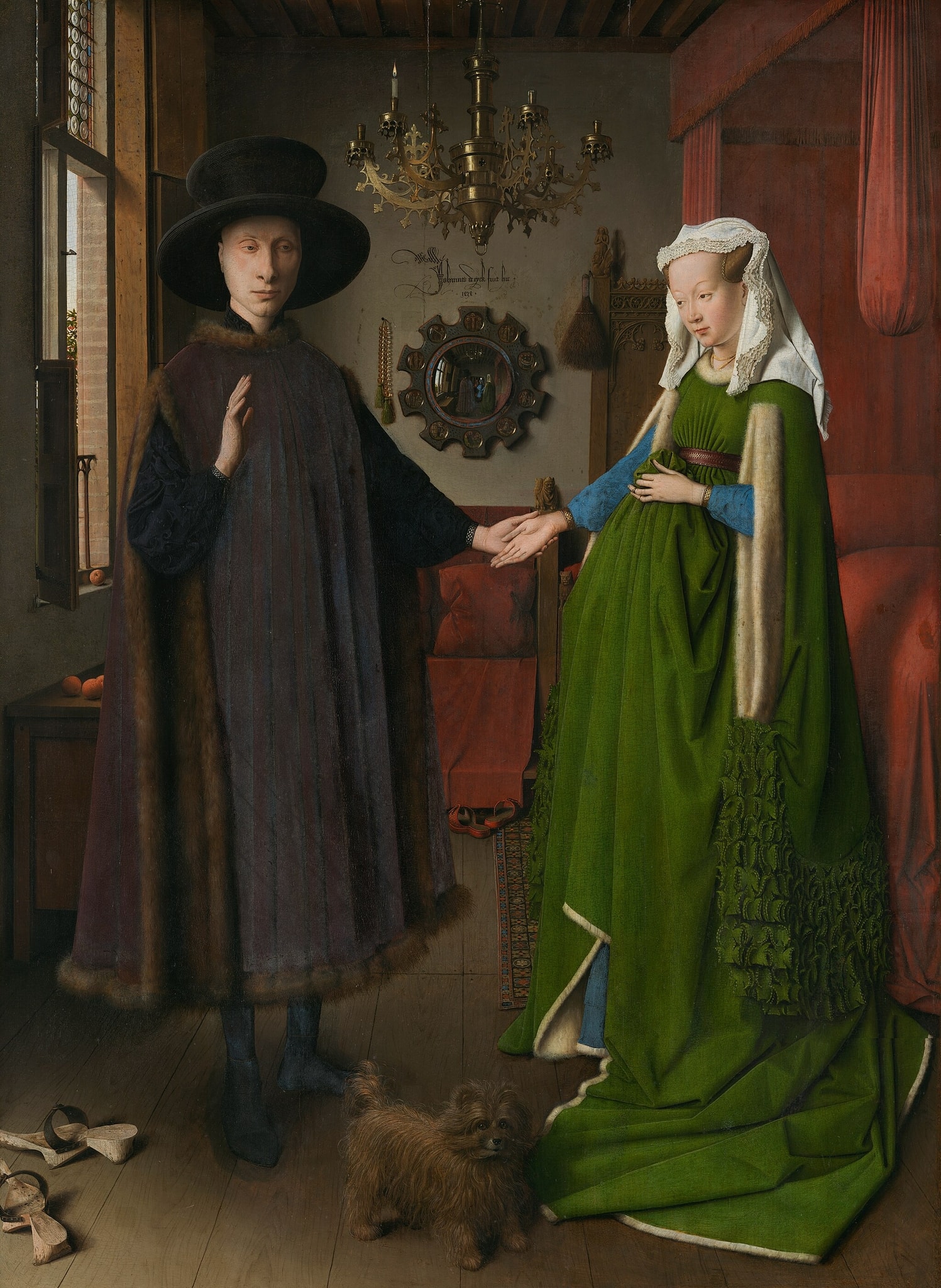
Two pairs of discarded pattens — the man’s pale wooden overshoes at lower left and the woman’s red leather‑covered pair beside the bed — quietly stage a passage from street to chamber in Jan van Eyck’s Arnolfini Portrait. Rendered with forensic clarity, they fuse everyday practice with meanings that scholars have debated for nearly a century.
Historical Context
In Bruges around 1434, pattens were standard overshoes worn outdoors to lift the foot above mud and refuse. Van Eyck depicts not one but two pairs: the man’s pale, strapped wooden pattens, spattered with dirt and scuffed along their inner edges, lie near the picture plane at lower left; the woman’s red, leather‑covered pattens with brass studs rest to the right, beside the bed. The National Gallery’s catalogue and audio guide document these precise materials, colors, and signs of wear, anchoring the scene in believable domestic routine 12.
Such footwear was commonly removed on entering interiors. By showing both pairs set aside, van Eyck signals that the couple has crossed the threshold from street to room — an action consistent with period custom and with his broader commitment to observed detail. The shoes help date and localize the setting, convey status through fine materials (notably the red, metal‑trimmed pair), and exemplify the painter’s aim to make a portrait read as lived reality, not staged allegory. Their placement corroborates the left‑hand light and the viewer’s implied entry from that side, integrating social practice with spatial design 12.
Symbolic Meaning
Erwin Panofsky’s classic reading made the removed shoes a linchpin of “disguised symbolism.” Drawing on Exodus 3:5, he proposed that setting footwear aside evokes standing on holy ground — evidence, for him, that the image records a solemn, possibly nuptial act enacted in a sanctified domestic space 4. In this view, everyday objects bear latent theological charge: shoes off equals reverence, culminating in a sacramental reading of the couple’s joined hands and the painter’s signature above the mirror.
Subsequent scholarship has pushed back. Lorne Campbell argues that the man has not gone barefoot but has only taken off his outdoor pattens; he still wears indoor shoes, which undercuts the “holy ground” inference and favors a strictly practical explanation tied to household etiquette and van Eyck’s realism 1. Survey sources sometimes float alternatives — wedding gifts or a generalized sign of sacred precinct — but these claims rest on weaker evidence than function and custom 7. Recent syntheses emphasize how the painting blends meticulous description with potential, not compulsory, symbolism: the shoes can register threshold, propriety, and status while remaining entirely plausible props in a portrait interior 5.
Artistic Technique
Van Eyck paints the pattens with microscopic specificity: pale wood that contrasts with darker floorboards, leather straps pinned to the soles, and tiny mud flecks that imply recent use; the woman’s pair glows with red leather and small metal studs that echo the room’s red textiles 12. Compositionally, the man’s wooden pattens anchor the foreground at lower left, aligning with the window’s light and the viewer’s approach, while the red pair balance the right side near the bed.
Technical imaging deepens the picture: infrared reflectography shows no underdrawing for either pair (also none for the dog and chandelier), indicating late‑stage additions painted over established passages. This suggests van Eyck fine‑tuned such objects as iconographic and spatial accents as the work progressed, sharpening both narrative plausibility and visual rhythm 3.
Connection to the Whole
The discarded pattens crystallize the painting’s governing dialectic: a threshold crossed from the muddy world outside to a curated interior. Placed left (man) and right (woman), they echo the composition’s subtle play between window/outside and bed/interior, situating the couple within a convincingly ordered home without imposing a fixed story 1.
They also model van Eyck’s signature strategy—realism that can carry meaning. Whether read as simple markers of propriety or as participants in a network of potential symbols, the shoes help the portrait feel inhabited and morally legible at once, a hallmark of Early Netherlandish art that later interpreters have framed as “realism plus possible symbolism” rather than a single allegorical code 58.
Explore More from This Painting
This detail is one part of The Arnolfini Portrait. Use the links below to return to the full interpretation, browse the full set of details, or view the painting's valuation if available.
Sources
- National Gallery (London), Lorne Campbell, The Arnolfini Portrait — catalogue entry
- National Gallery (London), Audio description: Jan van Eyck’s The Arnolfini Portrait
- National Gallery Technical Bulletin: Infrared reflectograms of van Eyck’s Arnolfini Portrait
- Erwin Panofsky, Jan van Eyck’s Arnolfini Portrait (1934), The Burlington Magazine
- Smarthistory, Jan van Eyck, The Arnolfini Portrait — essay and video transcript
- Web Gallery of Art, detail note on clogs/pattens (survey reference)
- Britannica, Early Netherlandish art (overview of disguised symbolism)