The Owl in the Fountain in The Garden of Earthly Delights
A closer look at this element in Hieronymus Bosch's c.1490–1500 masterpiece
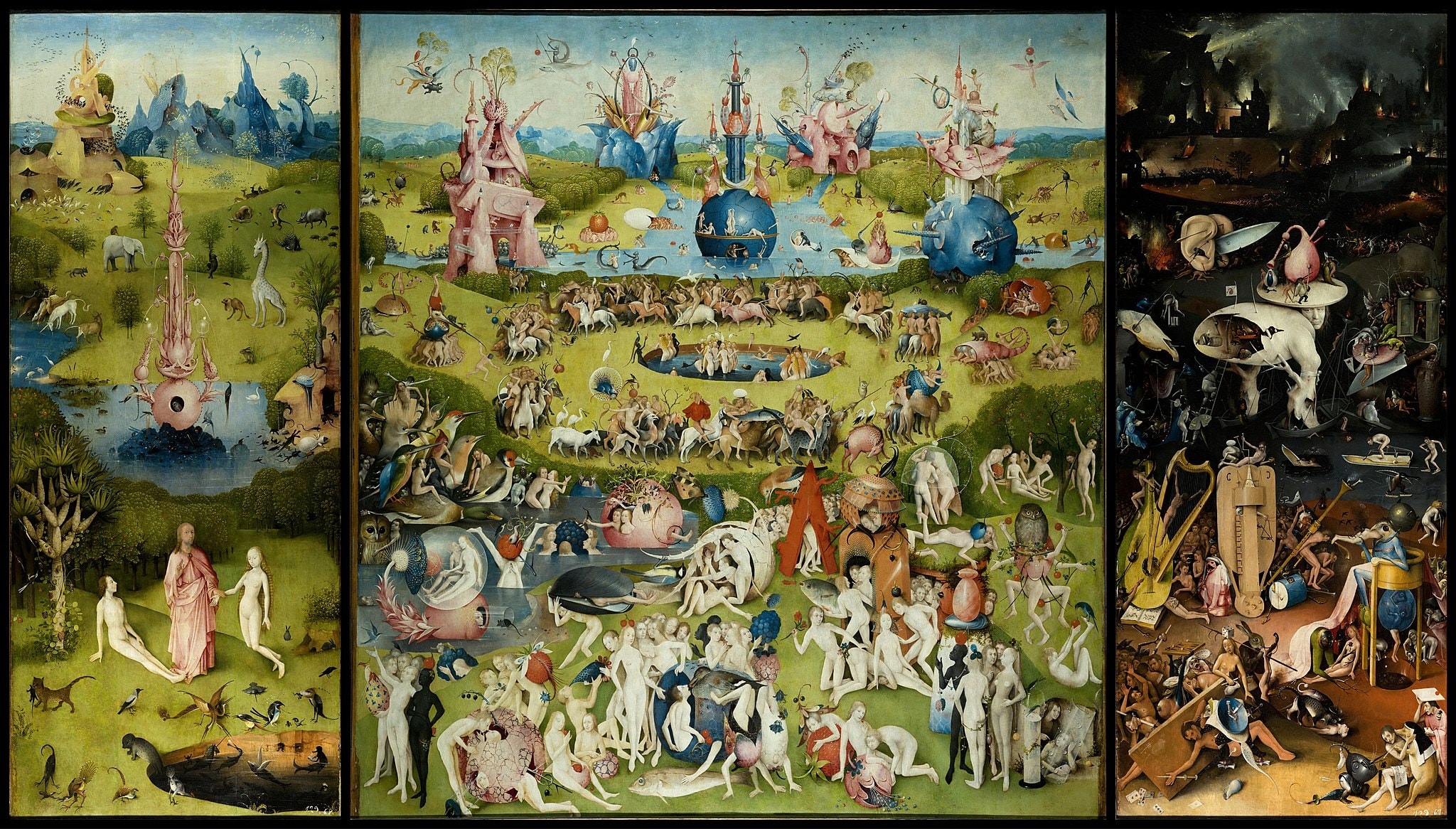
In the Eden panel of Bosch’s The Garden of Earthly Delights, a small owl peers from a dark aperture inside the pink, organic Fountain of Life—an eye-like center that watches over the union of Adam and Eve. Far from benign, this owl seeds the triptych’s moral arc: a quiet emblem of corruption planted at creation that will bloom into lust and, finally, damnation [1][2].
Historical Context
Painted around 1490–1500 in the northern Netherlands, The Garden of Earthly Delights stages a triptych narrative from creation to punishment. In the left panel’s Eden, Bosch sets a rose‑pink Fountain of Life over the waters of Paradise—an image tied to medieval motifs of the Four Rivers and paradisal spring. Within the fountain’s circular opening he places a diminutive owl, positioned at the visual core of the scene 1. Smarthistory notes how the pink roundel and black aperture function like an eye, the owl perched at its pupil and looking down toward the presentation of Eve to Adam 2.
Bosch’s choice of bird belonged to contemporary codes. In late medieval Netherlandish culture the owl signified night, moral blindness, and evil—a meaning Bosch employs throughout the triptych 3. The Prado further shows how this Eden fountain anticipates the center panel’s analogous water‑tower, now fractured and filled with carnal display, establishing a deliberate Eden‑to‑Fall progression 1. Technical study of the triptych confirms Bosch’s careful reworking of the Eden group’s placement—a compositional calibration the ‘watching’ owl presides over from the fountain’s core 4.
Symbolic Meaning
The owl inside Eden’s fountain is a concentrated sign of darkness intruding upon Paradise. Medieval Christian symbolism cast the owl as a creature that shuns daylight—the light of Christ—making it a cipher for folly, error, and evil 3. Smarthistory therefore reads Bosch’s owl as a “creature of darkness” installed at the painting’s center, where the aperture becomes a pupil and the fountain an enormous, surveilling eye 2. Within Bosch’s own visual vocabulary, museum scholars emphasize that owls in the triptych “evoke evil,” a meaning reinforced by the central panel’s enlarged, overt owls and by the bird‑headed tormentor in Hell 1.
This negative coding overrides the classical topos of the “wise owl.” Bosch’s audience would not have associated this bird with wisdom but with moral blindness and the devil’s workings—an interpretation argued theologically by Benno Zuiddam and aligned with broader medieval exegesis 7. By planting the owl in the life‑giving fountain—the very symbol of pristine creation—Bosch turns Eden into a site already shadowed by the Fall. The bird’s downward gaze toward Adam and Eve foreshadows desire’s derailment and binds the triptych’s three acts—innocence, indulgence, punishment—into a single, ominous motif 123.
Artistic Technique
Bosch renders the owl in tiny, cool browns and greys with bright, beadlike eyes, set against a deep black circular opening that punches high contrast amid surrounding blues and pinks. The dark aperture reads as a pupil framed by a roseate disc, a compositional device that makes the minuscule bird legible as the fountain’s ‘eye’ 25. Aligned near the panel’s vertical axis, the fountain and its ‘pupil’ connect visually with the trio of God, Adam, and Eve below, tightening narrative focus through placement rather than scale 2.
Surface finesse abounds: the fountain’s base glitters with jewel‑like details typical of Netherlandish miniaturism, enhancing the sense of precious, paradisal architecture 6. Conservation study indicates Bosch adjusted the Eden group’s position during painting, evidence of calculated orchestration around this axial structure that the owl anchors from within 4.
Connection to the Whole
The Eden owl inaugurates a cross‑panel leitmotif. In the central panel, the analogous water‑tower is broken and the owl’s niche is usurped by eroticized human display, transforming Paradise’s life‑spring into a theater of lust 1. Elsewhere a youth embraces a giant owl—Bosch’s blunt image of moral blindness—and the right panel culminates in a bird‑headed (owl‑type) devil who consumes and excretes sinners, completing the arc from seed to consequence 31.
Because period viewers read owls as emblems of darkness, the tiny bird inside the Fountain of Life would have operated as an immediate warning: creation already harbors its corruption. This single, strategically placed detail thus binds composition and meaning, steering the eye and the narrative from Eden’s promise to humanity’s fall and retribution 123.
Explore More from This Painting
This detail is one part of The Garden of Earthly Delights. Use the links below to return to the full interpretation, browse the full set of details, or view the painting's valuation if available.
Sources
- Museo Nacional del Prado, collection entry for The Garden of Earthly Delights
- Smarthistory, Bosch: The Garden of Earthly Delights
- EBSCO Research Starters: Hieronymus Bosch (symbolism and context)
- Museo del Prado, Technical study of The Garden of Earthly Delights (video)
- Wikimedia Commons, high‑resolution detail: Eden Fountain with owl
- Web Gallery of Art, Eden panel overview (fountain description)
- Medievalists.net summary of Benno Zuiddam, SAJAH 29.1 (2014), on the owl as devil’s sign
- Encyclopaedia Britannica, overview of The Garden of Earthly Delights