Tree Man in The Garden of Earthly Delights
A closer look at this element in Hieronymus Bosch's c.1490–1500 masterpiece
Bosch’s Tree Man is the eerie, pale centerpiece of the Hell panel in The Garden of Earthly Delights: a hollow, eggshell torso turned tavern, poised on rotting trunks that end in boats, and capped by a platform where devils circle a bagpipe. Lit like a beacon against the night, it condenses Bosch’s vision of appetite becoming prison—the body of vice made literal.
Historical Context
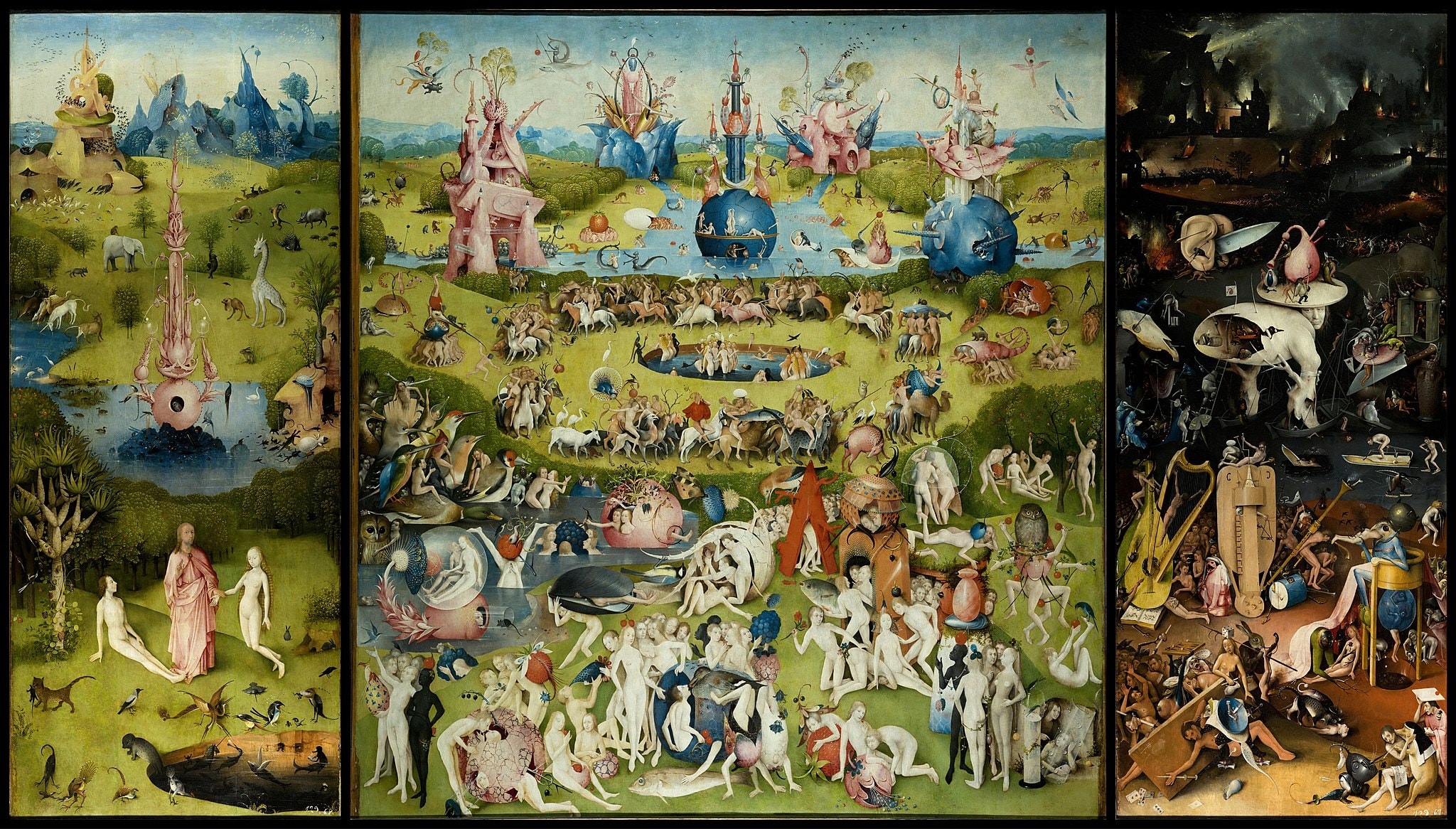
Painted c. 1490–1500 for a Burgundian‑Habsburg courtly audience and recorded in the Brussels palace of the Nassau family by 1517, The Garden of Earthly Delights was conceived as a sophisticated moral spectacle. Within this program the right‑hand panel shows Hell as a catalog of punishments for the cardinal sins. At its center Bosch placed the Tree Man: a pale, hybrid body whose eggshell torso opens as a tavern, whose trunk‑legs stand in small boats, and whose head supports a disk crowded with devils circling a bagpipe. The figure’s face looks out at us, fixing the viewer at the very heart of damnation 12.
The Prado situates the triptych as a sequential moral narrative—Creation, a deceptive world of delights, then retribution—and highlights how the Tree Man concentrates vices associated with courtly leisure: gluttony, gaming, and lust. The demons serving unclean fare inside the ‘inn,’ the laddered entry into the hollow body, and the musical platform above, all frame a spectacle of appetite turned captivity. In this setting, the Tree Man exemplifies the loss of divine likeness that the Hell panel dramatizes for elite viewers 12.
Symbolic Meaning
The Tree Man operates as a speculum of Luxuria—a mirror of vice that aggregates the temptations of courtly pleasure. Inside his eggshell torso, demons run an inn that feeds the damned with unclean fare, a pointed emblem of gluttony and unchecked appetite 2. Above, victims and tormentors parade around outsized bagpipes, a late‑medieval erotic sign; the instrument’s presence brands this as a ‘musical Hell’ in which festive sound is warped into punishment 34. The ladder into the body literalizes the surrender of will: sinners climb into the prison they have chosen 2.
Equally potent are symbols of instability and decay—the stump‑like legs planted in boats, the rotting trunks, the brittle shells—which figure the futility of earthly delights and the breakdown of the body 6. Bosch treated this hybrid body as a signature invention beyond the triptych, developing it in an autonomous pen drawing now in the Albertina (Der Baummensch), which underscores the motif’s programmatic force in his imagery 7. The self‑aware face that confronts the viewer has prompted proposals of a self‑portrait; Prado teaching materials even call the idea ‘probable,’ sharpening the figure’s role as a moral mirror held up to us 29.
Artistic Technique
Executed in oil on oak with minute, enamel‑like strokes, the Tree Man shows Bosch’s capacity for fine linear detailing—delicate flesh modeling, hairline cracks of the eggshell torso, and the crisp silhouettes of the bagpipe platform. Technical studies and recent IRR campaigns reveal a working process of revision and refinement across the triptych, confirming the deliberateness of this composite form 15.
In the Hell panel’s cold, nocturnal palette, Bosch sets the Tree Man in a higher key so the pale torso cuts through the darkness like a beacon. Its vertical thrust occupies the panel’s center, balancing the flanking chaos and acting as the composition’s anchor—much as emblematic verticals organize the other wings—so the viewer’s eye locks onto this embodiment of vice 61.
Connection to the Whole
The triptych moves from Eden to a seductive ‘garden’ of delights and ends in Hell; the Tree Man is the keystone of that final act. It gathers the painting’s recurring pleasures—food, sex, spectacle, games—and converts them into instruments of bondage, making the moral arc legible at a glance 12. Structurally, the Tree Man mirrors the central verticals that focus the other panels (e.g., the Eden fountain), creating a visual rhyme that binds the narrative together. Surrounded by musical tortures and clerical satire, it stands as Hell’s organizing emblem, the composite ‘body of vice’ that translates the center panel’s transient delights into their eternal consequence 26.
Explore More from This Painting
This detail is one part of The Garden of Earthly Delights. Use the links below to return to the full interpretation, browse the full set of details, or view the painting's valuation if available.
Sources
- Museo Nacional del Prado – Object record: The Garden of Earthly Delights Triptych
- Museo Nacional del Prado – Enciclopedia (Pilar Silva): Jardín de las delicias, El [El Bosco]
- HNA Reviews – Review of Reindert Falkenburg, The Land of Unlikeness
- Early Music Muse – Bosch’s musical Hell and bagpipes as erotic emblem
- Yale University Press – Time and Transformation: Hieronymus Bosch’s Process
- Web Gallery of Art – Right wing (Hell) detail and Tree Man commentary
- Albertina (Vienna) – Der Baummensch (Tree‑Man) drawing
- Museo del Prado – El Bosco, una historia en imágenes (interactive)