How Much Is Approach to Venice Worth?
Last updated: May 6, 2026
Quick Facts
- Methodology
- comparable analysis
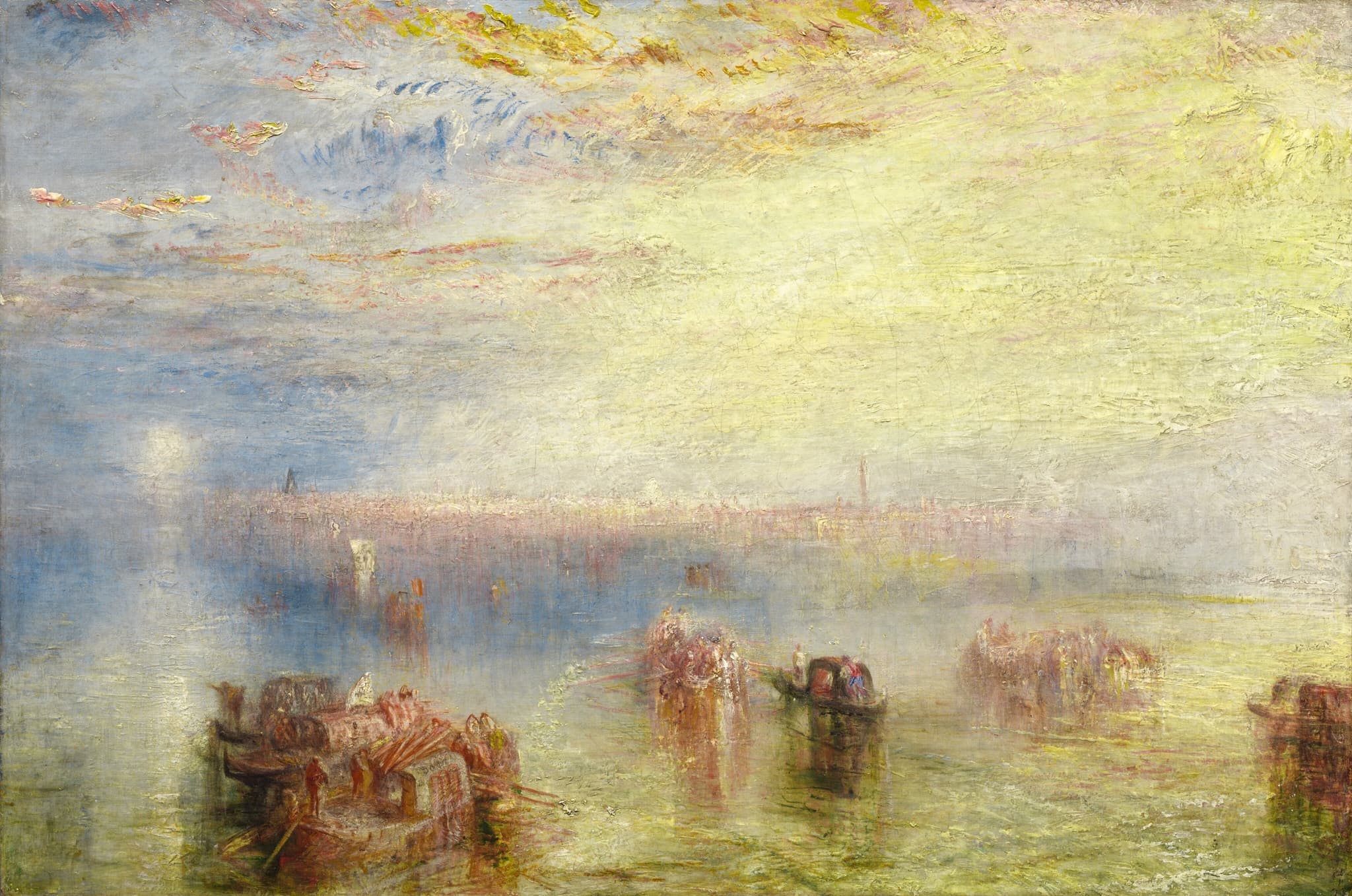
Assuming the canonical 1844 oil painting Approach to Venice (National Gallery of Art, Washington), the likely market value today is $60–90 million. This estimate is anchored to Turner’s top late Italian city-view oil results and adjusted for trophy scarcity and current Old Masters dynamics.
Valuation Analysis
Scope. This valuation assumes the canonical 1844 oil on canvas, Approach to Venice, in the Andrew W. Mellon Collection at the National Gallery of Art, Washington. It is a signature late Turner Venetian masterpiece, extensively published and exhibited, and it has not appeared at public auction in the modern era [1].
Method and benchmarks. With no modern sale for this specific painting, the estimate is anchored to best-in-class late Turners of comparable stature. The artist’s auction record is Rome, from Mount Aventine (1835), sold for £30.3m ($47.4m at the time) in 2014 [2]. Closely related is Modern Rome – Campo Vaccino (1839) at £29.7m in 2010, and a prime Venetian oil, Giudecca, La Donna della Salute and San Giorgio, realized $35.856m in 2006 [3]. A major late Turner oil of comparable ambition, Ehrenbreitstein (1835), made £18.5m in 2017, representing a step down in subject magnetism versus Venice or Rome [4]. Adjusted to 2026 dollars, the 2010–2014 Rome results imply a mid-$60m baseline for a work of this tier, before subject- and scarcity-premia.
Subject and scarcity premia. Venice is one of Turner’s most coveted motifs, and Approach to Venice is widely regarded as a pinnacle of his luminous late style. Trophy demand for blue-chip Venetian cityscapes remains robust, as evidenced by Canaletto’s Venice, the Return of the Bucintoro setting a £31.94m/$43.9m record in 2025—a cross-artist signal of depth at the top for iconic Venetian subjects [5]. Supply of museum-caliber late Turner oils is exceptionally tight (many leading works are institutionalized), which typically amplifies competition when a masterpiece-quality example surfaces.
Market context and positioning. While global art sales contracted in 2024 and Old Masters totals declined by value, the segment has shown a pronounced “flight to quality”: masterpiece-level works continue to outperform even in thinner markets [6], with the 2025 Canaletto result underlining the point [5]. Against this backdrop, Approach to Venice would be positioned to test or exceed inflation-adjusted Turner benchmarks. The low end of $60m reflects the 2010–2014 comparables and current liquidity; the midpoint ($70–80m) captures the Venice subject premium and iconic status; and the high end ($90m) allows for intense trophy competition in a marquee sale.
Conclusion. On a comparable and scarcity-adjusted basis, the fair market range is $60–90 million. A pristine condition report, first-rate scholarly dossier, and top-tier sale context could push the result to the upper bound or beyond; conversely, material condition or provenance issues could compress outcomes toward the lower bound. Replacement (insurance) values for institutional loans would plausibly exceed prior Turner public records, but such figures are typically undisclosed [1][2][3].
Key Valuation Factors
Art Historical Significance
High ImpactApproach to Venice (1844) is one of Turner’s consummate late masterpieces, encapsulating the luminous, dissolving atmospherics that define his final phase and his poetic vision of Venice. The picture is frequently reproduced in Turner scholarship and exhibition literature, and it was recognized in the 19th century as a work of special importance. As a culmination of the artist’s Venetian preoccupations—light, reflection, procession, and the city’s spectral grandeur—it stands in a tight peer group with the great Rome and apex Venetian oils. That stature anchors the estimate in the same band as Turner’s record-setting late Italian city views and justifies a subject premium over non-Venetian late works.
Subject and Period Quality
High ImpactVenice is Turner’s most commercially magnetic subject alongside Rome, and this canvas presents a quintessential lagoon view in his radiant late style. Market history shows persistent premiums for Turner’s Italian cityscapes, particularly those balancing architecture, water, and atmospheric light. Approach to Venice aligns precisely with that sweet spot: it is an exhibition-format, matured late work that distills the artist’s signature virtues (luminous color, vaporous light, and dynamic marine life). Cross-artist evidence—such as record pricing for top-tier Canalettos—confirms robust demand for blue-chip Venetian images, reinforcing the subject premium that elevates this work above otherwise comparable non-Venetian late oils.
Provenance and Institutional Visibility
High ImpactThe painting’s residency in the National Gallery of Art, Washington (Andrew W. Mellon Collection) confers supreme credibility. Its 19th‑century provenance includes leading collectors and recognized dealers, culminating in Mellon’s acquisition and 1937 gift to the NGA. Deep institutional visibility—cataloguing, display, and inclusion in authoritative literature—magnifies both scholarly significance and market confidence. If deaccessioned (purely hypothetically), the work would arrive on the market with a gold-standard pedigree readily comprehensible to museums and private buyers alike. That provenance would likely attract robust third‑party guarantees and marquee‑sale placement, two mechanisms that have underpinned peak Turner results.
Rarity and Supply Dynamics
High ImpactMasterpiece‑level late Turner oils are exceptionally scarce in private hands. Many of the finest works are in the Tate (Turner Bequest) or other museums, severely constraining supply. When a top-caliber late Turner does appear, it typically catalyzes international competition and can outperform model estimates. This structural scarcity is a core driver of the $60–90 million range: it allows an iconic subject like Approach to Venice to command pricing above inflation‑adjusted precedents for Rome and other Italian views. In a market that has polarized toward trophy assets, rarity functions as an amplifier, increasing both the likelihood and the magnitude of record‑challenging bids.
Sale History
Approach to Venice has never been sold at public auction.
J. M. W. Turner's Market
J. M. W. Turner is among the most valuable pre‑20th‑century British artists. His top results concentrate in late, exhibition‑scale oils of Venice and Rome, where his luminous style is most fully realized. The artist’s auction record is Rome, from Mount Aventine at £30.3m ($47.4m at the time; 2014), followed closely by Modern Rome – Campo Vaccino (2010). A major Venetian oil achieved $35.856m in 2006, and a late Rhenish oil reached £18.5m in 2017. Watercolors provide liquidity in the mid six to low seven figures, with prime Swiss and coastal views clearing $1–3m. Supply of museum‑caliber oils is extremely thin, and when examples surface, they draw global museum and private capital, often with guarantees and marquee placement.
Comparable Sales
Giudecca, La Donna della Salute and San Giorgio
J. M. W. Turner
Same artist; late 1830s–1840s Venetian oil with a closely related lagoon/architecture subject and exhibition-format scale; blue-chip trophy result.
$35.9M
2006, Christie's New York
~$56.6M adjusted
Rome, from Mount Aventine
J. M. W. Turner
Same artist; late master oil from the Italian city series, similar period/handling and market tier; set Turner’s auction record.
$47.4M
2014, Sotheby's London
~$64.0M adjusted
Modern Rome – Campo Vaccino
J. M. W. Turner
Same artist; late Italian city view, luminous late style oil and exhibition-scale—direct peer to the Venice masterworks in market stature.
$44.9M
2010, Sotheby's London
~$66.0M adjusted
Ehrenbreitstein, or The Seat of the Electors of Trier
J. M. W. Turner
Same artist; 1835 late-phase oil of comparable ambition and scale, museum-caliber; subject is Rhenish rather than Venetian, so slightly less directly comparable.
$24.0M
2017, Sotheby's London
~$31.4M adjusted
The approach to Venice or Venice from the lagoon (watercolor)
J. M. W. Turner
Same artist and essentially the same subject/title and date range; medium is watercolor on paper (lower tier than a major oil) but confirms buyer appetite for the motif.
$328K
2025, Christie's New York
Current Market Trends
Old Masters values softened by aggregate in 2024 amid a broader market slowdown, yet the segment remains decisively two‑speed: mid‑tier material can struggle, while masterpieces command energetic bidding and can set records. In 2025, a Canaletto Venice view reset the artist’s record at £31.94m/$43.9m, signaling that capital remains available for best‑in‑class historic pictures, particularly iconic cityscapes. For Turner, this polarization favors late oils of Venice and Rome with superior provenance and exhibition histories. Against structurally tight supply, trophy buyers continue to prioritize rarity, condition, and fame—factors that position Approach to Venice at the very apex of demand even in a selective market.
Sources
- National Gallery of Art: Approach to Venice (1844)
- The Guardian: JMW Turner’s Rome from Mount Aventine sets £30m record (2014)
- Christie’s: Giudecca, La Donna della Salute and San Giorgio achieves $35.856m (2006, press release)
- Sotheby’s: Records & Rediscoveries—Top 10 Old Masters of 2017 (includes Ehrenbreitstein result)
- Christie’s: Classic Week led by Canaletto’s record-breaking masterpiece (2025)
- The Art Newspaper: Global art sales fell 12% in 2024—Art Basel & UBS Report (2025)