How Much Is The Burning of the Houses of Lords and Commons Worth?
Last updated: May 6, 2026
Quick Facts
- Methodology
- extrapolation
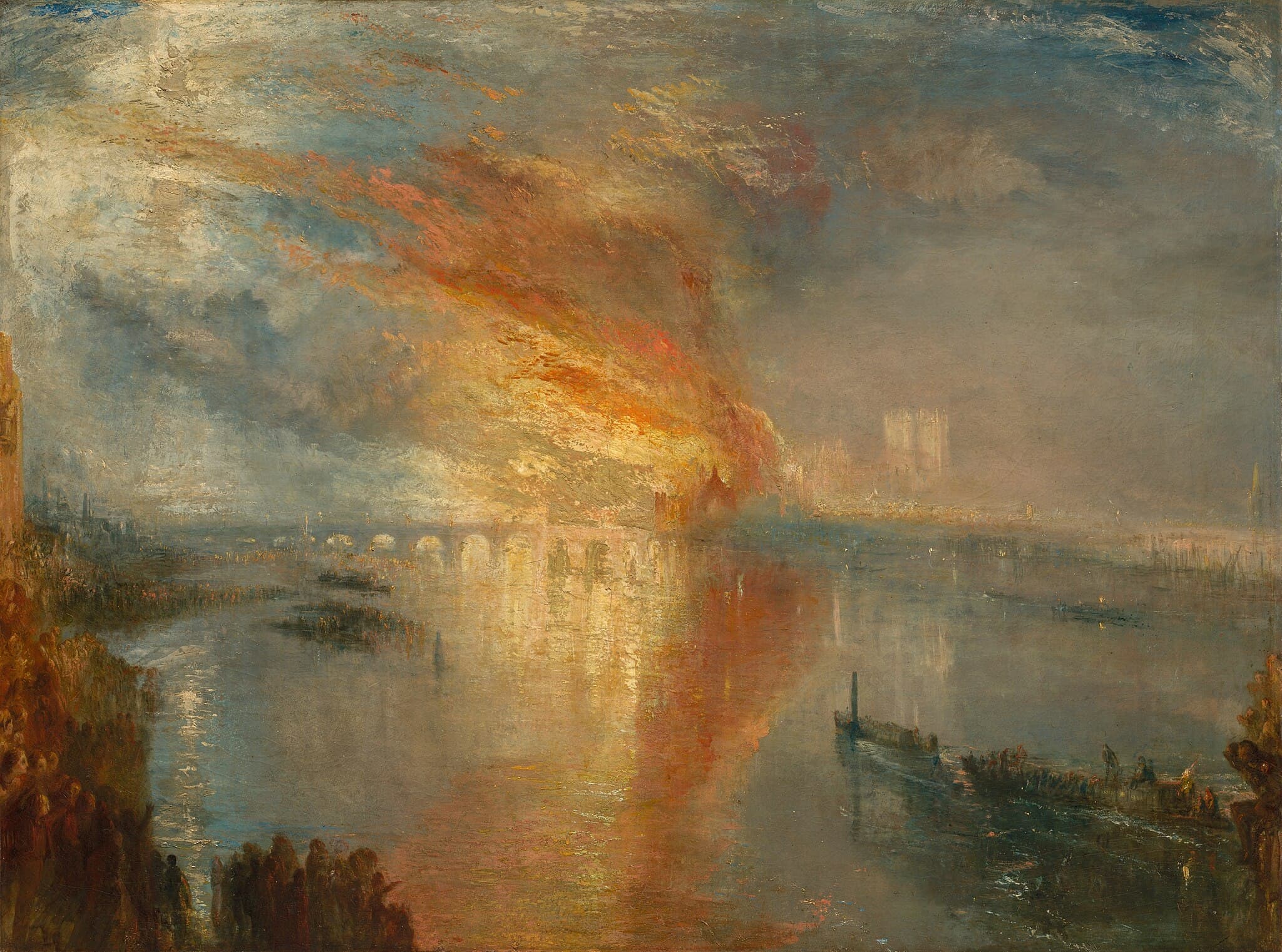
If one of Turner’s two prime large oils of The Burning of the Houses of Lords and Commons (1834–35) were offered today, we estimate it would achieve $100–150 million. This range extrapolates from Turner’s standing oil-painting record and adds a significant premium for the subject’s A+ status, extreme rarity (both prime versions are museum-held), and current trophy-market dynamics. Autograph but smaller oils or watercolours of the subject would price materially lower.
Valuation Analysis
What is being valued. The estimate here applies to either of the two prime, large oil canvases of J. M. W. Turner’s The Burning of the Houses of Lords and Commons, painted 1834–35 (each c. 92 × 123 cm). One version is in the Cleveland Museum of Art and the other in the Philadelphia Museum of Art; both are iconic late works that epitomize Turner’s atmospheric color and modern subject matter, and neither is on the market [1][2].
Method and benchmarks. Because these specific oils have not traded in the modern auction era, we extrapolate from the top of Turner’s market and apply an “iconic subject” premium. Turner’s auction record is Rome, from Mount Aventine, sold at Sotheby’s London in 2014 for £30.3m (≈$47.4m), a work close in date, size, and ambition to the Burning canvases [3]. Another major late oil, Ehrenbreitstein (1835), realized £18.53m in 2017 [4]. These anchor a base range in the mid–eight figures for a first‑tier late Turner oil.
Why this subject commands more. The Burning of the Houses of Lords and Commons is not just a virtuoso display of light and color; it records a defining event in British history (16 October 1834) and is among Turner’s most reproduced and taught images. Its combination of headline historical subject, dazzling pyrotechnics, and mature style places it on a very short list of the artist’s signature pictures. Scarcity is acute: the only two prime versions reside in major U.S. museums, which dramatically elevates the hypothetical price of any comparable example and supports a step‑change above the artist’s extant record [1][2][3].
Market context and timing. At the top end, Old Masters and Romantic pictures have shown renewed strength since 2025 when high‑quality consignments appeared; rediscoveries and blue‑chip names drew deep bidding, as seen with a rediscovered early Turner oil selling around £1.9m in July 2025—evidence of engaged, competitive demand across the artist’s oeuvre [5]. In today’s trophy‑driven market, a museum‑caliber Turner with global name recognition and impeccable provenance would likely attract both private collectors and institutions, driving pricing well beyond prior benchmarks.
Conclusion. On that basis, we estimate $100–150 million for a canonical 1834–35 large oil of this subject, assuming excellent condition, unencumbered title, and standard sale terms. Smaller autograph oils related to the subject would likely fall in the $10–30 million range, and autograph watercolours in roughly $3–10 million, depending on quality and provenance. The $100–150 million range reflects an informed, market‑tested extrapolation above the artist’s record to account for the image’s iconic status and near‑absolute scarcity [3][4][5].
Key Valuation Factors
Art Historical Significance
High ImpactThis subject sits at the heart of Turner’s mature achievement and public reputation. Painted immediately after witnessing the 16 October 1834 conflagration, the two prime oils fuse topographical acuity with Turner’s late, incandescent handling of light and color to narrate a pivotal moment in British history. The pictures are among his most frequently reproduced works and are staples of museum teaching and scholarship. Within Turner’s oeuvre, they occupy the same prestige tier as Rain, Steam and Speed, The Slave Ship, and The Fighting Temeraire. That stature translates directly into market power: when a work is a canonical touchstone—instantly legible even to non‑specialists—it commands a durable and often outsized premium.
Rarity and Scarcity
High ImpactThere are only two prime, large oil versions of this subject, both completed c.1834–35 and both held by major U.S. museums (Cleveland and Philadelphia). As a result, true like‑for‑like comparables are effectively off‑market, and any hypothetical opportunity to acquire one would be a once‑in‑a‑generation event. Turner’s very best oils seldom appear at auction; supply scarcity is the single strongest driver of step‑change pricing in the Old Masters/Romantic segment. For an image of this renown, scarcity is amplified by broad institutional interest and global brand recognition, creating a deep potential bidder pool and supporting a level well above the artist’s already formidable auction benchmarks.
Market Benchmarks and Trophy Dynamics
High ImpactTurner’s current oil record—Rome, from Mount Aventine at £30.3m ($47.4m in 2014)—and the £18.5m result for Ehrenbreitstein (2017) define the top of his public market. Since 2014, trophy‑level prices across categories have risen, and bidding for blue‑chip historical masters has re‑intensified when best‑in‑class works appear. A rediscovered early Turner oil drawing intense competition in 2025 further evidences active demand. Given Burning’s A+ subject, international fame, and extreme rarity, an extrapolation above these records is warranted. The $100–150 million range reflects a realistic premium for a work that would reset the artist’s market and attract crossover buyers from Impressionist, Modern, and Contemporary segments.
Provenance, Exhibition, and Condition
High ImpactBoth prime versions have long, well‑documented provenances and have resided in major institutions for decades—an indicator of curatorial endorsement that typically commands a premium. In any hypothetical sale, condition would be pivotal: large late Turners can be sensitive to overcleaning or past restorations. Assuming an excellent, stable state with no material overpaint and strong color preservation, the price impact would be maximal; notable condition compromises could reduce the ceiling materially. Extensive literature citations and loan histories for these works further enhance market confidence and buyer willingness to pay a record‑resetting price, should a museum‑grade example ever be deaccessioned or privately offered.
Sale History
The Burning of the Houses of Lords and Commons has never been sold at public auction.
J. M. W. Turner's Market
J. M. W. Turner stands at the apex of the British and Romantic landscape market. His finest oils—especially large late works from the 1830s–1840s—are considered blue‑chip trophies with global appeal. The artist’s auction record is $47.4 million for Rome, from Mount Aventine (Sotheby’s London, 2014), with other marquee oils selling between roughly $20 million and $45 million over the last two decades. High‑quality watercolours routinely achieve seven figures, with the very best historically reaching the mid‑single‑digit millions. Supply of top‑tier oils is extremely limited because many masterpieces are in public collections. When exceptional quality appears, bidding is deep and international, and results can surpass estimates decisively.
Comparable Sales
Rome, from Mount Aventine
J. M. W. Turner
A+ late Turner oil (1835), near-identical size and date to the Burning canvases; canonical cityscape trophy and current auction record for the artist.
$47.4M
2014, Sotheby's London
~$64.5M adjusted
Modern Rome – Campo Vaccino
J. M. W. Turner
A+ late Turner oil (1839), large Roman cityscape of comparable scale and prestige; key benchmark at the top of the Turner market.
$44.9M
2010, Sotheby's London
~$66.5M adjusted
Ehrenbreitstein, or the Seat of Ehrenbreitstein
J. M. W. Turner
Major late Turner oil (1835) of similar period/scale; strong institutional-level subject and light effects, sold at top-tier evening sale.
$24.0M
2017, Sotheby's London
~$31.4M adjusted
Giudecca, La Donna della Salute and San Giorgio
J. M. W. Turner
Iconic late Venetian view (1841), large oil and former record at the time; close in period, ambition, and market tier to the Burning canvases.
$35.8M
2006, Sotheby's New York
~$57.3M adjusted
Current Market Trends
Old Masters and 19th‑century Romantic works experienced a softer 2024 but rebounded in 2025–26 as quality consignments returned and trophy demand re‑engaged. Records for canonical names and strong sell‑throughs underscore a selective, two‑speed market: mid‑tier material remains price‑sensitive, while exceptional, fresh‑to‑market works with clear attribution and strong provenance can achieve outsized results. In this context, Turner benefits from renewed institutional programming (e.g., Turner 250) and steady collector interest. For a museum‑caliber, iconic Turner oil, current conditions would likely support aggressive bidding and a new artist record, particularly given the near‑total scarcity of comparable works in private hands.
Sources
- Cleveland Museum of Art – The Burning of the Houses of Lords and Commons (Object 1942.647)
- Philadelphia Museum of Art – The Burning of the Houses of Lords and Commons (Object 103831)
- The Guardian – Turner painting sells for record £30m at Sotheby’s (2014)
- Sotheby’s – Turner leads Old Masters Evening Sale (Ehrenbreitstein, 2017 result)
- The Art Newspaper – £500 Turner painting sells for almost £2m (July 2025)