How Much Is Portrait of Madame Moitessier Worth?
Last updated: April 18, 2026
Quick Facts
- Methodology
- extrapolation
Portrait of Madame Moitessier (Ingres, 1856) is a canonical, museum‑held masterpiece (National Gallery, London) and is effectively not available on the open market. If hypothetically transferable, a realistic projected auction/private‑sale range is $100–150 million, reflecting extreme scarcity, institutional desirability and likely competitive bidding.
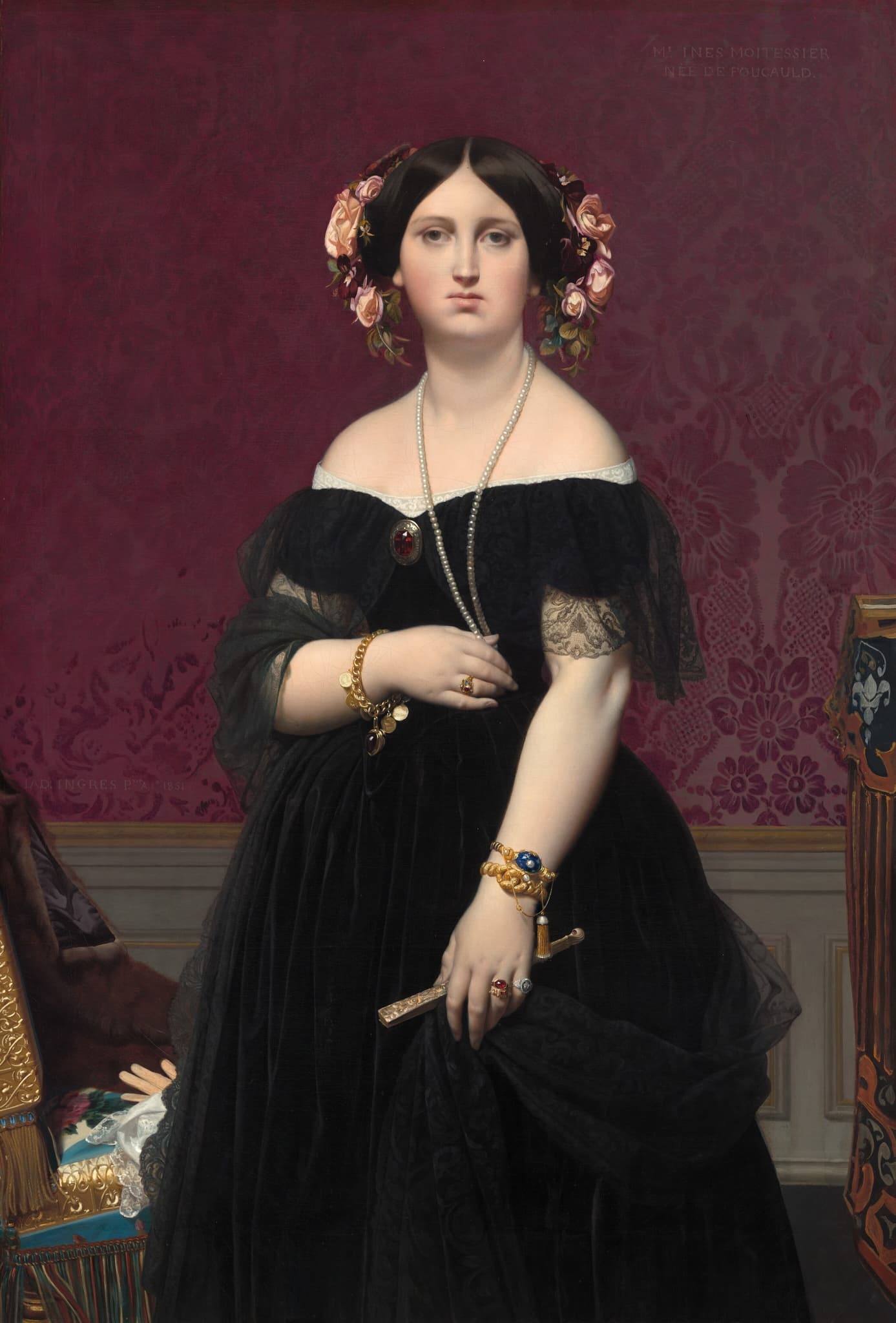
Portrait of Madame Moitessier
Jean-Auguste-Dominique Ingres, 1856 • Oil on canvas
View more by Jean-Auguste-Dominique Ingres →Valuation Analysis
Portrait of Madame Moitessier (Ingres, 1856) is one of the artist's signature late portraits and is in long‑term institutional care (National Gallery, London; inv. NG4821). Because the canonical 1856 canvas has been museum‑owned since acquisition in 1936 and is widely exhibited and published, it has no modern public‑auction sales history and is effectively not saleable under ordinary market conditions [1].
The valuation given here is necessarily hypothetical and derived by extrapolation from available market data for Ingres works (drawings, small oils and occasional lesser portraits), the behaviour of trophy 19th‑century portraits, and precedent private/trophy sales. Direct auction comparables for the 1856 canvas do not exist; relevant market touchpoints include high‑quality Ingres drawings that have realised near‑million euro figures, occasional Ingres oils selling in the low‑millions (for example, an Ingres oil from the Jayne Wrightsman collection realised c.$1.7M at Christie’s New York in 2020), and portrait trophies in other schools that have achieved eight or nine‑figure private sale results. These data and dynamics inform the range below [2].
Valuation conclusion: assuming the painting were legally transferable and in museum‑quality condition, I estimate a realistic market range of $100–150 million. This range reflects the painting's exceptional art‑historical standing, its near‑absence from the market, and the strong probability of intense competition from museums, foundations and wealthy private collectors. In constrained institutional sale scenarios the painting could realise tens of millions; in an open, highly competitive trophy campaign it is reasonable to expect nine‑figure bids that align with the range above. The lower bound is conservative relative to extreme trophy outcomes, the upper bound assumes multiple well‑capitalised rivals and strong publicity [2].
Material contingencies remain: the painting's condition and any conservation history, clear title and absence of donor restrictions, applicable export or patrimony rules, and the choice of sale mechanism will each exert decisive influence on final price. Because the work is under public stewardship, deaccession and export processes would likely be required and could meaningfully suppress or prevent a market sale. Any formal transactional valuation must therefore be contingent on legal clearance and a full technical/condition report.
Operationally, a sale—if permitted—would be executed as a bespoke campaign with simultaneous discreet outreach to institutions and private buyers, specialist cataloguing and underwriting discussions with insurers. The estimate provided is a market‑facing projection informed by comparables and trophy precedents and should be used as a transactional planning range, not a guaranteed auction outcome or insured replacement value.
Key Valuation Factors
Art Historical Significance
High ImpactMadame Moitessier occupies a central place in Ingres's late oeuvre: the 1856 seated portrait exemplifies his mastery of line, surface and idealisation and is frequently reproduced in survey histories and exhibition catalogues. That canonical status increases institutional urgency to acquire or retain the work because it materially enhances curatorial narratives, exhibition draw and scholarship. In market terms, art historical prominence creates a multiplier effect relative to ordinary Ingres works: institutions and top collectors are prepared to pay a substantial premium for a museum‑quality canvas that fills a clear historical or curatorial gap. This factor therefore exerts a high upward pressure on valuation, assuming transferability and excellent condition.
Provenance & Ownership
High ImpactThe painting's provenance—acquired by the National Gallery in 1936 (via Jacques Seligmann from the sitter's descendants)—is exemplary and eliminates most provenance‑related buyer discounts. Museum custody both validates attribution and drives scholarly visibility through loans and publications. However, institutional ownership simultaneously removes the work from routine market circulation, making it effectively supply‑restricted. For valuation this is a dual effect: impeccable provenance increases theoretical value and buyer confidence, while historic museum ownership means an actual sale would be exceptional and likely subject to special political and procedural scrutiny.
Market Rarity & Supply
High ImpactLarge canonical Ingres oil portraits are extremely rare on the secondary market because most are retained by major museums. This acute scarcity converts any available canonical canvas into a trophy lot, concentrating demand among a narrow set of deep‑pocketed institutions, foundations and private collectors. The rarity effect can produce non‑linear price outcomes: while drawings and lesser oils commonly trade in the hundreds of thousands to low millions, a bona fide museum‑quality masterpiece can command multiples of those sums. Scarcity therefore justifies extrapolating to nine‑figure territory for a transferable Madame Moitessier.
Condition & Conservation
Medium ImpactCondition is a material, inspectable factor. A painting in stable, well‑documented condition with limited interventive restoration will support the high end of the range; conversely, structural problems, heavy overpainting or unresolved conservation interventions reduce market appetite and price. For a trophy canvas, technical authentication—infrared, pigment analysis, varnish stratigraphy—and a recent condition report are prerequisites for underwriting and institutional purchases. While condition rarely eliminates demand for canonical works, it can trim the top‑end multiple and therefore is a medium‑impact factor in final price determination.
Legal & Institutional Constraints
High ImpactLegal, policy and institutional constraints are often decisive. Deaccession rules, donor covenants, national patrimony statutes and export licensing can prevent or severely limit sale of museum‑held works. For a painting in major public care, transfer typically requires board approval, transparent justification and sometimes governmental consent; these processes are politically visible and can deter broad competitive bidding. If the object is legally non‑transferable, market value is effectively zero. Any practical valuation or sale strategy must therefore be contingent on a legal opinion confirming free alienability.
Sale History
Portrait of Madame Moitessier has never been sold at public auction.
Jean-Auguste-Dominique Ingres's Market
Jean‑Auguste‑Dominique Ingres is a top‑tier 19th‑century French master whose draftsmanship is especially prized. Market activity is bifurcated: drawings and studies are the most liquid and can achieve high six or low seven figures when exceptional, while full‑scale canonical oils are overwhelmingly museum‑held and rarely appear at auction. When important Ingres canvases do come forward they attract concentrated demand but public‑sale benchmarks are sparse; realized oil prices historically cluster in the low millions for non‑canonical works. Scarcity and scholarly importance therefore drive any potential trophy pricing for canonical canvases.
Comparable Sales
Portrait de la comtesse de La Rue
Jean-Auguste-Dominique Ingres
A like-for-like Ingres oil portrait sold at a major house — directly relevant as a realized market data point for Ingres painted portraits, though it is a less canonical work than Madame Moitessier.
$2.7M
2009, Christie's, Paris
~$3.7M adjusted
Odalisque (from the Jayne Wrightsman collection)
Jean-Auguste-Dominique Ingres
Recent sale of an Ingres oil from a high‑profile private collection; demonstrates that non‑canonical Ingres oils have traded in the low‑millions in the modern market.
$1.7M
2020, Christie's, New York
~$2.0M adjusted
High‑quality Ingres drawing (reported Paris sale, c. €960,000)
Jean-Auguste-Dominique Ingres
Premium single‑sheet Ingres drawings can approach ~€1M; useful to show the strength of the artist's market for works-on-paper, though drawings are not directly equivalent to a large canonical oil portrait.
$1.1M
2014, Paris auction (reported)
~$1.4M adjusted
Study of the Arms and Hands of the Princesse Pauline de Broglie
Jean-Auguste-Dominique Ingres
Recent realized price for an Ingres study; indicates the liquidity and typical realized range for studies (five‑to‑low‑six‑figures), providing a useful floor for comparables.
$93K
2025, Van Ham (Cologne)
Portrait of Adele Bloch‑Bauer I
Gustav Klimt
Trophy‑portrait precedent showing the upper bound for high‑profile portraits with exceptional provenance/market interest. Different artist/period but useful to illustrate the ceiling in a trophy sale scenario.
$135.0M
2006, Private sale (to Ronald Lauder, reported)
~$195.8M adjusted
Current Market Trends
Top‑end Old Masters and museum‑quality 19th‑century works have seen selective strength recently, with trophy lots and premium drawings achieving competitive results while mid‑market material remains price‑sensitive. Ingres has not experienced a fresh public‑auction revaluation; attention has focused on drawings and occasional studio works. Demand is concentrated among institutions, foundations and a narrow set of ultra‑high‑net‑worth collectors. These dynamics support a high theoretical valuation for a transferable Madame Moitessier, but institutional caution and legal/policy constraints mean actual sales are infrequent and commonly handled by private treaty.