How Much Is The Last Supper Worth?
Last updated: May 5, 2026
Quick Facts
- Current Location
- Museo del Cenacolo Vinciano (Santa Maria delle Grazie)
- Methodology
- extrapolation
The Last Supper is an immovable, state-protected mural with no real-world sale pathway; any price is necessarily hypothetical. Using Leonardo’s record-setting market, the Mona Lisa’s historic insurance benchmark, and the work’s singular fame, a fully transferable, notional fair-market value is estimated at $1–3 billion. Condition and mural format temper the estimate below the Mona Lisa but well above any known auction result for a Leonardo.
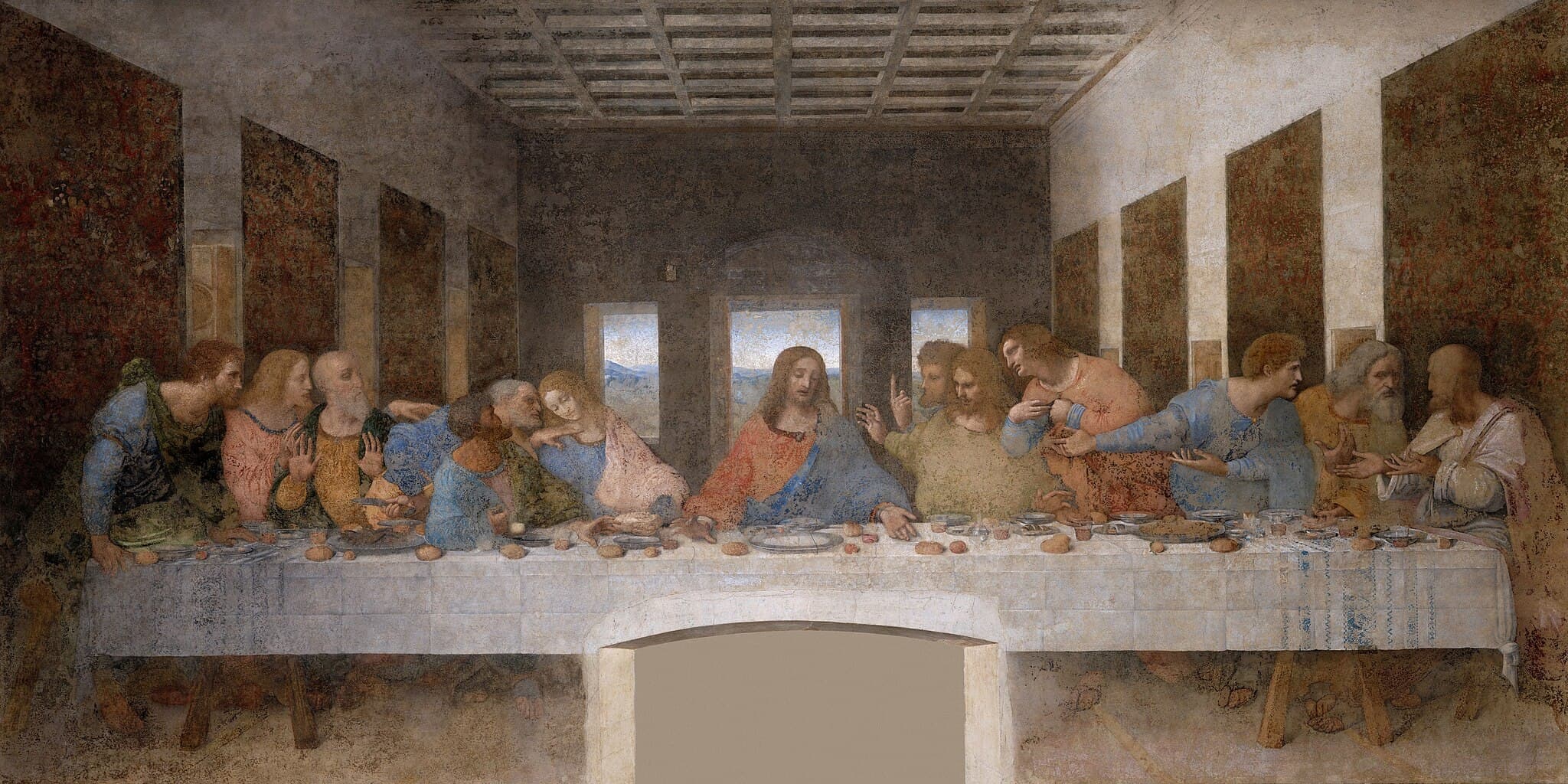
The Last Supper
Leonardo da Vinci, 1495–1498 • Experimental dry wall-painting (tempera/oil on dry plaster)
Read full analysis of The Last Supper →Valuation Analysis
Conclusion: The Last Supper is legally inalienable and physically immovable, so it has no practical market value. For planning and benchmarking only, a fully transferable, hypothetical fair-market value is estimated at $1–3 billion. This extrapolation anchors to Leonardo’s demonstrated demand ceiling and the painting’s near-peerless cultural stature, while applying a discount for condition and mural format.
Methodology and anchors: We triangulate from (1) Leonardo’s auction record—Salvator Mundi at $450.3 million—establishing the modern upper bound of spend on the artist at public sale [1], and (2) the Mona Lisa’s $100 million insurance valuation for its 1962 U.S. tour—roughly on the order of $1 billion in today’s dollars—signaling the policy-level scale assigned to an apex Leonardo icon [2]. Because The Last Supper ranks with the Mona Lisa in global recognition and art-historical importance, a value materially above $450 million is warranted in a hypothetical, fully transferable scenario.
Legal and physical constraints (context, not pricing inputs): The mural forms part of the refectory of Santa Maria delle Grazie in Milan and is protected under Italy’s Cultural Heritage Code (D.Lgs. 42/2004), which renders such public cultural property inalienable or subject to prohibitive constraints; export is effectively impossible [3]. The site is also a UNESCO World Heritage property, underscoring its immovable, integral status [5]. These facts eliminate real-world liquidity but are set aside here solely to model a theoretical market price.
Condition and conservation discount: Executed in an experimental oil/tempera on dry plaster, the painting deteriorated swiftly; it has undergone multiple restorations, most notably a comprehensive campaign concluded in 1999. An 1821 attempt to detach the mural caused further loss, confirming its non-transferability and fragile state [4]. In ordinary market terms, the extent of loss and overpaint would suppress price; in the case of a cultural icon of this magnitude, the condition penalty moderates—but does not eclipse—demand driven by authorship and fame.
Market positioning: Supply of autograph Leonardos is essentially nil, and even minor autograph works on paper can reach eight figures (e.g., Head of a Bear at $12.2 million) [6]. Only Leonardo has tested buyers’ willingness at the half-billion level [1]. On that basis, The Last Supper—if it could be legally and safely transacted—would likely attract sovereign, institutional, and ultra-high-net-worth competition at levels well beyond existing auction records. Balancing world-defining significance against its compromised condition and the practical challenges of a mural, a notional range of $1–3 billion is defensible for policy, risk, or strategic benchmarking. This figure is a thought-experiment, not a sale estimate or formal appraisal.
Key Valuation Factors
Art Historical Significance
High ImpactThe Last Supper is one of a handful of images—alongside the Mona Lisa—that define the canon of Western art. Leonardo’s revolutionary composition, psychological grouping of the apostles, and mastery of perspective made this mural a foundational statement of the High Renaissance. Its subject is universally resonant, reproduced across centuries and cultures, and permanently embedded in scholarly discourse, popular culture, and religious iconography. That singular prominence creates demand that transcends ordinary connoisseurship and national borders. In a hypothetical market, such significance places the work at the absolute apex of valuation, limited only by practical constraints (legality, transferability) and secondarily by condition. No other Old Master mural commands equivalent global name recognition or pedagogical centrality.
Legal and Physical Transferability
High ImpactAs a site-specific mural in the refectory of Santa Maria delle Grazie, the work is integrated into a protected architectural complex and is covered by Italy’s Cultural Heritage Code, which renders comparable public cultural property effectively inalienable and non-exportable. The site’s UNESCO World Heritage status reinforces this immovability. Historically, even attempts to detach the painting have caused damage, confirming that safe transfer is not feasible. For real-world valuation, these facts reduce market value to zero because no lawful sale path exists. For a hypothetical, fully transferable model, we set legal constraints aside to isolate brand, authorship, and cultural impact. Even then, the mural format introduces logistical and conservation risk that warrants a discount relative to an easel painting of similar fame.
Condition and Conservation
Medium ImpactLeonardo’s experimental technique—oil and tempera on dry plaster—proved unstable almost immediately, leading to rapid deterioration. The mural has undergone multiple campaigns of restoration, culminating in a comprehensive effort completed in 1999. Significant areas comprise later interventions over fragile original paint layers, and an 1821 detachment attempt inflicted further loss. In a standard market framework, such condition would materially depress value versus a well-preserved easel painting. For this icon, however, fame and authorship dominate pricing power; condition acts as a moderating factor rather than a determinant. In a notional valuation, the compromised state justifies a range below the Mona Lisa but far above any other Leonardo transaction, supporting a $1–3 billion bracket rather than an even higher figure.
Market Demand and Scarcity
High ImpactAutograph Leonardos in private hands are extraordinarily scarce, and when objects credibly by the master appear, demand is unparalleled. Salvator Mundi’s $450.3 million auction result remains the all-time price benchmark, demonstrating buyers’ willingness to compete at the highest levels for the Leonardo name. Even small autograph drawings can command eight figures. This extreme scarcity, combined with brand-level cultural magnetism, implies that a transferable, museum-grade Leonardo of defining importance would likely trigger sovereign, institutional, and UHNW bidding wars. In that scenario, the expected clearing price would exceed previous records by a wide margin. The Last Supper’s notoriety and pedagogical ubiquity lift it into a class of its own, with demand constrained mainly by feasibility, not appetite.
Sale History
The Last Supper has never been sold at public auction. It has been held by Museo del Cenacolo Vinciano (Santa Maria delle Grazie).
Leonardo da Vinci's Market
Leonardo da Vinci occupies the absolute apex of the Old Master market. Public opportunities to buy authenticated works by him are vanishingly rare, fueling intense global competition when they appear. The auction record is the $450.3 million sale of Salvator Mundi at Christie’s New York in 2017—the highest publicly recorded price for any artwork, even amid attribution debate. Works on paper also command exceptional sums; in 2021, Head of a Bear realized approximately $12.2 million at Christie’s London. Leonardo’s scientific manuscripts are coveted as well, with the Codex Leicester selling for $30.8 million in 1994. Supply scarcity and enduring cultural prestige anchor demand at the very top of the market, with collectors and institutions prepared to pay premiums for authenticated, high-importance works.
Comparable Sales
Salvator Mundi
Leonardo da Vinci
Same artist; rare autograph painting of Christ and the all-time auction record; demonstrates the demand ceiling for Leonardo (though portable, single-figure, and with debated attribution, unlike the site-specific mural).
$450.3M
2017, Christie's New York
~$582.9M adjusted
Portrait of a Young Man Holding a Roundel
Sandro Botticelli
Blue-chip Renaissance trophy painting by a peer master; top Botticelli auction result; shows depth of demand for early Renaissance icons (portable panel vs. mural).
$92.2M
2021, Sotheby's New York
~$107.9M adjusted
The Massacre of the Innocents
Peter Paul Rubens
Monumental, multi-figure religious narrative by a top Old Master; a market-defining trophy that indicates the upper bound for non-Leonardo Old Masters.
$76.7M
2002, Sotheby's London
~$135.1M adjusted
Head of a Young Apostle
Raphael
Direct peer; master drawing tied to The Transfiguration; shows the price ceiling for pinnacle Renaissance works on paper.
$47.8M
2012, Sotheby's London
~$66.0M adjusted
The Man of Sorrows
Sandro Botticelli
Devotional Christ subject by an early Renaissance master; strong recent data point for religious imagery at the top of the market (portable panel vs. mural).
$45.4M
2022, Sotheby's New York
~$49.2M adjusted
Codex Leicester (Hammer Codex)
Leonardo da Vinci
Same artist; record-setting manuscript that evidences willingness to pay for Leonardo’s intellectual legacy and brand beyond paintings.
$30.8M
1994, Christie's New York
~$65.9M adjusted
Current Market Trends
Old Masters have shown renewed resilience relative to more volatile contemporary segments. After a broader market slowdown in 2023–2024, 2025 saw stronger sell-through for high-quality, well-attributed works, with polarisation intensifying: masterpieces soar while average material lags. Trophy lots with impeccable authorship, strong provenance, and museum-level significance continue to attract guarantees and deep bidding benches. Renaissance material, while thinly supplied, benefits from institutional validation and sustained public interest in canonical names. Given the near-zero availability of autograph Leonardos, pricing signals must be extrapolated from the few top comparables and broader Old Master strength. In that context, a market for a transferable, apex Leonardo icon—were one to exist—would likely set new records by a large margin.
Study print
Study this painting as a print
Pair the full artwork with a museum-style study sheet focused on one meaningful detail.
Sources
- The Art Newspaper: Leonardo’s Salvator Mundi sells for $450m at Christie’s New York
- Guinness World Records: Highest insurance valuation for a painting (Mona Lisa)
- Italy’s Cultural Heritage Code (D.Lgs. 42/2004), arts. 54–56 (inalienability/alienation rules)
- Museo del Cenacolo Vinciano (Backstage/Conservation): technique, restorations, and detachment attempt
- UNESCO World Heritage: Santa Maria delle Grazie with The Last Supper
- Christie’s Press Office: Leonardo da Vinci, Head of a Bear (2021 result)