How Much Is Self-Portrait with Seven Fingers Worth?
Last updated: July 29, 2026
Quick Facts
- Methodology
- extrapolation
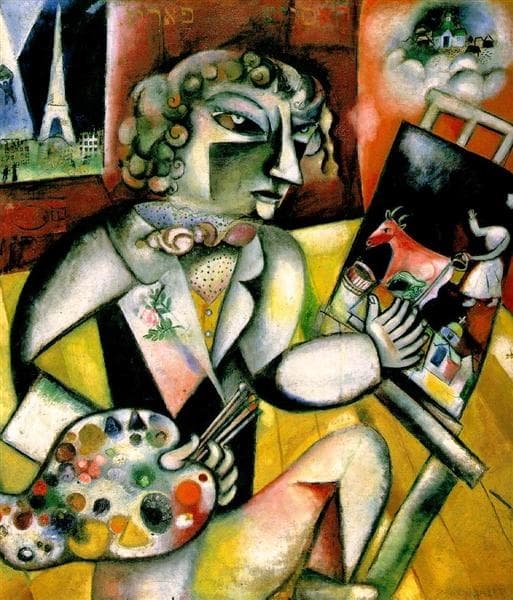
If hypothetically offered at a top-tier evening auction, Marc Chagall’s Self-Portrait with Seven Fingers would likely reset the artist’s record. Based on trophy-level comparables and the work’s singular importance, a fair-market estimate of $45–70 million is warranted.
Valuation Analysis
Opinion of value: $45–70 million (fair‑market/auction) for Marc Chagall’s Self‑Portrait with Seven Fingers, assuming sale under optimal conditions at a premier auction house. This estimate is derived by extrapolating from the artist’s top public benchmarks and applying a substantial scarcity and iconography premium appropriate to a canonical, early Paris‑period masterpiece held by the Stedelijk Museum Amsterdam [3][4].
Market anchors: Chagall’s current auction record is $28.45 million for Les Amoureux (Sotheby’s New York, 2017) [1]. Recent marquee results confirm renewed depth at the top: Le songe du Roi David brought $26.51 million at Christie’s New York in November 2025 [2], while emblematic imagery such as Au‑dessus de la ville achieved $15.62 million at Sotheby’s New York in 2023 [5]. These datapoints demonstrate consistent eight‑figure demand for significant oils and establish a platform from which to extrapolate for a once‑in‑a‑generation work.
Why this work commands a premium: Painted circa 1912–1913, Self‑Portrait with Seven Fingers crystallizes Chagall’s early Paris synthesis—Vitebsk memory, modernist experimentation, and self‑mythology—in one of his most reproduced and studied images [4]. Pre‑WWI oils of this caliber are exceptionally scarce in private hands; museum retention largely suppresses supply, which amplifies pricing when a masterpiece does surface. For context, even a rare 1911 oil, Le Père, realized $7.4 million at Phillips in 2022 despite being far less iconic than the Stedelijk self‑portrait [6].
Methodology and range formation: We start from the artist’s inflation‑aware record level (the 2017 $28.45m benchmark) and recent high‑water marks ($26.51m in 2025) [1][2], then apply a 1.3x–1.9x “trophy‑status” multiple to reflect the work’s superior period, art‑historical centrality, and brand recognition relative to any Chagall sold publicly. That matrix yields an implied band in the high‑$30ms to high‑$60ms; given current category strength for blue‑chip Modern masters and the specific fame of this image, a confident $45–70 million range is appropriate. Under perfect conditions (freshness, top‑tier estimate strategy, global outreach, and a strong financial guarantee), the high end—if not a record reset—appears probable.
Risk and sensitivity: As the work is oil on a non‑canvas support and long museum‑held, condition and conservation history should be reviewed; structural or surface issues could compress pricing. Conversely, pristine condition, comprehensive provenance, and marquee placement would support the upper band. Macro factors (sale timing, guarantee terms, deaccession optics) may add ±10–15% variance. Even so, relative to recent eight‑figure comparables, this painting’s art‑historical weight justifies an extrapolated valuation above prior public benchmarks [1][2][5].
Key Valuation Factors
Art Historical Significance
High ImpactCreated in 1912–1913 during Chagall’s formative Paris period, Self-Portrait with Seven Fingers is a keystone in the artist’s oeuvre. It fuses memories of Vitebsk with avant‑garde experimentation and self-representation, capturing the identity, poetics, and dream logic that define Chagall’s legacy. As one of his most reproduced and discussed images, it has outsized scholarly and cultural resonance, comparable in recognition to I and the Village. Works with this degree of art-historical centrality typically command premiums well beyond formal comparables, because they are understood as irreplaceable, canon‑defining statements that museums foreground in teaching and exhibition programs.
Rarity of Paris‑Period Masterpieces
High ImpactTop‑tier, pre‑WWI Paris‑period oils by Chagall almost never appear at auction; many of the very best examples are in museums. This structural scarcity suppresses supply and creates a trophy premium when an early, defining work is hypothetically available. While select early pieces do surface, they are typically more intimate or less iconic than Self-Portrait with Seven Fingers, and still achieve strong prices. The rarity dynamic means comparables can understate achievable value for a singular painting, especially when the image is archetypal and draws demand from both connoisseur collectors and institutions.
Iconic Imagery and Brand Recognition
High ImpactThe image is instantly recognizable and frequently reproduced, making it one of the emblematic pictures that shape public understanding of Chagall. Iconicity widens the bidder pool beyond specialist buyers to include cross‑category collectors who prize cultural visibility. In recent seasons, Chagall’s most beloved themes—lovers, bouquets, soaring figures—have outperformed less iconic subjects, even at the high end. A signature self‑portrait that encapsulates the artist’s mythology carries a marketing advantage and can produce bidding that exceeds purely formal comparables, particularly in marquee evening sales with global media reach.
Provenance and Institutional Status
Medium ImpactThe painting’s long-term residence in the Stedelijk Museum Amsterdam enhances credibility and scholarship, which typically supports value by removing authenticity and provenance risk. If hypothetically deaccessioned, the museum pedigree and extensive publication/exhibition history would be compelling to buyers. However, deaccessioning can introduce timing, optics, and jurisdictional constraints; managing these factors (transparency, restitution diligence, and ethical compliance) is essential to preserve demand. In net terms, institutional status is a positive for market confidence, albeit with practical considerations around process and sale venue.
Condition and Support
Medium ImpactThe work is frequently described as oil on a non‑canvas support (e.g., cardboard or board). Such supports can age differently than canvas and warrant close technical due diligence. A stable surface, minimal restoration, and sound mounting would maintain the estimated range; any structural issues (warping, delamination, overcleaning) could compress the outcome. Given the work’s age and museum stewardship, a professional conservation assessment should accompany sale preparations. For a masterpiece of this stature, excellent condition can catalyze competitive bidding and help realize the upper end of the estimate.
Sale History
Self-Portrait with Seven Fingers has never been sold at public auction.
Marc Chagall's Market
Marc Chagall is a blue‑chip 20th‑century artist with global collector demand and deep market breadth, from works on paper to major oils. His auction record stands at $28.45 million for Les Amoureux (Sotheby’s New York, 2017), with recent marquee results approaching that level—most notably Le songe du Roi David at $26.51 million in 2025. Eight‑figure prices are consistently achieved for vibrant, sizeable oils with signature themes (lovers, bouquets, circus). While Chagall’s ceiling resides below Picasso/Klimt/Magritte levels, the top of his market is highly competitive, and culturally resonant subjects can outperform estimates under strong conditions. Early, museum‑grade works remain exceptionally scarce and command meaningful premiums.
Comparable Sales
Les Amoureux
Marc Chagall
Artist’s auction record; large, colorful, iconic ‘lovers’ theme central to Chagall’s imagery. Demonstrates the market ceiling for a trophy-level oil under marquee conditions (final price incl. premium).
$28.5M
2017, Sotheby's New York
~$37.0M adjusted
Le songe du Roi David
Marc Chagall
Second-highest public price for Chagall (final incl. premium). Confirms current market capacity for top-tier, vibrant oils; though later (1966), it benchmarks upper-tier demand in 2025.
$26.5M
2025, Christie's New York
Au‑dessus de la ville (Over the Town)
Marc Chagall
Iconic soaring-lovers motif from the interwar period (final incl. premium). A close thematic proxy for canonical Chagall imagery with strong color and romance, indicating eight‑figure support for signature subjects.
$15.6M
2023, Sotheby's New York
~$16.5M adjusted
Le Père
Marc Chagall
Rare early (1911) oil close in date to Self‑Portrait with Seven Fingers; underscores the premium for pre‑WWI works with intimate, biographical content (final incl. premium).
$7.4M
2022, Phillips New York
~$8.1M adjusted
Le jongleur
Marc Chagall
Desirable subject (circus/performer) and strong color in oil; illustrates pricing for high‑quality mid‑century Chagalls under competitive conditions (final incl. premium).
$11.8M
2022, Christie's London
~$13.0M adjusted
Current Market Trends
The upper tier of the Impressionist & Modern category has stabilized and shown renewed competitiveness since late 2024, with marquee weeks in 2025–2026 producing strong sell‑through and several artist records. Collectors have gravitated to time‑tested names with impeccable provenance and exhibition histories, while mid‑market liquidity remains selective. Within Chagall’s market, recent evening‑sale results confirm sustained eight‑figure capacity for prime oils, especially those with quintessential imagery and strong color. Asia-based bidding continues to underpin demand in Western sales, and financial guarantees help de‑risk consignments, enabling ambitious estimates for scarce, museum‑caliber works.
Sources
- Sotheby’s – Chagall’s Les Amoureux leads Evening Sale (record $28.45m, 2017)
- Christie’s – 20th Century Evening Sale results (Le songe du Roi David, $26.51m, 2025)
- Stedelijk Museum Amsterdam – Annual Report (painting listed in collection)
- Marc Chagall Official Website – Self-Portrait with Seven Fingers (1913) overview
- Sotheby’s – 2023 New York highlights (Au-dessus de la ville, $15.62m)
- Phillips – New York Evening Sale (Le Père, $7.40m, 2022)