How Much Is The Boating Party Worth?
Last updated: January 15, 2026
Quick Facts
- Insurance Value
- $60.0M (Analyst estimate)
- Current Location
- National Gallery of Art, Washington, DC
- Methodology
- comparable analysis
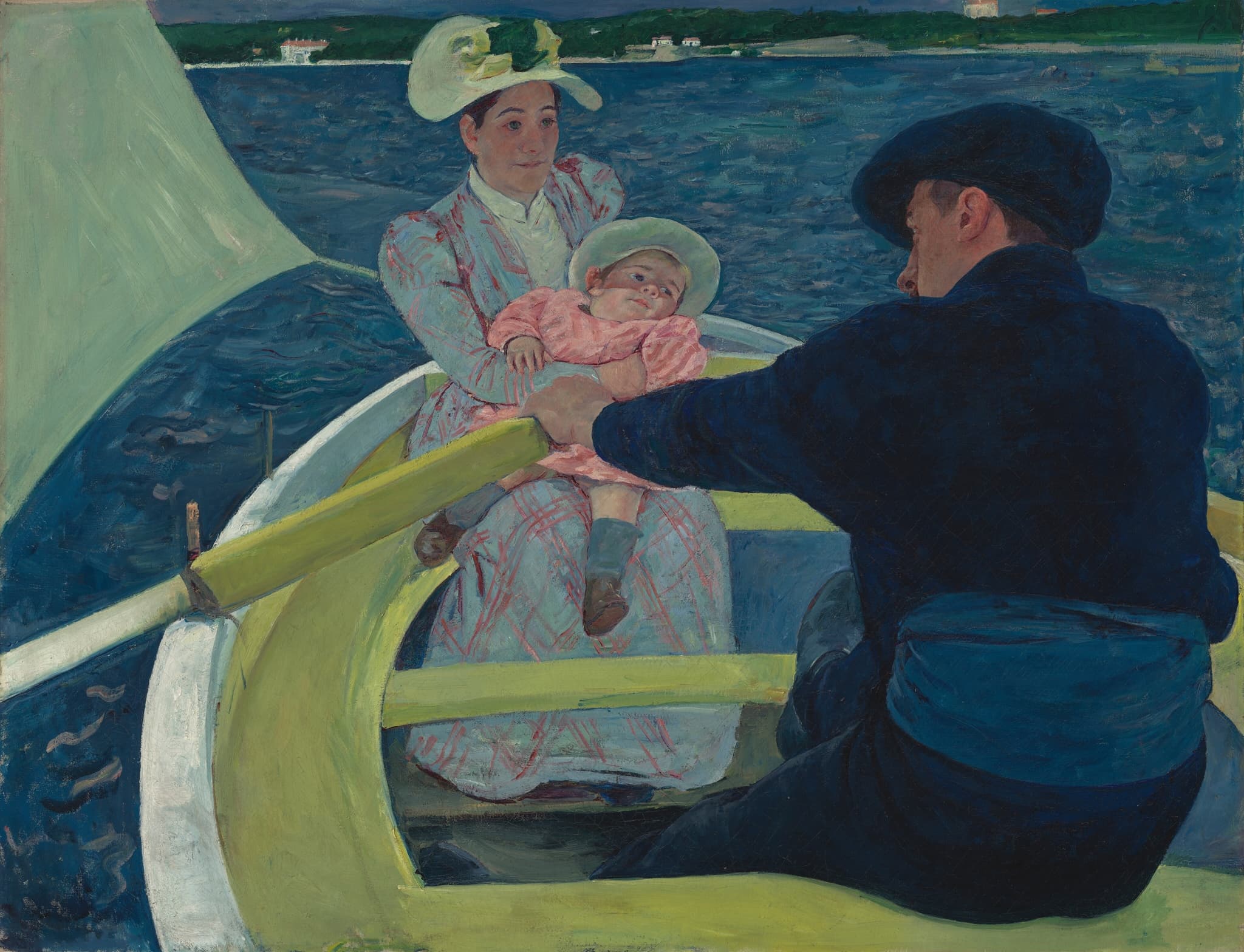
Hypothetical fair‑market auction estimate for Mary Cassatt’s The Boating Party: $25–45 million. This top‑tier, large‑scale 1893–94 oil is a canonical Cassatt masterpiece, far surpassing the quality and ambition of works that have set her public auction record to date.
Valuation Analysis
Conclusion: Our synthesized fair‑market (auction) estimate for Mary Cassatt’s The Boating Party is $25–45 million, with an indicative insurance/loan value at $60 million. The picture is a signature, large‑scale, 1893–94 oil—an acknowledged masterpiece in Cassatt’s oeuvre—and is held by the National Gallery of Art (NGA), Washington. It has never been publicly auctioned; the work passed from the artist through Durand‑Ruel to collector Chester Dale and entered the NGA in 1963, where Dale‑gift restrictions effectively preclude loan or sale [1][4].
Method and market anchors: We derive the range by triangulating Cassatt’s recent market ceiling and high‑quality comparables, then applying a “masterpiece premium.” Cassatt’s current public auction record is $7,489,000 for Young Lady in a Loge, Gazing to Right (a prime, museum‑caliber pastel sold from the Ann & Gordon Getty Collection in 2022) [2]. Small to mid‑scale oils—strong but not canonical—have traded recently around $0.5–1.3 million, including an 1879 oil at €1,216,000 (≈$1.33m) in Paris in 2023, acquired by an institution [3]. The Boating Party is materially more important: a daring, Japonisme‑inflected composition of exceptional scale (90 × 117.3 cm), extensively exhibited and published, and routinely cited among Cassatt’s greatest works [1]. That combination of scale, period, subject ambition, and art‑historical stature warrants a step‑change over the artist’s record.
Positioning the estimate: The $25–45 million band reflects where a career‑defining Cassatt oil would clear if presented in a marquee evening sale with global marketing and appropriate financial backing. It explicitly recognizes that Cassatt’s public record understates demand for her very best works due to scarcity at the top of her market, while also acknowledging that her price tier historically trails male Impressionists. The upper end of the range captures competitive stretch potential for a masterpiece with this visibility, especially given renewed curatorial and public focus on Cassatt following major 2024–25 museum exhibitions [6].
Institutional context and replacement risk: The painting resides at the NGA with Chester Dale gift restrictions that keep it onsite; there is no public sale history and no disclosed insured value [1][4]. Museums typically insure irreplaceable masterpieces at a premium to auction comparables to reflect replacement risk and institutional protocols; a notional agreed value of ~$60 million is consistent with that practice in the absence of marketability [5].
Market conditions: Impressionist and Modern auction volumes dipped in 2023–24 largely from a shortage of trophy consignments, then stabilized with renewed appetite for best‑in‑class works in 2025. In such environments, blue‑chip, exhibition‑proven canvases attract concentrated competition and can outperform broader category indices [5]. Within this backdrop, The Boating Party would command exceptional interest from institutions and leading private collectors were it ever to be offered.
Key Valuation Factors
Art Historical Significance
High ImpactThe Boating Party is universally regarded as one of Cassatt’s masterpieces and among the most compositionally audacious oils of her 1890s Japonisme‑inflected period. It is frequently reproduced in surveys of her work and stands alongside canonical images such as The Child’s Bath. Its museum‑enshrined status and centrality to scholarship confer a scarcity and prestige premium that justifies pricing well above the artist’s general auction record.
Scale, Medium, and Visual Impact
High ImpactAt 90 × 117.3 cm, this is a large, fully realized oil—Cassatt’s most valuable medium and a favored format for top collectors. The flat‑planar, cropped composition derived from Japonisme delivers high wall power and immediate recognizability, qualities that drive competition in marquee evening contexts. Large, iconic oils typically trade at multiples of smaller oils and pastels by the same artist.
Rarity and Market Supply
High ImpactMasterpiece‑level Cassatt oils of this ambition very rarely appear on the market; many were placed early with institutions or major U.S. collections. Recent public sales have featured smaller oils and works on paper, which cap the published record. This supply constraint supports extrapolating meaningfully above existing auction benchmarks when valuing a career‑defining canvas.
Provenance and Institutional Standing
High ImpactDirect provenance from the artist to Durand‑Ruel, to Chester Dale, and to the National Gallery of Art is unimpeachable. The NGA’s stewardship and the Chester Dale gift restrictions underline the work’s non‑marketable, irreplaceable status, reinforcing a higher insurance value and a premium hypothetical auction estimate relative to ordinary private‑collection property.
Sale History
The Boating Party has never been sold at public auction. It has been held by National Gallery of Art, Washington, DC.
Mary Cassatt's Market
Mary Cassatt is a blue‑chip American Impressionist whose market has been historically strong and steady, with top demand for late‑19th‑century oils and major pastels featuring figures and mother‑and‑child themes. Her public auction record stands at $7,489,000, achieved in 2022 for a prime pastel from the Ann & Gordon Getty Collection [2]. Scarcity of large, exhibition‑grade oils has kept the published record below male Impressionist peers, but institutional interest and a sustained curatorial focus on women artists have underpinned upward reappraisal. Recent sales activity shows selective but reliable depth, with small to mid‑scale oils trading in the low seven figures when quality and provenance align, and works on paper anchoring an active mid‑market.
Comparable Sales
Young Lady in a Loge, Gazing to Right
Mary Cassatt
Same artist; canonical subject from Cassatt’s prime Impressionist era; top auction price for the artist. Differs in medium (pastel vs oil) and scale, but shows the market ceiling for a museum-grade Cassatt picture.
$7.5M
2022, Christie's New York
~$8.2M adjusted
Portrait de jeune femme au chapeau blanc
Mary Cassatt
Same artist; oil on canvas (closer in medium to The Boating Party). Earlier date (1879) and much smaller, but a good-quality oil with institutional buyer—useful for calibrating pricing of smaller Cassatt oils.
$1.3M
2023, Ader, Paris (Drouot)
~$1.4M adjusted
Mother Resting Her Cheek on Her Daughter’s Blond Head
Mary Cassatt
Same artist; oil on canvas; intimate mother-and-child theme central to Cassatt’s oeuvre. Later date (1913), modest scale, regional venue—useful as a lower-bound indicator for lesser, late oils.
$480K
2023, Guyette & Deeter, Portsmouth, NH
~$514K adjusted
Sketch of “Sara in a Green Bonnet”
Mary Cassatt
Same artist; pastel (work on paper) on a small support; shows current day-sale liquidity and the discount applied to minor works/mediums relative to major oils.
$152K
2025, Christie's New York
Après le déjeuner (After Luncheon)
Berthe Morisot
Closest high-level analogue among women Impressionists: a major, museum-caliber oil from the same period. Demonstrates the market’s capacity to pay eight figures for canonical female Impressionist oils (though different artist and subject).
$10.9M
2013, Christie's London
~$14.5M adjusted
Current Market Trends
After a pandemic‑era rebound, Impressionist/Post‑Impressionist auctions contracted in 2023–24 due to a dearth of trophy consignments, while lot counts rose—evidence of depth at mid‑levels. In 2025, houses reported firmer demand for best‑in‑class works, with renewed bidding at the top end. In such conditions, truly iconic, exhibition‑proven canvases outperform broader averages. Cassatt’s market benefits from this selectivity: mid‑tier works remain price‑sensitive, but masterpieces—especially large oils with distinctive compositions and impeccable provenance—attract concentrated competition and support step‑change pricing above historical records [5].
Study print
Study this painting as a print
Pair the full artwork with a museum-style study sheet focused on one meaningful detail.
Sources
- National Gallery of Art – The Boating Party (object page)
- Christie’s Press – Ann & Gordon Getty Collection (Cassatt record)
- The Art Newspaper (France) – Cassatt 1879 oil acquired by Fondation Bemberg
- National Gallery of Art – Chester Dale Collection (exhibition note)
- Art Basel & UBS – The Art Market 2024: Auctions
- Philadelphia Museum of Art – Mary Cassatt at Work (press release)