How Much Is The Creation of Adam Worth?
Last updated: January 14, 2026
Quick Facts
- Methodology
- extrapolation
In real-world market terms, Michelangelo’s The Creation of Adam is unsaleable: it is an in-situ fresco in the Sistine Chapel owned by the Holy See. Under a hypothetical scenario where it could be lawfully transferred, safely detached, and stably displayed, we estimate fair market value at $1.5–3.0 billion. This range reflects its singular art-historical stature and global cultural resonance, far beyond existing public market benchmarks.
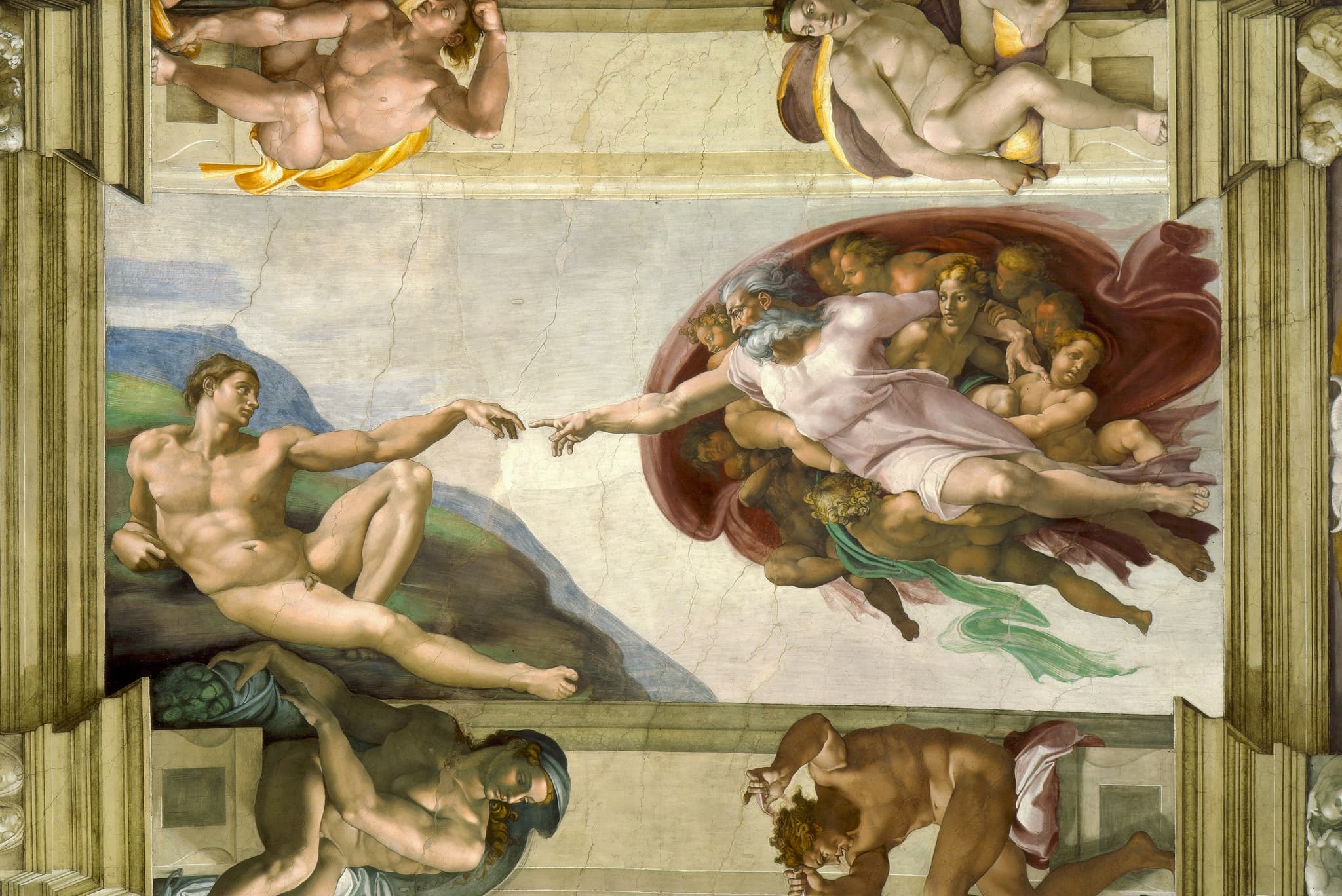
The Creation of Adam
Michelangelo, c.1511–1512 • Fresco (buon fresco)
Read full analysis of The Creation of Adam →Valuation Analysis
Conclusion. Assuming lawful transfer, safe detachment, and long-term stability for display, we estimate Michelangelo’s The Creation of Adam at $1.5–3.0 billion. In the real world, it is not commercially alienable: the fresco is integral to the Sistine Chapel and belongs to the Holy See, so it carries no practical market price [1]. This estimate is a hypothetical fair market value derived by extrapolating from the public market ceiling for Old Masters and the work’s unmatched cultural status.
Benchmarking and extrapolation. The highest confirmed auction price remains Leonardo da Vinci’s Salvator Mundi at $450.3 million, which sets a public anchor for top-tier Renaissance works [2]. Michelangelo’s tradable market is essentially drawings, with a record of approximately $24.3 million (Christie’s Paris, 2022) [3]. The Creation of Adam, however, is a crown-jewel, civilizational image: a central Sistine scene and a pinnacle of High Renaissance achievement. Its cultural weight, rarity (unique and non-replicable), and art-historical primacy justify a multiple far above contemporary auction records.
Demand profile. At this echelon, potential buyers would include major sovereigns, global institutions, and the handful of ultra-high-net-worth collectors capable of underwriting acquisition, conservation, and security at national-treasure levels. The Creation of Adam is among the most recognized images on earth, conferring unparalleled symbolic capital to any holder. Comparable national-treasure works like the Mona Lisa are typically characterized as “priceless,” with the Louvre’s 1962 insurance valuation of $100 million often cited as a baseline that implies a modern value above $1 billion [4]. In a hypothetical transaction, such brand-level recognition is a key price escalator.
Medium and feasibility considerations. Fresco is inherently site-specific; detachment carries conservation risk and would ordinarily reduce the buyer pool. Our range explicitly presumes a best-case technical outcome: clean, conservation-grade transfer with structural integrity and display viability. Even then, the object’s massive scale and security requirements would limit venues able to house it, nudging demand toward state-level or institutional buyers. If stability or integrity were compromised, value would trend toward the lower bound; if a turnkey, museum-grade solution were guaranteed, appetite could push toward or beyond the high end.
Positioning. The Creation of Adam is institutionally held and unsaleable in reality [1]. Within a strictly hypothetical, transferable framework, $1.5–3.0 billion reflects a premium over the public market apex for Old Masters [2], the extraordinary scarcity and record-level demand for even Michelangelo drawings [3], and the pricing logic applied to universally iconic, “never-for-sale” masterpieces [4].
Key Valuation Factors
Art Historical Significance
High ImpactThe Creation of Adam is a central panel of the Sistine Chapel ceiling and a pinnacle of High Renaissance art. It encapsulates Michelangelo’s synthesis of anatomy, theology, and monumental design, and is one of the most studied and reproduced compositions in Western culture. As a masterwork within a masterwork, its significance transcends the artist’s oeuvre to occupy a defining place in art history. Works at this level sit outside normal market dynamics because they anchor national and religious identity, scholarship, and tourism. In a hypothetical market, such primacy commands a multiple of any existing Michelangelo price data, and places the work in the ultra-rare cohort of civilizational images with multi-billion-dollar valuations.
Global Iconicity and Cultural Reach
High ImpactThe near-universal recognition of the fingertip-to-fingertip motif gives this fresco unparalleled brand equity. It is reproduced across media, education, and popular culture worldwide, conferring a level of cultural penetration that few artworks approach. For potential acquirers (sovereigns, global museums, or mega-philanthropists), such recognition translates to unmatched symbolic capital, tourism magnetism, and soft-power value. This demand-side amplification cannot be replicated by lesser works: it stems from centuries of visibility, religious resonance, and art-historical canonization. Iconicity therefore acts as a direct price escalator above auction-record benchmarks, justifying a range that begins in the billions when—hypothetically—legal transfer and museum-grade display are assumed.
Legal/Ownership and Alienability Constraints
High ImpactIn reality, the work is not commercially alienable: it is part of the fabric of the Sistine Chapel, owned by the Holy See, and functionally inseparable from a living religious and cultural monument. That renders its practical market value nil. Our estimate therefore requires an explicit hypothetical: lawful transferability and removal with ecclesiastical and sovereign approvals. Those conditions, while improbable, frame how market participants might price the work if it could legally trade. The constraint also skews the theoretical buyer pool toward institutions and states, entities that bid for cultural prestige rather than investment return. This factor explains the binary: unsaleable in practice, but worth multiple billions if alienability were granted.
Medium/Portability and Conservation Risk
Medium ImpactFresco is a wall-bound medium. Any attempt to detach and mount such a large, structurally integrated work presents significant technical and ethical challenges. Even assuming a best-case strappo/transfer with minimal loss, the result would be a complex, heavy, and conservation-dependent object requiring specialized climate, mount, and security. These constraints typically narrow the buyer universe and could pressure price. In our estimate, we explicitly assume a museum-grade, stable outcome; under that assumption, the uniqueness and fame of the image dominate the discount that non-portability would otherwise impose. If condition risk proved higher or display viability lower, the valuation would compress toward the low end of the range.
Comparables and Market Ceiling
High ImpactPublic price anchors for Renaissance masterpieces include Leonardo’s Salvator Mundi at $450.3 million, the standing global auction record, and the high eight-figure records for Michelangelo drawings. These figures understate the value of the most culturally loaded works because such objects almost never trade publicly. National-treasure benchmarks—like the Mona Lisa’s famous 1962 insurance valuation—illustrate how institutions conceptualize value for unrivaled icons, implying modern, inflation-adjusted valuations well north of $1 billion. The Creation of Adam surpasses typical market leaders in fame and art-historical gravity, justifying extrapolation beyond auction precedents. Together, these comparables and scarcity dynamics support a $1.5–3.0 billion range for a legally transferable, museum-stable object.
Sale History
The Creation of Adam has never been sold at public auction.
Michelangelo's Market
Michelangelo’s market is defined by extreme scarcity: virtually all paintings and major sculptures reside in public institutions, leaving drawings as the primary tradable category. The current auction record for the artist is approximately $24.3 million (Christie’s Paris, 2022) for a rediscovered pen-and-ink study, with earlier blue-chip sheets achieving high seven- to eight-figure prices. Even minor autograph material attracts strong bidding, underscoring deep, global demand. Because no autograph paintings or monumental sculptural works are available to collectors, true price discovery for major Michelangelo masterpieces does not exist in modern markets. Consequently, any valuation for the Sistine frescoes must be an extrapolation from drawing records and the broader apex of Old Master pricing.
Comparable Sales
Salvator Mundi
Leonardo da Vinci
Highest auction price ever; High Renaissance master; religious image with global recognition; sets the public market ceiling for Old Masters.
$450.3M
2017, Christie's New York
~$585.0M adjusted
Portrait of a Young Man Holding a Roundel
Sandro Botticelli
Blue‑chip Italian Renaissance masterpiece; shows the recent market’s willingness to pay for prime Old Master paintings by canonical Florentine artists.
$92.2M
2021, Sotheby's New York
~$108.8M adjusted
Head of a Muse (drawing)
Raphael
Record‑level Old Master drawing; close peer benchmark for the absolute top of Renaissance works on paper, useful because Michelangelo’s market consists largely of drawings.
$47.9M
2009, Christie's London
~$70.0M adjusted
A nude young man (after Masaccio) and two figures behind him (drawing)
Michelangelo
Current auction record for Michelangelo; critical datapoint for the artist’s tradable market (drawings) and for Sistine‑related connoisseurship.
$24.3M
2022, Christie's Paris
~$27.2M adjusted
Study for the Risen Christ (drawing)
Michelangelo
Major Michelangelo drawing sale that long served as a benchmark; helps frame the upper tier of prices for autograph sheets by the artist.
$12.3M
2000, Christie's London
~$23.0M adjusted
Current Market Trends
Old Masters represent a smaller share of overall art-market turnover, but the category has shown resilience and renewed momentum at the high end. After a muted 2024, 2025 saw improved sell-through and marquee results, reaffirming appetite for best-of-type works with secure attribution, provenance, and condition. Trophy assets continue to command significant competition, while mid-level material is more selective. For Renaissance masters, supply remains the dominant constraint; when fresh, high-quality pieces appear, they attract global bidding from institutions and sophisticated private buyers. In this context, the theoretical value of a peerless, institution-grade icon like The Creation of Adam sits well beyond observed auction benchmarks, reflecting structural scarcity and outsized cultural demand.
Study print
Study this painting as a print
Pair the full artwork with a museum-style study sheet focused on one meaningful detail.
