The Creation of Adam
by Michelangelo
Michelangelo’s The Creation of Adam crystallizes the instant before life is conferred, staging a charged interval between two nearly touching hands. The fresco turns Genesis into a study of imago Dei, bodily perfection, and the threshold between inert earth and active spirit [1][2].
Fast Facts
- Year
- c.1511–1512
- Medium
- Fresco (buon fresco)
- Dimensions
- approx. 280 × 570 cm
- Location
- Sistine Chapel, Vatican City
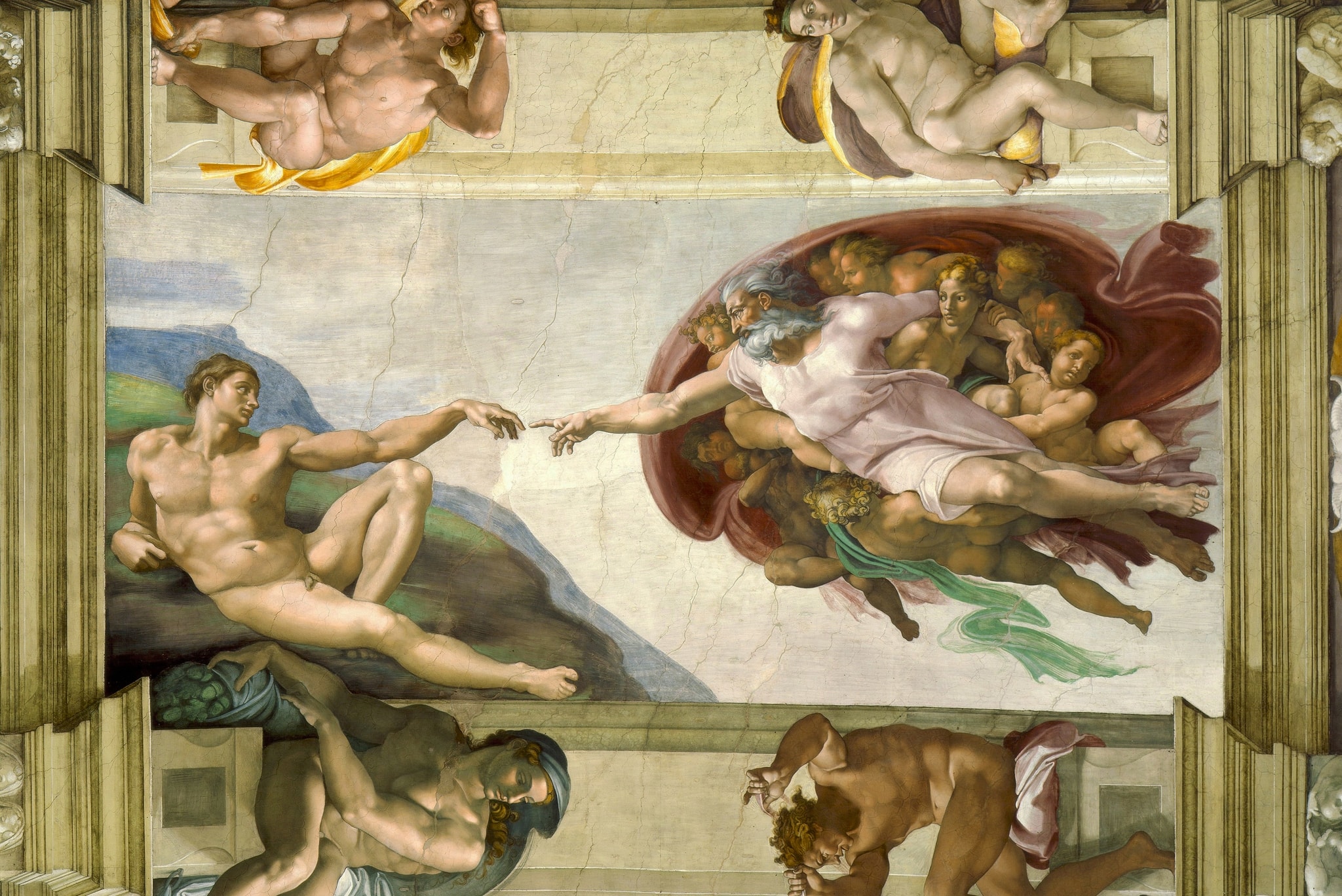
Click on any numbered symbol to learn more about its meaning
Meaning & Symbolism
Michelangelo constructs a theology of potential by suspending contact at the last possible moment. Adam reclines on a stony ledge, his torso beautifully modeled yet visibly heavy; his left arm extends but lacks tension, his wrist droops, and his fingers open as if awaiting charge. Opposite him, God whirls forward within a voluminous red mantle, borne by vigorous attendants; His right arm is taut, His index finger targeted with intent. The micro-gap between their fingertips is not empty—it is the visual measure of breath withheld, the space in which freedom, contingency, and the very idea of personhood can take hold. The Vatican’s account underscores this as the instant of the “breath of life”; Michelangelo amplifies that doctrine by delaying touch and converting it into dramatic voltage 1.
Formal symmetries proclaim the imago Dei. Adam’s relaxed left arm mirrors God’s outstretched right, and the diagonal axes of the two bodies rhyme: a horizontal, earthbound nude counters a wind-driven, aerial deity. This pairing is not mere resemblance; it lays claim to dignity. The sculptural clarity of Adam’s ribcage, obliques, and deltoid—formed from the artist’s intense life studies—declares the human body worthy as a bearer of divine likeness 24. Color polarities reinforce the metaphysics: Adam is framed by cool greens and browns, tones of soil and slope, while God’s mantle blazes with saturated crimson and lively flesh notes revealed by modern cleaning, the palette of active spirit and purposeful motion 6. Even the green scarf that whips beneath the angel at lower right vectors energy forward, a chromatic brush of wind that contradicts Adam’s inertia.
Iconography deepens the scene’s reach. Tucked beneath God’s left arm, a female figure looks toward Adam. Many commentators have identified her as the yet-uncreated Eve, present in the divine mind before her formation, a reading that aligns with the fresco’s anticipatory logic; other proposals name her Mary, Sophia, or a personified human soul. Scholarly debate persists, and the Vatican description refrains from dogmatic identification, yet her expectant gaze clarifies the panel’s temporal structure: creation unfolds as both present act and foreseen lineage 12. Surrounding figures have been variously read as angelic escorts or, more speculatively, unborn humanity; Michelangelo leaves identities suspended to keep focus on the imminent gift of life.
Modern medical-humanities readings have proposed additional layers. One influential hypothesis argues the red mantle and clustered bodies outline the human brain, implying that God grants intellect alongside life; another sees the mantle as a postpartum uterus, with the green scarf functioning as an umbilical cord, reframing creation as birth. These theories, published in reputable medical journals, remain debated outside art history’s consensus and should be treated as suggestive rather than evidentiary claims 35. Even so, they resonate with what the picture unquestionably asserts: creation encompasses animation and mind, body and meaning.
In the ceiling’s wider program, the panel sits among nine Genesis scenes that progress from cosmic order to human destiny. Here, Michelangelo condenses the arc into a single motif—the almost-touching hands—that has become a modern shorthand for creativity, agency, and relational dependence. The meaning of The Creation of Adam thus exceeds narrative illustration; it visualizes a philosophical claim of the High Renaissance: that human excellence, grounded in anatomy and reason, is derived, dignified, and answerable to a higher source. That is why The Creation of Adam is important—because it binds beauty to origin, and origin to purpose 12.
Explore Deeper with AI
Ask questions about The Creation of Adam
Popular questions:
Powered by AI • Get instant insights about this artwork
💬 Ask questions about this artwork!
Interpretations
Historical Context: Papal Power and the Vault’s Theology
Commissioned by Pope Julius II, the Sistine ceiling converts papal space into a stage of cosmic authority, with The Creation of Adam anchoring a narrative from genesis to human destiny. Michelangelo, primarily a sculptor, enlarged an initial plan into a grand, scripture-spanning program that dramatizes divine prerogative and human dependence. The near-touch becomes a political theology of sovereignty: God’s outstretched arm models legitimate, purposive power, while Adam’s receptive posture figures derived authority. Unveiled in 1512, the cycle aligns High Renaissance humanism with papal vision, displaying the Church’s claim to guard the origins and meanings of life. In this reading, the fresco is not only doctrinal but institutional—an image of power rendered as gift rather than coercion 26.
Source: Smarthistory; Wikipedia (Sistine Chapel ceiling chronology/unveiling)
Iconographic Debate: Who Is the Woman by God?
The female figure under God’s arm has long provoked debate. Many identify her as Eve, present in the divine intellect before her formation, which suits the panel’s anticipatory logic; others propose the Virgin Mary, Sophia (Wisdom), or a personified soul. Leo Steinberg traced the shifting claims, noting how identities often reflect interpretive desires more than secure evidence. The Vatican’s text remains noncommittal, keeping the focus on the life-giving act rather than pre-existence doctrines. What matters visually is her expectant gaze, which extends the panel’s time-frame forward—creation is not a closed incident but a lineage foreseen. This ambiguity is method, not error: Michelangelo maintains a productive opacity to hold theological multivalence in suspense 17.
Source: Vatican Museums; Leo Steinberg (Art Bulletin, 1992)
Medical-Humanities Reading: Brain and Womb Hypotheses
Modern medical readings propose that God’s red mantle and clustered figures outline a human brain, implying that intellect accompanies animation; others see a postpartum uterus, with the green scarf as an umbilical cord, recasting creation as birth. These hypotheses—published in JAMA and Mayo Clinic Proceedings—are not consensus art history, yet they sharpen what the fresco already asserts: creation confers life and mind, body and meaning. Even if understood as anachronistic overlays, they reframe the micro-gap as both neural spark and natal separation—moments of individuation. Such readings underscore Michelangelo’s convergence of the anatomical and the theological, where the body’s forms become carriers of metaphysical claims 35.
Source: Frank L. Meshberger, JAMA (1990); Mayo Clinic Proceedings (2015)
Conservation and Color: Energy Rediscovered
The 1980–1994 restoration revealed a high-key palette: saturated crimsons, incisive greens, and luminous flesh tones that restore the scene’s kinesis. God’s mantle now burns with chromatic urgency, the green scarf reads as a wind-slice, and Adam’s cool earth-tones reassert the polarity between spirit and soil. Far from cosmetic, this chromatic recovery recalibrates interpretation: the color fields articulate metaphysics—active spirit versus inert matter—and make the near-touch a hinge of energy transfer. The cleaning also sharpened contours and revealed the graphic decisiveness of Michelangelo’s drawing, aligning the fresco’s look with its thesis: life as a burst of clarity and motion into a world of heaviness 16.
Source: Vatican Museums; Wikipedia (Sistine Chapel ceiling restoration)
Draftsmanship and the Sculptural Body
Surviving red-chalk studies (British Museum) confirm that Adam’s pose and musculature derive from intense life study, translating sculptural knowledge into fresco. Michelangelo’s “sculptural clarity” is not display for its own sake; it is a theological argument in flesh, asserting that the human body can bear divine likeness. The ribcage, obliques, and deltoid are not generic but observed and constructed to suggest potential energy arrested by dependence. This anatomical truthfulness turns the near-touch into a hinge between matter and form: a body exquisitely prepared yet awaiting animation. In Renaissance terms, mimesis becomes metaphysics, the accurate body the medium of imago Dei 24.
Source: Smarthistory; The British Museum (Study for Adam)
Programmatic Humanism: From Origin to Agency
Placed within nine Genesis scenes, this panel condenses a Renaissance anthropology: dignity grounded in derivation. The mirrored arms (Adam’s left, God’s right) visualize imago Dei as resemblance-with-difference—earthbound recline versus aerial rush. This is humanism without hubris: reason and beauty as gifts, not self-originating achievements. The almost-touching hands became shorthand for creativity and collaborative agency—human action calibrated to a higher source. In the ceiling’s macro-structure (Creation–Fall–Noah), the image sits at the pivot where possibility precedes failure, and grace precedes effort. It is a philosophy in paint: excellence as response rather than self-invention 12.
Source: Vatican Museums; Smarthistory
Related Themes
About Michelangelo
Michelangelo (1475–1564) was a Florentine-trained sculptor, painter, architect, and poet whose authority over the human form shaped the High Renaissance. Commissioned by Pope Julius II, he transformed the Sistine ceiling (1508–1512) into a monumental synthesis of theology and anatomy; the unveiling in 1512 cemented his renown [2][7].
View all works by Michelangelo →