Adam's Reclining Pose in The Creation of Adam
A closer look at this element in Michelangelo's c.1511–1512 masterpiece
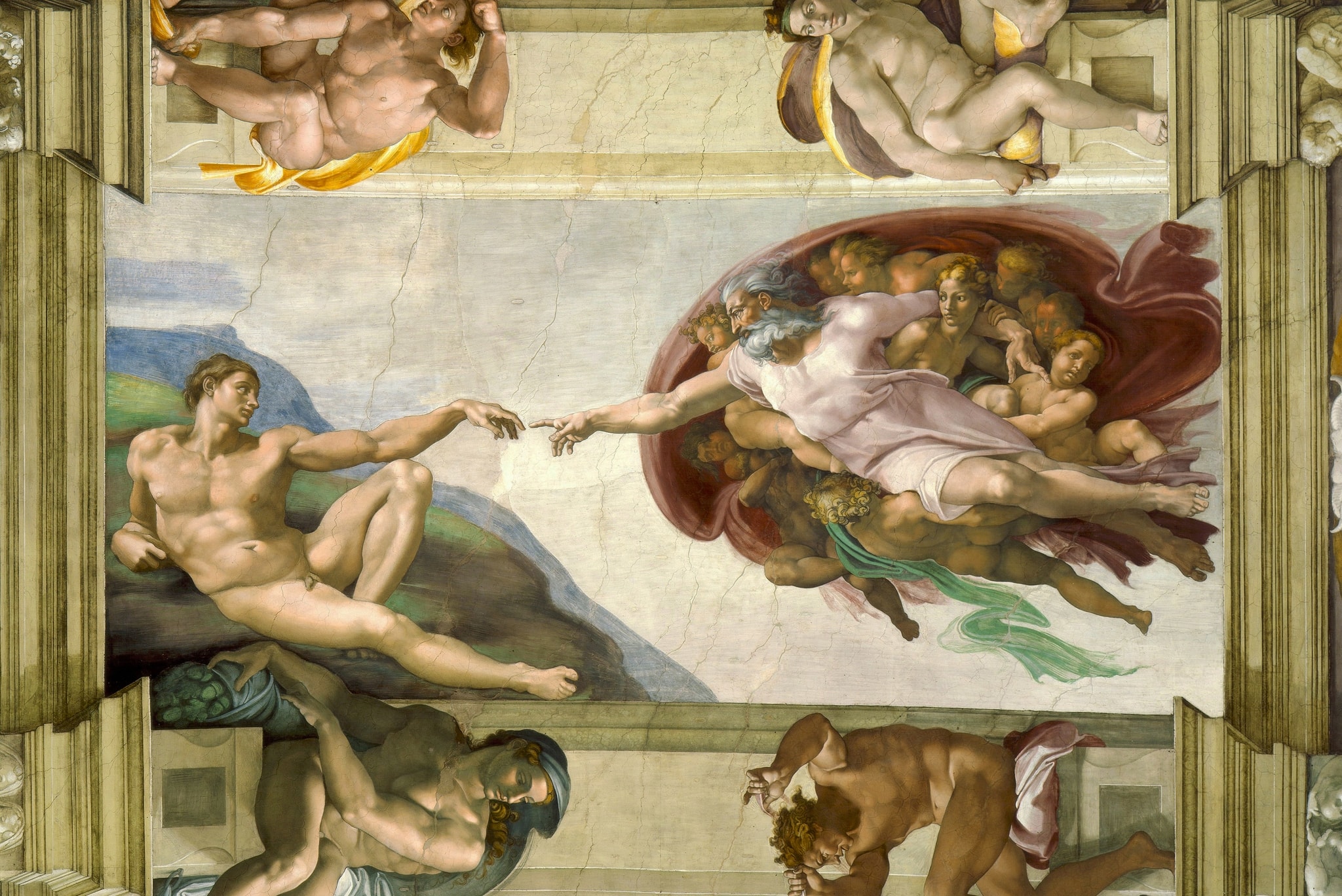
Adam’s Reclining Pose crystallizes Michelangelo’s vision of humanity at the instant before animation: an ideal body, beautiful yet inert, stretched along the earth as life nears his fingertip. His relaxed, concave form mirrors the Creator’s urgent, convex sweep, turning a single posture into a charged dialogue of likeness and dependence [1][5].
Historical Context
Michelangelo painted The Creation of Adam during the second campaign of the Sistine Ceiling (c. 1511–1512), when he reduced the narrative to a few monumental figures placed for maximum clarity across the chapel’s central spine 34. In this phase, the artist privileged broad, legible silhouettes that could be grasped instantly from the floor—an approach that explains Adam’s expansive, open recline and the calm breadth of his contours 4.
Drawing practice guided the final pose. In a surviving red‑chalk study, Michelangelo strengthened the figure’s outer lines specifically so the body would read from over sixty feet below; that pursuit of visibility shaped the splayed, at‑rest posture we see on the vault 2. Vatican curators characterize the finished figure as an “athlete at rest,” fully formed yet awaiting the divine spark—language that reflects both the work’s narrative moment and the artist’s intent to fuse classical bodily ideal with Christian content 16.
Symbolic Meaning
Adam’s languid recline is the emblem of a not‑yet‑animated being. Vatican commentary describes him as an “athlete at rest,” his beauty confirming creation “in the image and likeness of God,” while the small gap between fingers becomes the conduit for the breath of life 1. The body is complete, but slack; its earth‑bound ease marks Adam as the receiving pole of the drama, poised to awaken at contact.
The pose also visualizes the imago Dei. Adam’s concave, open outline and extended arm echo—while opposing—the convex surge of God borne forward in a billowing mantle. This mirroring translates theology into geometry, dignifying Adam even as it stresses dependence on the Giver 5.
Curators of Michelangelo’s red‑chalk study underline the pre‑Fall perfection of the torso and the generative connotations of the candidly splayed thighs—fitting symbols for the first man who will father humankind once life is bestowed 2. Set within Renaissance Rome’s classical framework, the serene, ideal nude fuses antique corporeal ideals with a Christian moment of ensoulment, making passivity itself the sign of potentiality 68.
Artistic Technique
Michelangelo prepared Adam with a red‑chalk study that models the undulating torso through tight hatching and stippling, then reinforces the outer contour so the figure’s silhouette would carry from the chapel floor 2. In fresco, he translated this into a broad, low left diagonal that anchors the scene against God’s rightward rush, using simplified masses and emphatic edges characteristic of his late‑ceiling style 4.
Compositional counterforms do crucial work: Adam’s relaxed, concave envelope meets God’s convex, wind‑filled mantle, while the warm, living flesh tones of both figures are set off against a cool, spare ground to heighten the charged interval between their hands 5. The economy of means lets a single, restful nude bear the drama of life’s imminent transfer.
Connection to the Whole
Adam’s recline is the necessary foil to God’s airborne urgency, crystallizing the ceiling’s giver/receiver dialectic: heaven’s dynamic will meets earth’s passive potential 14. The pose anchors the left half of the composition, staging the famous hair‑thin gap as a hinge between creation and consciousness. Its clarity from the nave ensures that viewers grasp the narrative at a glance—man, complete yet inert, about to be animated.
Within the Genesis cycle, this posture becomes the signature image of human dignity and dependence that bridges creation and the Fall, and it set an enduring model for later artists who looked to this expressive repose as a paradigm of potent stillness 47.
Explore More from This Painting
This detail is one part of The Creation of Adam. Use the links below to return to the full interpretation, browse the full set of details, or view the painting's valuation if available.
Sources
- Musei Vaticani — The Creation of Adam (official commentary, includes “atleta in riposo” and imago Dei)
- British Museum — Study for Adam (red chalk) with curatorial notes on pose, contours, and generative meaning
- Encyclopaedia Britannica — Michelangelo: The ceiling of the Sistine Chapel (project phases and context)
- Smarthistory — Michelangelo, Ceiling of the Sistine Chapel (monumental figures and late-ceiling simplification)
- ItalianRenaissance.org — Michelangelo’s Creation of Adam (concave/convex analysis and Adam’s languor)
- ArtDaily — Michelangelo’s inspiration among Vatican ‘secrets’ revealed (classical models such as the Belvedere Torso)
- Art Institute of Chicago — Rodin, Adam (on Michelangelo’s Adam as source for the pose)
- Annenberg Learner — The Body: The Creation of Adam (genesis cycle context on the ceiling)