Eve Under God's Arm in The Creation of Adam
A closer look at this element in Michelangelo's c.1511–1512 masterpiece
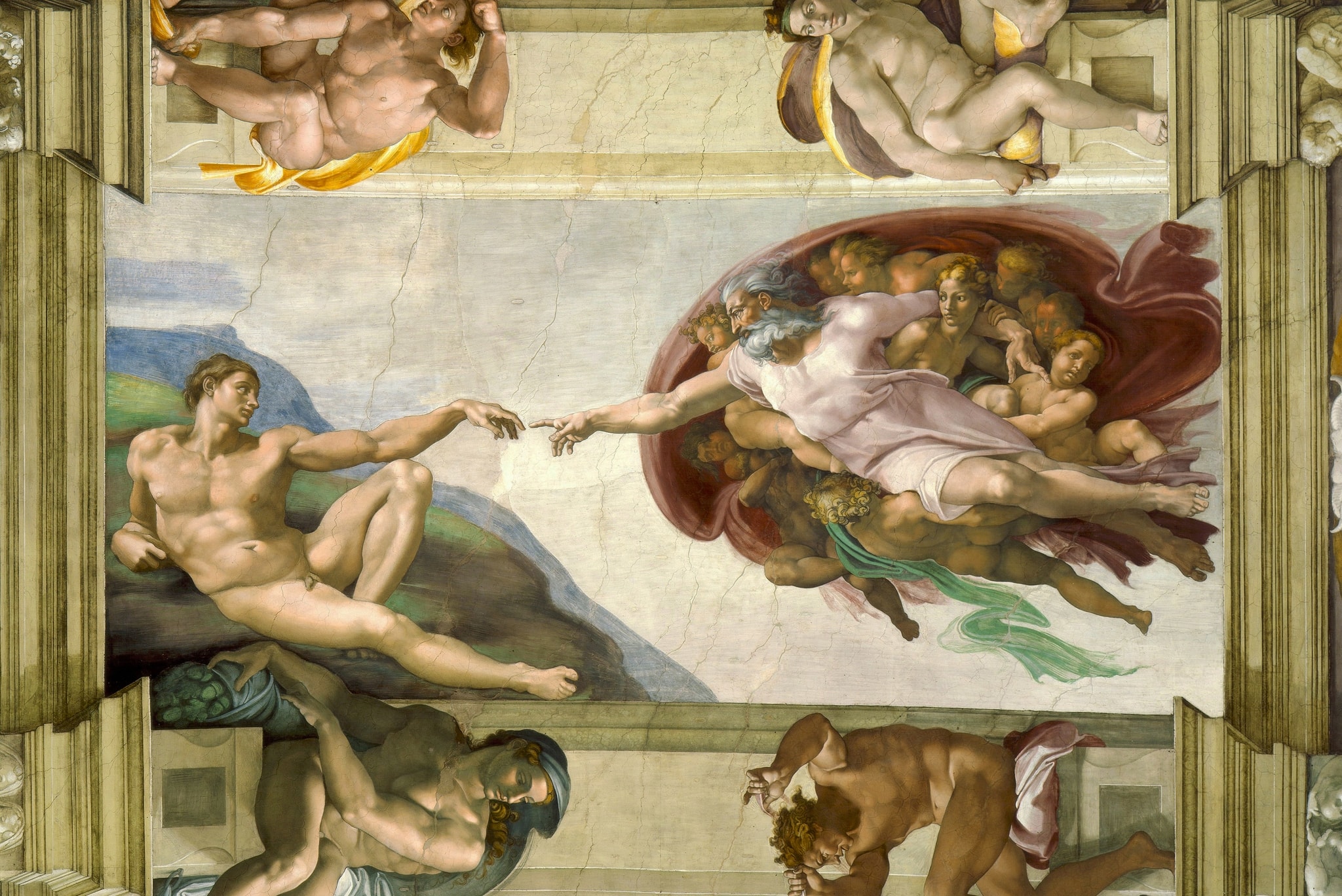
Tucked beneath God’s left arm in The Creation of Adam, a poised female figure peers toward Adam from within the billowing crimson mantle. Her presence compresses past, present, and future into a single moment, signaling what God intends next and inviting centuries of interpretation about who she is and why she is there.
Historical Context
Michelangelo painted The Creation of Adam around 1511–1512 as part of the Sistine Chapel ceiling commission he executed between 1508 and 1512 for Pope Julius II. The scene occupies the central Genesis sequence and stages the instant just before God’s life-giving touch. On the right, God races across the sky, enveloped in a bright crimson mantle and borne by angels; directly beneath His left arm a woman’s head and shoulders emerge, her gaze fixed on Adam across the gap. The Vatican’s description of the panel locates and frames this inner cohort within God’s mantle, the compositional arena where the woman appears 1.
Within the ceiling’s carefully ordered program, Michelangelo compresses Genesis into monumental, legible images that can be read from the chapel floor. Creation of Adam precedes Creation of Eve in the sequence, so placing a female figure by God anticipates the next episode and projects divine providence across time. Smarthistory’s overview emphasizes how these pared‑down, monumental forms and clear sightlines carry narrative meaning, making the right‑hand group not an incidental cluster but a strategic narrative device that foreshadows what follows 2.
Symbolic Meaning
The traditional identification reads the woman as Eve in potentia—Eve “to be”—sheltered under God’s arm as He hastens to animate Adam. Walter Pater gave classic voice to this idea, describing God arriving “with the forms of things to be, woman and her progeny, in the fold of his garment,” a formulation that clarifies both her placement and her forward‑leaning gaze toward Adam 3. This reading makes the figure a visual promise: companionship, lineage, and human future already present in God’s counsel as Adam receives life 23.
Other robust interpretations have circulated. A widely taught alternative sees the woman as Mary, the small child near God as the Christ Child—an explicit Marian typology binding the first Adam to the “New Adam” and compressing Creation with Redemption in a single, theologically resonant image 6. Maria Rzepińska argued instead for Sophia/Divine Wisdom (Prov. 8:22–31), the personified Wisdom who was “with” God at Creation; the fresco’s post‑cleaning clarity, she maintains, supports such a reading 5. Survey literature also records proposals that the group around God alludes to unborn humanity or to the human soul, while noting doctrinal caution around the pre‑existence of souls 8.
These identifications converge on a shared function: the woman signifies forethought and providence. Even anatomical readings that see God’s mantle as the outline of a human brain heighten this sense of divine intellect and intention precisely where she resides 7.
Artistic Technique
Michelangelo renders the figure with sculptural clarity: robust anatomy, firm contour, and high‑contrast modeling that read unmistakably from the chapel floor. Cradled within the intense crimson of God’s mantle, her head emerges beneath His left arm and turns decisively toward Adam, creating an optical vector that bridges the central interval between fingers 12.
The color design isolates and protects the cohort around God—the saturated red mantle acting as a frame against the cool, neutral sky—while the sweeping ellipse of the drapery stabilizes the right‑hand mass against Adam’s earthen ledge. The simplified silhouettes and monumental scale, hallmarks of the ceiling’s style, ensure that this tucked‑in presence is legible as an intentional, privileged figure rather than background ornament 12.
Connection to the Whole
Within the ceiling’s narrative arc, the woman under God’s arm functions as a hinge across time. By carrying her into the Creation of Adam, Michelangelo foreshadows the next panel (Creation of Eve) and extends the fresco’s “about‑to‑happen” tension beyond the spark of life to the emergence of human companionship and posterity 2.
If read as Mary with the Christ Child, the image also forges a Creation‑to‑Redemption axis, linking the first Adam to the New Adam and aligning the Genesis core with the chapel’s liturgical meaning 6. Leo Steinberg showed how such multivalence is programmatic rather than accidental: the entourage around God is designed to sustain layered readings without collapsing into a single label, amplifying the fresco’s theological breadth while preserving its crystalline visual logic 4.
Explore More from This Painting
This detail is one part of The Creation of Adam. Use the links below to return to the full interpretation, browse the full set of details, or view the painting's valuation if available.
Sources
- Vatican Museums — The Creation of Adam (Sistine Chapel ceiling)
- Smarthistory — Michelangelo, ceiling of the Sistine Chapel
- Walter Pater, The Renaissance (VictorianWeb excerpt)
- Leo Steinberg, Michelangelo’s Painting: Selected Essays (U. Chicago Press) — 'Who’s Who in the Creation of Adam'
- Maria Rzepińska, 'The Divine Wisdom of Michelangelo in The Creation of Adam,' Artibus et Historiae 15, no. 29 (1994)
- ItalianRenaissance.org — Michelangelo, Creation of Adam (Mary/Christ typology summary)
- Frank L. Meshberger, 'An Interpretation of Michelangelo’s Creation of Adam Based on Neuroanatomy,' JAMA (1990)
- Wikipedia — The Creation of Adam (identification options overview)