The Touching Fingers in The Creation of Adam
A closer look at this element in Michelangelo's c.1511–1512 masterpiece
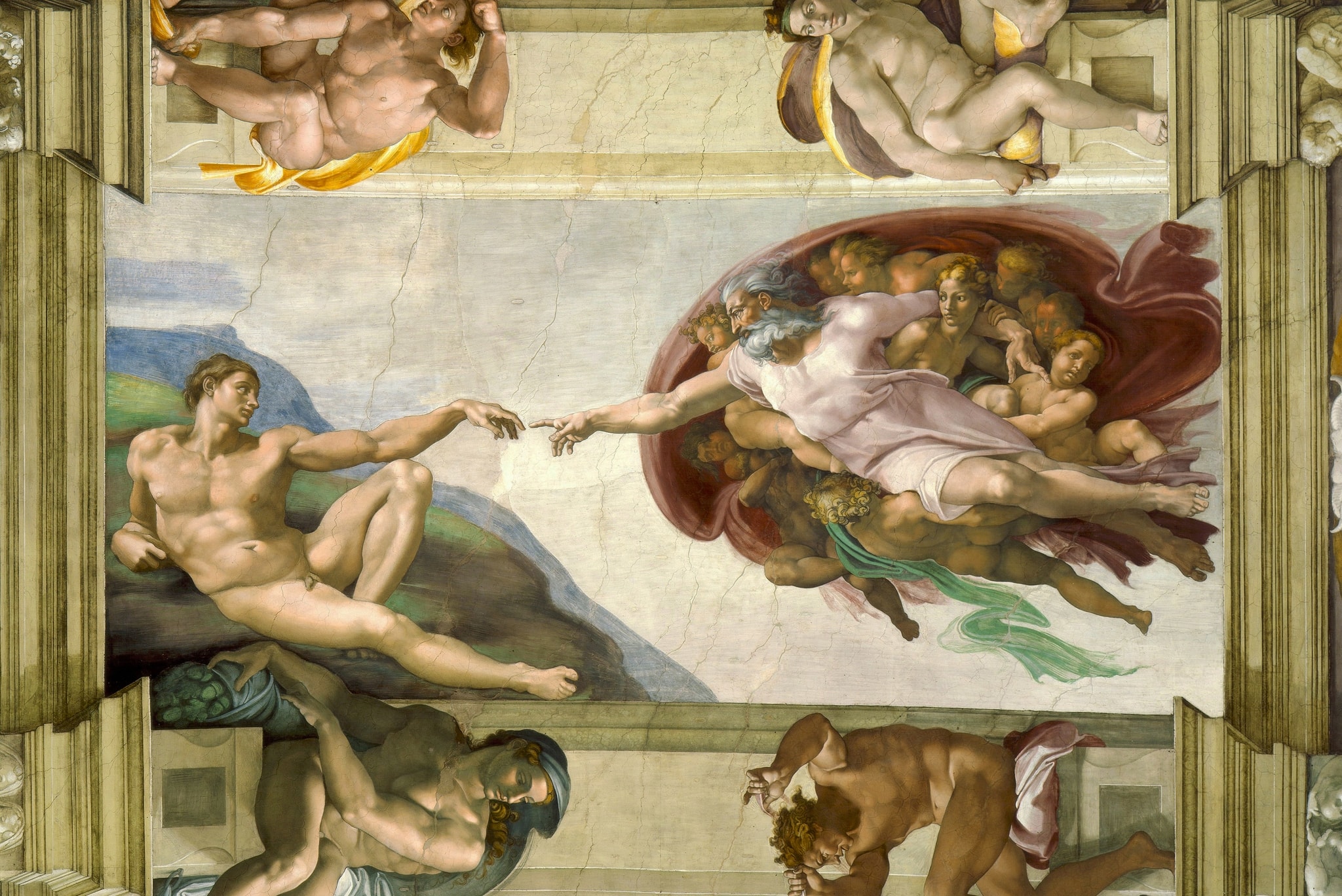
At the center of Michelangelo’s Creation of Adam, two index fingers hover in a breath‑thin gap—the instant before God transmits life. This poised non‑touch concentrates the drama of creation into a single charged interval, a visual shorthand for origin, likeness, and human potential.
Historical Context
Commissioned by Pope Julius II, the Sistine Chapel ceiling (1508–1512) arranges nine monumental scenes from Genesis across the vault. The Creation of Adam belongs to the middle triad devoted to humanity’s making and fall and was painted in the final campaign, around 1511–1512, when Michelangelo had refined his approach to a few colossal figures legible from the chapel floor 12.
By choosing the split second before contact—God’s hand driving forward, Adam’s hand receiving—Michelangelo dramatizes creation as imminent gift rather than accomplished fact. Contemporary liturgy and theology sharpen the focus on the hand: the hymn Veni Creator Spiritus invokes the “finger of the paternal right hand,” a poetic figure for divine agency that the fresco translates into the near‑meeting digits at the center of the scene 2. The result fuses scriptural narrative with High Renaissance clarity and stagecraft, fixing the viewer’s eye on the suspenseful interval where life is about to pass from Creator to creature 12.
Symbolic Meaning
The almost-touching fingers visualize the moment of animation—the famed “spark of life”—and at the same time proclaim humanity’s likeness to God. Adam’s arm mirrors God’s, a bodily rhyme that makes the doctrine of imago Dei visible while the gap insists that life and perfection originate in the divine source, not in man himself 23. Critics repeatedly identify this interval as the true locus of meaning: energy held in pause, a threshold where potential becomes being and where responsibility accompanies the gift of life 6.
Traditions of the “finger of God” deepen the gesture’s resonance. As commentators note, biblical images of God inscribing the Law with his finger inform readings in which the poised touch signifies the bestowal of intellect and moral order—the education of humankind as much as its animation 5. Modern scholarly debates have expanded the symbolism: physicians have argued that the mantle around God outlines a human brain, casting the near‑contact as the infusion of mind 7, while others see a postpartum uterus and umbilical imagery underscoring birth and severance 8. Across interpretations, the hands condense origin, likeness, freedom, and intellect into a single, unforgettable sign 26.
Artistic Technique
Michelangelo builds the scene around two diagonals—God’s thrusting right arm and Adam’s receptive left—whose fingertips converge near the composition’s center, a lucid design optimized for long‑distance viewing in fresco on the chapel vault 13. Drawing underpins the clarity: red‑chalk studies for Adam show the sculptural modeling of the arm and hand and the thickened contours that would read from below 9.
Color heightens the drama. Restoration revealed a high‑key palette—cool stone and flesh against the warm, windblown mantle—that sharpens the silhouette of the hands and the bright negative space between them 10. Executed in buon fresco, the panel’s large, simplified forms and crisp edges exemplify the streamlined style of Michelangelo’s later ceiling campaign 13.
Connection to the Whole
Within the ceiling’s Genesis sequence, the hovering fingertips crystallize the program’s central claim: the divine origin and dignity of the human person. Their extreme legibility—two vectors meeting across a sliver of air—anchors the panel’s geometry and serves as an emblem for the cycle’s synthesis of classical form and biblical narrative 3.
Surrounded by prophets, sibyls, and ignudi, the gesture converses with the vault’s wider themes of revelation and potential. Conservation has only intensified this centrality: the recovered brilliance of the flesh tones and mantle reasserts the hands as the chapel’s visual keystone, now a global shorthand for creation and human capacity 103.
Explore More from This Painting
This detail is one part of The Creation of Adam. Use the links below to return to the full interpretation, browse the full set of details, or view the painting's valuation if available.
Sources
- Wikipedia — Sistine Chapel ceiling (context, chronology, technique)
- Wikipedia — The Creation of Adam (overview, hymn connection, moment before touch)
- Smarthistory — Michelangelo, Ceiling of the Sistine Chapel
- Encyclopaedia Britannica — The Creation of Adam
- Smithsonian Magazine — The Measure of Genius (A. Graham-Dixon on the 'finger' as intellect/law)
- The Independent — Tom Lubbock on the 'gap' between the fingers
- JAMA — Meshberger, 'An Interpretation of Michelangelo’s Creation of Adam Based on Neuroanatomy'
- Mayo Clinic Proceedings/PubMed — 'The Delivery of Adam' medical interpretation
- British Museum — Studies for Adam (red‑chalk drawing)
- Conservation Science in Cultural Heritage — Colalucci on the 1980–1994 restoration