The Brain-Shaped Cloak in The Creation of Adam
A closer look at this element in Michelangelo's c.1511–1512 masterpiece
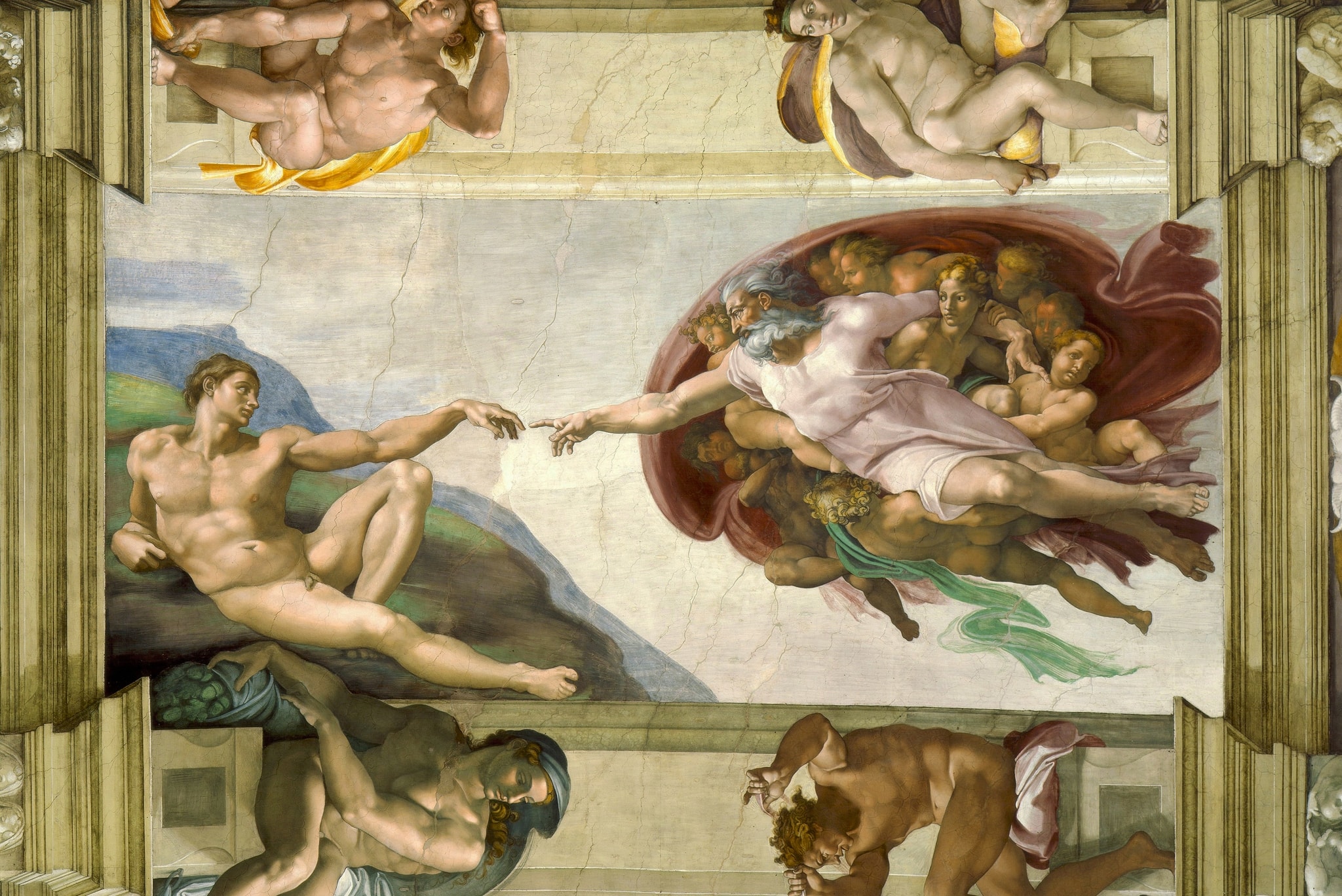
In The Creation of Adam, Michelangelo wraps God and a host of figures in a sweeping red mantle that hurtles across the sky toward Adam. Long read as a powerful vehicle for divine motion, this form has also sparked modern anatomical interpretations—the famed “brain-shaped cloak”—that recast the moment of creation as a gift of intellect or even birth.
Historical Context
Michelangelo painted The Creation of Adam in the second phase of the Sistine Ceiling, around 1511–1512, when he adopted a larger, clearer narrative style that could be read from the chapel floor. In this campaign, he repeatedly encloses the deity in a voluminous mantle—an oviform mass that concentrates energy and propels God across space—echoing medieval and Renaissance precedents for surrounding divinity in an aureole or mandorla, though rendered here as naturalistic cloth rather than a strict almond halo 1.
The artist’s lifelong study of anatomy, including cadaver dissection, sharpened his understanding of musculature and drapery and shaped the ceiling’s monumental bodies and dynamic wraps. The red cloak in Creation of Adam belongs to this broader drive for legibility and impact: it frames God’s movement, separates the divine realm from Adam’s earthbound ledge, and clarifies the drama of transmission between their near-touching hands—an approach entirely consistent with Michelangelo’s practice and the period’s visual theology of creation 2.
Symbolic Meaning
In mainstream art-historical reading, the mantle is a formal and theological device. It distinguishes the divine sphere from Adam’s recumbent figure, amplifies God’s forward rush, and gathers within it figures often identified—following a long scholarly thread summarized by Leo Steinberg—as Eve and humankind held in potential. In this view the cloak visualizes God as the source of human destiny while staging the instant of animation at the fingertips 15.
Modern medical scholarship has advanced two notable overlays. First, the “brain” hypothesis argues that the mantle’s outline, its internal shading, and the placement of figures and green scarf align with landmarks of neuroanatomy (cerebrum, brainstem, optic chiasm, pituitary). Read this way, the scene encodes the gift of intellect alongside life, a Renaissance-humanist affirmation of the imago Dei in reason 38. Second, a “womb” hypothesis reads the mantle as a postpartum uterus with the green drapery as an umbilical cord, shifting the metaphor toward physical birth and the “delivery” of Adam 4.
These interpretations are provocative and widely circulated, but museum overviews continue to ground the mantle’s meaning in composition and biblical narrative rather than in hidden anatomy 1.
Artistic Technique
Michelangelo builds the mantle as a powerful ovoid that carries weight and speed, its dark interior cavity throwing God’s pale torso and billowing beard into sharp relief. The restored palette reveals saturated crimson‑to‑purple hues and incisive green accents, effects brought back to brilliance by the 1980–1994 cleaning, which reanimated the ceiling’s chroma and legibility 6. He reinforces motion with overlapping bodies, elastic foreshortening, and a wind‑caught edge that streams behind the divine figure. Descriptive catalogues aptly call it a “huge purple/red mantle,” a theatrical billow whose silhouette reads instantly from below—one reason viewers discern large anatomical profiles in its outline 17.
Connection to the Whole
Within the panel, the mantle concentrates and directs force toward the famous interval between God’s and Adam’s fingers, the visual fulcrum of creation. It secures a legible contrast—encapsulated divinity versus earthly repose—so the viewer’s eye moves from God’s surge to the spark about to pass 1.
Within the nine‑scene Genesis cycle, enclosing God together with the figure often read as Eve links Adam’s animation to the unfolding of human history. The crimson surround thus operates as more than drapery: it is the engine that binds origin, promise, and motion, integrating this scene with the ceiling’s theology of beginnings and the destiny of humankind 15.
Explore More from This Painting
This detail is one part of The Creation of Adam. Use the links below to return to the full interpretation, browse the full set of details, or view the painting's valuation if available.
Sources
- Smarthistory — Michelangelo, Ceiling of the Sistine Chapel (overview and style shift)
- Smarthistory — Michelangelo: sculptor, painter, architect, and poet (training and anatomy)
- Frank L. Meshberger, “An Interpretation of Michelangelo’s Creation of Adam Based on Neuroanatomy,” JAMA (1990)
- Mayo Clinic Proceedings (2015) — “The ‘Delivery’ of Adam: A Medical Interpretation of Michelangelo”
- Leo Steinberg, “Who’s Who in the Creation of Adam”
- Osservatore Romano — on the Sistine restoration and renewed chroma
- Web Gallery of Art — descriptive notes on the mantle in Creation of Adam
- Scientific American — overview of the Mantle-as-Brain interpretation