The Bull in Guernica
A closer look at this element in Pablo Picasso's 1937 masterpiece
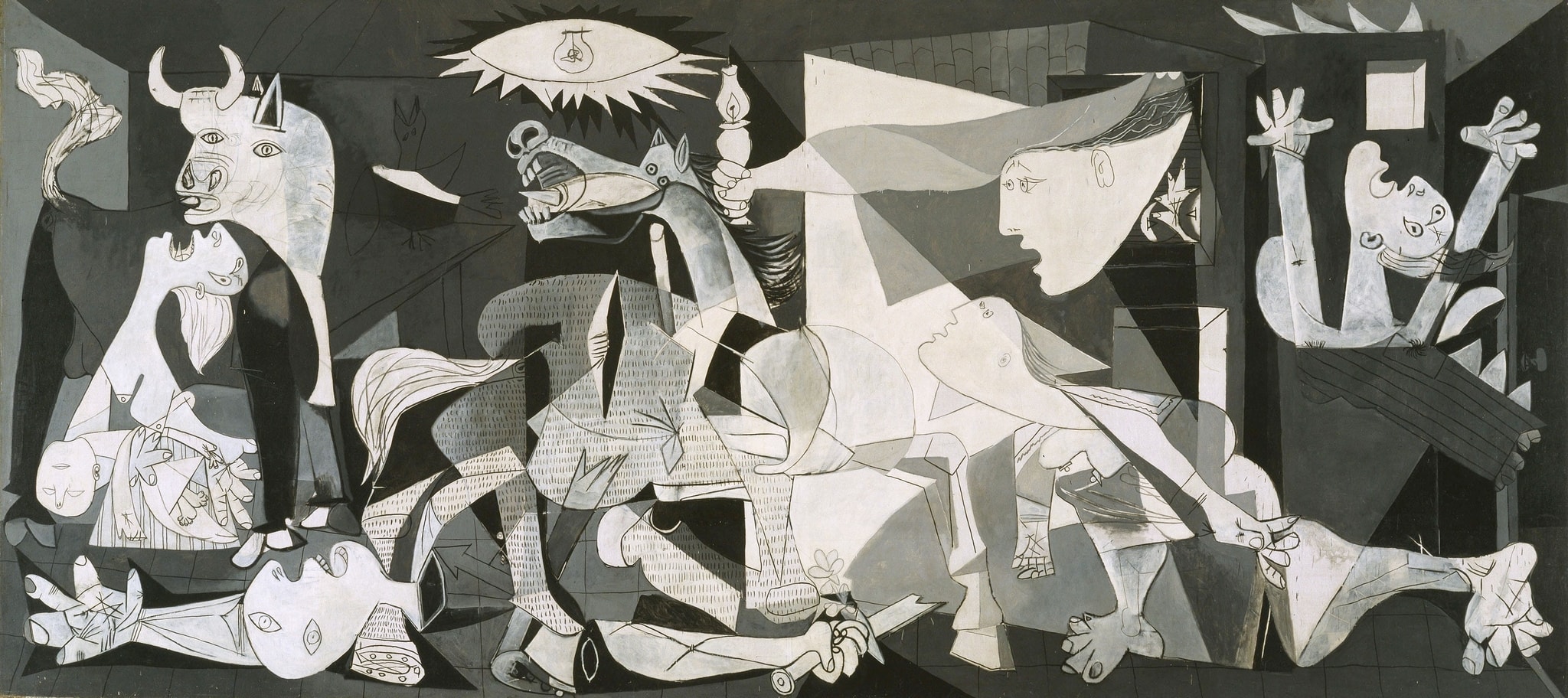
The bull in Guernica stands like a dark, unblinking witness at the painting’s left edge, a charged emblem drawn from Picasso’s lifelong taurine imagery. Neither mascot nor mascot of a party, it condenses brutality, myth, and national memory into a single, magnetic silhouette that steadies the chaos around it.
Historical Context
Picasso painted Guernica for the Spanish Pavilion at the 1937 Paris Exposition in the immediate aftermath of the bombing of the Basque town on April 26, 1937. Working between early May and early June, he built the composition from a vocabulary he already commanded—bulls, horses, and hybrid creatures—so that the work could speak swiftly and forcefully to the Spanish Civil War and to modern warfare more broadly 1.
The bull was not a last‑minute invention. Throughout the 1930s Picasso had mined Spain’s taurine culture and the myth of the Minotaur in prints and drawings (notably Minotauromachy, 1935). This deep reservoir of forms and meanings flowed directly into Guernica, giving the left‑hand bull a culturally legible presence while allowing Picasso to keep its significance open and mobile within the crisis of 1937 2.
Symbolic Meaning
Picasso resisted one-to-one allegories, yet he did clarify that the bull signifies brutality and darkness—not a specific political faction—while the horse figures “the people.” He urged viewers to make their own readings, keeping the painting’s symbols dynamically open 36.
Art-historically, the bull fuses Spain’s taurine emblem with Picasso’s Minotaur, a personal alter‑ego across the 1930s. In Guernica, its humanized head and steady, frontal gaze push it beyond animal to mythic witness, a presence that implicates human agency in violence rather than locating guilt only outside ourselves 4. Kahnweiler, Picasso’s dealer, likewise argued against partisan identifications, casting the picture’s creatures—human and animal—as a syntax of world suffering rather than party iconography 5.
This polyvalence has sustained the image’s reach: the bull can read as aggressor, complicit onlooker, enduring Spain, or a mask for the artist’s own Minotaur self. Because Picasso anchored the symbol in both national sign and personal myth while refusing a fixed key, the figure remains elastic enough to carry new historical traumas without losing its charge 136.
Artistic Technique
Picasso renders the bull high at the painting’s left, its massive, calm body and humanized head cut into the black‑white‑gray of Guernica’s grisaille. The restricted palette evokes press photography and heightens the starkness of form against void 1. The head’s simplified planes, frontal eye, and masklike muzzle recall the Minotaur and give the creature an unnervingly lucid stare 4.
Process drawings show Picasso repeatedly reworking the bull’s visage—studies of a bull with a human face and focused trials of the eyes—refining its expression from animal to hybrid witness 89. Writers also note the tail drawn like smoke or flame, a small visual hinge between beast and battlefield atmosphere, and its looming adjacency to the mourning mother-and-child group, which tightens the symbol’s emotional field 7.
Connection to the Whole
The bull operates as a compositional anchor and thematic counterweight to the painting’s convulsed center. Its impassive mass “answers” the lacerated horse, setting up a dialogue of brute force versus suffering that structures the picture’s drama 4. The left‑side cluster—bull above, bereaved mother below—establishes a tragic key that the rest of the scene amplifies 1.
Because the bull remains steady rather than shattered, it also reads as a witness: present, enduring, and morally charged. This role dovetails with Guernica’s migration from a Civil War canvas to a universal emblem against state violence, allowing the animal to stand at once for Spain, for myth, and for the persistent shadow of human brutality that the painting condemns 105.
Explore More from This Painting
This detail is one part of Guernica. Use the links below to return to the full interpretation, browse the full set of details, or view the painting's valuation if available.
Sources
- Museo Reina Sofía – Guernica (collection entry)
- Musée Picasso–Paris – La Minotauromachie (context on the minotaur)
- Philadelphia Museum of Art Archives – “Picasso Explains” (Seckler interview, 1945)
- Smarthistory – Pablo Picasso, Guernica
- Rethinking Guernica – Kahnweiler to Barr on symbolism (1947)
- Encyclopaedia Britannica – Guernica
- Wikipedia – Guernica (placement, tail like smoke)
- Rethinking Guernica – Bull with Human Face (sketch, 11 May 1937)
- Rethinking Guernica – Bull’s Head with Studies for Eyes (20 May 1937)
- Rethinking Guernica – “Guernica as a political symbol”