Pablo Picasso
Biography
Themes in Their Work
Where to See Pablo Picasso's Paintings
Explore Pablo Picasso's works on display in museums around the world.
Compare Pablo Picasso
Most Expensive Pablo Picasso Paintings
Explore ranked valuations of Pablo Picasso's most valuable works →
Featured Artworks
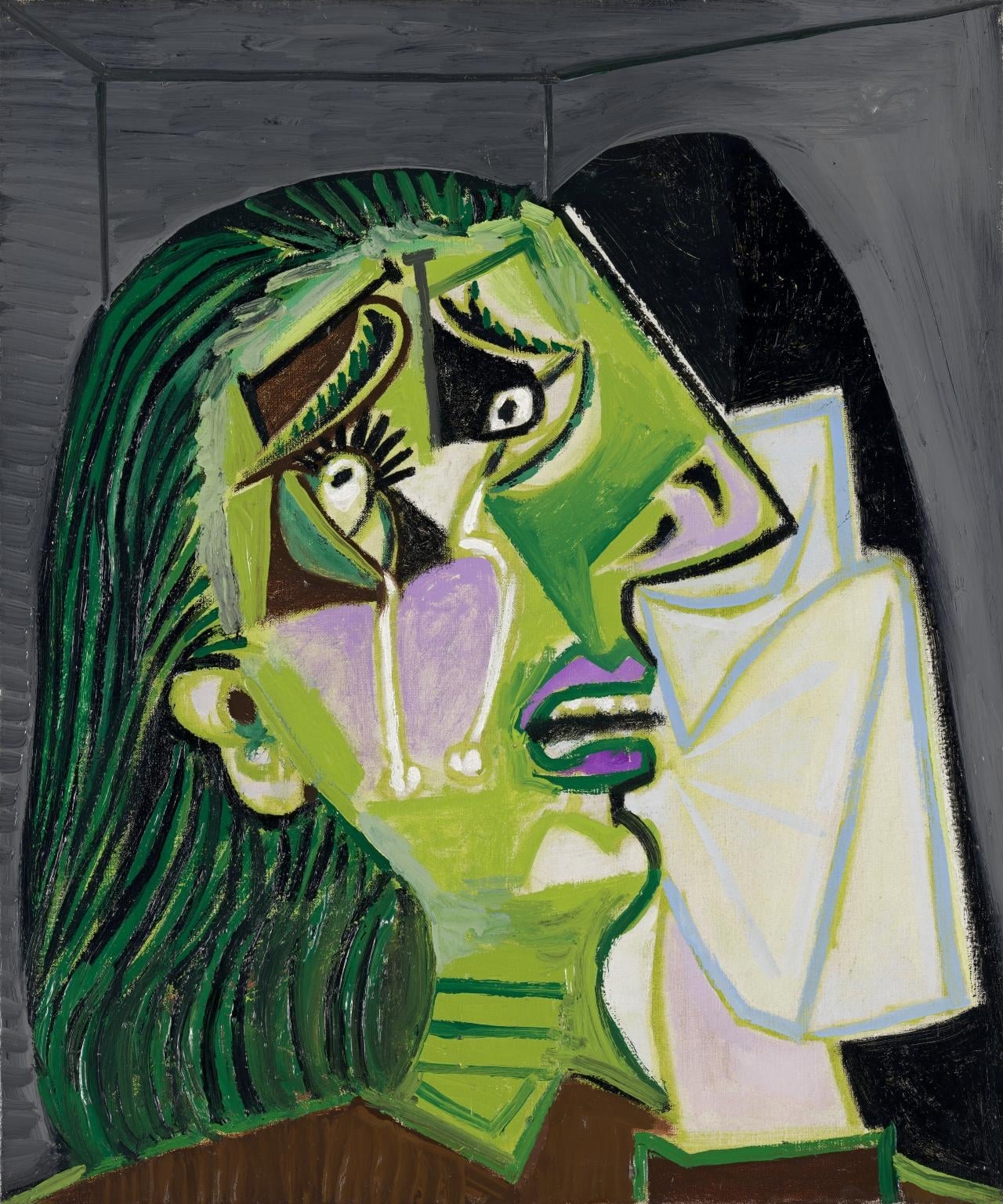
The Weeping Woman
Pablo Picasso (1937)
Picasso’s The Weeping Woman turns private mourning into a public, <strong>iconic emblem of civilian grief</strong>. Shattered planes, <strong>acidic greens and purples</strong>, and jewel-like tears force the viewer to feel the fracture of perception that follows trauma <sup>[1]</sup><sup>[2]</sup>.
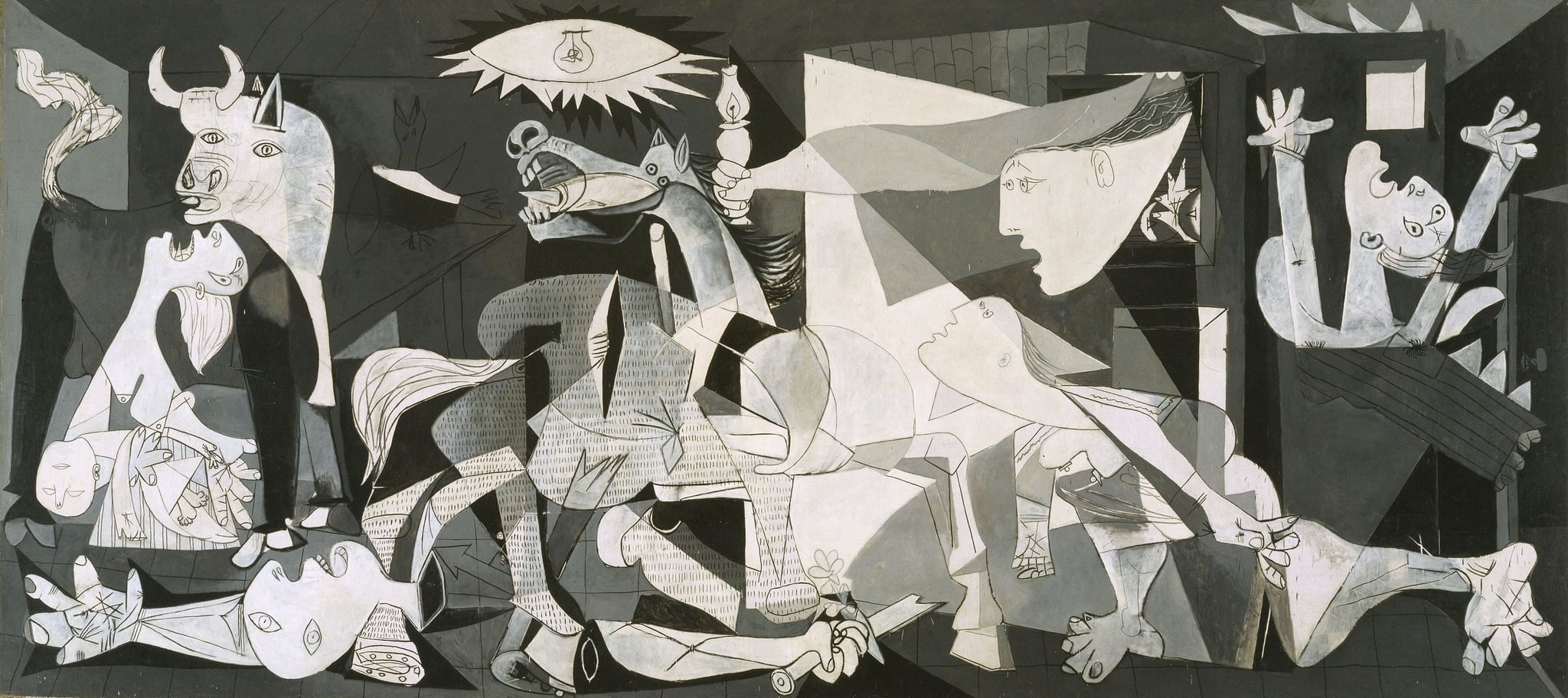
Guernica
Pablo Picasso (1937)
Guernica is a monumental, monochrome indictment of modern war, compressing a town’s annihilation into a frantic tangle of bodies, beasts, and light. Across the canvas, a <strong>shrieking horse</strong>, a <strong>stoic bull</strong>, a <strong>weeping mother with her dead child</strong>, and a <strong>fallen soldier</strong> stage a civic tragedy rather than a heroic battle. The harsh <strong>electric bulb</strong> clashes with a fragile <strong>oil lamp</strong>, turning the scene into a stark drama of terror and witness.
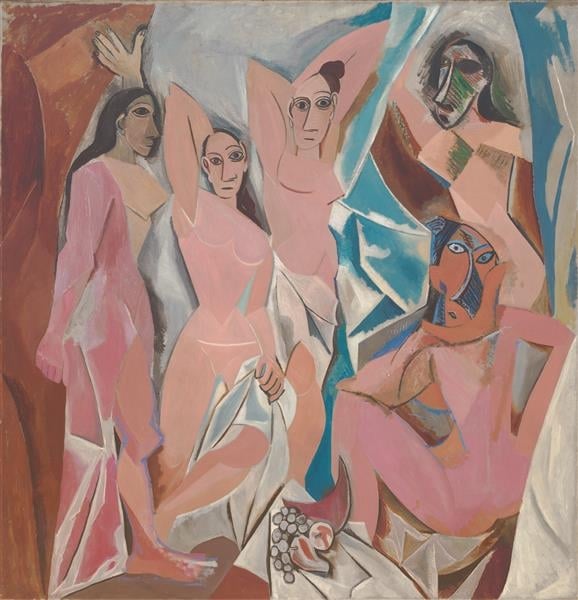
Les Demoiselles d'Avignon
Pablo Picasso (1907)
Les Demoiselles d'Avignon hurls five nudes toward the viewer in a shallow, splintered chamber, turning classical beauty into <strong>sharp planes</strong>, <strong>masklike faces</strong>, and <strong>fractured space</strong>. The fruit at the bottom reads as a sensual lure edged with threat, while the women’s direct gazes indict the beholder as participant. This is the shock point of <strong>proto‑Cubism</strong>, where Picasso reengineers how modern painting means and how looking works <sup>[1]</sup><sup>[2]</sup>.
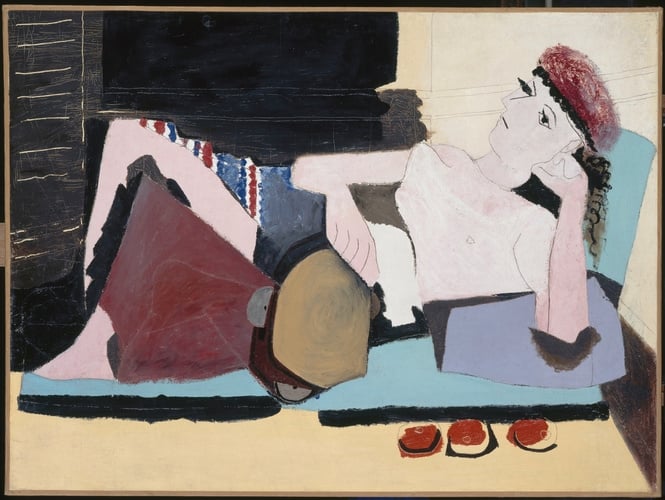
Femme au tambourin
Pablo Picasso (1925)
Picasso’s 1925 <strong>Femme au tambourin</strong> stages a reclining performer whose body is reduced to <strong>bold planes and hard contours</strong>. The circular tambourine across her lap and the <strong>three fruits</strong> aligned below create a visual rhythm that weighs <strong>pleasure against performance</strong> <sup>[1]</sup>.
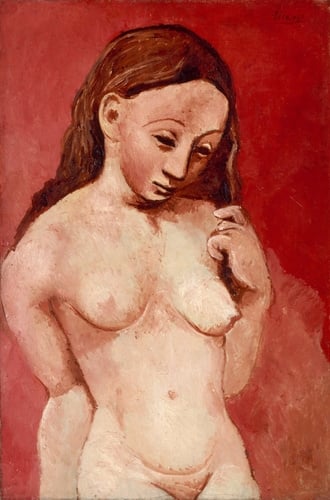
Nu sur fond rouge
Pablo Picasso (1906)
A solitary nude stands against a pulsating, uniform red field, her body reduced to <strong>rounded, sculptural planes</strong> and her face set with <strong>masklike eyes</strong>. The lowered gaze and self-touching gesture fold desire and inwardness into a single emblem, turning the figure into a <strong>proto‑Cubist icon</strong> rather than a person in space <sup>[1]</sup><sup>[2]</sup>.
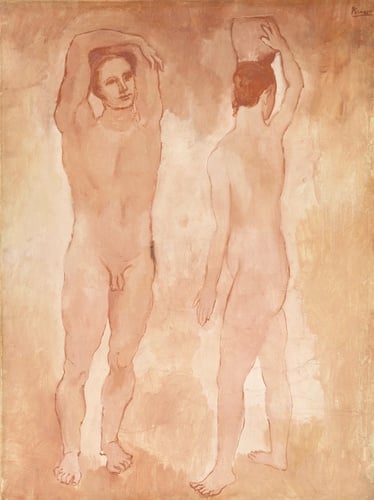
Les Adolescents
Pablo Picasso (1906)
Two nude youths stand in a shallow, fresco-like field, their bodies modeled in warm rose ochres that evoke Picasso’s <strong>Rose Period</strong> calm. Their matched yet misaligned gestures—one frontal with arms raised, the other in profile balancing a <strong>pitcher</strong>—stage a quiet rite of passage that turns adolescence into a timeless, <strong>classical</strong> type <sup>[1]</sup>.
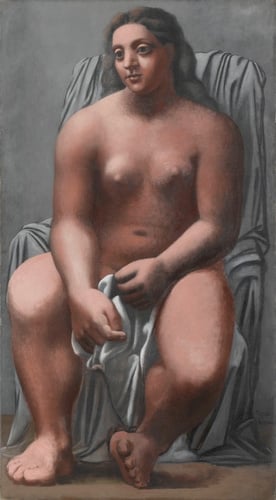
Grande baigneuse
Pablo Picasso (1921)
Picasso’s Grande baigneuse stages a monumental nude as an <strong>archetype of endurance</strong>, not a private individual. Seated frontally on a draped, stone-like chair, with <strong>downcast eyes</strong> and a towel clenched in her hand, she reads as a modernized classical statue—solid, calm, and timeless <sup>[1]</sup>. The painting fuses <strong>compressed modern space</strong> with antique gravitas to assert stability after wartime rupture <sup>[1]</sup><sup>[2]</sup>.
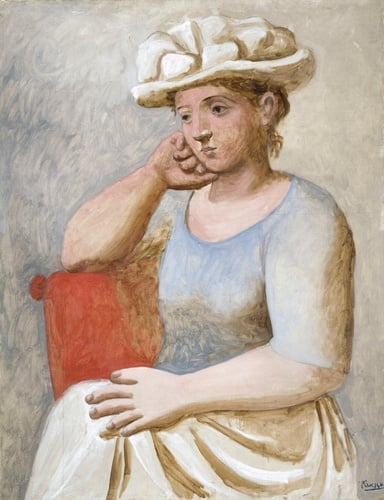
Femme au chapeau blanc
Pablo Picasso (1921)
Femme au chapeau blanc distills Picasso’s postwar <strong>neoclassical</strong> turn into a quiet yet monumental presence. A woman, elbow braced on a scarlet cushion and cheek in hand, sits beneath a <strong>billowing white hat</strong> whose cloudlike volume crowns her everyday dignity. The hushed whites and blues, anchored by the single red accent, assert <strong>calm, order, and permanence</strong> over experiment and fracture <sup>[1]</sup><sup>[2]</sup>.
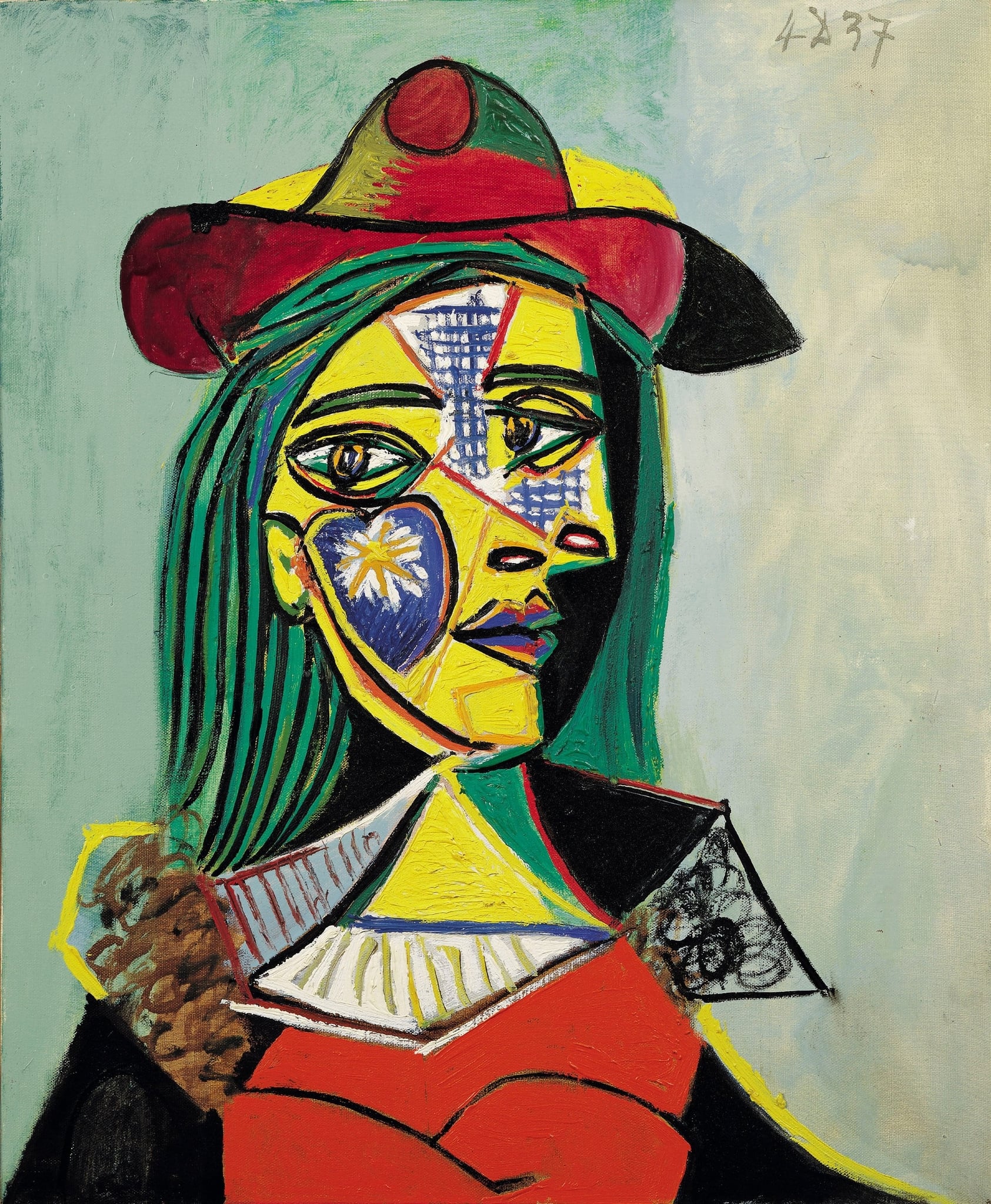
Woman in Hat and Fur Collar (Marie-Thérèse Walter)
Pablo Picasso (1937)
Picasso’s Woman in Hat and Fur Collar (Marie-Thérèse Walter) crystallizes a lover’s image into a <strong>split, mask-like icon</strong>: profile and frontal views fuse under a red hat while emerald hair cascades over a russet fur collar. Electric yellows, greens, and reds, bound by <strong>black contours</strong>, turn intimacy into a modern emblem of desire and poise <sup>[1]</sup>.
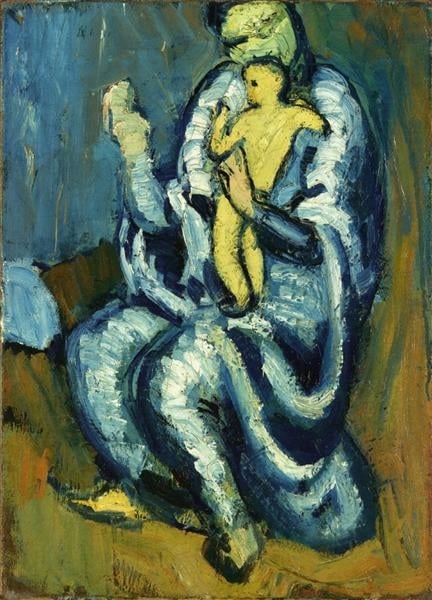
Motherhood (La Maternité)
Pablo Picasso (1903)
Motherhood (La Maternité) condenses a mother and child into a near-monument, the woman’s body forged from sweeping bars of blue and white that form a protective shell. The child’s <strong>ocher warmth</strong> glows against the cold field, a fragile ember of life amid austerity. The image declares <strong>care as architecture</strong> and frames tenderness as resistance.