Nu sur fond rouge

by Pablo Picasso

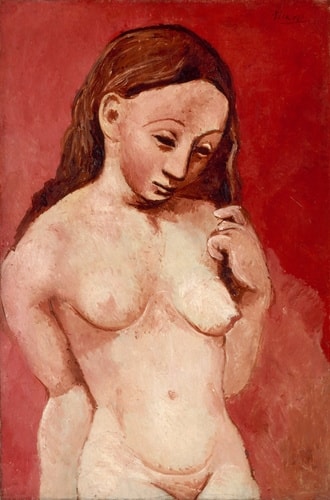
A solitary nude stands against a pulsating, uniform red field, her body reduced to rounded, sculptural planes and her face set with masklike eyes. The lowered gaze and self-touching gesture fold desire and inwardness into a single emblem, turning the figure into a proto‑Cubist icon rather than a person in space [1][2].

Study Print Studio

Create a personal study print

Build a companion study sheet around the part of this painting that speaks to you most. Choose a detail, shape an interpretation, and walk away with something personal and display-worthy.

Fast Facts

Year
1906
Medium
Oil on canvas
Dimensions
81 × 54 cm
Location
Musée de l’Orangerie, Paris
See all Pablo Picasso paintings in Paris
Nu sur fond rouge by Pablo Picasso (1906) featuring Mask-like face and eyes, Uniform red field, Self-touching gesture, Rounded sculptural planes

Click on any numbered symbol to learn more about its meaning

Meaning & Symbolism

Picasso organizes the figure as a compact architecture of planes. The torso swells in broad, even modeling, while the shoulders and abdomen are carved into simplified curvatures that suppress surface incident. The right hand rises to pinch a lock of hair; the head tilts down, and the mouth tightens beneath two slit-like, heavy-lidded eyes. This facial schema—continuous brow to nose ridge, elongated almond sockets—performs as a mask rather than a portrait, a direct uptake from Iberian sculpture that Picasso studied intensely in 1906 at the Louvre 13. The result is not empathy through expression but an impersonal, archaic calm. The pronounced silhouette against a uniform red ground abolishes room depth; the background is an atmosphere that presses forward, flattening the figure into an emblem. In place of modeled recession, the painting stakes meaning on outline, pressure, and schema—formal procedures that define Picasso’s 1906 pivot toward construction and the proto‑Cubist shallow stage 124. Color in Nu sur fond rouge is strategic rather than descriptive. The warm flesh tones echo the red field, welding body and surround into a single thermal register. That fusion intensifies two opposing claims: sensual immediacy and controlled containment. The red suggests heat and life force, but the planar handling and firm contours restrain it, installing the nude as a monument of inwardness rather than a figure available to the gaze. The modest tilt of the head and the self-contact at the shoulder implicate a private, contemplative circuit; desire is interiorized, not displayed. Even local “distortions”—the simplified bend of the arms and the blocky transition at the shoulder—announce an artist less concerned with anatomical truth than with structural legibility of parts, anticipating the analytic carve-up of form that would soon follow 12. In this equilibrium—tender surface warmth versus austere construction—the painting articulates the program of 1906: to transpose sources from the ancient world into a modern syntax that could sustain new spatial logics. That is why Nu sur fond rouge stands as a keystone in the gestation of Cubism: it proves that a figure can be built as a system of planes, stabilized by mask physiognomy and a compressed field, without surrendering its charge of human presence 125. Historically, the canvas bridges Picasso’s Rose/Ochre palette and the seismic innovations of 1907. The mask-face here is not quotation but method; it neutralizes anecdote and frees the figure from narrative time, aligning with museum accounts of 1906 as a turning point when ancient prototypes—especially Iberian—supplied him with a grammar of simplification 23. The uniform red ground acts like a testing bench for this grammar: with depth canceled, every decision about contour, plane, and junction becomes legible, a discipline that would soon govern the fractured spaces of Les Demoiselles and early Cubism 124. Nu sur fond rouge thus reads as a manifesto in the guise of a nude, declaring that modern painting will construct, not imitate; will monumentalize, not describe; and will seek meaning in the designed relations of planes as much as in the body they compose.

Explore Deeper with AI

Ask questions about Nu sur fond rouge

Popular questions:

Powered by AI • Get instant insights about this artwork

💬 Ask questions about this artwork!

Interpretations

Formal Laboratory: The Red Ground as Procedural Device

Rather than a setting, the saturated red functions as a procedural surface that strips out depth cues so that contour, planar joins, and silhouette pressure become legible operations. In this shallow field, the viewer reads “how” the figure is built—broad modeling offset by schematic curvatures—more than “who” she is. This aligns with the 1906 pivot toward construction, when Picasso tested a newly acquired grammar of simplification against a flattened stage to audit each junction and deformation (notably the elbow). The ground thus acts like a painter’s proving bench, where recession is subtracted to foreground method—a crucial rehearsal for the compressed spaces of 1907–1908 Cubism 12.

Source: Musée de l’Orangerie; Museo Reina Sofía

Iberian Mask as Method: Primitivism, Museums, and Making

The face’s continuous brow‑to‑nose ridge and slit eyes derive from Iberian sculpture that Picasso studied at the Louvre, but here the mask is not mere citation; it’s a working schema that neutralizes anecdote and re-centers construction. This museum‑mediated primitivism complicates authorship: the Louvre’s displays supplied formal templates that Picasso converted into a modern syntax. Scholarship locates this pivot firmly in 1906, with object‑based evidence tying specific features to Iberian carvings. Debates persist about the timing of extra‑European influences, but Iberian sources are the best‑documented drivers for this particular mask‑method, making Nu sur fond rouge a case study in how institutional collections shaped modernism’s grammar 134.

Source: Philadelphia Museum of Art; Musée de l’Orangerie; Musée Picasso–Paris

Against the Spectacle: A Feminist Rereading of the Nude

Despite chromatic heat, the painting refuses the classical nude’s display economy. The head’s modest tilt, the self‑touch at the shoulder, and the impersonal mask fold desire inward: “desire is interiorized, not displayed.” The result is a figure that withholds availability, substituting contemplative self‑containment for erotic invitation. By suppressing facial expressivity and staging the body as legible planes, Picasso frustrates the spectator’s possessive gaze; surface warmth remains, yet it is disciplined by contour and planar order. This tension—thermal allure versus schematic restraint—recasts the nude as a site of withheld intimacy, a move that troubles habitual modes of viewing female bodies in early twentieth‑century Paris 15.

Source: Musée de l’Orangerie; The Metropolitan Museum of Art

Relief-Space and the Proto‑Cubist Stage

Nu sur fond rouge compresses figure and ground into a near‑relief, where the silhouette carries the pictorial load. This shallow stage limits volumetric play so that planar articulation—shoulder blocks, abdominal curves, the angular elbow—reads like carving in paint. Such relief‑logic sets up the spatial contracts of 1907: surfaces are pressed forward, depth is rationed, and meaning aggregates in the joints between planes. Curators frame 1906 as the year Picasso forged this syntax from ancient prototypes, then stress‑tested it in a compressed field. The painting thus functions as a spatial manifesto in embryo, previewing how Cubism would convert depth into adjacency and narrative into construction 12.

Source: Musée de l’Orangerie; Museo Reina Sofía

Market Circuits and Modernist Canon‑Making

The canvas’s path—from Ambroise Vollard to Paul Guillaume and into a French state collection—maps the dealer‑museum circuit that consolidated Picasso’s transitional works as canonical. Such provenance is not incidental: it shaped how proto‑Cubist procedures (mask physiognomy, planar construction) were historicized as stepping‑stones to Cubism. Guillaume’s eye for schematic modernity and Vollard’s networks helped position pieces like Nu sur fond rouge as keystones in the 1906–1907 arc. Cataloging and state acquisition later stabilized this narrative, ensuring the work’s exemplary status within public discourse and pedagogy. In other words, the painting’s formal experiment became institutional memory through the channels that circulated and enshrined it 16.

Source: Musée de l’Orangerie; On‑line Picasso Project

Related Themes

About Pablo Picasso

Pablo Picasso (1881–1973), a founder of Cubism, was living in Paris during the Spanish Civil War and was commissioned by the Spanish Republic for the 1937 Paris Exposition. After the bombing of Guernica, he abandoned an earlier theme and conceived this mural; Dora Maar documented its making and the work later became a political envoy, returning to Spain only after its democratic transition [2][4][5].
View all works by Pablo Picasso

More by Pablo Picasso

The Weeping Woman by Pablo Picasso

The Weeping Woman

Pablo Picasso (1937)

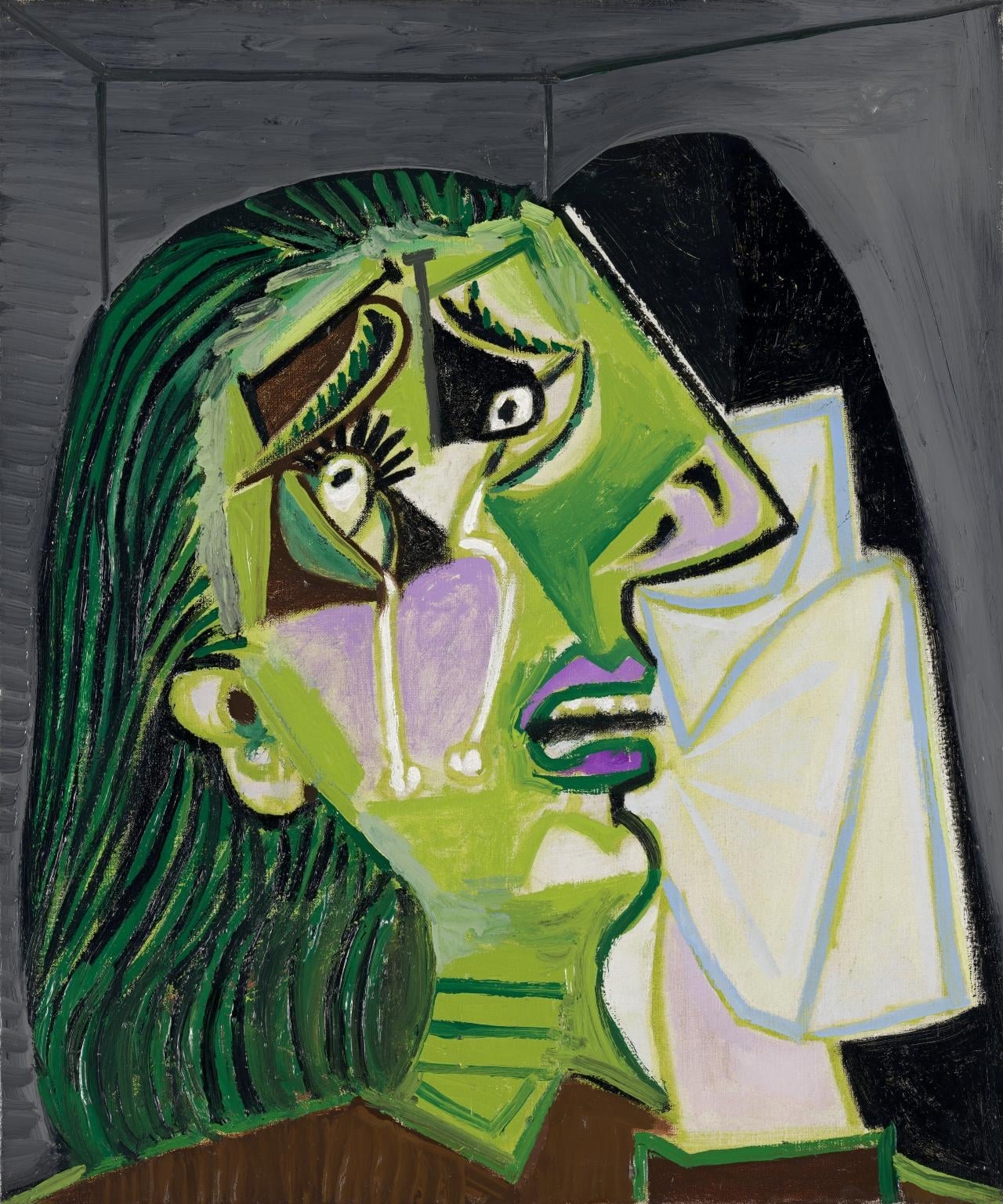
Picasso’s The Weeping Woman turns private mourning into a public, <strong>iconic emblem of civilian grief</strong>. Shattered planes, <strong>acidic greens and purples</strong>, and jewel-like tears force the viewer to feel the fracture of perception that follows trauma <sup>[1]</sup><sup>[2]</sup>.
Guernica by Pablo Picasso

Guernica

Pablo Picasso (1937)

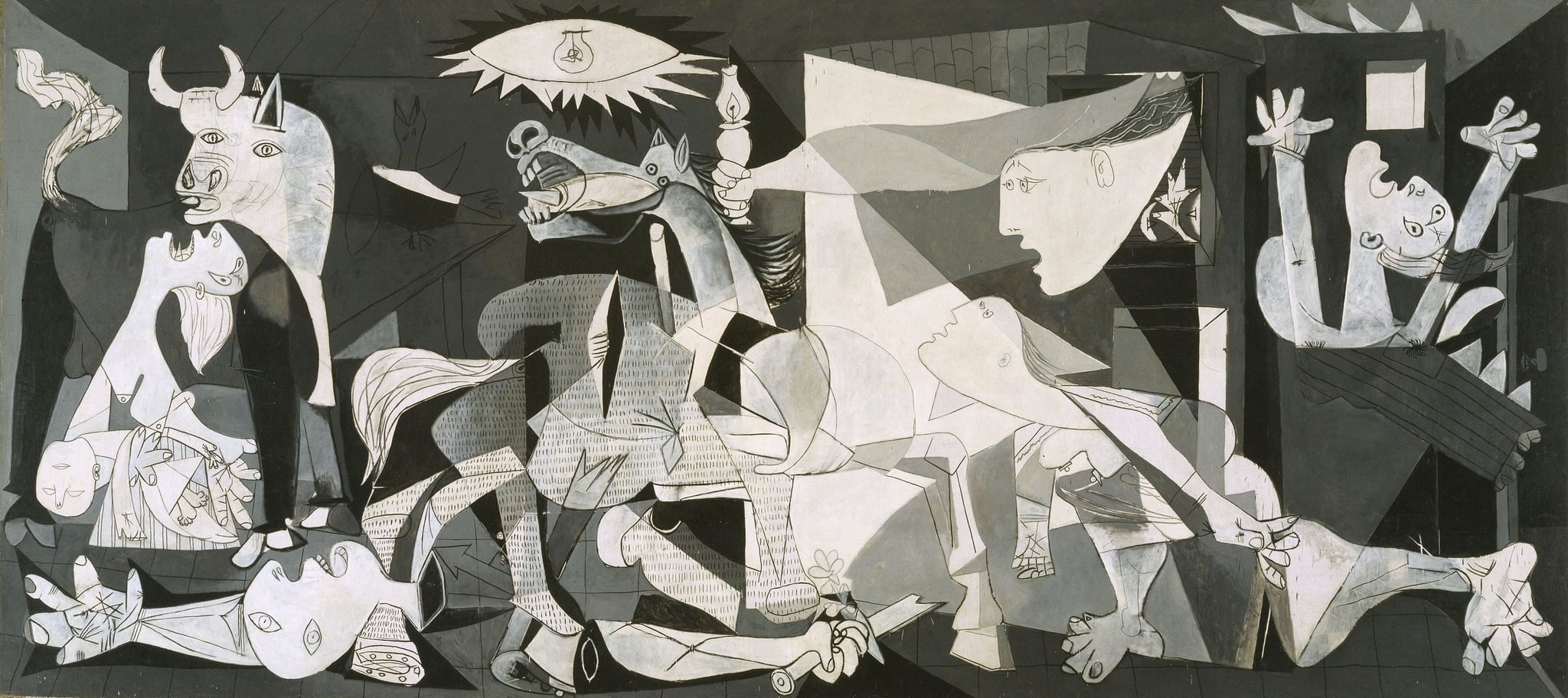
Guernica is a monumental, monochrome indictment of modern war, compressing a town’s annihilation into a frantic tangle of bodies, beasts, and light. Across the canvas, a <strong>shrieking horse</strong>, a <strong>stoic bull</strong>, a <strong>weeping mother with her dead child</strong>, and a <strong>fallen soldier</strong> stage a civic tragedy rather than a heroic battle. The harsh <strong>electric bulb</strong> clashes with a fragile <strong>oil lamp</strong>, turning the scene into a stark drama of terror and witness.
Les Demoiselles d'Avignon by Pablo Picasso

Les Demoiselles d'Avignon

Pablo Picasso (1907)

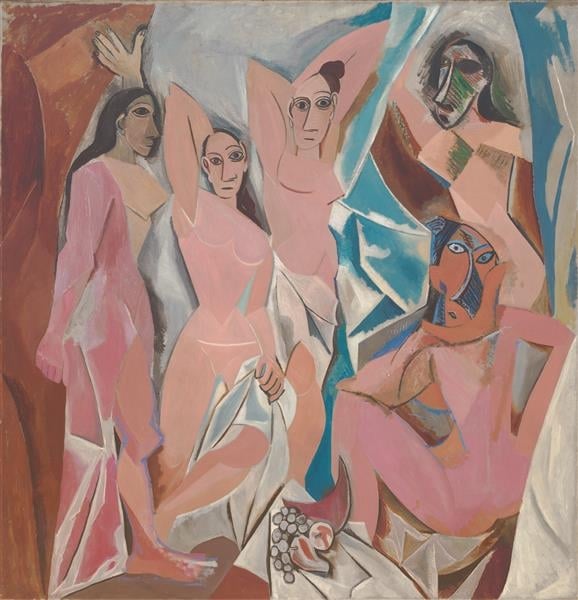
Les Demoiselles d'Avignon hurls five nudes toward the viewer in a shallow, splintered chamber, turning classical beauty into <strong>sharp planes</strong>, <strong>masklike faces</strong>, and <strong>fractured space</strong>. The fruit at the bottom reads as a sensual lure edged with threat, while the women’s direct gazes indict the beholder as participant. This is the shock point of <strong>proto‑Cubism</strong>, where Picasso reengineers how modern painting means and how looking works <sup>[1]</sup><sup>[2]</sup>.
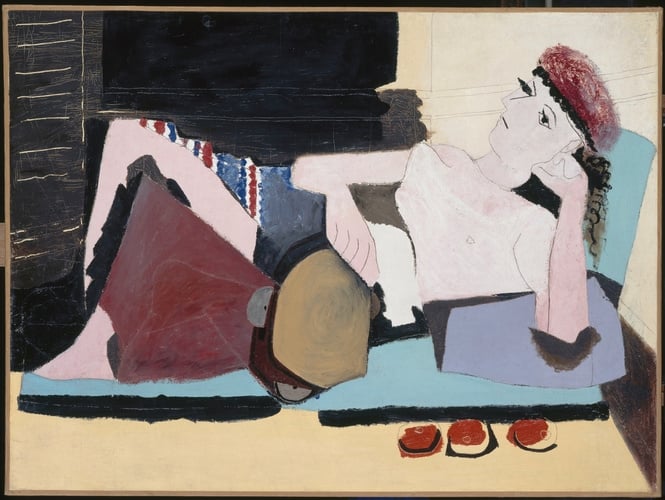
Femme au tambourin by Pablo Picasso

Femme au tambourin

Pablo Picasso (1925)

Picasso’s 1925 <strong>Femme au tambourin</strong> stages a reclining performer whose body is reduced to <strong>bold planes and hard contours</strong>. The circular tambourine across her lap and the <strong>three fruits</strong> aligned below create a visual rhythm that weighs <strong>pleasure against performance</strong> <sup>[1]</sup>.
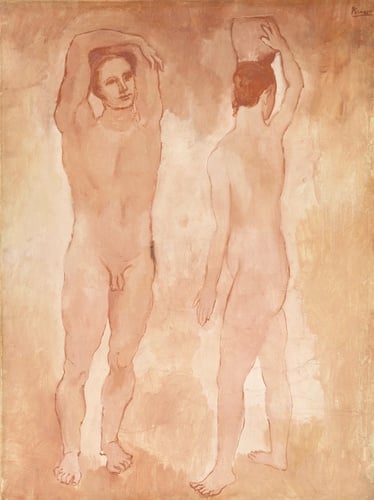
Les Adolescents by Pablo Picasso

Les Adolescents

Pablo Picasso (1906)

Two nude youths stand in a shallow, fresco-like field, their bodies modeled in warm rose ochres that evoke Picasso’s <strong>Rose Period</strong> calm. Their matched yet misaligned gestures—one frontal with arms raised, the other in profile balancing a <strong>pitcher</strong>—stage a quiet rite of passage that turns adolescence into a timeless, <strong>classical</strong> type <sup>[1]</sup>.
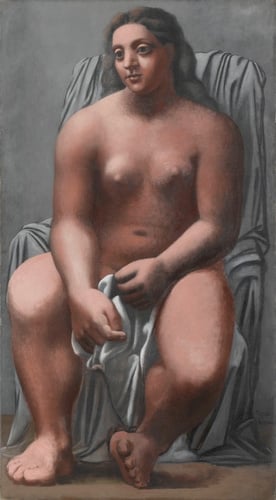
Grande baigneuse by Pablo Picasso

Grande baigneuse

Pablo Picasso (1921)

Picasso’s Grande baigneuse stages a monumental nude as an <strong>archetype of endurance</strong>, not a private individual. Seated frontally on a draped, stone-like chair, with <strong>downcast eyes</strong> and a towel clenched in her hand, she reads as a modernized classical statue—solid, calm, and timeless <sup>[1]</sup>. The painting fuses <strong>compressed modern space</strong> with antique gravitas to assert stability after wartime rupture <sup>[1]</sup><sup>[2]</sup>.