Les Adolescents

by Pablo Picasso

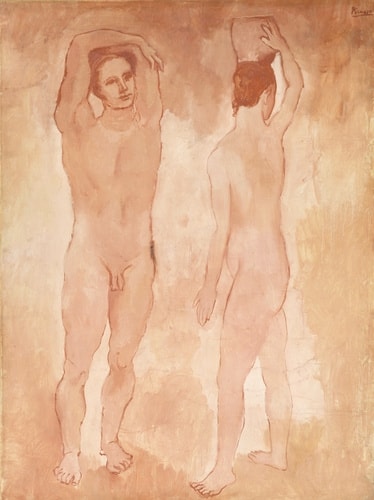
Two nude youths stand in a shallow, fresco-like field, their bodies modeled in warm rose ochres that evoke Picasso’s Rose Period calm. Their matched yet misaligned gestures—one frontal with arms raised, the other in profile balancing a pitcher—stage a quiet rite of passage that turns adolescence into a timeless, classical type [1].

Study Print Studio

Create a personal study print

Build a companion study sheet around the part of this painting that speaks to you most. Choose a detail, shape an interpretation, and walk away with something personal and display-worthy.

Fast Facts

Year
1906
Medium
Oil on canvas
Dimensions
157 x 117 cm
Location
Musée de l’Orangerie, Paris
See all Pablo Picasso paintings in Paris
Les Adolescents by Pablo Picasso (1906) featuring Pitcher/Vessel, Raised-Arms Frontal Pose, Twinning/Duality of Two Figures, Bare Feet on a Shallow Plane

Click on any numbered symbol to learn more about its meaning

Meaning & Symbolism

Picasso builds the scene from essentials—line, contour, and a restricted rose–ochre scale—to remove narrative clutter and concentrate meaning in pose. The left figure faces us directly, arms joined overhead so the ribcage opens like a shield and a wound at once, a classical motif that reads as both offering and exposure. The right figure turns in profile, one arm bent to steady a pitcher perched on the crown; the other arm hangs, palm slightly open, as if testing the air. Their feet align on the same shallow plane, yet their vectors diverge: the frontal body addresses the viewer, while the profile body orients toward an elsewhere. In that misalignment, Picasso composes an ethic rather than a story—the posture of adolescence as alternating approach and retreat, assertion and balance. The matte, plastery ground refuses deep space; it is time without setting, a fresco-like stage where identity is carved rather than described. Within this spareness, gender cues blur: the right figure’s long back, tightened waist, and vessel-bearing silhouette code as traditionally feminine, while the left figure’s frontal genitals and blocky limbs read as masculine—yet both are thinned, elongated, and smoothed toward androgyny, shifting our attention from personhood to condition 12. Formally, the painting routinizes antiquity to modern purpose. Clear, enclosing contours and an economical modeling of volume align it with the year’s pink classicism and Ingresque linearity that surfaces across Picasso’s 1906 pairs, such as Les Deux Frères; here too bodies become sculptural types rather than portraits 13. The pitcher, a Mediterranean sign of timeless domestic labor, stabilizes the right figure into a hieratic calm that rhymes with archaic bearing figures and Iberian prototypes that preoccupied Picasso after Gósol; set against the left figure’s open chest, it turns utility into emblem—balance, poise, and self-carriage as the labor of growing up 12. The visible, undulating underdrawing near the legs—ghost lines from an earlier horizontal conception—testifies to a process of searching and re-formation; even the canvas’s making mirrors adolescence as revision in progress 1. The rose–ochre field, often linked to the earthy pigments and Romanesque clarity that saturated Picasso’s 1906 summer, washes the scene in tender neutrality: flesh becomes clay, heat without heat, a humane light that softens eroticism into presence 12. Placed within the hinge of 1906, Les Adolescents functions as a proof of concept for a reconceived nude. Rather than narrate circus life or society, Picasso tests how minimal variables—frontality versus profile, raised arms versus bearing weight, exposure versus poise—generate meaning. The paired youths echo contemporaneous studies of two figures, including male duos like Two Youths, where Picasso experiments with bodily twinning to explore rhythm, symmetry, and difference 4. Here, that experiment arrives at a quietly radical proposition: that identity can be staged as a set of embodied relations, not a fixed essence. In doing so, the picture advances the year’s broader project—what curators call “the body in representation”—a transcultural, gender-fluid idealized type forged from classical, Iberian, and so‑called “primitive” dialogues 2. The result is a minimal narrative with maximal resonance: the awkward grace of growth, the awakening of sensual self-knowledge, and the search for composure inside a changing body, all rendered as contour, rhythm, and light. As the Rose Period closes, this serene classicism becomes a springboard, preparing the ground for the seismic redefinitions of the figure in 1907 while foreshadowing the 1920s turn toward order; the canvas is at once culmination and threshold 1235.

Explore Deeper with AI

Ask questions about Les Adolescents

Popular questions:

Powered by AI • Get instant insights about this artwork

💬 Ask questions about this artwork!

Interpretations

Historical Context

In 1906 Picasso’s summer in Gósol catalyzed a shift from Rose Period sentiment to a pink classicism steeped in ochre earth, Romanesque clarity, and Iberian severity. Les Adolescents absorbs this milieu: the matte, rose‑ochre field reads like fresco, while simplified volumes and frontal calm echo archaic prototypes. Curators at the Reina Sofía frame 1906 as a hinge where Picasso reconceives “the body in representation,” testing how cultural canons—classical, Iberian, so‑called “primitive”—can remake the nude as a type rather than a person. The Orangerie further positions the painting as anticipating the later “return to order,” compressing history into a serene experiment whose restraint becomes a platform for 1907’s formal ruptures. Thus, context clarifies why minimal variables here carry maximal conceptual charge: the work is both culmination and threshold 126.

Source: Museo Reina Sofía; Musée de l’Orangerie; Britannica

Symbolic Reading

The right figure’s pitcher reframes domestic labor as emblem. Balanced on the crown, it stabilizes the body into a hieratic vertical that answers the left figure’s exposed, ventilated chest. Read together, utility becomes ethos: self‑carriage, balance, and measured bearing as the inward labor of growing up. Mediterranean iconography (vessel‑bearing women) meets Picasso’s archaizing impulse, translating the everyday into timeless sign. This symbol also modulates gender: the amphora‑like silhouette codes “feminine” even as the bodies slide toward androgyny, underscoring function and poise over sexual difference. The pitcher thus mediates the painting’s ethics of adolescence—composure under weight—while yoking modern linearity to antique clarity 125.

Source: Musée de l’Orangerie; Museo Reina Sofía; Philadelphia Museum of Art

Formal Analysis

Picasso retools Ingresque linearity: clean enclosing contours, economical modeling, and shallow ground convert bodies into sculptural types. The frontal/profile duet produces a measured polyphony—call (open ribcage) and response (balancing armature)—within a nearly monochrome field that unifies flesh and space. Crucially, the visible, undulating underdrawing below the legs—ghosts from an abandoned horizontal layout—reveals the canvas as a site of revision. Form becomes process: searching lines, then decisive contour. This aligns Les Adolescents with 1906 pairings like Les Deux Frères and Two Youths, where frontality, mirroring, and volumetric calm are laboratories for a new canon of the nude. Here, linear discipline is not decorative; it is the argument 134.

Source: Musée de l’Orangerie; Musée Picasso–Paris; National Gallery of Art

Gender/Queer Theory Lens

Rather than fix sexed bodies, Picasso proposes androgyny as a working model: genitals and silhouettes offer cues, yet contour smooths difference into a shared, idealizing type. The Reina Sofía identifies 1906 as the moment Picasso constructs a gender‑fluid body, a cultural synthesis where classical measure and Iberian mask‑like severity mute erotic specificity. In Les Adolescents, identity is relational—frontality invites address, profile with pitcher withholds—so gender functions as a sliding sign within a typology of poses. This is not indecision but method: the canvas tests how posture, balance, and bearing articulate subjectivity when sexual dimorphism is bracketed by style. The result is an ethics of ambiguity that anticipates later modernist de‑essentials of the body 21.

Source: Museo Reina Sofía; Musée de l’Orangerie

Medium/Process Reflexivity

The painting thematizes becoming through its making. Subsurface “ghost lines” from an earlier horizontal conception, still legible near the calves, attest to re‑composition in situ—a palimpsest that mirrors adolescence as revision. The matte, plastery ground refuses perspectival depth, asserting the support as a stage where identity is carved by contour rather than discovered in mimetic space. This self‑awareness aligns with 1906’s broader project: the nude as a constructed sign system, not naturalized body. Process is legible, but deliberately retained, allowing viewers to witness the negotiation from search to decision. In this sense, medium becomes metaphor: the adolescent self is a work‑in‑progress, articulated by erasure, correction, and the settling of line into law 12.

Source: Musée de l’Orangerie; Museo Reina Sofía

Related Themes

About Pablo Picasso

Pablo Picasso (1881–1973), a founder of Cubism, was living in Paris during the Spanish Civil War and was commissioned by the Spanish Republic for the 1937 Paris Exposition. After the bombing of Guernica, he abandoned an earlier theme and conceived this mural; Dora Maar documented its making and the work later became a political envoy, returning to Spain only after its democratic transition [2][4][5].
View all works by Pablo Picasso

More by Pablo Picasso

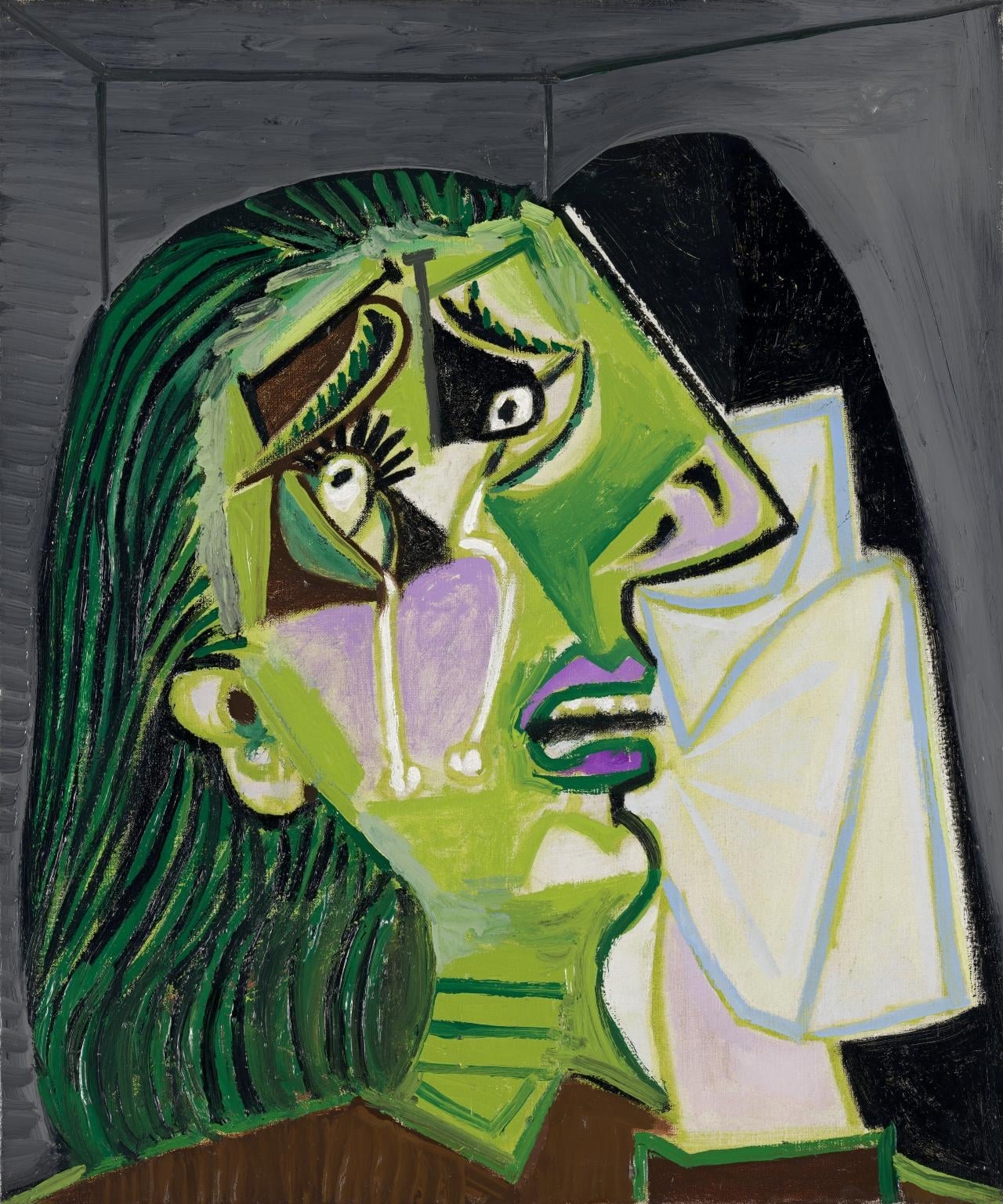
The Weeping Woman by Pablo Picasso

The Weeping Woman

Pablo Picasso (1937)

Picasso’s The Weeping Woman turns private mourning into a public, <strong>iconic emblem of civilian grief</strong>. Shattered planes, <strong>acidic greens and purples</strong>, and jewel-like tears force the viewer to feel the fracture of perception that follows trauma <sup>[1]</sup><sup>[2]</sup>.
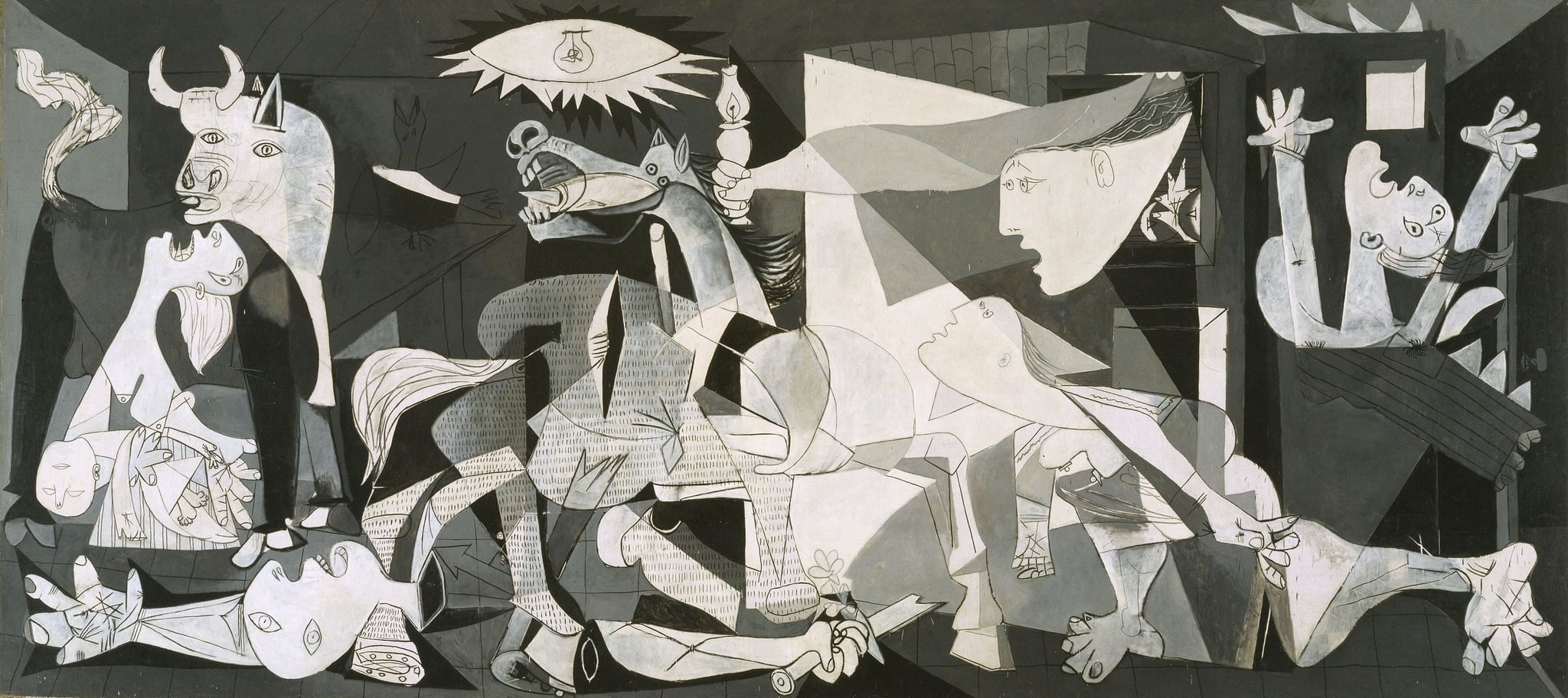
Guernica by Pablo Picasso

Guernica

Pablo Picasso (1937)

Guernica is a monumental, monochrome indictment of modern war, compressing a town’s annihilation into a frantic tangle of bodies, beasts, and light. Across the canvas, a <strong>shrieking horse</strong>, a <strong>stoic bull</strong>, a <strong>weeping mother with her dead child</strong>, and a <strong>fallen soldier</strong> stage a civic tragedy rather than a heroic battle. The harsh <strong>electric bulb</strong> clashes with a fragile <strong>oil lamp</strong>, turning the scene into a stark drama of terror and witness.
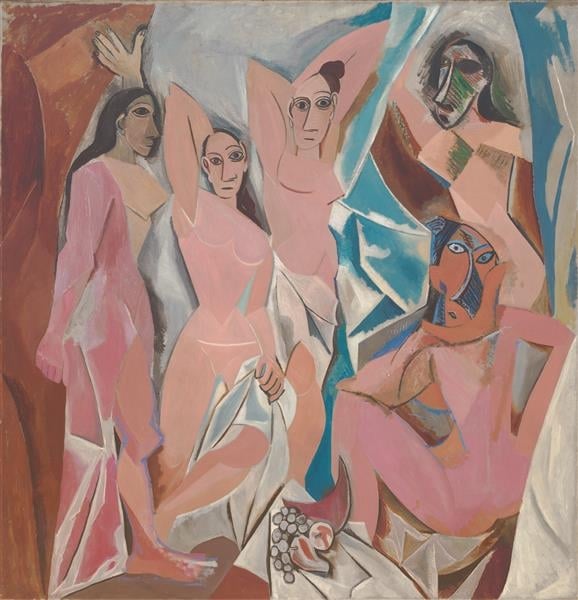
Les Demoiselles d'Avignon by Pablo Picasso

Les Demoiselles d'Avignon

Pablo Picasso (1907)

Les Demoiselles d'Avignon hurls five nudes toward the viewer in a shallow, splintered chamber, turning classical beauty into <strong>sharp planes</strong>, <strong>masklike faces</strong>, and <strong>fractured space</strong>. The fruit at the bottom reads as a sensual lure edged with threat, while the women’s direct gazes indict the beholder as participant. This is the shock point of <strong>proto‑Cubism</strong>, where Picasso reengineers how modern painting means and how looking works <sup>[1]</sup><sup>[2]</sup>.
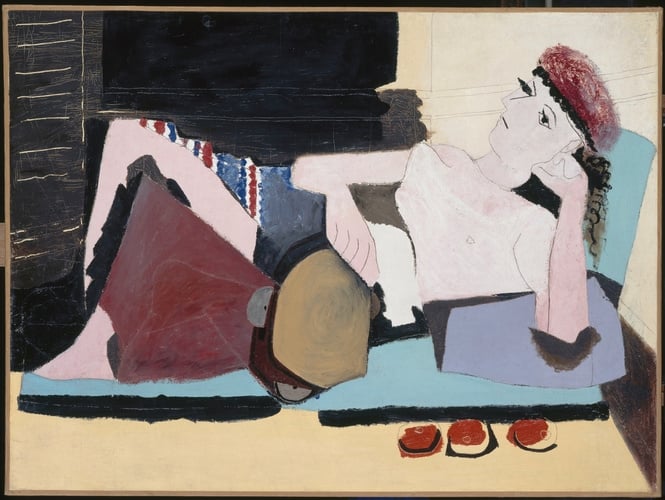
Femme au tambourin by Pablo Picasso

Femme au tambourin

Pablo Picasso (1925)

Picasso’s 1925 <strong>Femme au tambourin</strong> stages a reclining performer whose body is reduced to <strong>bold planes and hard contours</strong>. The circular tambourine across her lap and the <strong>three fruits</strong> aligned below create a visual rhythm that weighs <strong>pleasure against performance</strong> <sup>[1]</sup>.
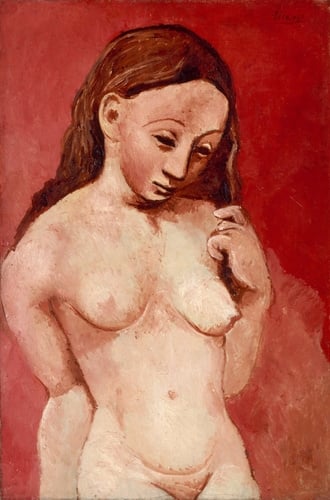
Nu sur fond rouge by Pablo Picasso

Nu sur fond rouge

Pablo Picasso (1906)

A solitary nude stands against a pulsating, uniform red field, her body reduced to <strong>rounded, sculptural planes</strong> and her face set with <strong>masklike eyes</strong>. The lowered gaze and self-touching gesture fold desire and inwardness into a single emblem, turning the figure into a <strong>proto‑Cubist icon</strong> rather than a person in space <sup>[1]</sup><sup>[2]</sup>.
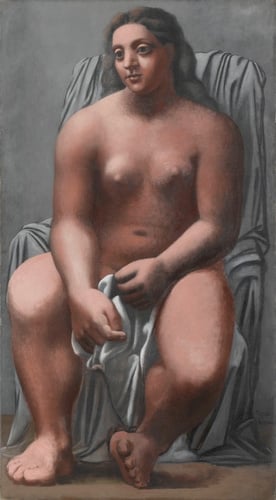
Grande baigneuse by Pablo Picasso

Grande baigneuse

Pablo Picasso (1921)

Picasso’s Grande baigneuse stages a monumental nude as an <strong>archetype of endurance</strong>, not a private individual. Seated frontally on a draped, stone-like chair, with <strong>downcast eyes</strong> and a towel clenched in her hand, she reads as a modernized classical statue—solid, calm, and timeless <sup>[1]</sup>. The painting fuses <strong>compressed modern space</strong> with antique gravitas to assert stability after wartime rupture <sup>[1]</sup><sup>[2]</sup>.