Pablo Picasso Paintings in Paris — Where to See Them
Paris remains essential for understanding Picasso because the city was the engine of his creative life and the modernist conversations that shaped his work; while you won't find his canvases scattered through salons, you'll encounter about five of his paintings on permanent display across two museums — notably five at the Musée de l'Orangerie and none at the Musée d'Orsay. For a practical visit, that means a focused, up-close look at Picasso’s paintings in the Orangerie, set within Paris’s broader modern-art institutions that chart the movements he helped redefine.
At a Glance
- Museums
- Musée d'Orsay, Musée de l'Orangerie
- Highlight
- Visit Musée de l'Orangerie to view Picasso's paintings
- Best For
- Art lovers and seekers of intimate modern-art displays
Musée d'Orsay
Although the Musée d'Orsay does not prioritize Picasso paintings in its permanent displays, it matters for experiencing Picasso because its outstanding holdings of Impressionist and Post‑Impressionist masters (Manet, Degas, Cézanne) show the visual and technical currents that Picasso reacted to and built upon during his early career. Viewing these works in the same museum gives concrete context for how Picasso’s break with 19th‑century conventions — his move toward simplification of form, multiple perspectives and new uses of color — was a radical departure from the art that preceded him. The D’Orsay’s rotating temporary exhibitions and loans also occasionally reunite Picasso with his contemporaries, letting you see direct contrasts and influences in one place.
Musée de l'Orangerie
The Musée de l’Orangerie matters for Picasso because, beyond its famous Monet Nymphéas, its modern art rooms house a small but carefully curated selection of Picasso paintings that are shown in direct dialogue with other 20th‑century currents. The Orangerie’s intimate galleries and the provenance of the works on display (part of private collections and 20th‑century Parisian collector networks) let you see Picassos alongside contemporaries and collectors who shaped his reception in France, offering a concentrated view of how his work fit into Paris’s modern‑art ecosystem.
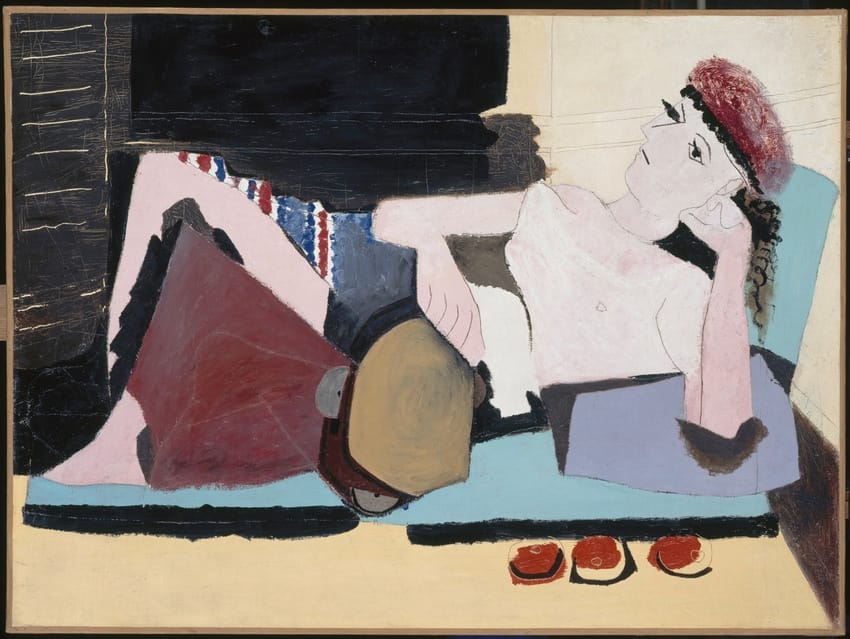
Femme au tambourin
1925
Depicts a seated, monumental woman holding a tambourine, rendered in Picasso’s neoclassical/post‑Cubist style with simplified volumes and sculptural forms. Significant as an example of Picasso’s 1920s return to monumental, classically inspired figuration after Cubism, blending solidity with modern stylization. Viewers should look for the emphasis on mass and contour, the restrained palette that models form, and the subtle tension between classical calm and modern abstraction.
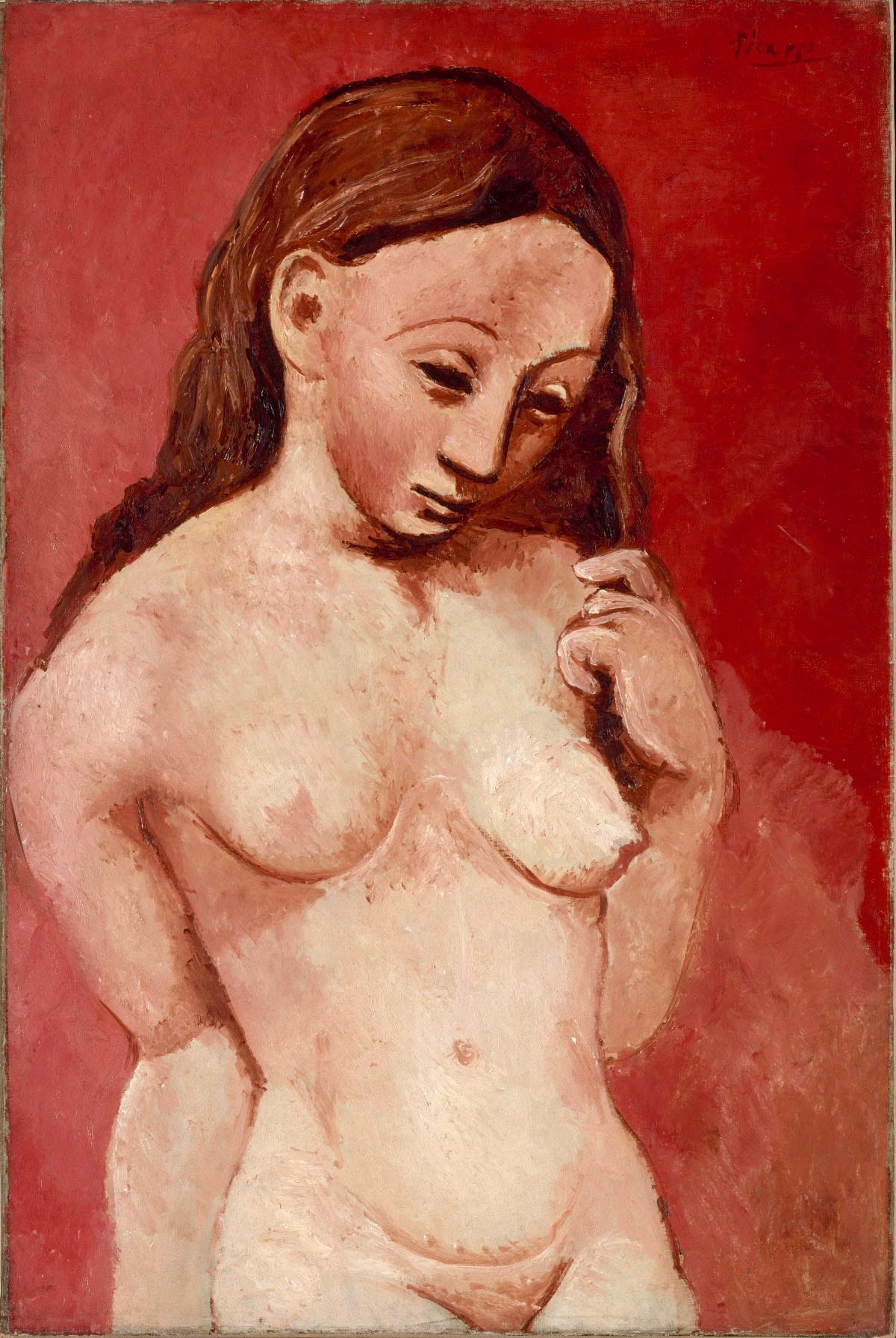
Nu sur fond rouge
1906
Shows a reclining nude set against a vivid red background, created during Picasso’s Rose Period when warmer tones and more intimate subjects reappeared. Important as a transitional work that moves away from his earlier Blue Period austerity toward greater warmth, tenderness, and exploration of form. Notice the soft modeling of the figure, the emotional warmth of the color field, and the way the red background both flattens and intensifies the presence of the body.
Must-see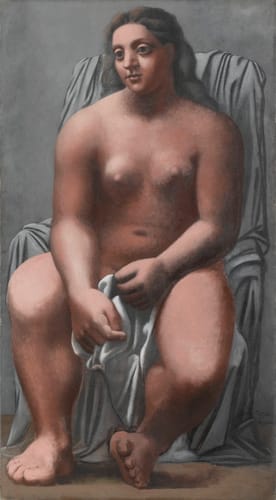
Grande baigneuse
1921
Portrays a large, seated bather in a simplified, monumental manner characteristic of Picasso’s post‑World War I classical phase. Significant for its fusion of archaic solidity with modern reduction of detail, reflecting Picasso’s interest in timeless sculptural forms and the human figure as an architectural presence. Look for the broad, smooth planes, the rhythmic organization of limbs, and how minimal features convey mass and serenity.
Must-see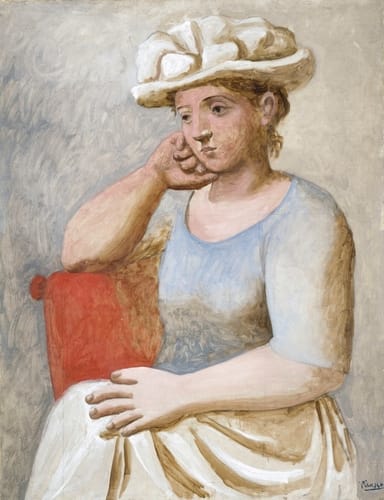
Femme au chapeau blanc
1921
Shows a composed woman wearing a white hat, rendered with the sculptural clarity and formal economy of Picasso’s classical revival. Important as part of his early‑1920s work that revisited portraiture with an emphasis on structural harmony and timeless dignity. Look for the interplay of angular and curved planes, the deliberate simplification of facial features, and how the white hat acts as a compositional focal point balancing mass and negative space.