Pablo Picasso Paintings in Barcelona — Where to See Them

Barcelona matters for experiencing Picasso because the city was central to his formative years and you can see that local connection in person: Museu Nacional d'Art de Catalunya (MNAC) keeps approximately 1 painting on permanent display. That single work is shown in dialogue with Catalan and Spanish masters, letting you place Picasso’s early development and regional influences in direct visual context rather than as an isolated masterpiece.

At a Glance

Museums
Museu Nacional d'Art de Catalunya (MNAC)
Highlight
See Picasso's works at MNAC with panoramic Montjuïc views.
Best For
Art and history lovers seeking Catalan modernism and city views.

Museu Nacional d'Art de Catalunya (MNAC)

Although MNAC holds only one painting by Pablo Picasso, that solitary work is meaningful because it places Picasso in direct dialogue with Catalonia’s wide sweep of medieval, modernist and Noucentista art — an important context for understanding the regional artistic currents that shaped his early career in Barcelona. The museum’s encyclopedic holdings let you compare Picasso’s piece against Catalan contemporaries and earlier visual traditions (Romanesque painting, Modernisme), making the single Picasso more instructive than isolated: it reveals how local schools and public taste intersected with the young artist’s evolving vocabulary.
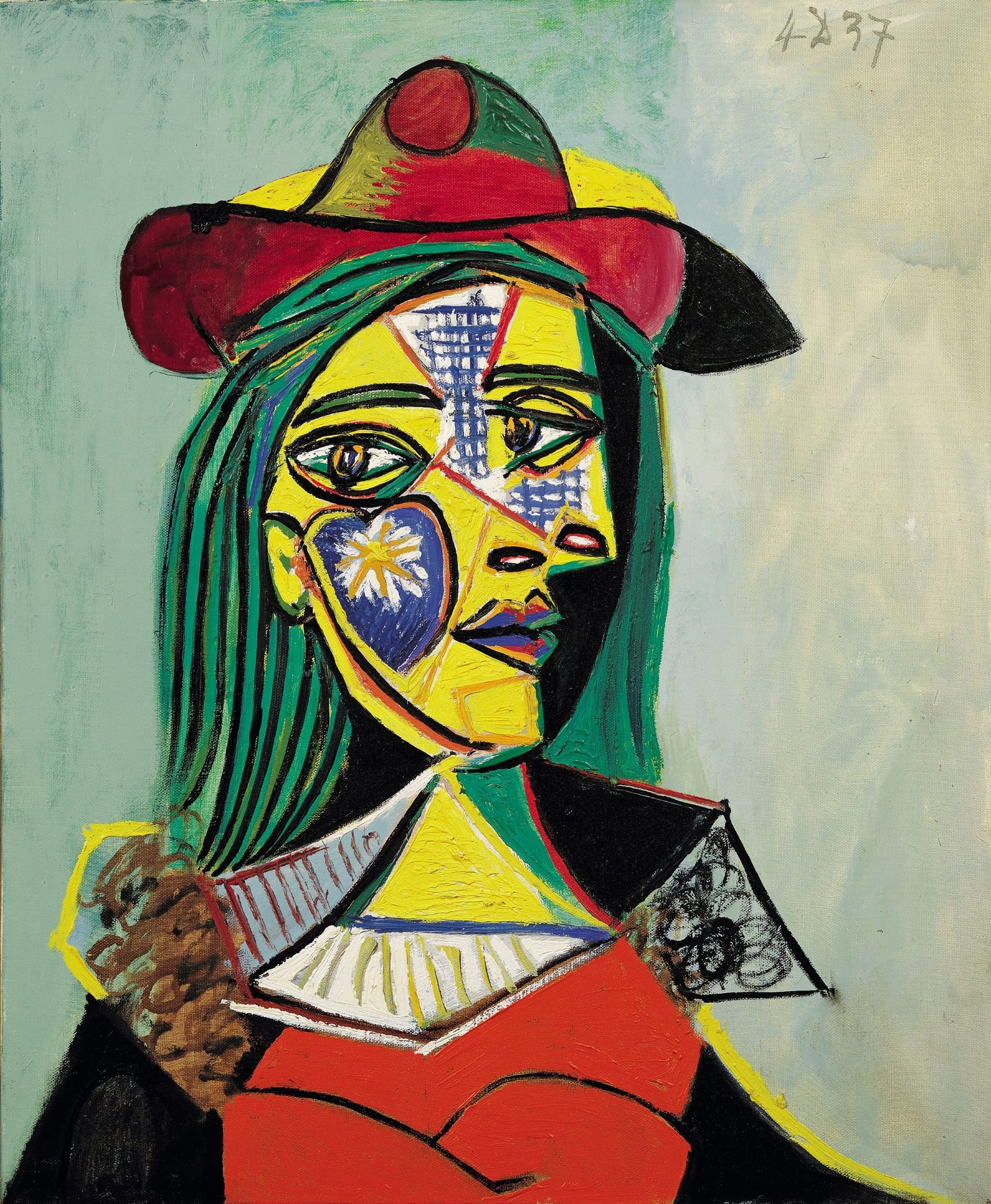
Woman in Hat and Fur Collar (Marie-Thérèse Walter)

Woman in Hat and Fur Collar (Marie-Thérèse Walter)

1937

This 1937 portrait shows Picasso’s lover Marie‑Thérèse Walter rendered with both a profile and a frontal face in the same composition, wearing a jaunty hat and a plush fur collar; the image compresses multiple viewpoints into a single, lyrical likeness. It’s significant as one of several intense studies of Marie‑Thérèse from this period that explore his move between classical portraiture and Cubist fragmentation; viewers should look for the interplay of curved, sensual lines against sharper planar facets, the bright color accents in the hat and face, and the deliberate tension between soft modeling and schematic geometry. ([museunacional.cat](https://www.museunacional.cat/en/colleccio/woman-hat-and-fur-collar-marie-therese-walter/pablo-picasso/214090-000?utm_source=openai))

Must-see
Address: Palau Nacional, Parc de Montjuïc, s/n, 08038 Barcelona, Spain
Hours: Winter (Oct 1–Apr 30): Tue–Sat 10:00–18:00; Sun & holidays 10:00–15:00. Summer (May 1–Sep 30): Tue–Sat 10:00–20:00; Sun & holidays 10:00–15:00. Closed Mondays (except public holidays).
Admission: General admission €12 (includes permanent and temporary exhibitions). Reduced and free-entry conditions apply (first Sunday of the month, Saturdays from 15:00, certain groups).
Tip: Ask the information desk where the Picasso painting is displayed before you begin — it is sometimes rotated or shown within thematic displays; visit first thing after opening to see it with fewer visitors, and then move through the Modernism and Noucentisme galleries to compare works that illuminate Picasso’s formative influences.

Pablo Picasso and Barcelona

Pablo Picasso’s formative years were closely tied to Barcelona. His family moved there in September 1895, and he enrolled at the Escola de Belles Arts (La Llotja), where his father taught and where Picasso studied from 1895–1897. 1 While based in Barcelona he rented his first studio (an attic on Carrer de la Plata) in 1896 and lived in the El Born / La Mercè quarter, producing early masterpieces such as Science and Charity (1897). 12 Barcelona’s modernist café Els Quatre Gats became a central nexus: Picasso was a regular, and his first solo shows in the city were held there in February and July 1900. 3 He also exhibited at established galleries such as Sala Parés (notably around 1901). 4 Key moments tied to Barcelona include his early public recognition (an honourable mention at the National Exhibition of Madrid for works painted while in Barcelona), the development of his Blue Period subjects influenced by the city’s social milieu, and—decades later—the founding of the Museu Picasso in Barcelona in 1963, the first museum devoted to him while he was alive, which preserves the largest collection of his early work. 15

Also See Pablo Picasso Paintings In