The Weeping Woman
Study Print Studio
Create a personal study print
Build a companion study sheet around the part of this painting that speaks to you most. Choose a detail, shape an interpretation, and walk away with something personal and display-worthy.
Fast Facts
- Year
- 1937
- Medium
- Oil on canvas
- Dimensions
- 55.2 × 46.2 cm
- Location
- National Gallery of Victoria, Melbourne
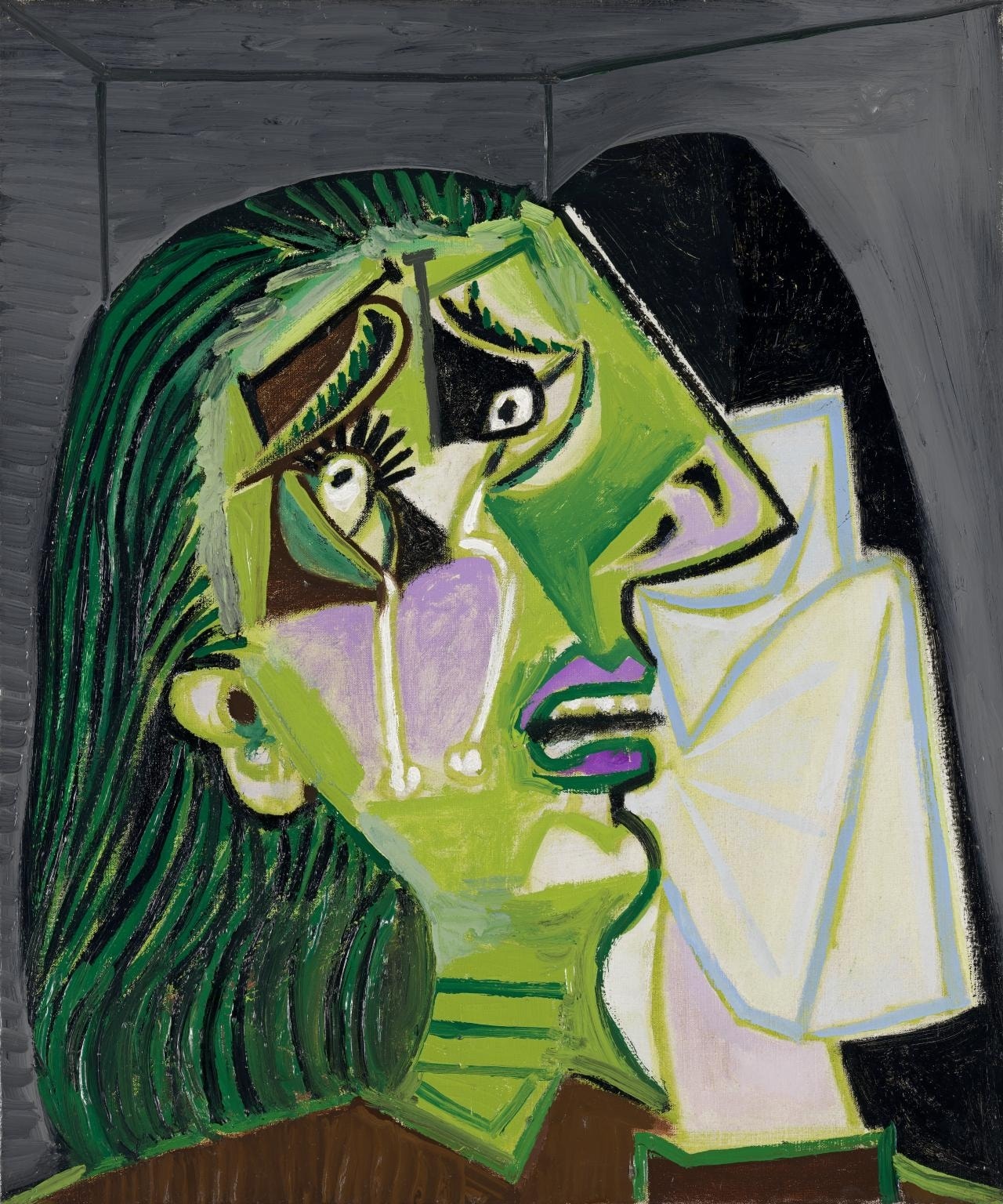
Click on any numbered symbol to learn more about its meaning
Meaning & Symbolism
Explore Deeper with AI
Ask questions about The Weeping Woman
Popular questions:
Powered by AI • Get instant insights about this artwork
Interpretations
Media Age Icon: From Photojournalism to Archetype
Source: Musée national Picasso–Paris
Secular Pietà: Spanish Baroque Recast
Source: Musée national Picasso–Paris
Color as Shock: Anti-Sentimental Chromatics
Source: Roland Penrose (via Tate/Art UK) and NGV
Biography vs. Public Emblem: Dora Maar’s Double Bind
Source: John Richardson/Françoise Gilot (via Christie’s); Musée Picasso; NGV
Serial Form: One Motif, Many Dates
Source: LACMA; Musée national Picasso–Paris; Art UK; Museo Reina Sofía
Seen in Comparisons
Related Themes
About Pablo Picasso
More by Pablo Picasso
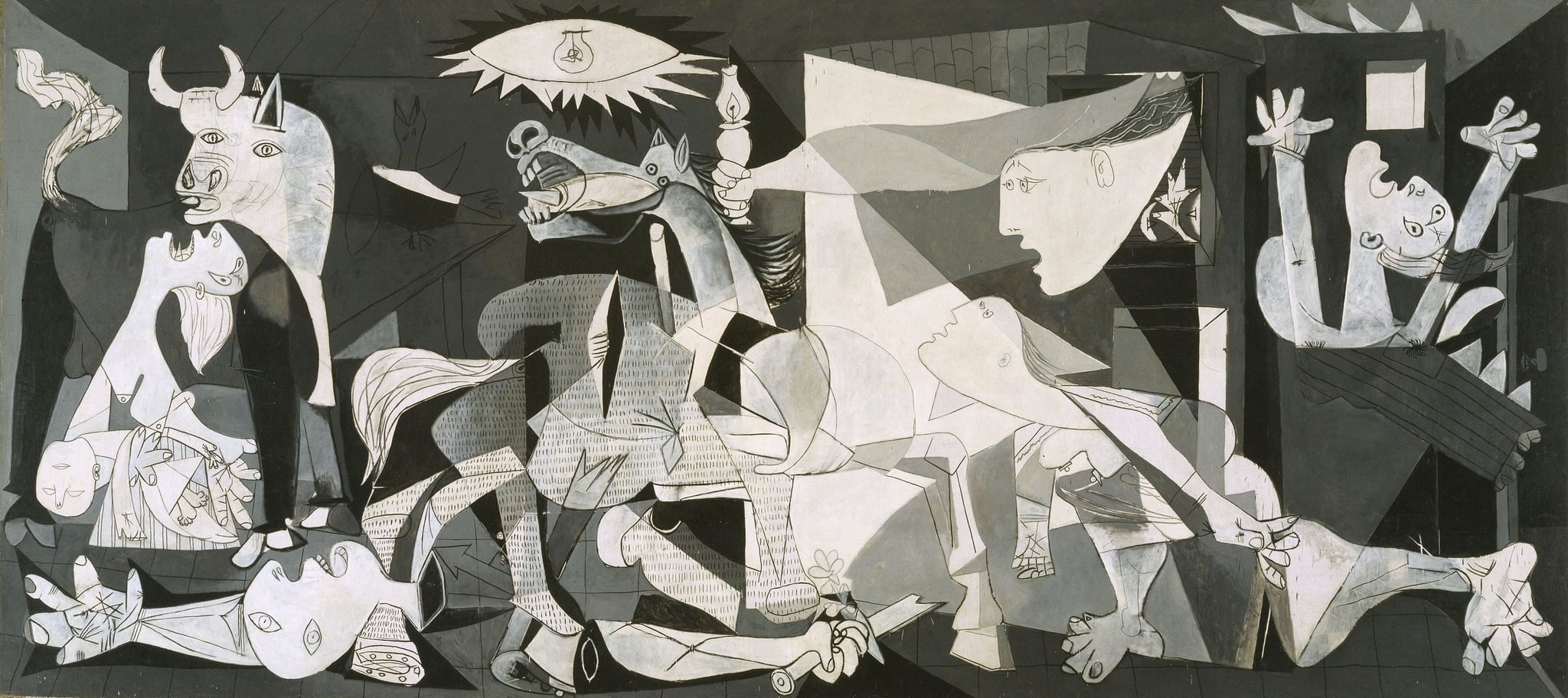
Guernica
Pablo Picasso (1937)
Guernica is a monumental, monochrome indictment of modern war, compressing a town’s annihilation into a frantic tangle of bodies, beasts, and light. Across the canvas, a <strong>shrieking horse</strong>, a <strong>stoic bull</strong>, a <strong>weeping mother with her dead child</strong>, and a <strong>fallen soldier</strong> stage a civic tragedy rather than a heroic battle. The harsh <strong>electric bulb</strong> clashes with a fragile <strong>oil lamp</strong>, turning the scene into a stark drama of terror and witness.
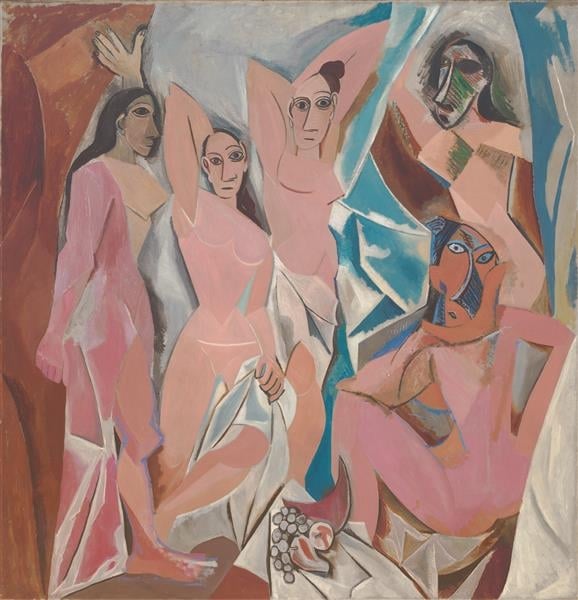
Les Demoiselles d'Avignon
Pablo Picasso (1907)
Les Demoiselles d'Avignon hurls five nudes toward the viewer in a shallow, splintered chamber, turning classical beauty into <strong>sharp planes</strong>, <strong>masklike faces</strong>, and <strong>fractured space</strong>. The fruit at the bottom reads as a sensual lure edged with threat, while the women’s direct gazes indict the beholder as participant. This is the shock point of <strong>proto‑Cubism</strong>, where Picasso reengineers how modern painting means and how looking works <sup>[1]</sup><sup>[2]</sup>.
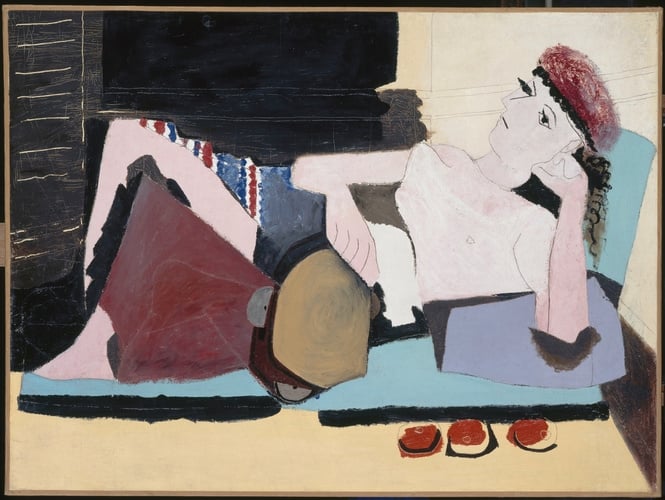
Femme au tambourin
Pablo Picasso (1925)
Picasso’s 1925 <strong>Femme au tambourin</strong> stages a reclining performer whose body is reduced to <strong>bold planes and hard contours</strong>. The circular tambourine across her lap and the <strong>three fruits</strong> aligned below create a visual rhythm that weighs <strong>pleasure against performance</strong> <sup>[1]</sup>.
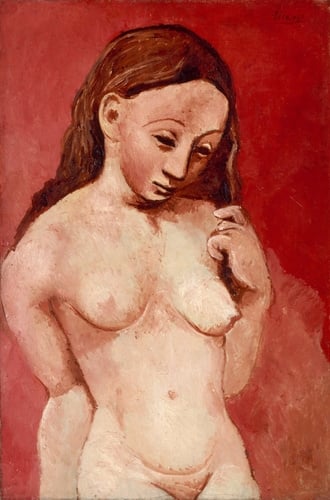
Nu sur fond rouge
Pablo Picasso (1906)
A solitary nude stands against a pulsating, uniform red field, her body reduced to <strong>rounded, sculptural planes</strong> and her face set with <strong>masklike eyes</strong>. The lowered gaze and self-touching gesture fold desire and inwardness into a single emblem, turning the figure into a <strong>proto‑Cubist icon</strong> rather than a person in space <sup>[1]</sup><sup>[2]</sup>.
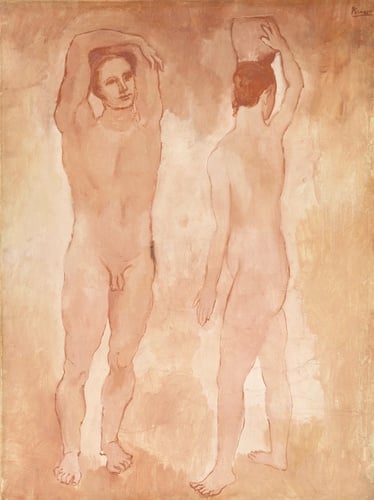
Les Adolescents
Pablo Picasso (1906)
Two nude youths stand in a shallow, fresco-like field, their bodies modeled in warm rose ochres that evoke Picasso’s <strong>Rose Period</strong> calm. Their matched yet misaligned gestures—one frontal with arms raised, the other in profile balancing a <strong>pitcher</strong>—stage a quiet rite of passage that turns adolescence into a timeless, <strong>classical</strong> type <sup>[1]</sup>.
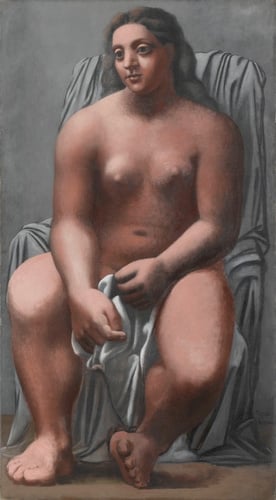
Grande baigneuse
Pablo Picasso (1921)
Picasso’s Grande baigneuse stages a monumental nude as an <strong>archetype of endurance</strong>, not a private individual. Seated frontally on a draped, stone-like chair, with <strong>downcast eyes</strong> and a towel clenched in her hand, she reads as a modernized classical statue—solid, calm, and timeless <sup>[1]</sup>. The painting fuses <strong>compressed modern space</strong> with antique gravitas to assert stability after wartime rupture <sup>[1]</sup><sup>[2]</sup>.