Two systems for building vision
Picasso and Matisse both replace imitation with construction. Picasso builds pictures from fractured viewpoints that make seeing analytic; Matisse builds pictures from saturated color that makes seeing immediate. The result is not abstraction for its own sake but two rival instructions for how a modern viewer should look.
Comparison frame: Two ways to unlearn Renaissance space: what does it feel like to see through Picasso’s Cubist lattice versus Matisse’s chromatic plane?
Quick Comparison
| Topic | Henri Matisse | Pablo Picasso |
|---|---|---|
| Core engine | Constructed viewpoints; analytic fracture; signs that stand for things. | Color-built continuity; reserves as drawing; decorative field as structure. |
| How space works | Shallow, faceted volumes; figure/ground ambiguity; depth by overlap. | Near-flat chromatic plane; objects hover; depth becomes hue intervals. |
| Viewer’s task | Decipher and reassemble; toggle readings to find the motif. | Settle into rhythm; feel orientation and mood through color. |
| Treatment of the figure | Confrontation and dislocation (Demoiselles; Weeping Woman). | Flow and arabesque; bodies tuned to a color climate (Joy of Life). |
| Studio as subject | Cubist studios parse objects into signs; collage and text appear. | The Red Studio converts the room into one continuous red field. |
| Non‑Western leverage | Iberian heads and African masks to block illusionism and reset faces as signs. | Islamic/Arabic pattern and textile logics to fuse figure, object, ground. |
| Stated aim | “Art is a lie that makes us realize truth.” | “An art of balance, purity and serenity.” |
Shared Ground
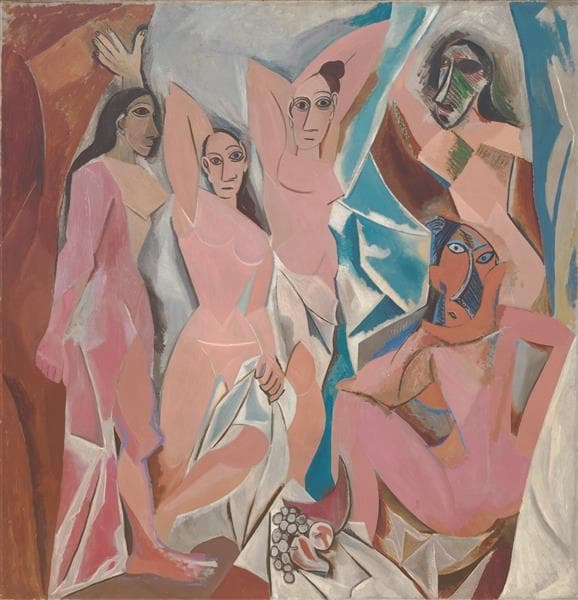
Picasso and Matisse start from the same modern premise: painting is not a window but a built experience. Both absorb Cézanne’s lesson that form can be constructed—by planes, by color—rather than copied from sight. Around 1905–07 they each dismantle Renaissance depth while keeping representation in play. Picasso’s Les Demoiselles d’Avignon fuses Iberian heads and African mask formats to harden faces into signs and splinter the chamber; Matisse’s Le bonheur de vivre spreads nudes through a harmonized color field where arcs and tonal intervals organize space more than perspective does. In both, the viewer must learn a new syntax to read the scene.
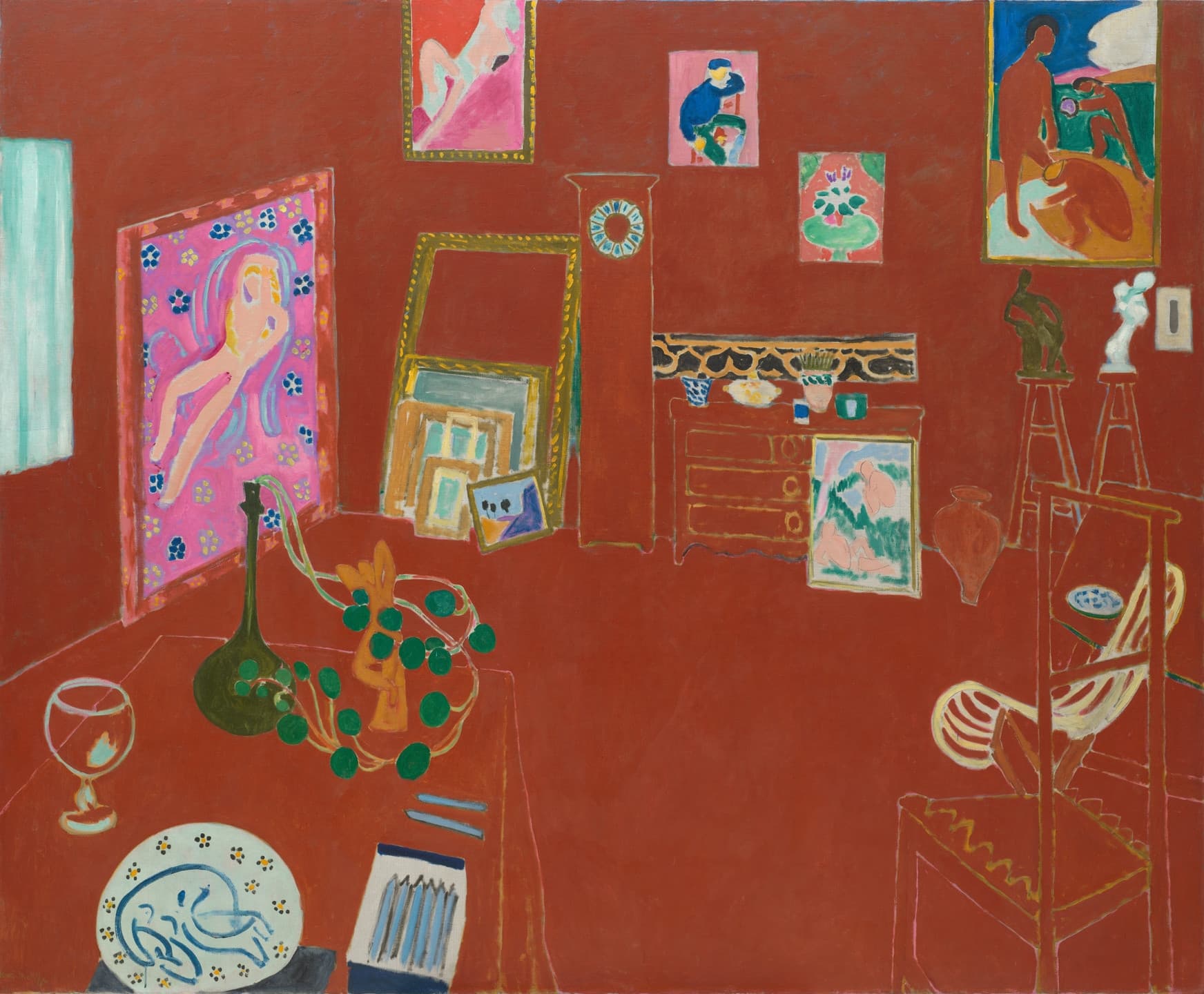
That shared ground extends to sources and subjects. Each artist uses non‑Western models as leverage against academic naturalism—Picasso to break open the face and contour; Matisse to validate all‑over pattern and ornamental continuity. Each turns the studio into a proving ground for vision: Picasso’s Cubist interiors treat instruments, bottles, and guitars as problems of structure and sign; Matisse’s The Red Studio replaces measured recession with a chromatic continuum and reserve lines that let furniture hover. Neither abandons the world; both rebuild how the world can be seen. Their common modernism lies here: painting becomes a system that trains perception—one that the viewer actively completes.
Decisive Difference
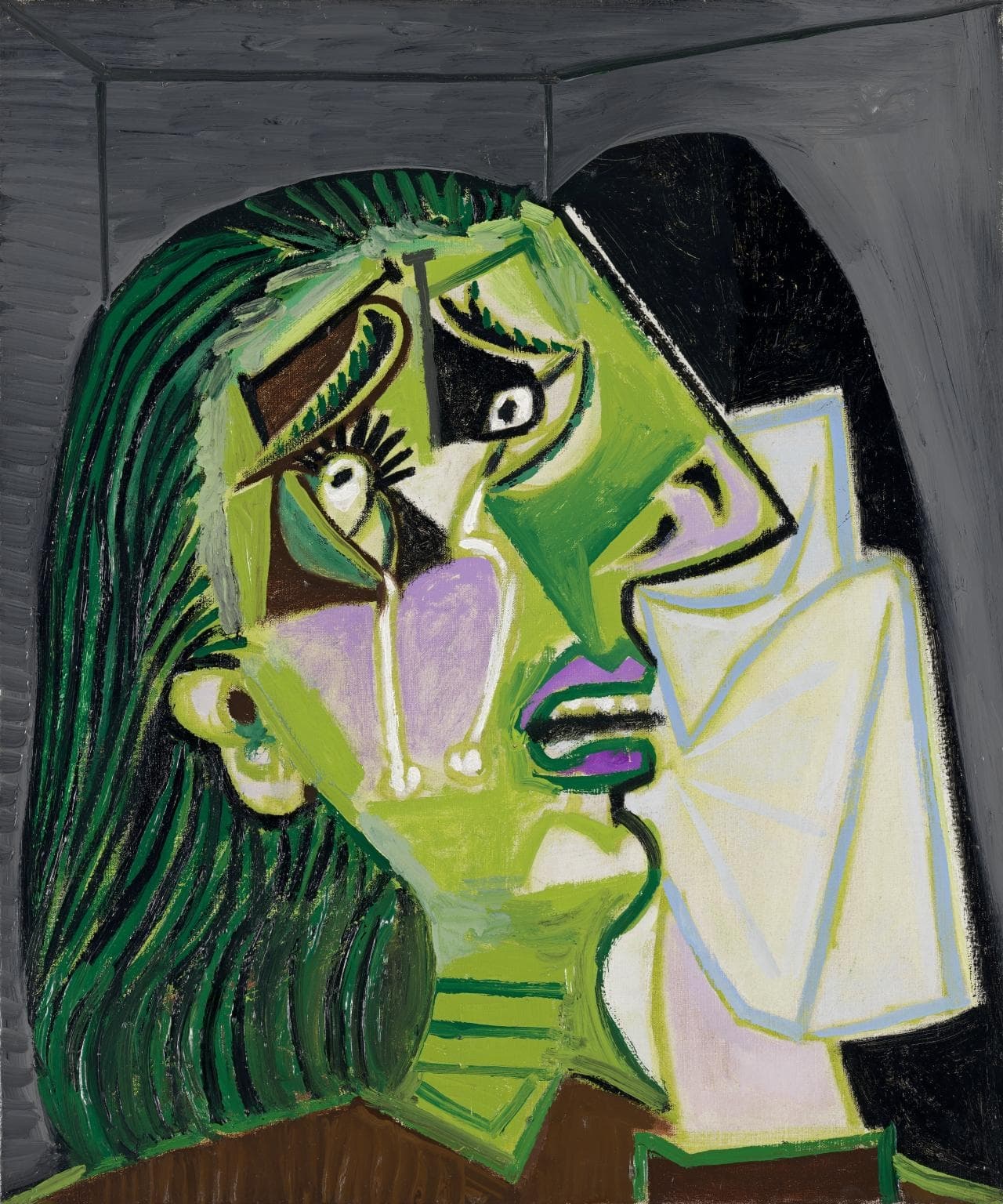
The decisive difference is the contract each artist makes with the beholder. Picasso makes seeing cognitive and effortful. In Analytic Cubism (Ma Jolie), he narrows the palette, slices contour into planes, and lets figure and ground toggle so that recognition arrives only after a mental reconstruction. His often‑quoted claim that “art is a lie that makes us realize truth” matches the experience: truth is a built inference, not a given. When color returns with force (The Weeping Woman; Guernica), it serves analysis—acid complements and jagged joins externalize grief and shock as structural dislocation. Picasso’s pictures teach by difficulty; their clarity is earned.
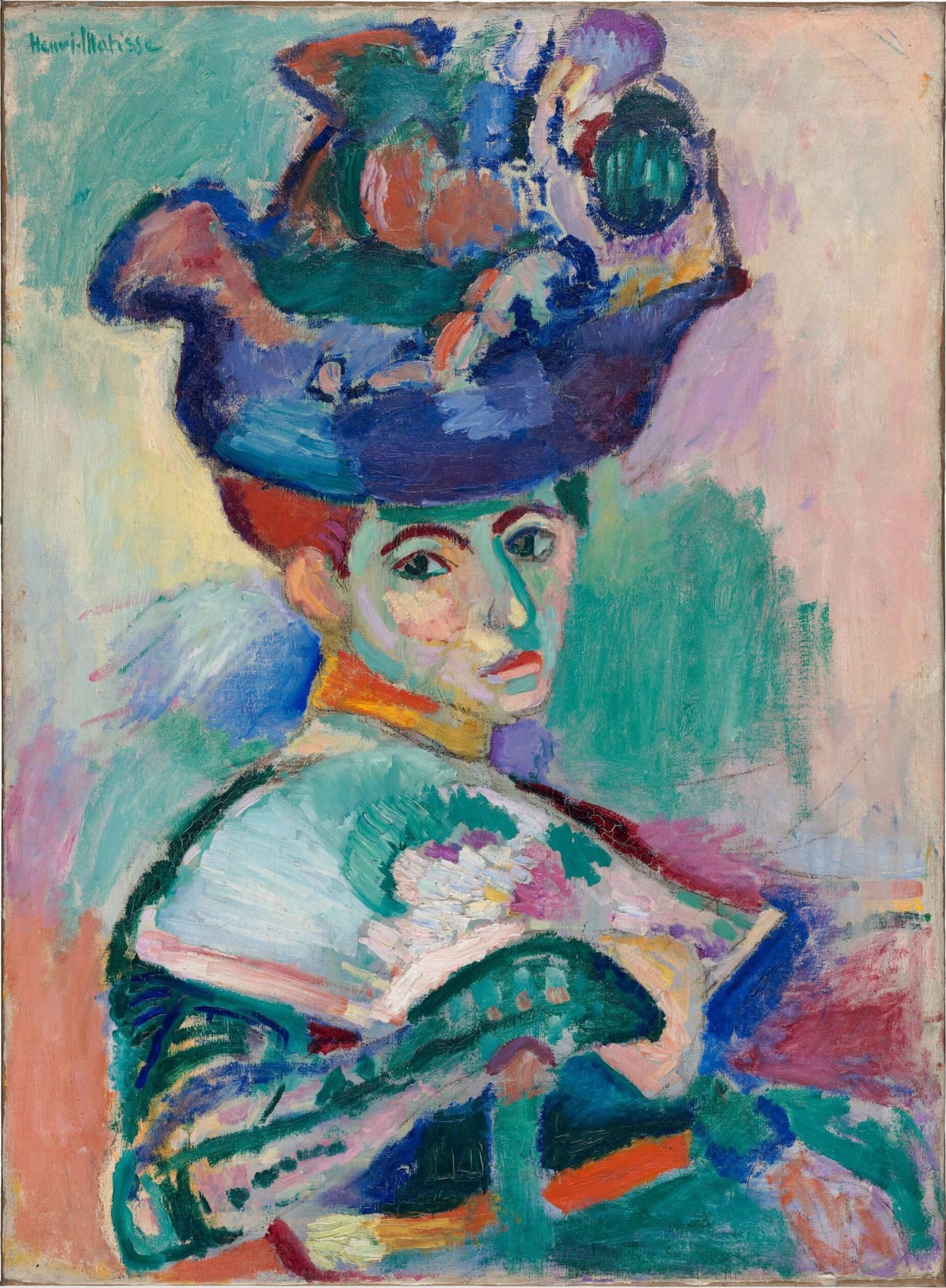
Matisse makes seeing affective and immediate. Color itself becomes architecture. In The Red Studio, a late flood of Venetian red dissolves walls and floor into one field; thin reserve lines supply the room’s skeleton while islands of full color (paintings, plants, objects) set the rhythm. In Woman with a Hat, the face is modeled by greens, violets, and oranges that declare mood and presence without traditional light and shade. Matisse’s stated aim for “balance, purity and serenity” is not softness; it is a rigorous clarity that prioritizes legibility and the felt tone of a place or person. Where Picasso builds a grammar of evidence, Matisse builds a climate of attention. Both are constructed, but one asks you to solve; the other asks you to dwell.
Paired Works
Modern nudes, modern space
Focus question: Fracture or flow—how do these canvases replace Renaissance depth while addressing the nude?
Les Demoiselles d'Avignon vs Le Bonheur de Vivre (The Joy of Life)
Two 1911 studios of seeing
Focus question: Same year, opposite logics: what work does the viewer do inside each picture?
Faces as systems
Focus question: How do structure and color encode emotion and identity?
The Weeping Woman vs Woman with a Hat
Why This Comparison Matters
This comparison clarifies two durable contracts between pictures and viewers. Picasso proposes that modern truth is built from partial views—signs, planes, toggling figure/ground—so that looking becomes inference. That contract underwrites later analytic art, from collage to conceptual diagrams and even data‑rich visualization, where comprehension emerges through assembly. Matisse proposes that modern truth is built from color—intervals, continuities, fields—so that looking becomes orientation and affect. That contract shapes color‑field painting, immersive environments, and any design that treats hue as the primary organizer of space and mood.
Seeing the polarity helps decode more than these two careers. It explains why Cubist difficulty and Matissean clarity can both feel necessary: one trains attention by confronting limits; the other trains attention by clarifying relations. Put simply, they map two credible ways forward once painting stops imitating sight: construct a grammar to be solved, or construct a climate to be lived in.
Related Links
Sources
- MoMA collection and galleries overview including Les Demoiselles d’Avignon
- MoMA Research/Conservation on Les Demoiselles d’Avignon
- MoMA: Picasso, Ma Jolie (1911–12)
- MoMA and SMK: The Red Studio—technical study and exhibition materials (2022)
- SFMOMA: Matisse, Woman with a Hat (1905)
- Khan Academy: Cubism and multiple perspectives
- The Met: Henri Matisse (1869–1954) overview including Cézanne’s impact
- Museo Reina Sofía: Dora Maar’s photo record of the making of Guernica
- State Hermitage Museum: Matisse, The Red Room (Harmony in Red)
- Matisse on Art: Notes of a Painter (1908), revised ed.