Motherhood (La Maternité)

by Pablo Picasso

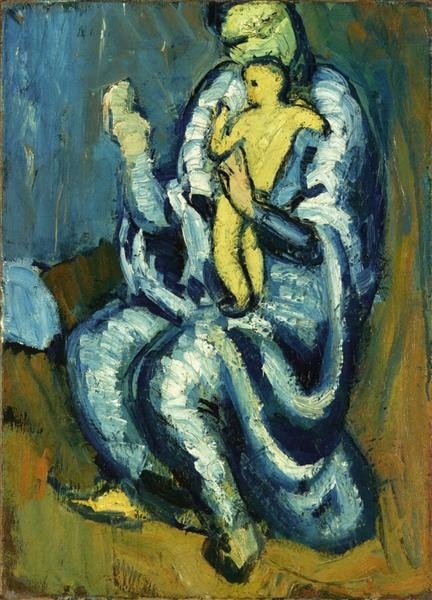
Motherhood (La Maternité) condenses a mother and child into a near-monument, the woman’s body forged from sweeping bars of blue and white that form a protective shell. The child’s ocher warmth glows against the cold field, a fragile ember of life amid austerity. The image declares care as architecture and frames tenderness as resistance.

Study Print Studio

Create a personal study print

Build a companion study sheet around the part of this painting that speaks to you most. Choose a detail, shape an interpretation, and walk away with something personal and display-worthy.

Fast Facts

Year
1903
Medium
Pastel and charcoal on paper
Dimensions
47 × 40 cm
Location
Museu Picasso, Barcelona
See all Pablo Picasso paintings in London
Motherhood (La Maternité) by Pablo Picasso (1903) featuring Protective blue-and-white robe (shell), Ocher child (ember of life), Raised, elongated hand (benediction), Bowed, veiled head

Click on any numbered symbol to learn more about its meaning

Meaning & Symbolism

Picasso builds the mother like a shelter. Thick, directional strokes weld her robe into ribbed bands of blue and white, turning drapery into structure. The torso swells forward, knees locked into a single mass, and an elongated hand rises in a benedictory arc—gestures indebted to El Greco that spiritualize the figure while keeping her rooted in want 12. The head is bowed, the face simplified to a mask of concentration; individuality yields to archetype. Pressed against her chest, the child’s small body burns a muted ocher, the only warm register in the scene. That chromatic contrast is not decoration but argument: blue names privation; warmth insists on life. The composition compresses ground and figure so tightly that negative space all but disappears, as if the world had closed in. Yet the rhythmic folds run upward, and the lifted hand opens a vertical path—signs of devotion that echo Madonna-and-Child iconography, rephrased in coarse pigment and abbreviated anatomy 12. This icon is modern because its sanctity comes from experience, not myth. Across 1901–1903, Picasso looked hard at social realities in Paris and Barcelona, including mothers connected with the Saint-Lazare prison-hospital; works from this cycle adopt the white bonnet and spare interiors as indices of hardship, translating observation into emblem 3. The mother’s monumental bulk, carved from icy color, reads as resilience scaled to architecture: care must be vast to counter scarcity. The elongated, expressive hand—flagged by curators as a deliberate borrowing from El Greco—functions here as a symbolic device, amplifying protection into a sign of grace while nudging the figure away from naturalism toward sculptural abstraction 12. Color completes the rhetoric. In the Blue Period, Picasso uses blue not merely to denote sadness but to orchestrate silence and moral gravity; within that field, the child’s warm ocher registers as the sole active light, a thesis of hope carried by a body that is poor but steadfast 24. In this way, Motherhood (La Maternité) stages a double truth: tenderness persists because it must, and art can extract the sacred from the most reduced means. The picture’s simplified faces, blocky limbs, and fused volumes anticipate the formal compression that will lead him toward cubist structures; yet the subject anchors those experiments in human stakes. That is why Motherhood (La Maternité) is important: it crystallizes Picasso’s early program—use distortion to tell the truth more fully—and makes the ethics of looking inseparable from style. The mother’s shell-like robe, the child’s ember-like skin, the raised, attenuated hand: each is a formal choice that argues for care as endurance, for love as architecture built inside a cold world 123.

Explore Deeper with AI

Ask questions about Motherhood (La Maternité)

Popular questions:

Powered by AI • Get instant insights about this artwork

💬 Ask questions about this artwork!

Interpretations

Social Documentary Lens: Saint-Lazare as Index

Read as a quasi-document, the image compresses Parisian social reality into emblem: the white bonnet and spare setting signal Saint-Lazare’s carceral-medical world, where mothers were marked by poverty, illness, and moral policing. Rather than anecdote, Picasso builds a system of signs—bonnet, cold ground, folded drapery—that converts observation into indexical form. This is not reportage; it is an ethics of seeing that dignifies subjects by monumentalizing them while preserving the institutional trace of their condition. The result is a modern icon whose sanctity is inseparable from social facture: the work’s very surfaces—abstemious blues, chalky flesh—speak to scarcity as a lived material 23.

Source: National Galleries of Scotland; Museu Picasso, Barcelona

Genealogy of the Hand: El Greco Recast

The attenuated, blessing-like hand is a historical citation turned tool: from El Greco’s ecstatic elongations to a modern sign of protection. In Picasso’s Blue-Period variant, elongation functions less as mannerism than as semiotic emphasis—a hypertrophy of care. It stretches the figure away from empirical proportion toward a sanctified register that still resists idealization. Curators have traced this to Picasso’s 1901 encounter with El Greco, but the borrowing is strategic: by isolating the hand as a vector, Picasso welds gesture to meaning, suspending naturalism to intensify affect. The hand becomes architecture and benediction at once, fusing spiritual precedent with social urgency 125.

Source: National Gallery, London; Museu Picasso, Barcelona; John Richardson

Materiality Matters: Support, Medium, and Surface Ethos

Picasso’s mother-and-child variants pivot across supports and mediums—oil on fibreboard (1901) versus pastel and charcoal on paper (1903)—and these choices recalibrate meaning. Fibreboard’s dense ground sustains planar welding and volumetric mass, while pastel’s friable particle sits closer to breath and touch, yielding powdery atmospherics and velvety transitions around flesh. In the Barcelona pastel, the mother’s robe reads as compressed strata of pigment, its material fragility echoing social precarity; in the 1901 oil, early Blue-Period blue rides a more luminous, still-transitional field. Medium here is not neutral carrier but ethical rhetoric, deciding how austerity and tenderness are felt at the surface 124.

Source: National Gallery, London; Museu Picasso, Barcelona; Saint Louis Art Museum

From Compression to Cubism: Structural Forecasting

Ground and figure are pressed until negative space thins; limbs fuse into blocky masses; drapery becomes ribbed scaffolding. These compressive tactics anticipate Cubist construction by privileging tectonics over incident. The Madonna echo is retained, but the staging is architectonic rather than spatially descriptive: verticals and arcs configure a load-bearing image. Such formal abridgment—abstraction via subtraction—prefigures the analytic dismantling of bodies into interlocking planes. In the Blue Period, this serves pathos; soon, it will serve analytical clarity. The lesson is continuous: structure is argument. Picasso’s early reductions test how much human truth can survive, even intensify, as description gives way to construction 126.

Source: National Gallery, London; Museu Picasso, Barcelona; Blue Period overview

Chromatic Ethics: Blue Silence, Ocher Ember

Color does moral work. The dominant blue organizes a field of hushed gravity, a sonic metaphor of near-silence, while the child’s ocher functions as a localized warmth—a thermal and ethical exception. This is not decorative contrast but a hierarchy of value mapped chromatically: scarcity is blue; life persists as ocher. Crucially, the warm note is not luminous spectacle but muted—endurance rather than triumph. Within Blue-Period rhetoric, such calibration turns color into care: the palette bears witness to deprivation without spectacle, and hope glows at a survivable, ember-like register. In this key, sentiment becomes structure, and hue becomes argument 2.

Source: Museu Picasso, Barcelona

Related Themes

About Pablo Picasso

Pablo Picasso (1881–1973), a founder of Cubism, was living in Paris during the Spanish Civil War and was commissioned by the Spanish Republic for the 1937 Paris Exposition. After the bombing of Guernica, he abandoned an earlier theme and conceived this mural; Dora Maar documented its making and the work later became a political envoy, returning to Spain only after its democratic transition [2][4][5].
View all works by Pablo Picasso

More by Pablo Picasso

The Weeping Woman by Pablo Picasso

The Weeping Woman

Pablo Picasso (1937)

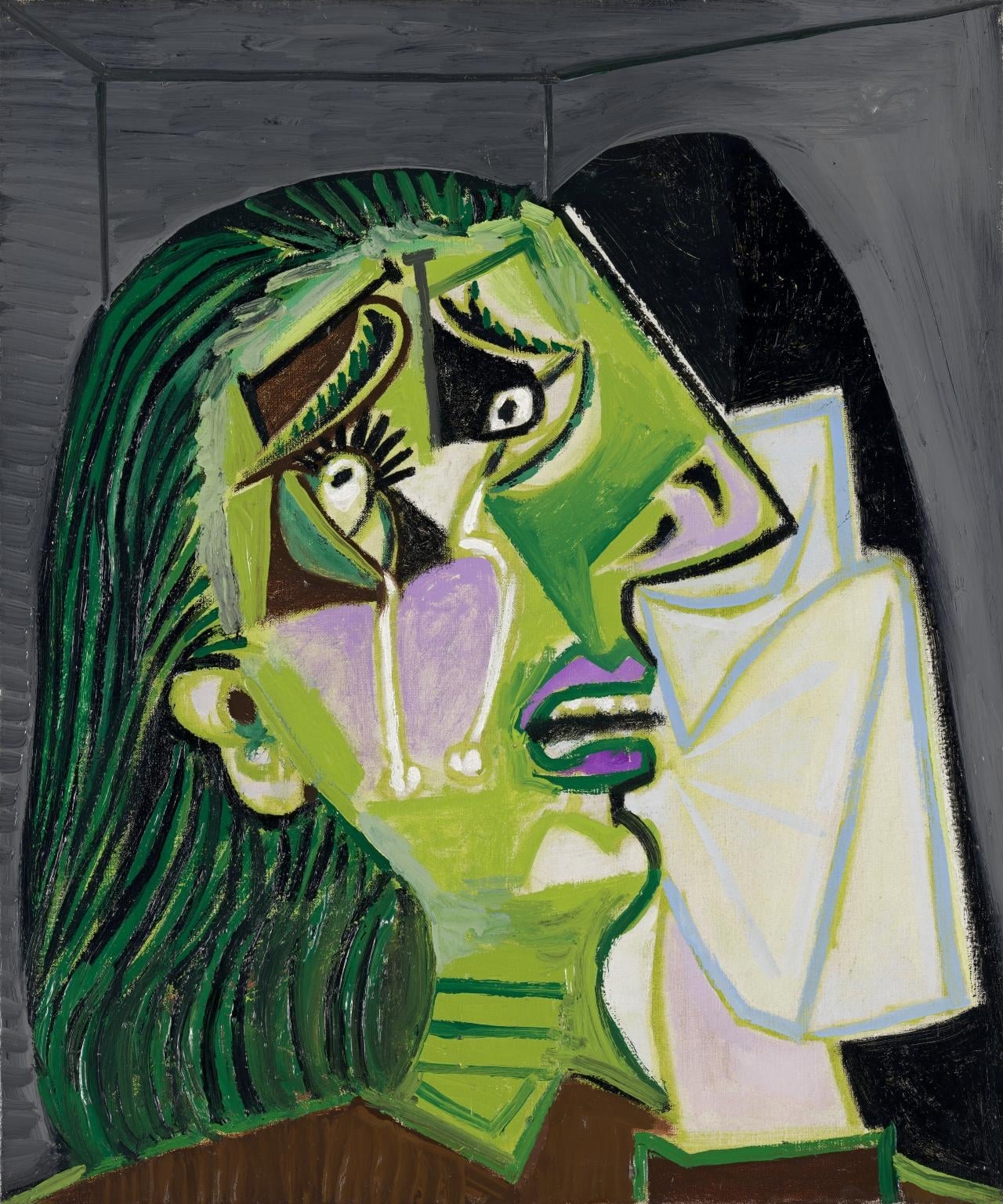
Picasso’s The Weeping Woman turns private mourning into a public, <strong>iconic emblem of civilian grief</strong>. Shattered planes, <strong>acidic greens and purples</strong>, and jewel-like tears force the viewer to feel the fracture of perception that follows trauma <sup>[1]</sup><sup>[2]</sup>.
Guernica by Pablo Picasso

Guernica

Pablo Picasso (1937)

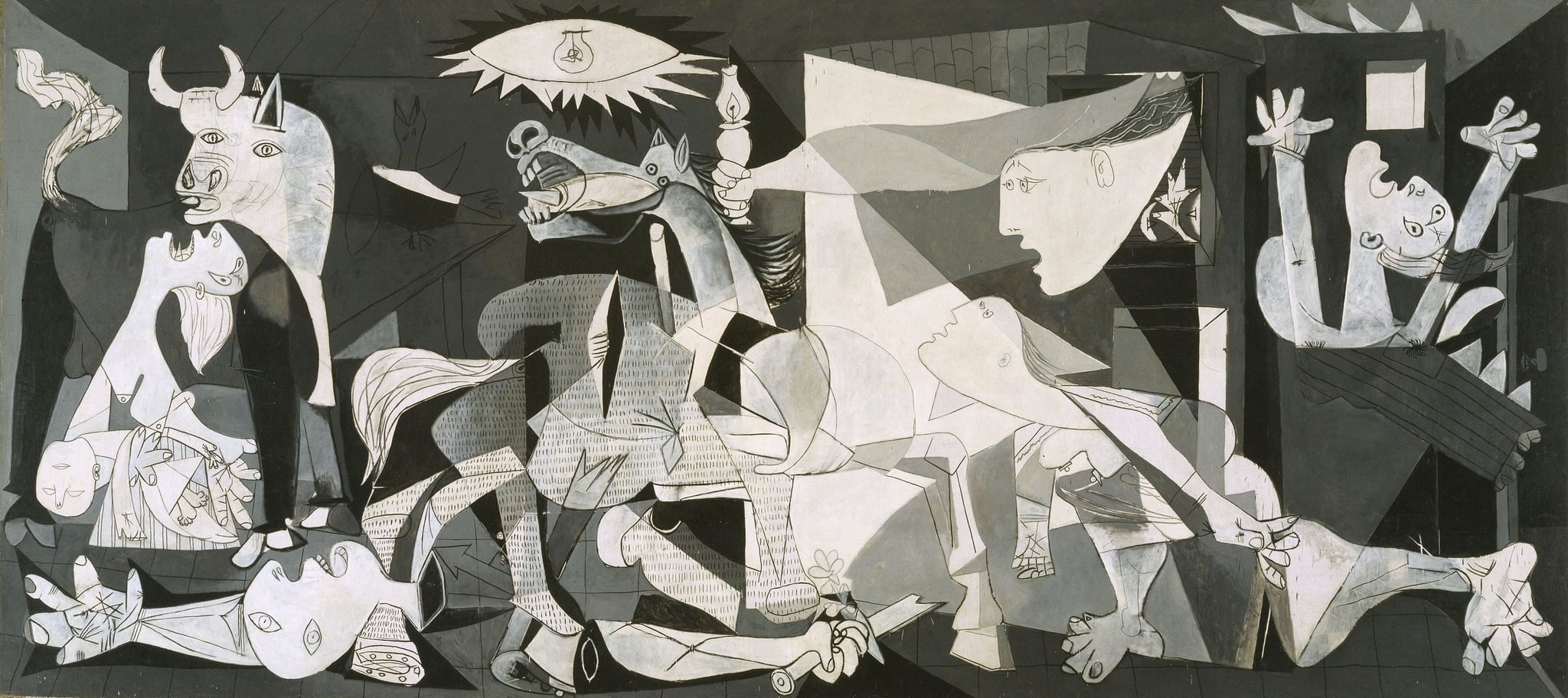
Guernica is a monumental, monochrome indictment of modern war, compressing a town’s annihilation into a frantic tangle of bodies, beasts, and light. Across the canvas, a <strong>shrieking horse</strong>, a <strong>stoic bull</strong>, a <strong>weeping mother with her dead child</strong>, and a <strong>fallen soldier</strong> stage a civic tragedy rather than a heroic battle. The harsh <strong>electric bulb</strong> clashes with a fragile <strong>oil lamp</strong>, turning the scene into a stark drama of terror and witness.
Les Demoiselles d'Avignon by Pablo Picasso

Les Demoiselles d'Avignon

Pablo Picasso (1907)

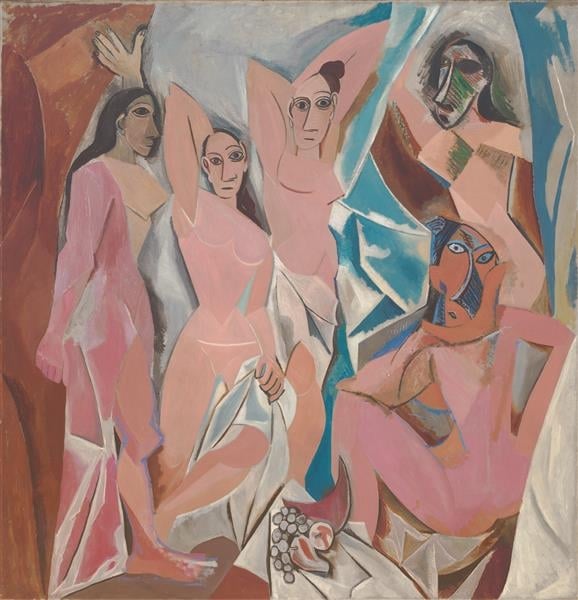
Les Demoiselles d'Avignon hurls five nudes toward the viewer in a shallow, splintered chamber, turning classical beauty into <strong>sharp planes</strong>, <strong>masklike faces</strong>, and <strong>fractured space</strong>. The fruit at the bottom reads as a sensual lure edged with threat, while the women’s direct gazes indict the beholder as participant. This is the shock point of <strong>proto‑Cubism</strong>, where Picasso reengineers how modern painting means and how looking works <sup>[1]</sup><sup>[2]</sup>.
Femme au tambourin by Pablo Picasso

Femme au tambourin

Pablo Picasso (1925)

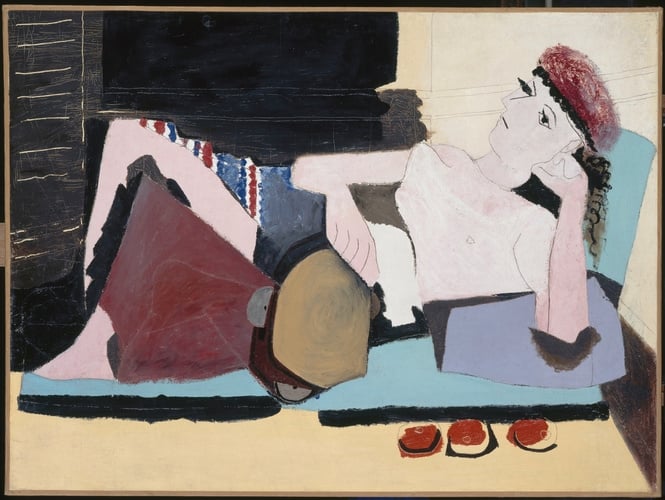
Picasso’s 1925 <strong>Femme au tambourin</strong> stages a reclining performer whose body is reduced to <strong>bold planes and hard contours</strong>. The circular tambourine across her lap and the <strong>three fruits</strong> aligned below create a visual rhythm that weighs <strong>pleasure against performance</strong> <sup>[1]</sup>.
Les Adolescents by Pablo Picasso

Les Adolescents

Pablo Picasso (1906)

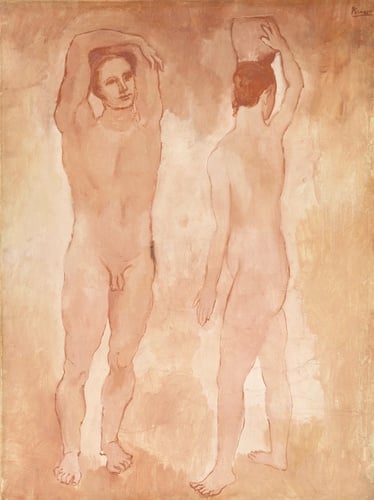
Two nude youths stand in a shallow, fresco-like field, their bodies modeled in warm rose ochres that evoke Picasso’s <strong>Rose Period</strong> calm. Their matched yet misaligned gestures—one frontal with arms raised, the other in profile balancing a <strong>pitcher</strong>—stage a quiet rite of passage that turns adolescence into a timeless, <strong>classical</strong> type <sup>[1]</sup>.

Nu sur fond rouge by Pablo Picasso

Nu sur fond rouge

Pablo Picasso (1906)

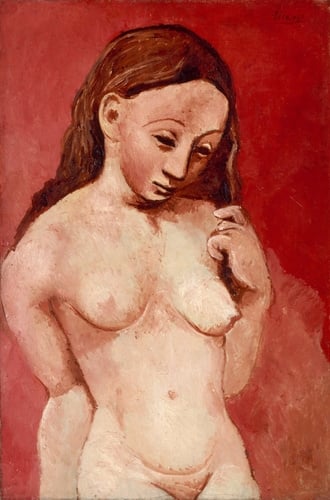
A solitary nude stands against a pulsating, uniform red field, her body reduced to <strong>rounded, sculptural planes</strong> and her face set with <strong>masklike eyes</strong>. The lowered gaze and self-touching gesture fold desire and inwardness into a single emblem, turning the figure into a <strong>proto‑Cubist icon</strong> rather than a person in space <sup>[1]</sup><sup>[2]</sup>.