Fractured Witness vs Non-Objective Score
Both artists stop treating painting as a window and make it an instrument for perception. Picasso reengineers depiction into fractured witness, tethered to bodies, rooms, and events. Kandinsky builds a non‑objective grammar of color, line, and plane to act directly on feeling. Seen together—from Les Demoiselles and Guernica to Composition VIII and Yellow‑Red‑Blue—they map two durable paths for modern vision.
Comparison frame: How do Picasso and Kandinsky turn painting from showing things to shaping how we see—one by fracturing the world we inhabit, the other by orchestrating forces we feel?
Quick Comparison
| Topic | Pablo Picasso | Wassily Kandinsky |
|---|---|---|
| What painting is “of” | Bodies, rooms, props, and public events under pressure (e.g., Guernica). | A non-objective language where color/line are the subject. |
| Primary aim | Civic witness and ethical confrontation. | Inner resonance through “inner necessity.” |
| Viewer’s task | Recompose multiple viewpoints; inhabit witness. | Attune to tensions among points, lines, circles, primaries. |
| Signature structures | Fractured planes, compressed depth, figure–ground interlock. | Vectorial diagonals, stabilizing circles, teachable syntax. |
| Color logic | Strategic palettes (grisaille of Guernica; acid dissonance in Weeping Woman). | Programmed tendencies (blue inward; yellow outward; red firm). |
| Scale and rhetoric | History‑painting scale for civilian tragedy. | Mural‑like orchestration modeling dynamic equilibrium. |
| Institutional context | Spanish Pavilion commission; Dora Maar’s process photos. | Bauhaus pedagogy (1922–33) formalizes the abstract grammar. |
| Music connection | Music as subject (e.g., performers in Synthetic Cubism). | Music as method (Compositions as conducted form). |
Shared Ground
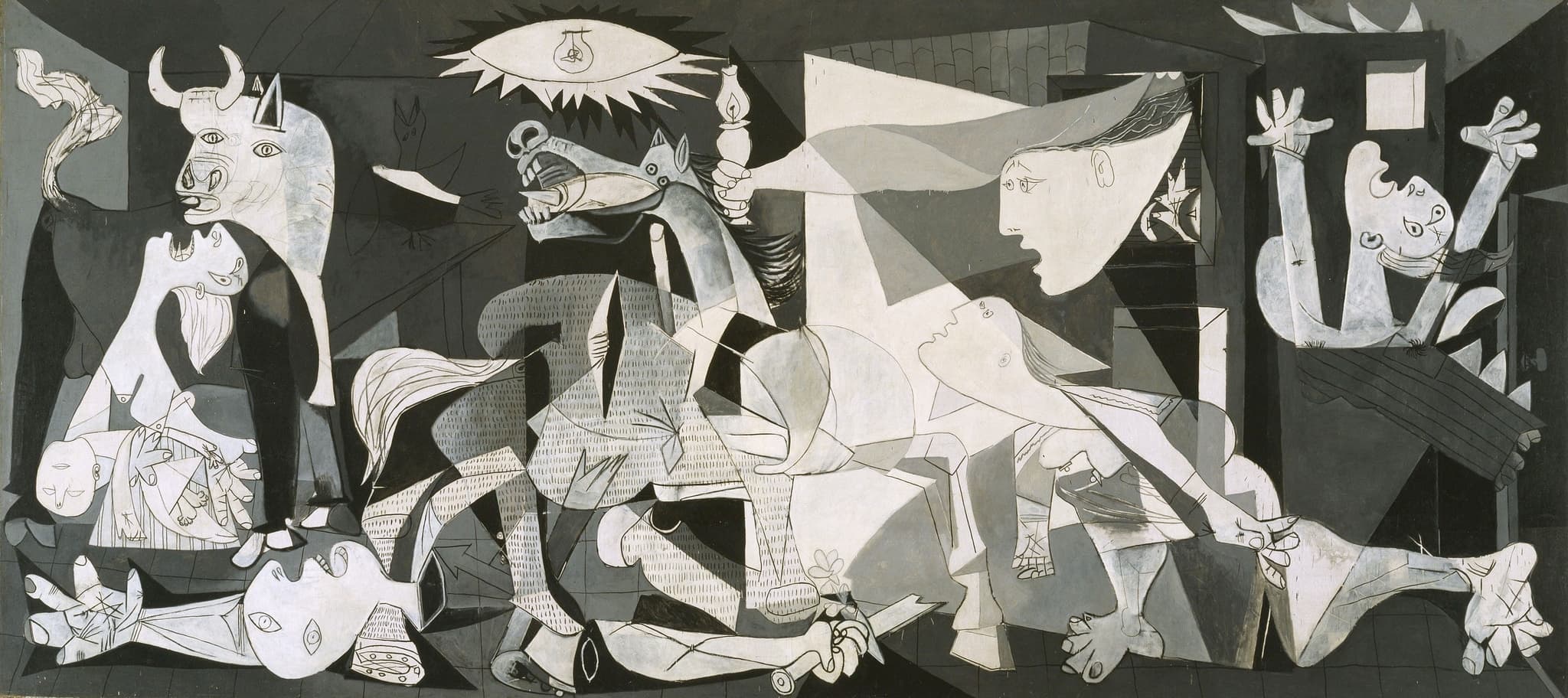
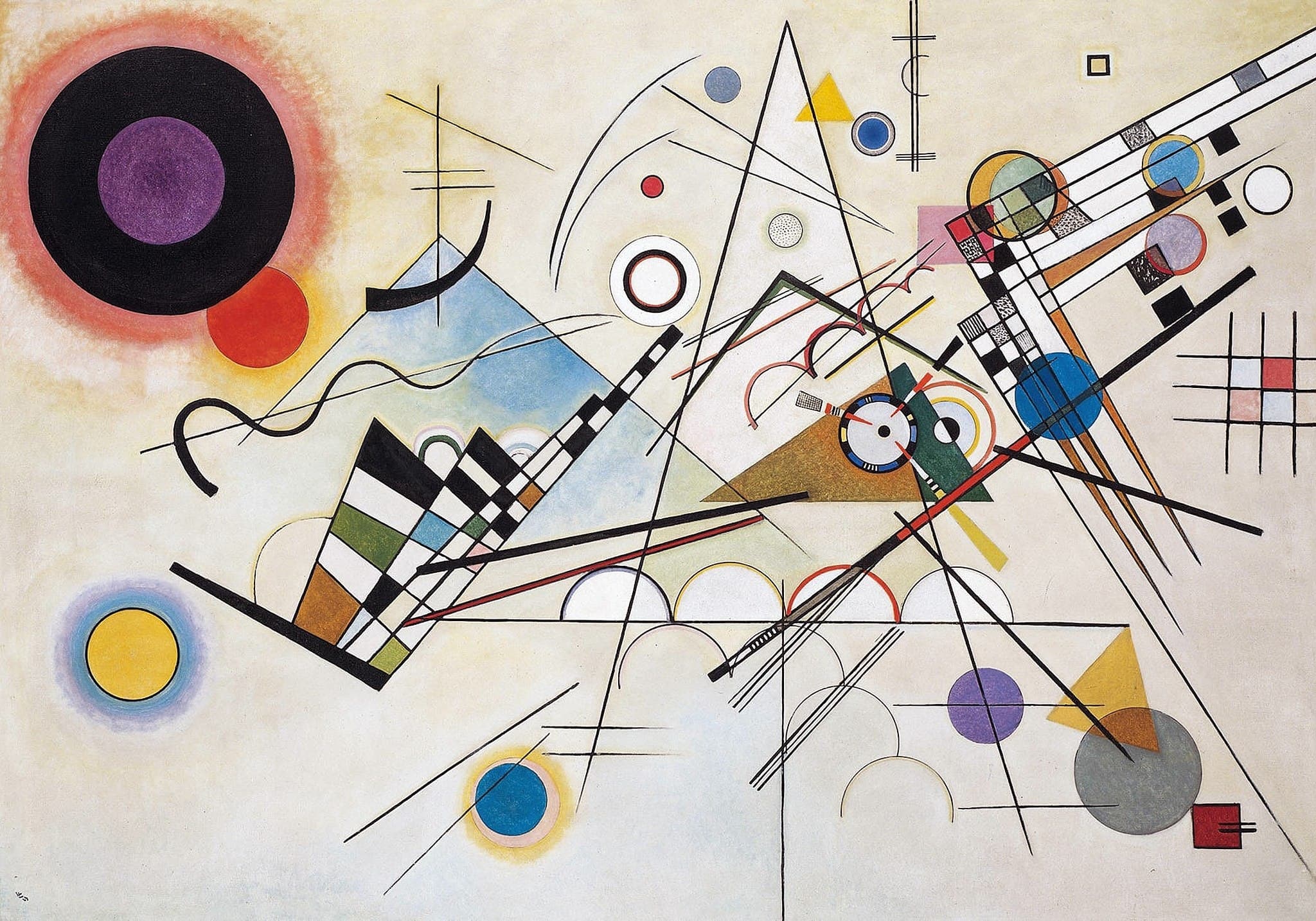
Picasso and Kandinsky both treat painting as an instrument that conditions perception rather than a window that imitates it. Each builds a system designed to retrain the eye: Picasso’s Cubist fractures and compressed interiors force us to assemble events from shards; Kandinsky’s grammar of point–line–plane and primaries teaches us to feel vectorial pulls, tonal centers, and counterweights. At summit scale, both stage public laboratories for seeing. Picasso’s Guernica redeploys the rhetoric of history painting to register civilian catastrophe; Kandinsky’s great Compositions and Bauhaus-period canvases conduct geometry like music, asking the eye to scan and rescan across diagonals, circles, checks, and grids.
Neither program is detached from history. Guernica emerged from a specific commission for the Spanish Republic’s 1937 Paris Pavilion and from press photographs of the aerial bombardment; its grisaille carries the chill of newsprint, and Dora Maar’s process images document how its structure was clarified. Kandinsky’s post‑WWI turn to measured geometry matured while teaching at the Bauhaus (1922–33), where he codified the tendencies of color and line. Across both artists, scale, clarity of motif, and rigorous ordering function as pedagogy as much as style: the canvases model how to look—whether by recomposing a splintered room into a civic drama or by tracking equilibria among abstract forces until a whole is felt rather than described.
Decisive Difference
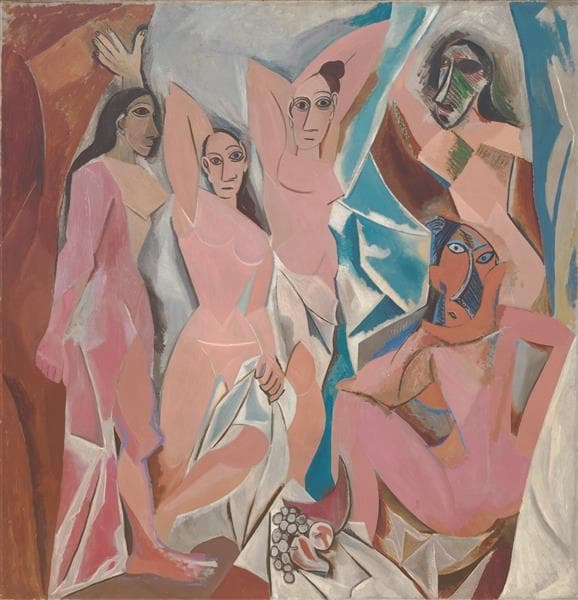
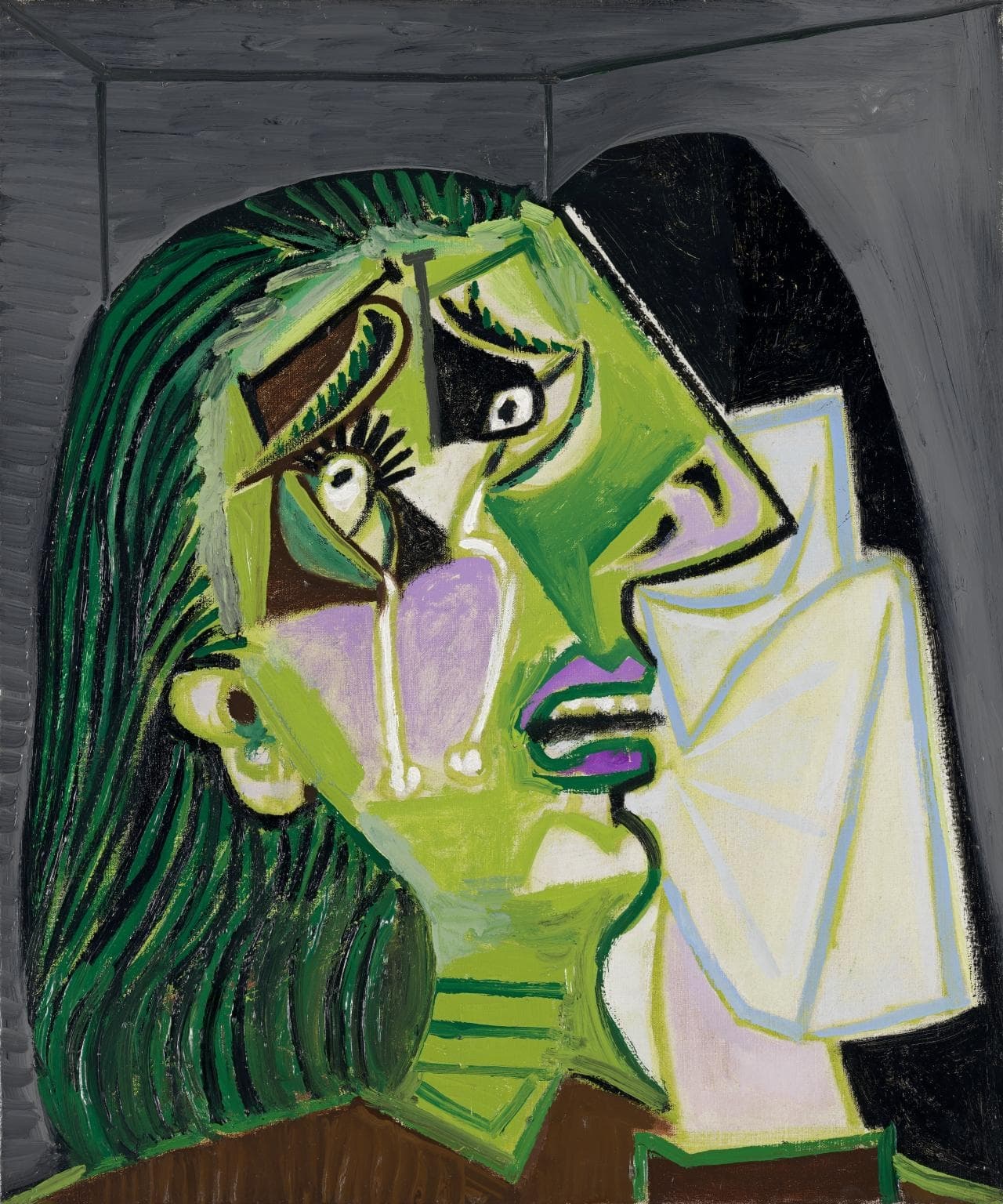
The decisive difference lies in what painting is “of.” Picasso keeps representation on a tight leash instead of cutting it loose. Even at maximum fracture, the work stays anchored to bodies, props, and civic space. In Guernica, the screaming horse, weeping mother, fallen soldier, and the stark clash of electric bulb with fragile oil lamp specify a witnessed event tied to aerial bombardment and photographic seeing. Les Demoiselles d’Avignon subjects the brothel to planar cuts and masklike faces; The Weeping Woman weaponizes color into a public icon of grief. For Picasso, seeing becomes a labor of ethical recomposition: multiple viewpoints, blocked interiors, and urgent diagonals make us reconstruct what happened and occupy the role of witness.
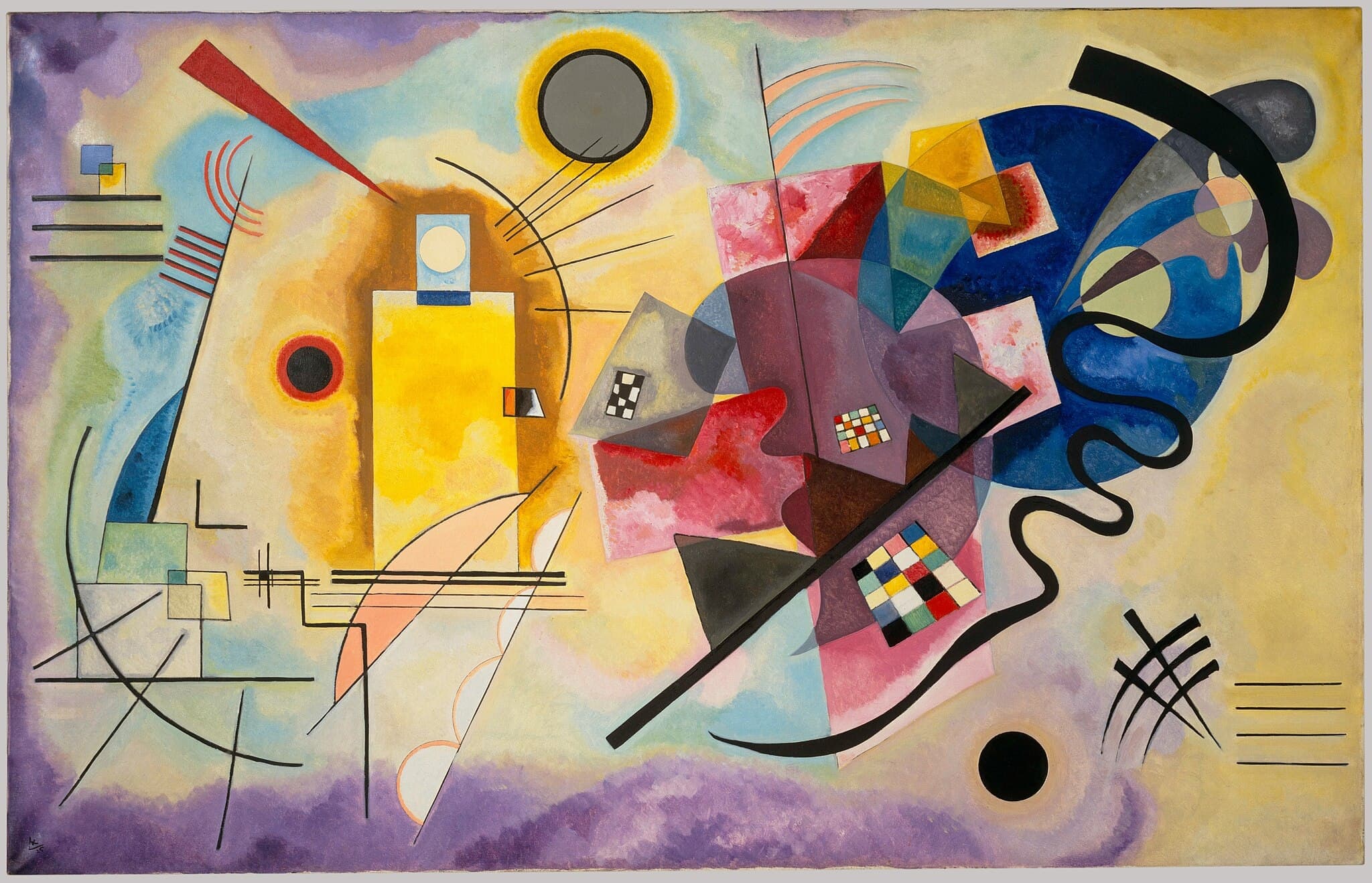
Kandinsky wagers something else: abandon depiction to construct a non‑objective language that works through inner necessity. Points, lines, circles, and triangles behave as agents with definable tendencies; primaries have temperament—blue recedes inward, yellow presses outward, red lies firm. In Composition VIII and Yellow‑Red‑Blue, our looking becomes attunement rather than narrative decoding. We read tensions, tonal centers, and counterweights across a field as one reads music; feeling is produced by calibrated relations, not by depicted events. The difference, stated plainly: Picasso reengineers depiction to confront the social real; Kandinsky replaces depiction with a conducted grammar so that painting can act directly on perception and spirit.
Paired Works
Witnessed Event vs Constructed Harmony
Focus question: What changes when a mural confronts a specific atrocity and a canvas conducts pure geometry?
Breaking with Naturalism
Focus question: How do early ruptures—fractured bodies versus near‑non‑objective energies—retrain the gaze?
Les Demoiselles d'Avignon vs Improvisation 28 (Second Version)
Coding Emotion
Focus question: How does each artist turn color into feeling—through a face or through pure form?
The Weeping Woman vs Yellow-Red-Blue
Why This Comparison Matters
This comparison explains two master routes modern painting opened for the rest of visual culture. Picasso shows how an image can confront public crisis without illustration—fracture becomes a structure for witnessing, useful to everything from photojournalism’s montage to contemporary memorial design. Kandinsky shows how form can communicate directly—points, lines, circles, and primaries become legible carriers of feeling and balance, a precedent for graphic design, data visualization, and motion graphics that move us without depicting stories.
For a general viewer, the payoff is practical: these paintings train different habits of looking. With Picasso, you reconstruct: track planes, props, and blocked rooms until the event coheres. With Kandinsky, you calibrate: sense centers of gravity, intervals, and counterweights until a harmony is felt. Knowing which mode you are in—recomposition or attunement—clarifies why these canvases still work and why their logics keep resurfacing wherever images aim to change how we see.
Related Links
Sources
- MoMA, “Multiple Perspectives” (Cubism).
- Museo Reina Sofía, Guernica collection entry.
- Museo Reina Sofía, Spanish Pavilion context (Sala 205.10).
- Smarthistory, Picasso’s Guernica.
- Wassily Kandinsky, Concerning the Spiritual in Art (1911/12).
- Kandinsky, Point and Line to Plane (1926), Bauhaus translation PDF.
- Guggenheim, Teaching Materials: Kandinsky and Composition VIII.
- Guggenheim, Press Kit: Vasily Kandinsky—Around the Circle.
- Centre Pompidou, Yellow‑Red‑Blue.
- MoMA, Les Demoiselles d’Avignon object page.
- Bauhaus Kooperation, Kandinsky biography (1922–33).