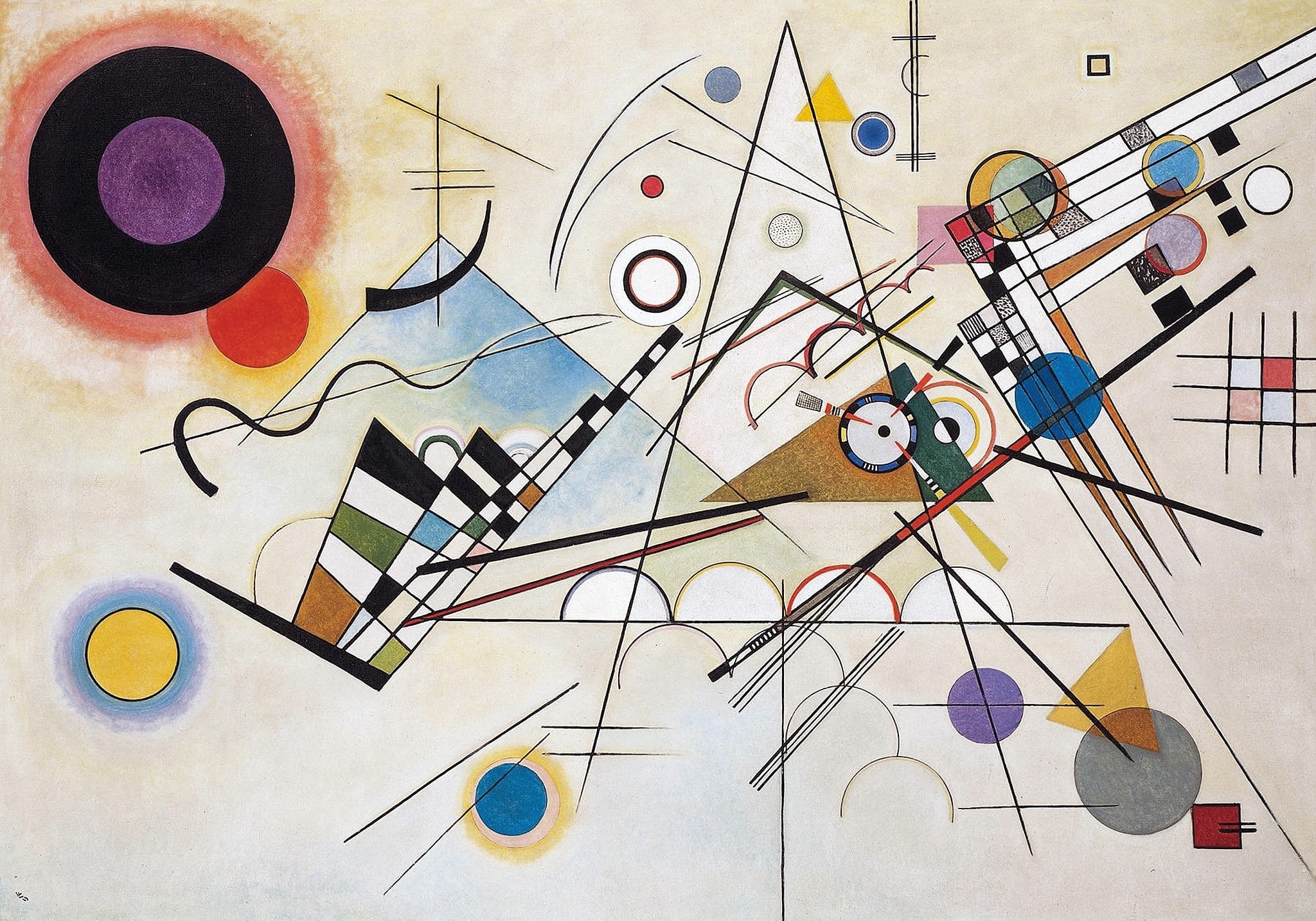
Yellow-Red-Blue

by Wassily Kandinsky

Yellow-Red-Blue stages a collision of order and impulse through primary color and geometry. A lucid field of yellow rectangles and orthogonals confronts a vortex of blues, reds, circles, and a serpentine black line, all bound by a commanding black diagonal. The canvas reads like a spiritual score, balancing tensions into dynamic equilibrium.

Fast Facts

Year
1925
Medium
Oil on canvas
Dimensions
128 x 201.5 cm
Location
Centre Pompidou, Musée national d’art moderne, Paris
Yellow-Red-Blue by Wassily Kandinsky (1925) featuring Yellow rectilinear block with capped circle, Commanding black diagonal, Radiant gray ‘sun’ circle with rays, Serpentine black line

Click on any numbered symbol to learn more about its meaning

Meaning & Symbolism

Kandinsky composes Yellow-Red-Blue as a staged drama of forces. On the left, a radiant yellow rectangle capped by a pale disk rises amid crisp verticals, horizontals, and measured arcs; these orthogonals read as an architecture of clarity, their calm steadied by thin black staves that function like notational bars. Above, a gray sun radiates fine vectors, while a red triangular accent and laddering red lines inject staccato emphasis into the otherwise ordered field. In Kandinsky’s system, yellow projects outward—bright, terrestrial, extroverted, even aggressive, akin to a trumpet—so the rectilinear yellow block deliberately “advances” toward the viewer as a declarative statement of reasoned construction 2. The poise of circles and the restraining pull of straight lines are not neutral descriptors but the visible trace of forces; each vector, arc, and intersection carries direction, tempo, and stress in the sense defined in Point and Line to Plane 3. The left half, then, asserts the possibility of an intelligible visual grammar: points stabilize, lines conduct, and the plane holds them in coherent relation. Across a seam marked by a thrusting black diagonal—like a conductor’s baton—order meets impulse. The right side swells into layered blues and reds, scalloped curves, tilting polygons, and a serpentine black line that undulates downward. A large dark blue circle and overlapping purple disks act as reservoirs of contemplative depth; for Kandinsky, blue recedes and calls inward, the most spiritual of the primaries, resonant like an organ or cello 2. Circles tend toward rest and unity, yet here their calm is agitated by surrounding crescents and the black ribbon’s improvisatory rhythm, so repose becomes a deep, breathing pulse rather than stasis 3. Red patches flicker between the blue masses and the central diagonal, warming and activating the field with what Kandinsky called an inner seething tension; red “lies firmly on the plane,” granting the swirling right half a grounded heat that resists dissolution 4. Two small checkerboard panels punctuate this turbulence like chords struck on a keyboard, reinforcing the canvas’s identity as a score in which tonal modules are placed, repeated, and varied. The painting’s unity lies not in symmetry but in dynamic equilibrium. The baton-like black diagonal binds the halves, conducting energy from the yellow block through the gray sun’s radiating lines into the vortex of blues and reds. The three primaries—yellow, red, blue—are not merely named in the title; they are deployed as actors with distinct temperaments and spatial behaviors that model a world where intellect and intuition must interpenetrate. Painted in Weimar in spring 1925, on the eve of the Bauhaus move to Dessau, Yellow-Red-Blue manifests the school’s constructive ethos while preserving the spiritual aspiration of Kandinsky’s earlier writings: abstract elements can carry inner necessity and move us as sound does 123. The measured staves at left, the calibrated arcs bridging the central threshold, and the rightward swell of curvilinear motifs demonstrate the Bauhaus project of turning perception into a teachable language without draining it of affect. In this sense, the work is both proposition and performance: it shows how color and form, each with its inner sound, can be orchestrated to produce meaning—order becoming music, impulse becoming structure—until the canvas resolves as a living harmony rather than a frozen plan 3.

Explore Deeper with AI

Ask questions about Yellow-Red-Blue

Popular questions:

Powered by AI • Get instant insights about this artwork

💬 Ask questions about this artwork!

Interpretations

Formal-Pedagogical Analysis: Bauhaus Grammar on Canvas

Painted weeks before the Bauhaus’s move to Dessau, Yellow-Red-Blue reads like a didactic plate for Kandinsky’s course. Orthogonals, arcs, and diagonals demonstrate how lines are not mere contours but “traces of forces” with direction and stress; the picture operationalizes his taxonomy of point–line–plane to teach how visual units bind into lawful relations 3. The left field’s rectilinear clarity models a constructive syntax while the right field tests elasticity through curvilinear counterpoint; the diagonal “baton” orchestrates passage between systems. This is pedagogy by demonstration: a public proof that abstract form can be systematized without losing affect—precisely the equilibrium the Bauhaus sought between artistic intuition and technical method 13.

Source: Centre Pompidou; Kandinsky, Point and Line to Plane

Color Acoustics: From Trumpet to Organ

Kandinsky frames color as acoustic. Yellow’s advancing, trumpet-like brilliance presses forward with assertive clarity, while blue’s receding, organ-like sonority opens contemplative depth; red, warm and tensile, “lies firmly on the plane,” stabilizing agitation with tonal weight 24. In this canvas, those timbres are spatial actors: the jutting yellow block projects reasoned measure, the dark blue circle withdraws into spiritual inwardness, and interleaved reds anchor turbulence so the right side does not dissolve. The result is a kind of polyphony of primaries, not named but performed—an ensemble whose interlocking advances and recessions create the work’s experiential space as much as any drawn boundary 24.

Source: Encyclopaedia Britannica; Getty Research Institute (Bauhaus Color)

Dialectical Structure: Twins in Dynamic Equilibrium

Rather than simple contrast, the left–right split acts as a dialectic that must be negotiated. The architectonic left proposes a transparent order; the curvilinear right answers with impulse and depth. The black diagonal conducts energy between them, proving unity is achieved not by symmetry but by regulated tension—Kandinsky’s “dynamic equilibrium” made visible 13. Circles (rest) meet vectors (thrust), and their frictions become the work’s subject. This two-part staging also mirrors Bauhaus-era debates—standardization versus expressivity—resolving not by victory but by productive coupling, where each system conditions, restrains, and energizes the other in a continuously renewed balance 13.

Source: Centre Pompidou; Kandinsky, Point and Line to Plane

Spiritual Abstraction: Circle Theology and Blue Inwardness

Kandinsky called the circle the most concentrated form of rest, a bearer of unity, and aligned deepening blues with spiritual inwardness. Here, stacked disks and a large dark blue circle function as reservoirs of contemplation, but their serenity is intentionally perturbed by crescents and a serpentine black line, turning static calm into a breathing pulse 23. This is not iconography but immanence: spirituality transmitted through formal behavior—recession, resonance, and rhythmic modulation—rather than through religious symbols. The right field thus practices what Kandinsky theorized: abstraction that “acts upon the soul” through the inner necessity of color–form relations, offering a non-figurative path to the sacred 3.

Source: Kandinsky, Point and Line to Plane; Encyclopaedia Britannica

Medium Reflexivity: Notation, Modularity, and the Score

Checkerboard panels, thin black staves, and repeating modules declare the canvas a score more than a scene. Units behave like measures and chords: placed, repeated, varied. In Kandinsky’s terms, points and lines possess interval and tempo; their spacing organizes visual time across the plane 3. By quoting notational devices inside a painting, he turns medium into message—painting about painting’s capacity to structure perception like music. This reflexivity aligns with Bauhaus pedagogy, where form was analyzed, recombined, and taught as a set of transferable procedures. Yellow-Red-Blue becomes a proposition and performance at once: the theory of pictorial elements made audible to the eye 13.

Source: Kandinsky, Point and Line to Plane; Centre Pompidou

Historical Threshold: Weimar 1925 and the Systematization of Vision

Executed in Weimar in spring 1925, the painting sits on the cusp of the Bauhaus’s institutional reconfiguration at Dessau. Its split structure emblemizes the school’s negotiation between craft-standardization and artistic intuition, anticipating Dessau’s stronger emphasis on design systems without surrendering expression 15. The work’s measured scaffolds, modular color blocks, and calibrated arcs read as tools for industrial-era clarity, while the rightward swells preserve the lyric inheritance of Der Blaue Reiter. In this light, Yellow-Red-Blue is a threshold artifact: it consolidates an analyzable visual grammar ready for curricular transmission even as it insists that such grammar must carry affective and spiritual charge to matter 15.

Source: Centre Pompidou; The Metropolitan Museum of Art (Bauhaus overview)

Related Themes

About Wassily Kandinsky

Wassily Kandinsky (1866–1944) pioneered non-objective painting, cofounding Der Blaue Reiter and authoring key texts that linked color and form to spiritual experience. After World War I he joined the Bauhaus (1922–1933), where his work pivoted toward disciplined geometric languages. His relationship with Solomon R. Guggenheim seeded the museum’s founding collection, with Composition VIII as a cornerstone [1][2].
View all works by Wassily Kandinsky

More by Wassily Kandinsky