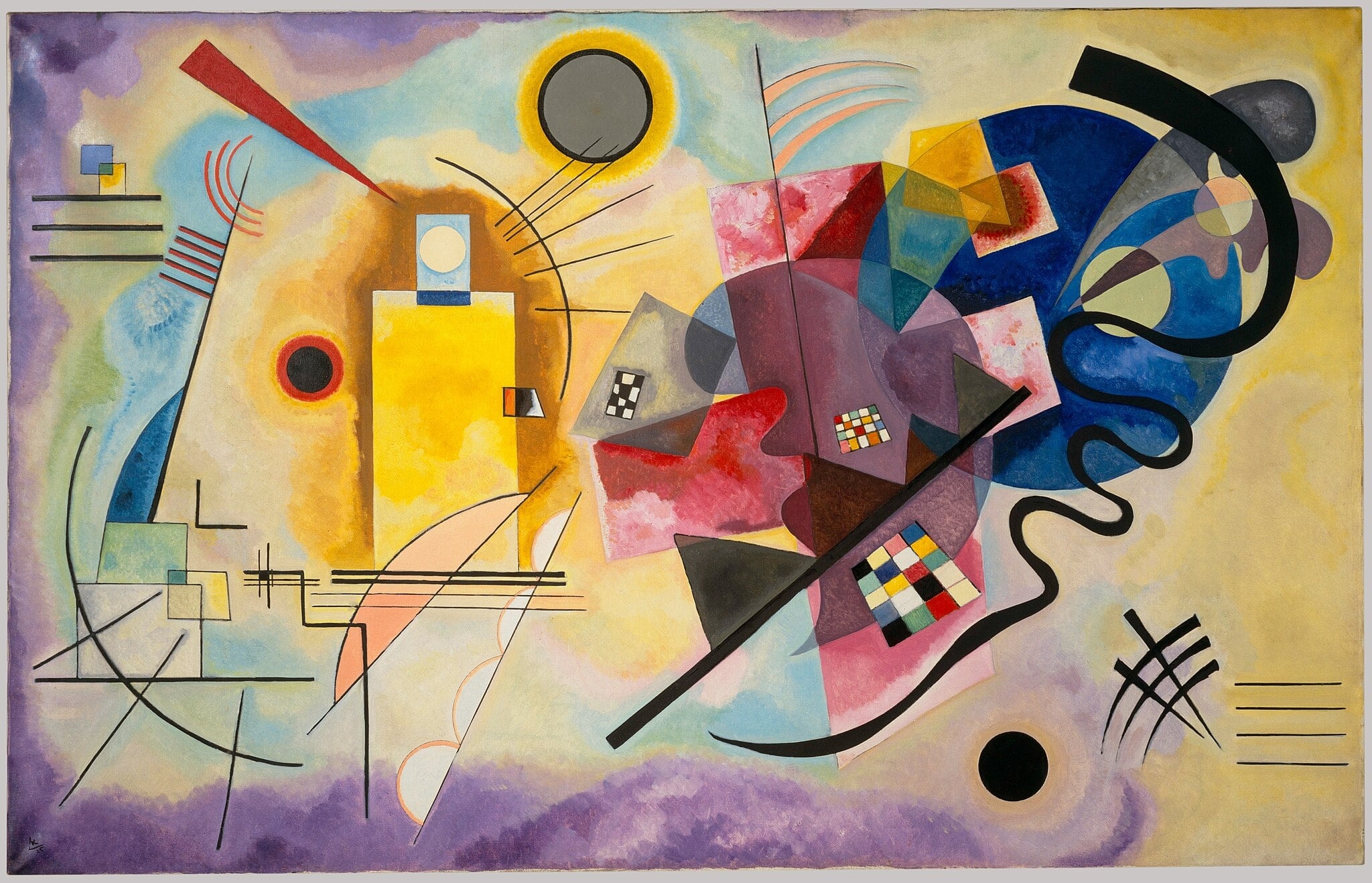
Composition VIII
Composition VIII stages a musical drama in geometry: circles, vectors, and triangles surge across a cream field in calibrated counterpoint. A brooding black circle at left sets the tonal center while grids, checkerboards, and compass-like dials organize bursts of color and rhythm. The canvas becomes a score of invisible harmonies, where pure form conveys feeling.
Fast Facts
- Year
- 1923
- Medium
- Oil on canvas
- Dimensions
- 140 × 201 cm
- Location
- Solomon R. Guggenheim Museum, New York

Click on any numbered symbol to learn more about its meaning
Meaning & Symbolism
Read as a composition, the painting assigns each form a role in a dynamic ensemble. The large black circle in the upper left acts as a gravitational bass note—its darkness embodies silence and cessation in Kandinsky’s color theory—against which smaller, chromatic circles vibrate like brighter instruments (yellow radiates, blue retreats) 5. Their dispersal across the field turns the surface into a cosmos of tensions that Kandinsky associated with the circle’s capacity to synthesize opposites and hint at higher dimensions 6. From this still center, razor-thin diagonals accelerate toward the right, intersecting arcs and semicircles that register as pulses and echoes rather than objects. The result is rhythm without motif: a choreography of approach, collision, and release, in which line operates as pure vector, the very force Kandinsky theorized in Point and Line to Plane 1.
Equally decisive is the painting’s architecture of measurement. A wedge of checkerboard squares climbs from the lower left toward a blue triangular plane, as if a scale or keyboard were being struck; at mid-right, a compass-dial cluster ticks like a metronome, surrounded by gearlike rings and ruled bands. Along the extreme right margin, a gridded scaffold and stacked stripes impose a drafting-room clarity, emblematic of the Bauhaus’s machine-age ethos 13. Yet these tools of calculation do not suppress lyricism; they frame it. Arcs hover like legato phrases above a staff of horizontal lines near the bottom edge, while acute triangles—especially the translucent one spanning center-right—cut crisp staccato accents through the haze of pastel washes. This is the engineered musicality scholars identify as the hallmark of Kandinsky’s Bauhaus period: a shift from prewar tumult to lucid, conducted form 234.
Color seals the argument by granting each geometry an affective charge. The yellow triangle near the upper right and the sun-like yellow disks at lower left and bottom center thrust outward with bright insistence, while the blue circles (one pressed to the right edge, another hovering near the bottom) recede into felt depth; the violet disk at lower right cools the tempo, and the hovering red note anchoring the gray circle’s edge introduces heat and dissonance 5. These chromatic oppositions—yellow/blue, red/green, white/black—operate as counterpoint rather than illustration, confirming Kandinsky’s premise that non-objective art can transmit spiritual states through calibrated relationships alone 5. In Composition VIII, that premise is realized with Bauhaus discipline: lines are honed to vectors, planes are parsed into triangles and circles, and the picture’s “melody” moves from left to right, from the black circle’s silence to the right-edge grid’s articulated speech. The painting therefore reads as a map of invisible harmonies—a cosmos orchestrated by geometry—while serving as a manifesto for universal, non-representational communication. This synthesis explains why museums cast Composition VIII as a summit of his postwar work and a beacon for later geometric abstraction, including his subsequent, circle-dominated explorations 124.
Explore Deeper with AI
Ask questions about Composition VIII
Popular questions:
Powered by AI • Get instant insights about this artwork
💬 Ask questions about this artwork!
Interpretations
Historical Context: Bauhaus Pedagogy as Compositional Method
Painted in July 1923, just after Kandinsky joined the Bauhaus (1922), Composition VIII channels the school’s didactic stress on structure into a visual “course” on relations among point, line, and plane. The picture’s calibrated diagonals, modular grids, and controlled transparencies read like outcomes of a workshop where form is tested, compared, and refined. Rather than suppressing lyricism, the Bauhaus lens conducts it: the picture behaves like a lesson-plan turned symphony, where instruments are triangles, circles, and vectors. This pedagogy also underwrites Kandinsky’s universalist aim—moving from national schools and symbol systems toward translingual abstraction—a project the Bauhaus framed as socially generative and technologically current 136.
Source: Guggenheim Museum; Britannica; Guggenheim Press Kit
Symbolic Reading: The Circle as Fourth-Dimensional Aperture
The large black circle acts less as an object than as an ontological portal. Kandinsky praised the circle as the “synthesis of the greatest oppositions,” a sign he linked to cosmic harmonics and the fourth dimension; in Composition VIII, its mute gravity (black as “silence”) organizes the field while colored satellites articulate competing energies. This repositions symbolism: not icon to referent, but form to experiential state. The circle’s authority also anticipates Kandinsky’s later, circle-dominant canvases, where orbital systems become whole worlds. Here, the circle grounds yet opens, anchoring the picture’s metric devices while promising passage beyond Euclidean space 145.
Source: Guggenheim Museum (education materials); Kandinsky, Concerning the Spiritual in Art; Norton Simon Museum (curatorial note)
Formal Analysis: Vectorial Rhythm and Instrument-Images
Composition VIII operates like a score for forces: hairline diagonals accelerate, arcs echo, and ruled bands set tempo. Measuring tools—compass-dials, checkerboards, scaffolds—double as “instrument-images,” converting Euclidean procedure into audible rhythm. Kandinsky’s later text Point and Line to Plane codifies line as vector and the triangle/circle/square as charged planes; the canvas anticipates that treatise by staging pure interactions shorn of motif. The result is not depiction but kinetic syntax: approach, collision, release. Such clarity marks a Bauhaus-era pivot from painterly apocalypse (e.g., VII) to engineered counterpoint, where precision is not the enemy of feeling but its calibrated carrier 12.
Source: Guggenheim Museum (education materials); MoMA, Kandinsky: Compositions (Dabrowski)
Reception & Provenance: How One Purchase Shaped a Canon
In spring 1929, Solomon and Irene Guggenheim—guided by Hilla Rebay—visited Kandinsky in Dessau and purchased Composition VIII, seeding what would become a foundational corpus of 150+ works. That acquisition helped institutionalize non-objective art in the U.S. and positioned the painting as a touchstone for geometric abstraction in the museum’s narrative. Its accession into a collection devoted to spiritual abstraction reframed the work less as a solitary innovation than as a charter document for a new museology of the abstract, influencing how audiences read geometry as ethical and universal, not merely stylistic 167.
Source: Guggenheim Museum (education materials); Guggenheim Press Kit; Guggenheim Bilbao Teachers’ Guide
Comparative Lens: From Cataclysm (VII) to Calibration (VIII)
Scholars cast the Compositions as Kandinsky’s periodic summits. Where Composition VII (1913) condenses eschatological tumult into painterly surge, Composition VIII (1923) resets the series through geometric order. The shift is historical as well as formal: postwar Europe, the Bauhaus milieu, and dialogue with Constructivism/Suprematism prompt a turn from apocalypse to architecture. VIII’s clarity is not retreat but rearmament: a belief that universal forms and ratios can repair vision after rupture. Thus, VIII reads as a counter-cataclysmic statement—rhythm without narrative, law without coercion—prefiguring later abstractions that treat measurement as a humane language 23.
Source: MoMA, Kandinsky: Compositions (Dabrowski); Encyclopaedia Britannica
Chromatic Counterpoint: Affect Without Motif
Color acts as the picture’s affect engine. Following Kandinsky’s theory, yellow projects, blue recedes, and black stills; their confrontations function like counterpoint rather than illustration. In VIII, yellow triangles and sunlike disks thrust into the viewer’s space, blue circles withdraw into felt depth, and a red accent heats an otherwise cool system, producing tensions we register bodily. This chromatic grammar replaces subject matter with calibrated affect, grounding the claim that non-objective art can transmit spiritual states. The palette’s oppositions—yellow/blue, red/green, white/black—become the emotional syntax of an image that sings without words 14.
Source: Guggenheim Museum (education materials); Kandinsky, Concerning the Spiritual in Art
Related Themes
About Wassily Kandinsky
Wassily Kandinsky (1866–1944) pioneered non-objective painting, cofounding Der Blaue Reiter and authoring key texts that linked color and form to spiritual experience. After World War I he joined the Bauhaus (1922–1933), where his work pivoted toward disciplined geometric languages. His relationship with Solomon R. Guggenheim seeded the museum’s founding collection, with Composition VIII as a cornerstone [1][2].
View all works by Wassily Kandinsky →