Forces made visible vs relations made exact
Both artists abandon depiction to craft a universal visual language, often explained in musical terms. Kandinsky treats color and line as affective “voices” orchestrated by inner necessity; Mondrian builds equilibrium from exact relations of vertical and horizontal, color and non‑color. This page sets their strongest shared ground and the single difference that most clarifies how each believes abstract painting should work.
Comparison frame: How do Kandinsky’s “forces made visible” and Mondrian’s “relations made exact” redefine what painting asks the eye to do?
Quick Comparison
| Topic | Piet Mondrian | Wassily Kandinsky |
|---|---|---|
| What a painting is | A drama of forces; color/line as affective voices | A field of equivalences; relations made exact |
| Basic grammar | Diagonals, arcs, circles; measured scaffolds as staves | Orthogonal bars and planes; diagonals excluded |
| Role of color | Psychological charge (yellow advances, blue recedes, red stabilizes) | Primaries and non‑colors as structural units |
| How rhythm is built | Orchestration of tensions (phrases, counterpoint) | Syncopated intervals within a grid |
| Attitude to diagonal | Embraced for heightened tension | Rejected to preserve balanced opposition |
| Compositional aim | Dynamic equilibrium among active forces | Asymmetrical, centerless balance by tuned inequalities |
| Late shift | Serial circle studies; Bauhaus clarity with lyric impulse | Color‑structured lines replace black bars (New York) |
Shared Ground
Kandinsky and Mondrian share a commitment to abstraction as a universal language—painting that communicates without depicting. Each theorized why it should matter. Kandinsky argued that colors and forms carry inner necessity, capable of transmitting states of spirit as directly as music does. Mondrian proposed Neo‑Plasticism, a grammar of vertical/horizontal opposition and limited color that could yield harmony accessible to all. In both accounts, seeing becomes a kind of listening: the eye follows tempo, interval, and counterpoint rather than stories about objects.
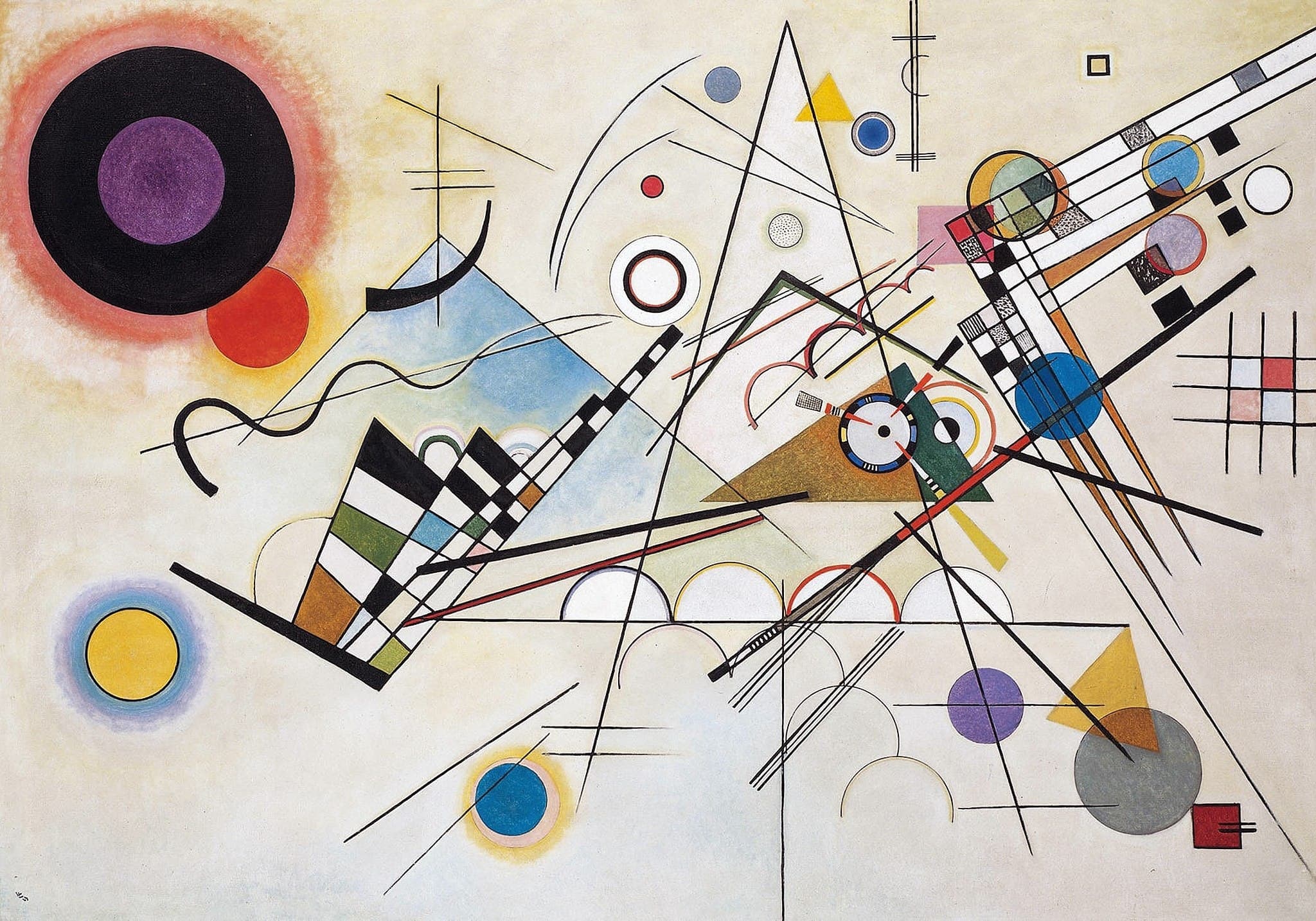
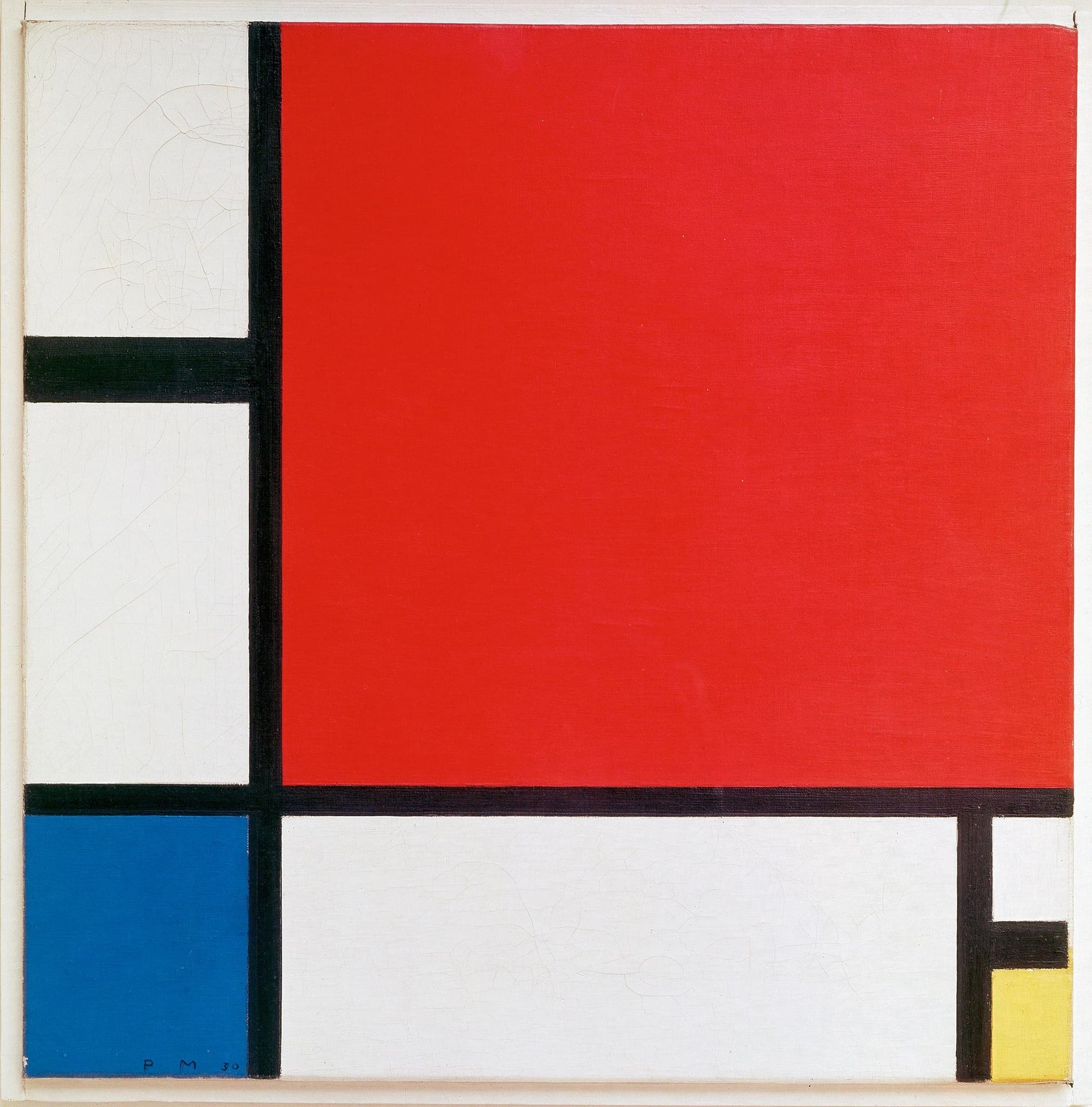
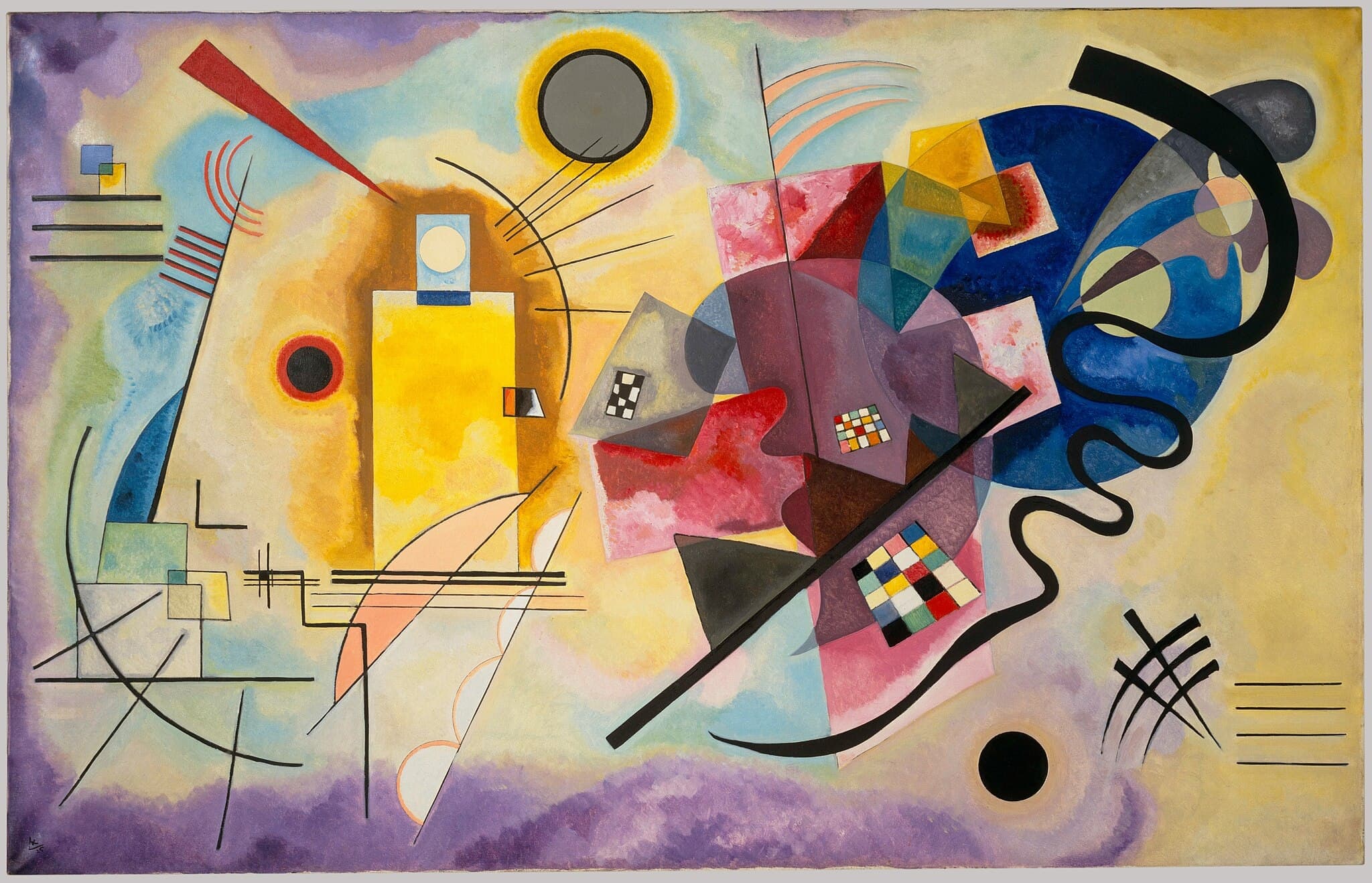
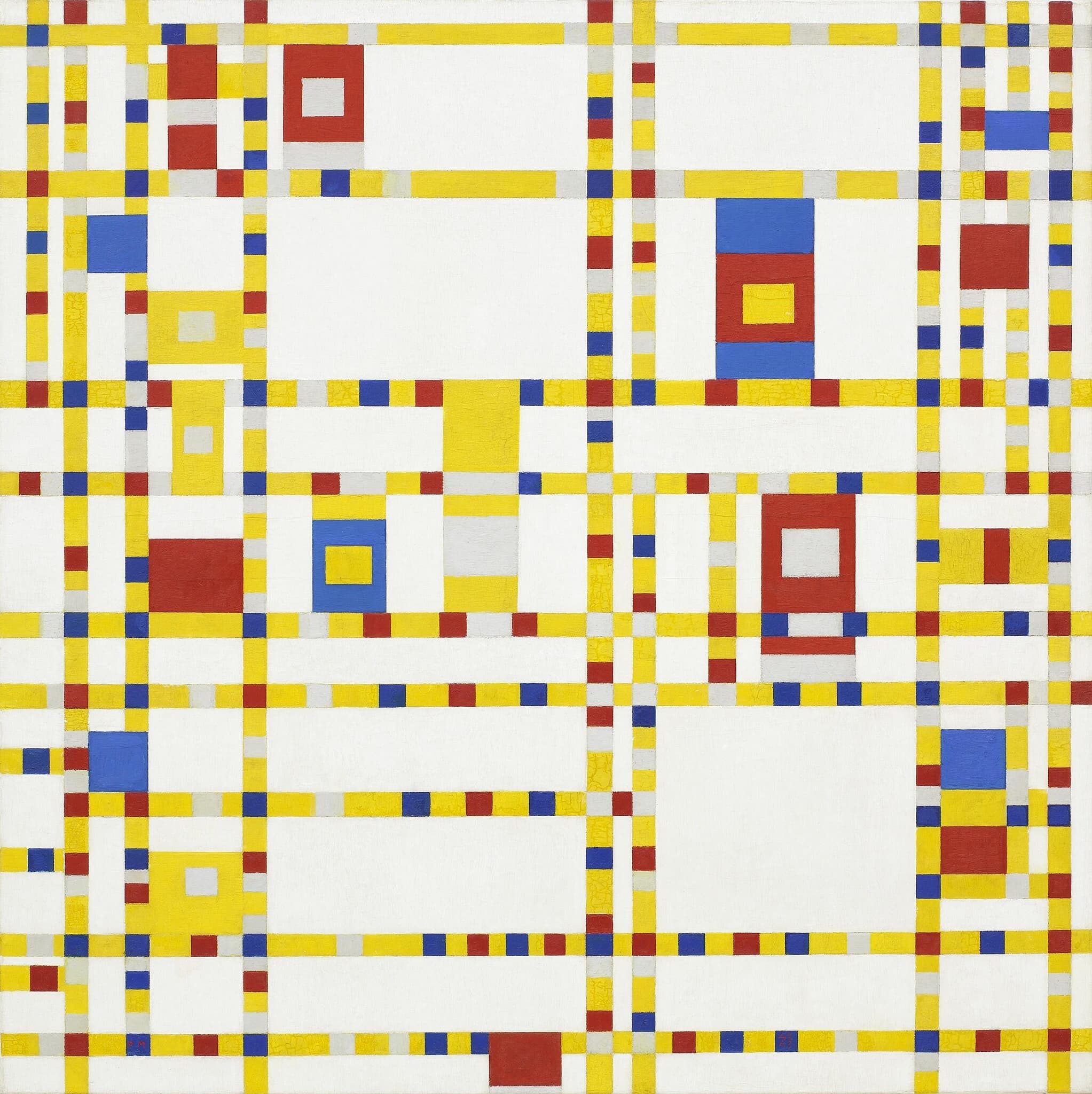
They also reached abstraction through reduction, not sudden rupture. Kandinsky’s Improvisation 28 (second version) compresses riders and a city into energetic fields; Mondrian’s Composition No. 10 (Pier and Ocean) distills sea and pier into short orthogonal strokes. From there, each simplifies means to gain generality: primaries, whites, blacks, and basic geometry. In Kandinsky’s Bauhaus phase (Composition VIII; Yellow‑Red‑Blue), grids, staves, and compasses structure lyrical forces. In Mondrian’s mature works (Composition with Red, Blue and Yellow; Broadway Boogie Woogie), black bars or color‑structured lines hold asymmetrical balance.
Finally, both embed aesthetics in larger aims. Kandinsky’s Blaue Reiter circle linked abstraction to spiritual renewal; Mondrian’s De Stijl connected art and design to an ethical, constructive order. Abstraction, for both, is not escape but a proposal for how modern perception—and modern life—might be organized.
Decisive Difference
The decisive split lies in what a painting fundamentally is. For Kandinsky, the canvas is a field where forces become visible: diagonals heighten tension, curves modulate movement, circles promise rest or unity, and every hue bears an affective voice. Harmony is a lived equilibrium, maintained moment to moment by the pull of vectors and the resonance of color. Composition VIII reads like a conducted score—diagonals, arcs, and circles pressing, checking, and releasing. Yellow‑Red‑Blue stages a lucid clash between rectilinear clarity and curvilinear impulse, its black diagonal acting like a baton that binds opposing energies.
For Mondrian, the canvas is a constructed order of exact relations. Vertical and horizontal are the irreducible opposites; diagonals are excluded because they bias direction and threaten equilibrium. Black bars are active planes, not outlines; white is an interval, not emptiness. In Composition with Red, Blue and Yellow, a dominant red is held by tuned inequalities—bar weight, interval, and the counterforce of smaller primaries. In Broadway Boogie Woogie, he goes further: color itself becomes structure, with yellow “avenues” and chromatic dashes generating all‑over rhythm inside strict orthogonality. In short, Kandinsky’s world hums with resonant energy; Mondrian’s is calibrated order. Both produce rhythm, but one derives it from affective tension, the other from relational equivalence.
Paired Works
Vectors vs planes
Focus question: When both limit color to primaries, what kind of balance emerges from vectors (Kandinsky) versus planes (Mondrian)?
Composition VIII vs Composition with Red, Blue and Yellow
Two paths to musicality
Focus question: If both claim musical rhythm, how do they build it—through affective tension or structural syncopation?
Yellow-Red-Blue vs Broadway Boogie Woogie
From nature to non‑objectivity
Focus question: How does each painter unhook painting from depiction in the years abstraction congeals?
Improvisation 28 (Second Version) vs Composition No. 10 (Pier and Ocean)
How little is enough?
Focus question: What happens when each artist strips means to near‑zero and asks if balance can still hold?
Several Circles vs Lozenge Composition with Two Lines
Why This Comparison Matters
Seeing Kandinsky next to Mondrian clarifies two viable models for abstract thinking that still shape how we read images today. One asks the eye to sense pressure, release, and timbre—the dynamics of attention as lived experience. The other trains the eye to weigh intervals and equivalences—the ethics of balance inside rules. Designers of interfaces, maps, and data visualizations inherit both legacies: rhythm that guides without icons, and structure that persuades without representation.
The comparison also guards against two clichés: that expression must be messy and that order must be static. Kandinsky’s Bauhaus works are disciplined yet vibrant; Mondrian’s New York grids are rule‑bound yet kinetic. Knowing why reveals what each believed painting could do for modern life: compose energy into meaning or specify relations into harmony. Both aims remain urgent—on our walls and on our screens.
Related Links
Sources
- Wassily Kandinsky, Concerning the Spiritual in Art (1911), trans. M.T.H. Sadler
- Wassily Kandinsky, Point and Line to Plane (Bauhausbücher 9)
- Piet Mondrian, Plastic Art and Pure Plastic Art (1936/1941)
- Guggenheim Bilbao, Kandinsky: Composition 8 (teacher’s guide)
- Centre Pompidou, Kandinsky: Jaune-rouge-bleu (Yellow-Red-Blue)
- MoMA, Piet Mondrian: Broadway Boogie Woogie
- Stedelijk Museum via Museum.nl, Mondrian: Lozenge Composition with Two Lines
- Smarthistory, Kandinsky: Improvisation 28 (second version)
- Wikipedia, De Stijl (on orthogonal grammar and the diagonal dispute)
- Kröller‑Müller Museum, Piet Mondrian: Composition 10 in Black and White; Pier and Ocean (1915)