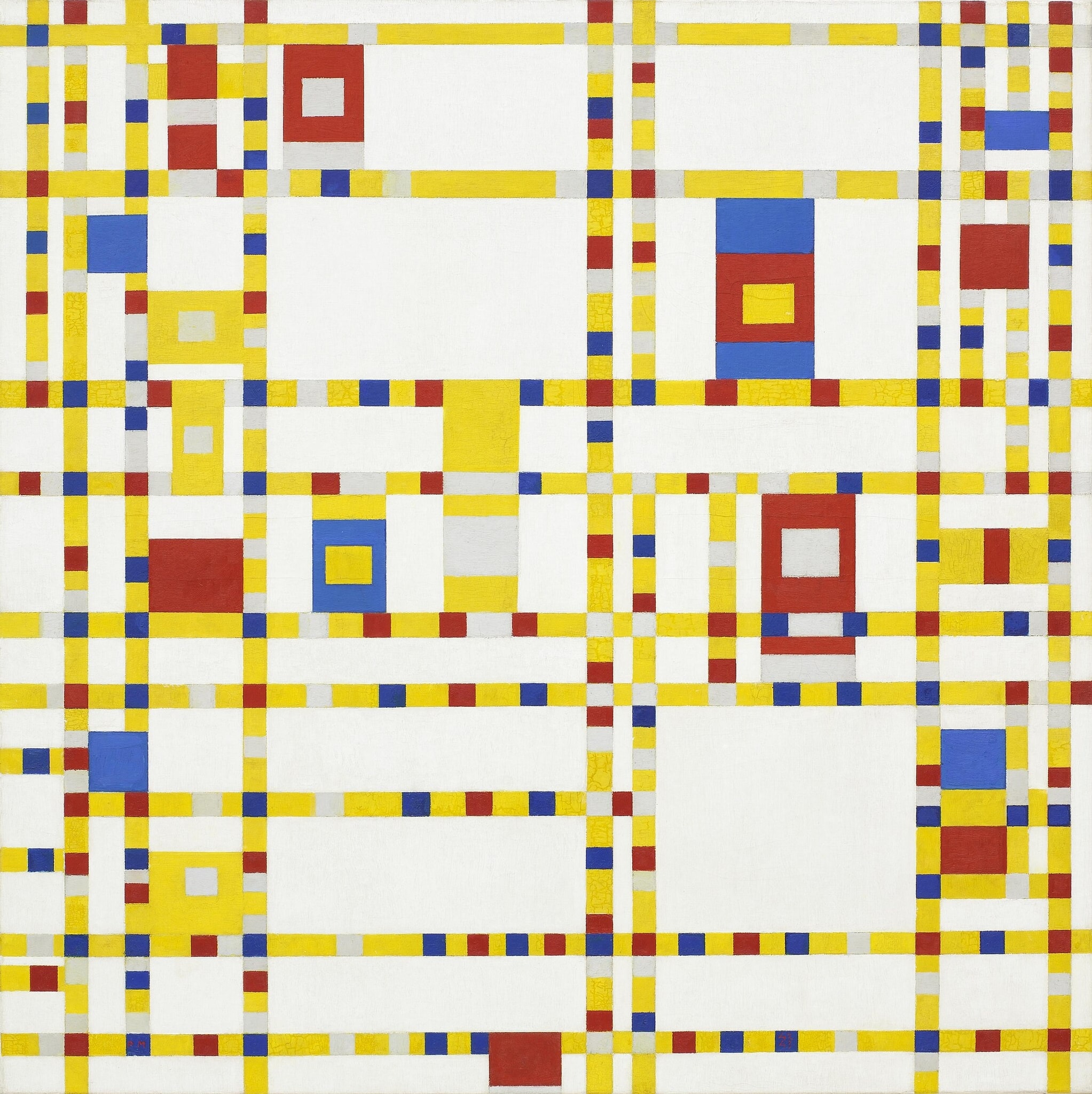
Broadway Boogie Woogie
Mondrian converts New York’s pulse into a vibrating grid of color. In place of black bars, intersecting yellow bands studded with red, blue, white, and light gray units generate a syncopated rhythm across wide white blocks that read as pauses and city blocks [1][2].
Study Print Studio
Create a personal study print
Build a companion study sheet around the part of this painting that speaks to you most. Choose a detail, shape an interpretation, and walk away with something personal and display-worthy.
Fast Facts
- Year
- 1942–1943
- Medium
- Oil on canvas
- Dimensions
- 127 × 127 cm
- Location
- The Museum of Modern Art (MoMA), New York
Click on any numbered symbol to learn more about its meaning
Meaning & Symbolism
Mondrian composes the canvas from orthogonal yellow thoroughfares that are not continuous stripes but chains of small units—yellow intercut with red, blue, white, and light gray—so every crossing becomes a micro‑syncopation. In the image, broad white rectangles open like empty city blocks; at their edges, denser nodes—such as stacked red‑blue‑yellow ‘squares‑within‑squares’ on the right and lower left—throb like intersections where routes converge. This is not a map; it is a calibrated rhythm engine. By dropping the black bars that governed his European grids and letting color carry structure, he transforms Neo‑Plasticism from static equilibrium into kinetic balance, where movement is produced by chromatic alternation and the eye’s compelled stepwise scanning 126. Technical studies confirm extensive reworking—shifts in tile size, tone, and placement—evidence of an iterative ‘composing’ in which visual beats are adjusted like musical phrasing to achieve an even yet lively swing 3.
The title binds Broadway’s rectilinear grid to the boogie‑woogie Mondrian embraced in wartime New York. The work synchronizes two migrations: the artist’s own flight to the city and the northward spread of boogie‑woogie through the Great Migration, making the grid a meeting ground of displacement and modern energy 45. That cultural charge is encoded formally. The yellow “avenues” read as bright conduits—taxis, marquees, traffic signals—yet the painting refuses literal signage; meaning arises from the counterpoint of limited primaries and neutrals. Repetition builds expectation; interruptions—blue or red dashes dropped into a yellow run, or a light‑gray soft accent amid brights—supply syncopation. Large white fields act like rests in musical notation, resetting tempo before the eye reenters a crowded crossing. The result is a democratic optic: no single center, many equivalent choices, continuous forward motion—an ethics of modern attention in which freedom operates inside rule‑bound structure 246.
Why Broadway Boogie Woogie is important is that it consummates Mondrian’s project to find universal harmony through abstraction while absorbing the lived tempo of New York. Its square format (50 × 50 in.) stages a non‑hierarchical arena where every interval matters equally, and its color‑structured grid anticipates later ideas of information flow—city systems, digital pixels, algorithmic rhythm—without surrendering to illustration 1. The painting models how art can translate social and musical forces into pure relationships: the city becomes rhythm, rhythm becomes geometry, and geometry becomes a radiant form of modern hope, composed in the very years of displacement and war 146.
Explore Deeper with AI
Ask questions about Broadway Boogie Woogie
Popular questions:
Powered by AI • Get instant insights about this artwork
💬 Ask questions about this artwork!
Interpretations
Reception, Display, and the Politics of Credit
First shown at Valentine Gallery in 1943 and acquired by MoMA the same year, the painting’s early institutional embrace helped canonize New York as abstraction’s new capital. MoMA’s record lists an anonymous donor; a recurring narrative credits sculptor Maria Martins with purchasing the work and donating it anonymously—plausible yet not confirmed in the museum’s current provenance text. This ambiguity underscores how networks of patronage and visibility shaped wartime modernism: private actors, galleries, and museums converged to stabilize a fragile avant‑garde newly landed in the U.S. The painting’s public life—prominent display, repeated scholarly attention—has reinforced readings of it as a civic emblem, while also reminding us that canons are built not only by form but by institutions and their records 17.
Source: MoMA (object record); Sotheby’s (secondary provenance note)
Technical/Process Analysis
Conservation science reveals that Broadway Boogie Woogie was not plotted once and transferred; it was iteratively composed. Macro X‑ray fluorescence mapping shows subtle overpaints, shifts in the size and tonality of tiles, and adjusted alignments within the yellow “avenues.” These changes are not corrections but phrasing decisions, akin to revising beats in a score to regularize swing without deadening it. The replacement of black bars by chromatic segmentation required Mondrian to manage load‑bearing through hue and value alone; MA‑XRF’s pigment distributions confirm how he modulated whites and light grays to tune the painting’s “rests” and prevent chromatic fatigue. Process here is content: the evidence of reworking materializes the artwork’s thesis that rhythm is constructed, not found, and that harmony emerges from disciplined adjustment rather than spontaneous gesture 3.
Source: npj Heritage Science (MoMA Conservation)
Transatlantic & Migration Studies
Recent scholarship positions the painting at the juncture of two migrations: Mondrian’s flight from fascist Europe and the Great Migration’s delivery of boogie‑woogie into New York’s cultural core. Rather than a neutral grid, the work encodes a contact zone, where European Neo‑Plasticism is re‑tempered by African‑American musical modernity encountered in venues like Café Society. The rhythmic counterpoint of primaries and neutrals becomes a formal analogue to diasporic exchange—repeatable units, interrupted paths, and moments of densification that echo polyrhythmic piano patterns. This lens complicates purely formalist readings: Broadway Boogie Woogie is not only an abstract celebration of order but also a historical synchronization of displaced bodies, styles, and sounds that redefines universality from the ground up 4.
Source: October (MIT Press)
Formalist Evolution: De Stijl to New York
Mondrian’s New York turn recasts Neo‑Plasticism’s equilibrium as kinetic balance. By “letting color carry structure,” he translates vertical/horizontal law into chromatic cadence, retiring the authoritarian clarity of black bars. The white ground isn’t void but a scalar field that regulates interval and pause; light‑gray notes temper glare, preventing dominance by any primary. This is a nonhierarchical arena—a square field where no unit is sovereign and every crossing negotiates equivalence. Such recalibration preserves De Stijl’s universalism while absorbing urban contingency, proving that strict means can host improvisatory outcomes. The result advances an ethics of attention—distributed focus, lateral choice, and continuous scanning—that defines late modernist optical experience 125.
Source: MoMA; Britannica (De Stijl/Neo‑Plasticism)
Urban Systems & Information Aesthetics
Read as proto‑systems art, the painting anticipates information flow metaphors: pixels, networks, and algorithmic rhythm. Its tiling behaves like a constrained code—limited symbols (primaries + neutrals), rule‑based adjacency, and local perturbations creating global pattern. The square format functions as a non‑centered matrix, distributing events across the field so that meaning arises from iteration and deviation rather than motifs. Contemporary critics have likened its tempo to data streams and traffic models; yet Mondrian avoids illustration, staging an abstract simulation of throughput, latency (white blocks as buffers), and packet collisions (busy intersections). In this view, Broadway Boogie Woogie becomes a blueprint for reading modern cities—and screens—as rhythmic grids that balance redundancy with surprise to maintain legibility at speed 126.
Source: MoMA; Washington Post (interpretive essay)
Phenomenology of Viewing
The work engineers a specific ocular choreography: the eye steps along yellow chains, stalls in white “rests,” and accelerates through denser intersections. Because structure is chromatic, not linear, perception toggles between local color contrasts and field‑level equilibrium, producing a flicker that viewers often liken to music. This is an experience of embodied scanning—anticipation set by repetition, then jolted by syncopated breaks (red/blue dashes, light‑gray soft accents). The square’s lack of orientation denies a privileged entry point, compelling multi‑directional wayfinding. Such phenomenology aligns with accounts of Mondrian’s fascination with boogie‑woogie’s steady pulse plus off‑beat accents: the painting’s success is measured less by image recognition than by how it times your attention in the act of looking 25.
Source: MoMA (audio guide); Harvard Art Museums (Transatlantic Paintings)
Seen in Comparisons
Related Themes
About Piet Mondrian
Piet Mondrian (1872–1944), co‑founder of De Stijl, pursued a universal visual language of verticals/horizontals, rectangles, and primary colors plus neutrals. After fleeing Europe during World War II, he settled in New York in 1940, where jazz and the city’s grid animated his late style, culminating in Broadway Boogie Woogie and the unfinished Victory Boogie Woogie [1][6].
View all works by Piet Mondrian →