The Light Bulb Eye in Guernica
A closer look at this element in Pablo Picasso's 1937 masterpiece
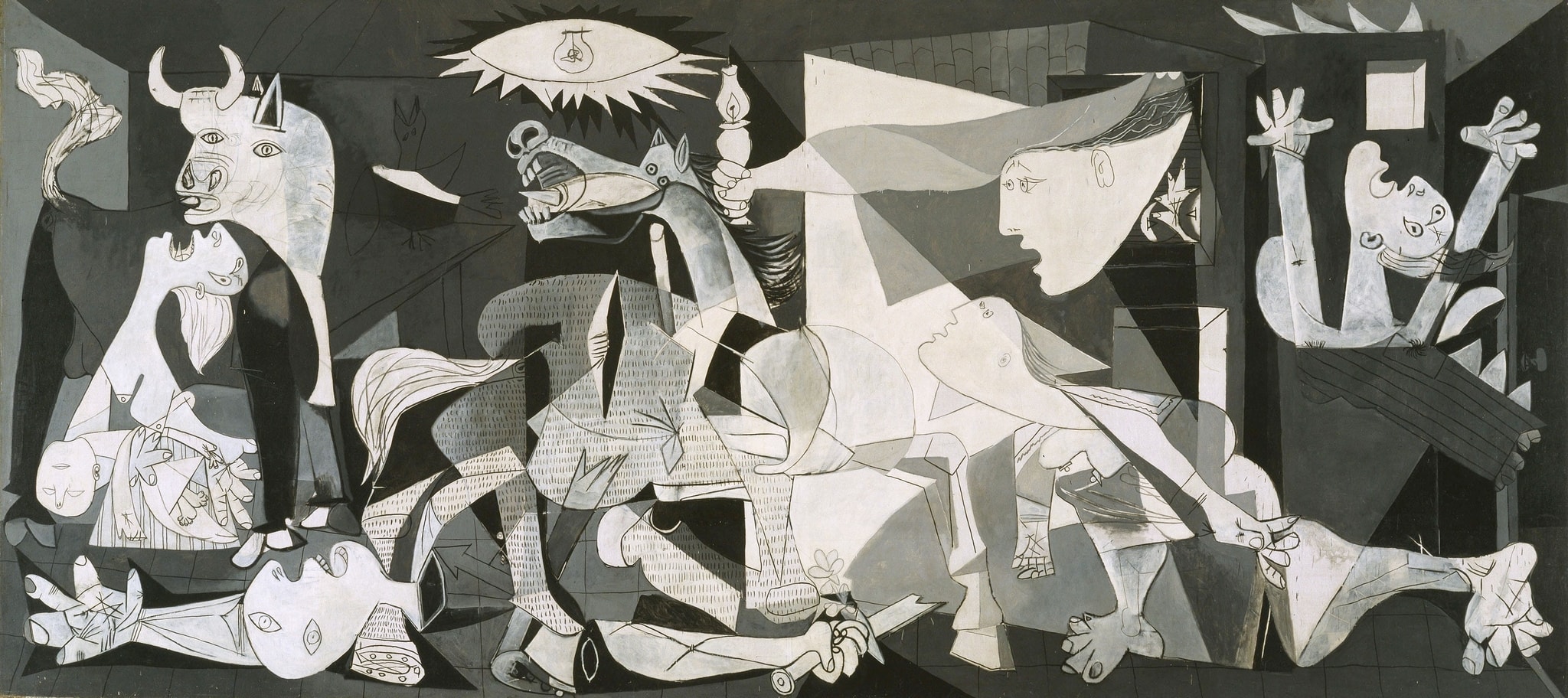
High overhead in Guernica, a bare electric bulb glares like an eye and detonates like a blast. Picasso turns the emblem of modern illumination into a merciless spotlight that crowns the central tragedy. The Light Bulb Eye crystallizes the painting’s charge: technology that promises progress can also expose, surveil, and destroy.
Historical Context
In spring 1937, Picasso painted Guernica for Spain’s pavilion at the Paris International Exposition, just weeks after the aerial destruction of the Basque town. The fair spectacularized electricity—its architecture and night displays presented modern light as a civilizing triumph. Picasso answered that spectacle by crowning his canvas with an electric bulb that reads as eye, streetlamp, and explosive flash, a visual summary of modernity’s double edge 12.
Smarthistory characterizes the central illumination as a polyvalent image that signals the cost of modern progress, while Luanne McKinnon’s study of the Exposition traces how electric lighting was engineered to awe visitors. Set against that pageantry, Picasso’s incandescent “sun” becomes an accusation, the glare of mechanized war. Poised above the horse at the composition’s center, the Light Bulb Eye turns the world’s‑fair language of enlightenment into a public indictment of contemporary atrocity, aligning form, subject, and venue with devastating clarity 12.
Symbolic Meaning
At once an eye, a modern sun, and an instant of detonation, the bulb compresses several traditions of seeing. It functions as the cold, clinical light of technology—akin to searchlights, photographic flashes, and the apparatus of surveillance—set against the warm, handheld oil lamp borne by the woman at right. Smarthistory frames this polarity as the price of modernity: illumination that clarifies, yet wounds 1. Spanish commentators also hear a wordplay—bombilla (light bulb) echoing bomba (bomb)—that turns the fixture into a linguistic emblem of aerial attack 7.
The form inherits older sacred symbols only to strip them of comfort. Critics have called it a degraded sun or an all‑seeing eye at the painting’s apex, a merciless witness rather than a benevolent deity 6. Rachel Wischnitzer proposed a geopolitical allegory: the electric bulb as the detached gaze of the “advanced” industrial powers, countered by the more engaged, human‑scaled oil lamp—a pairing that assigns different political charges to different kinds of light 5. Max Raphael’s succinct formulation—an electric bulb drawn inside the bomb—captures the consensus that a beneficial invention has been recoded as an instrument of terror 8.
Artistic Technique
Picasso sets the Light Bulb Eye within an almond‑shaped cartouche at the very top center, ringed by jagged, saw‑tooth rays. In grisaille—black, white, and grays—the element blazes by contrast: hard whites and knife‑edged blacks slice across the horse and the fallen soldier below, echoing the stark tonality of newsprint and photojournalism 4. A sharp cone of illumination rakes diagonally into the scene, fracturing bodies into shards and planes and pulling the viewer’s gaze toward the crisis under the bulb 9.
Its placement next to the woman who leans in from a window with a small oil lamp is deliberate; the Museo Reina Sofía notes this structural juxtaposition. The industrial glare and the human flame compete within the same pictorial architecture, making technique serve iconography 3.
Connection to the Whole
The Light Bulb Eye is Guernica’s crown and engine. It anchors the central register above the horse and fallen soldier, its spiked halo framing the tableau of agony and forcing us to look directly into the catastrophe 4. By rendering violence as a condition of light, Picasso fuses subject and means: illumination itself becomes the wound 1.
Made for a world’s fair that glorified electricity, the bulb recodes modern illumination as accusation 2. In dialogue with the oil lamp, it stages a dialectic of two lights—mechanized seeing versus human witnessing—that organizes the painting’s moral drama and clarifies its anti‑war message 13. Without this harsh, public glare, the work would lose the broadcast force that turns private suffering into a universal indictment.
Explore More from This Painting
This detail is one part of Guernica. Use the links below to return to the full interpretation, browse the full set of details, or view the painting's valuation if available.
Sources
- Smarthistory — “Pablo Picasso, Guernica”
- McKinnon, L. — “Picasso’s Guernica in the Shadow of Incandescence” (1937 Exposition and electric light)
- Museo Reina Sofía — Collection entry for Guernica (composition; lamp figure)
- Encyclopaedia Britannica — Overview of Guernica (grisaille; light bulb above the horse)
- Rachel Wischnitzer — “Picasso’s Guernica. A Matter of Metaphor,” Artibus et Historiae
- Wikipedia (EN) — Guernica (summary of common readings: all‑seeing eye, degraded sun)
- Wikipedia (ES) — Guernica (noting bombilla/bomba wordplay)
- Paris Update — Survey quoting Max Raphael on the “bulb inside the bomb”
- Kunstunterricht — Pedagogical analysis of the cone of light/composition