How Much Is Guernica Worth?
Last updated: January 14, 2026
Quick Facts
- Methodology
- extrapolation
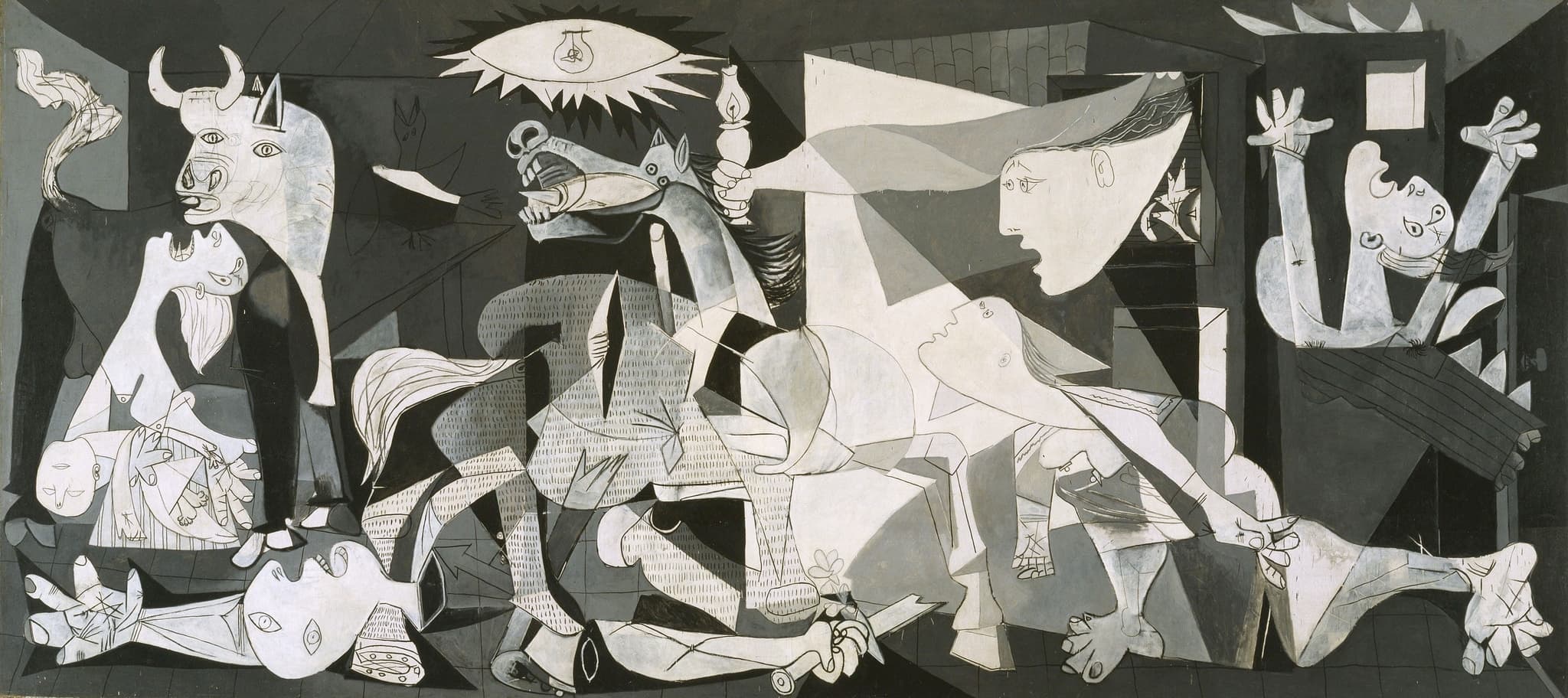
If Guernica were legally transactable, a rational clearing price would be in the $1.2–1.8 billion range. This estimate extrapolates from apex “trophy” benchmarks (Leonardo at $450.3m; Picasso’s record at $179.4m) and factors in the work’s unrivaled cultural status, national symbolism, and museum‑level demand. The painting is state‑owned, inalienable, and non‑exportable; this valuation is strictly hypothetical.
Valuation Analysis
Conclusion: In a hypothetical, fully transactable scenario, Pablo Picasso’s Guernica would likely command $1.2–1.8 billion. The estimate reflects the work’s absolute primacy within Picasso’s oeuvre, its canonical status in 20th‑century art, and its potency as a national symbol with global cultural resonance. It is owned by the Spanish state and housed at the Museo Reina Sofía; it has never been publicly sold and is effectively inalienable under Spanish patrimony law [1][2][3].
Methodology: With no sale history for Guernica, the valuation is an extrapolation anchored to trophy benchmarks. Leonardo da Vinci’s Salvator Mundi set the public apex at $450.3 million in 2017, establishing a modern reference point for singular, globally resonant masterworks [6]. Within Picasso’s market, the standing auction record is $179.4 million for Les femmes d’Alger (Version “O”) (2015) and, more recently, Femme à la montre achieved $139.4 million in 2023—demonstrating deep demand for peak pre‑war Picasso [4][5]. Adjusted for inflation and considering current trophy dynamics, these benchmarks imply that a universally recognized, once‑per‑generation icon like Guernica would reset pricing far above established records.
Why the estimate sits in the low billions: Guernica is widely regarded as Picasso’s single most important painting—a mural‑scale anti‑war manifesto created for the 1937 Paris International Exposition—and is one of the most famous images in modern art [1][2]. Its art‑historical significance, singularity within the oeuvre, and political/cultural weight generate a “sovereign‑level” buyer profile: were a sale possible, likely competitors would include national museums and state‑backed institutions. Such competition historically produces step‑function price jumps at the market’s apex, well beyond typical UHNWI bidding bands. The chosen band ($1.2–1.8 billion) reflects a conservative multiple of the Leonardo benchmark and a substantial premium over Picasso’s own records, consistent with Guernica’s unique status.
Constraints and their effect: The work is legally protected, state‑owned, and non‑exportable; it does not travel due to conservation risk [3][7]. These constraints make an actual sale implausible. However, in a hypothetical in which title transfer were permitted, the same factors—national symbolism, institutional centrality, and rarity—would intensify sovereign and museum competition rather than cap value. Practical considerations (mural scale, handling/installation costs, and security) narrow the feasible buyer set but do not reduce the price ceiling for a masterpiece of this magnitude.
Positioning: This estimate is designed for policy, indemnity, or scholarly contexts. It draws on primary institutional records and public auction benchmarks to establish a disciplined, supportable range for one of the most culturally consequential artworks of the 20th century [1][2][4][5][6][7].
Key Valuation Factors
Art Historical Significance
High ImpactGuernica is widely regarded as Picasso’s most important painting and a cornerstone of 20th‑century art. Painted in 1937 for the Spanish Pavilion at the Paris International Exposition, it functions both as a formal apex within Picasso’s practice and as a universal anti‑war statement. Its imagery is embedded in global visual culture, reproduced in education, media, and civic spaces. Within the artist’s oeuvre, only Les Demoiselles d’Avignon rivals it for historical consequence, but Guernica’s political resonance and monumental scale make it uniquely “national‑symbol” caliber. This extraordinary centrality justifies a substantial premium over even top-tier Picasso results, and underpins a valuation well beyond standard market comparables.
Trophy Benchmarking and Scarcity Premium
High ImpactThe top public auction benchmark for singular masterpieces is Leonardo’s Salvator Mundi at $450.3 million (2017). Picasso’s own records—$179.4 million in 2015 and $139.4 million in 2023—demonstrate deep global demand for his pre‑war peak. Guernica is far rarer and more culturally loaded than works setting those records. At this stratum, prices are set less by marginal collector demand than by institutional or sovereign competition for cultural primacy. Extrapolating from these benchmarks, and accounting for trophy premiums at the absolute apex, supports a low‑billions estimate. The $1.2–1.8 billion range reflects a disciplined, conservative multiple over the Leonardo anchor and a clear step above Picasso’s auction highs.
Legal/Institutional Status and Symbolism
High ImpactGuernica is owned by the Spanish state, protected under Spanish Historical Heritage law, and housed at the Museo Reina Sofía. Works in this category are effectively inalienable and non‑exportable, and Guernica does not travel due to conservation assessments. Paradoxically, these constraints heighten its symbolic and institutional value: if a sale were ever contemplated, it would be framed as a national‑level decision likely to mobilize state institutions and sovereign capital. The intense cultural and political stakes would encourage defensive bidding (or state intervention) to prevent loss of a national icon, pushing the hypothetical clearing price into a range that conventional art‑market dynamics rarely reach.
Scale, Visibility, and Audience Impact
Medium ImpactAt mural scale, Guernica commands architectural presence and unmatched public visibility. While its sheer size and condition sensitivities limit feasible buyers and complicate logistics, they also amplify institutional benefits: attendance, brand equity, philanthropy, and cultural diplomacy. For a leading museum or state-backed venue, the work’s draw can influence long-term footfall and reputation in ways that justify extraordinary capital outlay. In a hypothetical sale, these intangible but material benefits would be capitalized into price, contributing to a premium beyond the sums observed for smaller, private‑scale masterworks. Logistics narrow the buyer pool but do not diminish value at this apex of cultural significance.
Sale History
Guernica has never been sold at public auction.
Pablo Picasso's Market
Pablo Picasso remains one of the most liquid and globally collected artists, with deep demand across periods and mediums. His current auction record is $179.4 million (Les femmes d’Alger, Version O; 2015), and the market has repeatedly supported nine‑figure prices for best‑in‑class pre‑war works; in 2023, Femme à la montre achieved $139.4 million. While thousands of works trade across price tiers annually, the top of his market concentrates around Blue/Rose, Cubist, and prime 1932 Marie‑Thérèse periods, with masterworks drawing the most aggressive bidding. Picasso’s market breadth, institutional ubiquity, and perennial visibility sustain strong liquidity, but prices are highly quality‑sensitive, with trophy-level works vastly outperforming later series and secondary examples.
Comparable Sales
Les femmes d’Alger (Version “O”)
Pablo Picasso
Same artist; canonical masterpiece and Picasso’s auction record; demonstrates the historical ceiling for Picasso at auction, though smaller and not politically themed or mural-scale like Guernica.
$179.4M
2015, Christie's New York
~$242.2M adjusted
Femme à la montre
Pablo Picasso
Same artist; A‑tier 1932 Marie‑Thérèse period and the second‑highest Picasso auction price; shows current market depth for peak pre‑war Picasso, albeit much smaller and non‑mural.
$139.4M
2023, Sotheby's New York
~$146.3M adjusted
Femme assise près d’une fenêtre (Marie‑Thérèse)
Pablo Picasso
Same artist; prime 1932 portrait that crossed $100m; relevant for pricing upper‑tier Picassos though not comparable in scale, subject, or historic import to Guernica.
$103.4M
2021, Christie's New York
~$122.0M adjusted
Femme nue couchée
Pablo Picasso
Same artist; 1932 Marie‑Thérèse masterwork with a strong eight‑figure result; useful to triangulate demand for top pre‑war Picassos even though it is far smaller and not politically charged.
$67.5M
2022, Sotheby's New York
~$74.3M adjusted
Salvator Mundi
Leonardo da Vinci
Top global auction price; serves as an apex ‘trophy’ benchmark for singular, culturally resonant masterworks—useful for capping the plausible public‑auction ceiling even though it is a different period and artist.
$450.3M
2017, Christie's New York
~$585.4M adjusted
Portrait of Elisabeth Lederer
Gustav Klimt
Modern category apex (2025); indicates current market willingness to pay for pre‑war canonical masterpieces. Different artist/subject/scale, but relevant to the 20th‑century masterpiece benchmark that Guernica would exceed.
$236.4M
2025, Sotheby's New York
Current Market Trends
At the apex of the Modern category, buyers are selectively aggressive: exceptional provenance, art‑historical importance, and museum‑grade quality command outsized premiums, while average material is priced with discipline. Trophy benchmarks (e.g., Leonardo’s $450.3m) continue to anchor expectations for singular icons. Within Picasso’s market, nine‑figure results demonstrate resilient depth for pre‑war masterpieces, even as broader auction volumes have normalized from 2021–22 peaks. Institutional and sovereign participation remains a key swing factor at the top end, where supply is thin and competition for cultural capital drives step‑function pricing. In this context, a work as unique as Guernica would reset the ceiling far beyond standard comparables.
Study print
Study this painting as a print
Pair the full artwork with a museum-style study sheet focused on one meaningful detail.
Sources
- Museo Reina Sofía – Collection record: Guernica
- Museo Reina Sofía – Rethinking Guernica
- Spain’s Historical Heritage Law (Ley 16/1985), on inalienability/export
- Christie’s – Les femmes d’Alger (Version O) fetches $179,365,000 (2015)
- Sotheby’s – Femme à la montre (1932) sells for $139,363,500 (2023)
- Christie’s – Salvator Mundi sells for $450,312,500 (2017)
- Washington Post – Guernica to stay in Madrid (on non-travel policy)