How Much Is Blonde Bather (La Baigneuse blonde) Worth?
Last updated: March 11, 2026
Quick Facts
- Methodology
- comparable analysis
Working market range USD $0.5–25.0 million for a work titled "Blonde Bather (La Baigneuse blonde)" by Pierre‑Auguste Renoir. The low end assumes a modest study/workshop variant or uncertain attribution; the high end reflects a prime, securely authenticated and well‑provenanced 1880s canvas suitable for major evening sale or institutional acquisition.
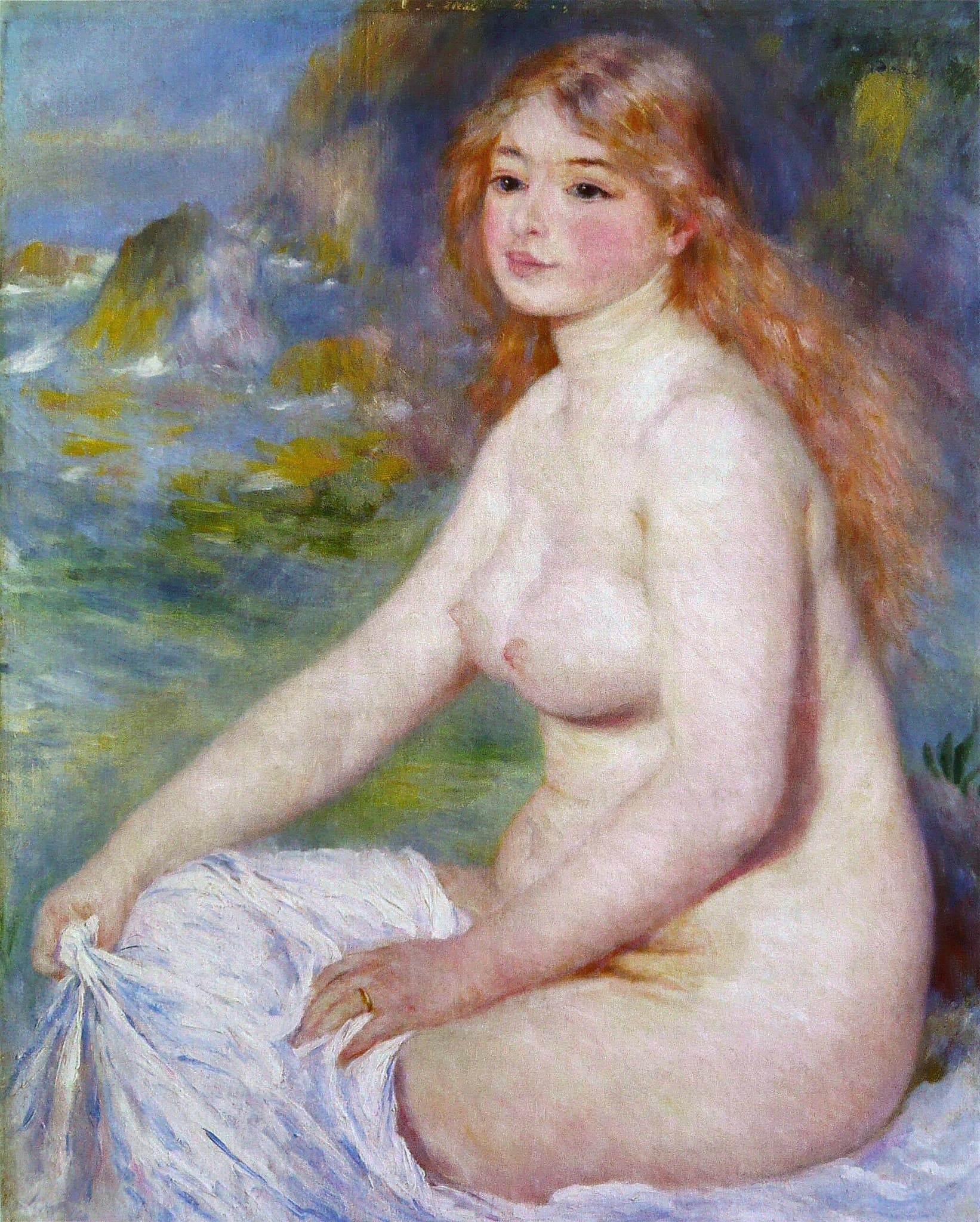
Blonde Bather (La Baigneuse blonde)
Pierre-Auguste Renoir • Oil on canvas
View more by Pierre-Auguste Renoir →Valuation Analysis
Valuation conclusion: Based on recently reported auction results for Renoir bathers and closely related late‑1870s/early‑1880s canvases, a practical working market range for a painting offered as "Blonde Bather (La Baigneuse blonde)" is USD $0.5–25.0 million. This band intentionally spans the most plausible market outcomes from a modest study or studio variant to a high‑quality, museum‑grade 1880s example. Two canonical museum versions (Clark 1881; Agnelli 1882) exist and are off‑market, which raises comparability requirements for any newly surfaced work [1].
Comparables and anchors: The most directly relevant public sale in recent seasons is a sister‑type early‑1880s bather sold at Sotheby’s Hong Kong (March 2025) for roughly US$3.02M (with premium), which functions as a mid‑market anchor for an authenticated but not trophy bather [2]. Higher‑quality late‑1870s/early‑1880s Renoirs with strong provenance and exhibition histories have realized low‑ to mid‑eight figures at major evening sales (for example, Christie’s New York results in 2023 and notable Sotheby’s London lots in 2024), which supports the upper portion of the range for prime examples [3][4].
Primary value drivers: The decisive factors are authentication/catalogue‑raisonné status, confirmed dating (c.1878–1884 places the work in Renoir’s strongest bather period), condition and conservation history, scale/finish, and secure provenance including exhibition/publication pedigree. A securely attributed, published 1881–82 bather that can be linked to Renoir’s studio practice and is in good condition will be bid toward the $5–25M band; an unattributed studio variant or a heavily restored canvas will usually trade at the lower end ($0.5–6M) or below.
Uncertainties, risk and next steps: Because two museum versions of "La Baigneuse blonde" are well documented and unavailable for sale, any newly offered work requires technical comparison against those canonical examples, specialist authentication (Wildenstein/recognized Renoir scholars), and a conservator’s report to refine the estimate. To tighten valuation, supply high‑resolution images (front/back), dimensions, signature details, provenance/exhibition citations and any prior sale records; technical analysis (X‑ray, pigment/varnish, IR) is recommended. With that material a major auction house can produce a formal pre‑sale estimate and sale strategy.
Bottom line: The $0.5–25M working range is a reasoned market position reflecting current comparables and the stratified nature of Renoir’s market: most newly surfaced bathers of uncertain pedigree sit in the sub‑$6M band, while thoroughly authenticated, well‑documented masterpieces command multi‑million to low‑two‑digit million prices at major evening sales [5].
Key Valuation Factors
Art Historical Significance
High ImpactRenoir’s bathers form a recurring, well‑studied motif that connects his engagement with the classical nude, his late‑1870s stylistic development and his studies of color and the human figure. Two museum examples titled La Baigneuse blonde (Clark, 1881; Agnelli, 1882) are established in the scholarly canon, so any newly presented work carrying the same title must be rigorously compared to those benchmarks. If the painting can be tied to a known exhibition, studio sequence or preparatory drawing, its art‑historical importance and market value rise substantially. Conversely, a repetitive studio production or later copy reduces significance and market desirability.
Authentication / Catalogue Raisonné
High ImpactAuthoritative authentication (inclusion in the accepted Renoir catalogue raisonné or endorsement by recognized scholars/institutions) is the single most powerful value driver. A confirmed autograph work attracts institutional interest and competitive evening‑sale bidding; an unresolved attribution or an attribution as 'workshop' materially depresses value. Technical studies—pigment analysis, X‑radiography and IR reflectography—are often decisive in distinguishing autograph passages from studio completion, and such results should be sought early in the valuation process.
Provenance & Exhibition History
High ImpactA continuous, documented provenance that traces ownership back to Renoir’s circle, an early reputable dealer (e.g., Durand‑Ruel) or appearance in 19th/20th century sale catalogues markedly increases buyer confidence and price. Museum loans, catalogue citations and inclusion in important exhibitions frequently upgrade a work’s market tier. Lacking provenance, buyers will apply a substantial discount and demand visible technical and connoisseurial evidence; thus provenance is high impact and often the difference between mid‑market and top‑tier outcomes.
Condition & Conservatorial History
Medium ImpactCondition—including varnish discoloration, retouching, relining and paint loss—has a direct and quantifiable effect on market value. A well‑preserved surface with minimal restoration retains buyer confidence and achieves stronger results; conversely, extensive overpainting or poor restorations reduce competitive bidding and may restrict sale to trade or private channels. Detailed conservator reporting (treatments, relative stratigraphy) is essential to slot the picture accurately within the stated valuation band.
Market Comparables & Demand
Medium ImpactRecent auction evidence demonstrates dispersion: close subject comparables have sold in the single‑million range (Sotheby’s HK bather ≈US$3.02M) while prime late‑1870s/early‑1880s works with strong provenance have reached low‑to‑mid eight figures in major houses. Current buyer preference favors freshness to market and museum‑grade provenance, so comparable sale results and the timing/venue of sale will materially affect outcome. This factor is medium impact because it interacts with authentication and provenance to determine final pricing.
Sale History
Blonde Bather (La Baigneuse blonde) has never been sold at public auction.
Pierre-Auguste Renoir's Market
Pierre‑Auguste Renoir is a blue‑chip Impressionist whose market is highly stratified: small studies, workshop pieces and late decorative works typically trade in the mid‑six‑figure to low‑seven‑figure bands, while autograph, museum‑quality canvases from his prime (late 1870s–1880s) achieve multi‑million results and occasionally reach low‑two‑digit millions at marquee evening sales. Renoir’s historical auction ceiling (historic major sales in the late 20th century) sets the high‑end reference point, but contemporary buyer selectivity and provenance requirements mean the realized price is highly sensitive to attribution, condition, and exhibition pedigree.
Comparable Sales
Baigneuse accoudée (1882, sister-type bather)
Pierre-Auguste Renoir
Directly comparable subject (bather), same early‑1880s period and similar scale; useful mid‑market comparable for Renoir bathers.
$3.0M
2025, Sotheby's Hong Kong (Modern & Contemporary Evening Sale)
Square de la Trinité
Pierre-Auguste Renoir
High‑quality late‑1870s/early‑1880s figure painting by Renoir with strong provenance; demonstrates top‑end pricing for prime canvases of this period.
$11.9M
2023, Christie's New York (20th Century Evening Sale)
~$12.5M adjusted
Bouquet de lilas
Pierre-Auguste Renoir
Same artist and similar chronological period (late 1870s); although a still life, it shows buyer appetite and pricing for prime Renoirs in major evening sales—useful for market context.
$8.8M
2024, Sotheby's London (Modern & Impressionist Evening Sale)
~$9.0M adjusted
Current Market Trends
Since 2022 the Impressionist/Post‑Impressionist segment has been selective: a post‑pandemic rebound gave way to a contraction in 2023–24, producing a flight‑to‑quality where top works with clean provenance achieve strong results and mid‑market lots are price‑sensitive. Late‑2024/2025 activity showed renewed appetite for marquee pieces but buyer discipline persists; museum exhibitions and fresh scholarship (which can clarify attributions) continue to drive demand for well‑documented works.
Sources
- Sterling and Francine Clark Art Institute — Blonde Bather (La Baigneuse blonde), 1881 (collection entry)
- Sotheby's Hong Kong March 28, 2025 — sale coverage (Baigneuse accoudée comparable)
- Christie's New York — Square de la Trinité (May 11, 2023) sale reporting
- Sotheby’s London / market coverage — Bouquet de lilas and June 2024 results (Artnet coverage)
- Art Basel & UBS — The Art Market Report (market trend context)